The last place that was available on my 2017 New Zealand South Island Masterclass has been taken and the workshop is now sold out. I am super excited to be heading back to New Zealand in a few months time. The South Island is absolutely spectacular and the 2017 Masterclass workshop includes extensive use of helicopters for accessing some of the most remote and spectacular country as well as aerial photography of the spectacular Southern Alps and glaciers. Very much looking forward to getting back to the land of Middle Earth.
Category: Photographs
Photographs
Choosing an Expedition to Antarctica – What you Must Know Part Three
In part one and part two of this series on choosing an expedition to Antarctica we discussed the option of either flying or sailing to Antarctica and how to choose the best ship for your needs if you have decided to sail. We also looked at the importance of selecting a truly dedicated photographic expedition (avoiding mixed expeditions at all cost) and the importance of ensuring that the expedition you chose has an expedition leader who understands the needs of photographers and a photography guide who has extensive experience in Antarctica. In part three of this series we are going to look at the very important decision of what time of year you should choose to travel to Antarctica.
 The Antarctic travel season begins in November and runs through until early / mid March. The short summer season runs a little over four months and there are some very significant differences between travelling early in the season and late in the season. Depending on your needs and expectations for photography you should be aware of these differences in both the landscape and wildlife at different times of the season (particularly at the beginning and tail ends of the season).
I have been fortunate to travel to Antarctica in every month of the short summer season at some point in the last few years and have found through experience the best times for specific given subjects. Irrespective of when you choose to travel to Antarctica you are going to require the same level of cold and wet weather clothing as well as the same sort of camera equipment (we are going to look at camera equipment in the next and final instalment in this series). Cutting right to the chase, in my experience, early November is the best time to travel to Antarctica for photography (unless you specifically want to photograph Penguin chicks). At this time of the season the snow and ice are still clean and pristine in Antarctica and the best photographic opportunities are usually to be found. The importance of clean snow and ice should not be underrated as it provides a platform for framing your photographs and makes it far easier to obtain clean and pristine backgrounds for your images. By comparison, late in the season (anytime after Christmas) much of the snow and ice is gone from many of the landing sites and any covering that may remain is muddy, dirty and covered in Penguin guano.
The weather in November is still highly variable in Antarctica and at this time of the year you can expect everything from clear blue sky days to overcast skies with the occasional blizzard and snow storm. This variability is absolutely ideal for photography as it is going to provide you with lots of different opportunities to create a varied and powerful portfolio. Although I personally detest blue sky days for photography, one or two of these are usually inevitable during an expedition and they do help to break up the overcast weather generally found in Antarctica at this time of the year. As the season progresses the weather stabilises and you can expect more clear blue sky days and far less snow and ice.
It is important to understand that overcast weather (Natures softbox) is preferred for photography in Antarctica as it ensures both soft light and a more controllable dynamic range. Bright sunlight tends to bleach icebergs pure white and creates super hot highlights on the ice and snow that make polar photography problematic. Ideal conditions for photography in Antarctica are almost always overcast skies with soft light with good cloud detail and you can expect to encounter these conditions in November more than any other month. Overcast light also has the added benefit of really enhancing the aquamarines and blues that are found in the icebergs in Antarctica. For photography, this is absolutely ideal. November is without doubt also the best time for iceberg photography in Antarctica. With a greater chance of overcast skies and far more ice in the water the chances for encountering spectacular icebergs are at their best in November. On a standard Antarctic Peninsular expedition in November you can expect to see and photograph large tabular icebergs coming up out of the Weddell Sea around Antarctic Sound as well as a great many other varied icebergs around the Peninsula itself. Later in the season icebergs can be harder to find and there is typically far less ice in the water than November.
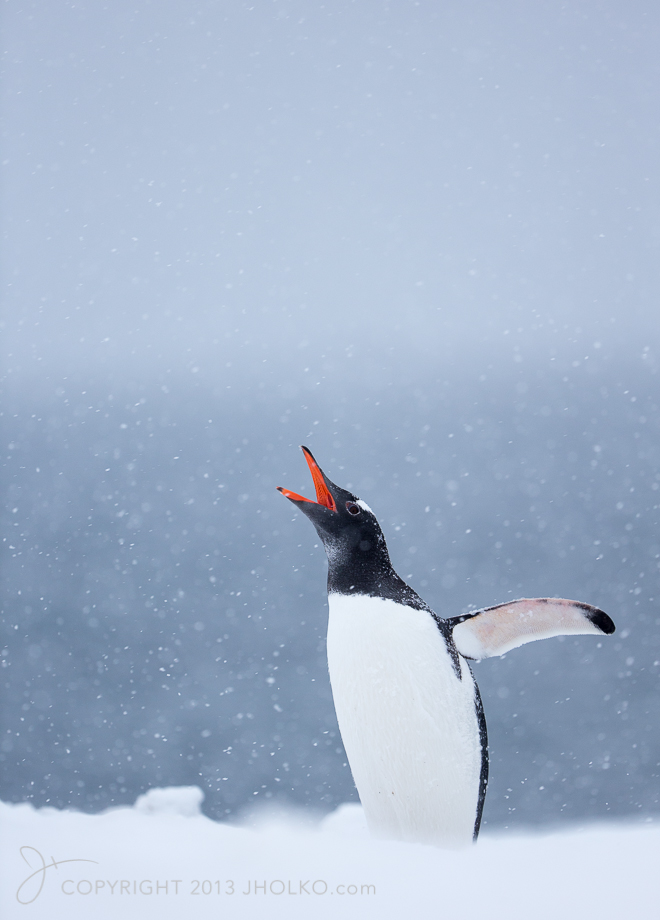
If the primary goal of your photographic expedition to Antarctica is to see and photographic Penguin chicks then you should choose an expedition later in the season (Penguins on eggs can be seen as early as November with regularity). Generally speaking an expedition in late January or February will be ideal for newborn Gentoo, Adelie and Chinstrap chicks. Be aware however that by late January there will be very little (if any snow) at the penguin colonies and as a result it is far more difficult to get clean backgrounds for your photographs. If the goal of your expedition is Emperor Penguin chicks then November is the ideal time. For Emperor Penguin chicks you will need to choose a fly to Antarctica expedition and fly to Union Glacier (Read a previous Emperor Penguin Expedition Report for an explanation of the logistics). In terms of other bird life you can expect a similar spread of Antarctic birds including Snow Petrels, Snowy Sheathbills, Albatross, Kelp Gulls, Giant Petrels, Prions, Diving Petrels, Wilsons and Storm Petrels, Antarctic Terns, Skuas and more irrespective of which month you decide to travel to Antarctica. Skua activity at the Penguin colonies is at its height from November onward and as soon as the Penguins have started to lay eggs.
 Although January and February are generally regarded as the best months for Whales in Antarctica I have actually historically had far more success in November with whales as they migrate down to Antarctica. Irrespective, whale photography is very hit and miss in terms of both sightings and significant photo opportunities so I would not base a decision on which month to travel to Antarctica if whales are one of your primary goals. You are just as likely to encounter a large pod of whales in November as you are any later in the season. The key to whale photography in Antarctica is actually to spend as much time as possible up on deck of the ship with binoculars and to always have a camera with you. Whale sighting are often brief and you may only get a few seconds to grab the photograph before the whale is gone.
When it comes to wind you should be aware that Antarctica is one of the windiest (and driest) places on the planet. From gentle breezes to near hurricane force katabatibc winds that come down from glacier fronts you will likely experience the full gamut of wind at some point during your time in Antarctica. You can expect a wider variation in wind speed during expeditions early in the season but you should keep in mind that blowing snow adds great drama to a photograph and will greatly assist you in the creation of powerful emotive imagery.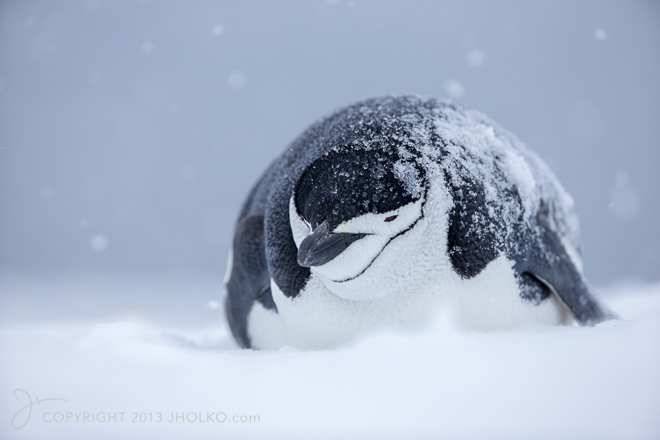 The success of any photographic expedition to Antarctica depends greatly on the choices you make when choosing your expedition. The timing of your expedition is absolutely critical to the encounters you will have, the weather and light you will experience and as a net result the portfolio of photographs you will produce. Consider carefully the time you choose to travel to Antarctica. Although it might be tempting to jump on board with a last minute bargain for a late season trip you should bear in mind that these reduced rates are only offered because many photographers recognise its not the best time of the season to travel to Antarctica. Choosing an expedition in November (or even early December) is likely to net you far better opportunities to create a strong and powerful portfolio of images.
In the final part of this four part series on what you must know when choosing an expedition to Antarctica we are going to look at photographic equipment as well as some ancillary equipment and accessories that are going to ensure you have the best possible photographic experience during your time in Antarctica.
Canon Australia Feature Outstanding Professional Photographs from 2016
Canon Australia has just published a series of photographs from a select group of its Australian professional photographers entitled Outstanding Professional Photographs to Make You Feel Better About 2016. The series of photographs includes one of my favourite images from my recent project on the Arctic Fox. You can see the full series online at Canons Website. “After sitting for days through the freezing arctic winter conditions of Iceland, I finally got the opportunity to photograph the white morph of an Arctic Fox. He was patrolling the edge of his territory during a heavy winter snowstorm. It’s very evocative o the incredibly harsh environment in which these animals survive. Able to withstand cold better than an other mammal, the Arctic Fox heads headlong into the blizzard in temperatures below -2o Celsius.”
I will soon be returning to the extreme northwest of Iceland to lead a small group of photographers on an expedition to photograph Arctic Fox in winter. This invitation only expedition has long been sold out, but I will soon be announcing details for the 2018 expedition. You can register your interest in this unique expedition by dropping me an email to info@jholko.com
Choosing an Expedition to Antarctica – What you Must Know Part Two
In part one of this series of articles on choosing an expedition to Antarctica we looked at the option of choosing either a fly or sail expedition. This critical decision will have a huge impact on both your wallet and your overall Antarctic expedition experience. In this second part of the series we are going to look at what you need to know about choosing a ship suitable for your needs if you have made the decision to sail to Antarctica. If you have made the decision to fly then you will likely already have chosen an operator (there are not many to choose from).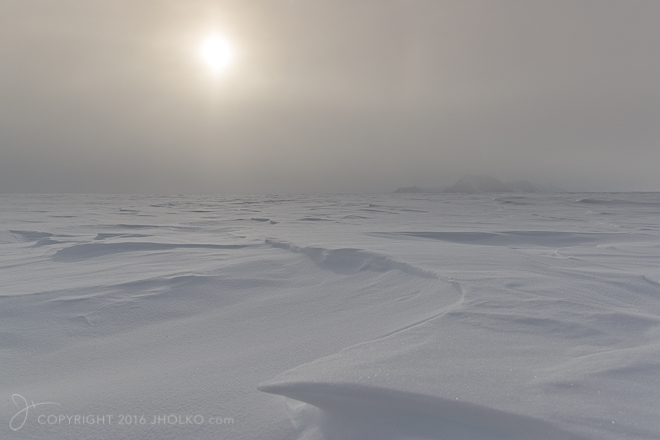 The first and most important consideration when you are investigating the multitude of ship options for sailing to Antarctica is how many passengers does the ship take. This very critical piece of information is going to have very significant impact on how much shore time you can expect whilst you are in Antarctica and what sort of photographic opportunities you can expect. Before we discuss this in further detail it is important to understand that the IATTO (International Antarctica Treaty Organisation) body is responsible for the protection of Antarctica and managing tourism to the continent. Their regulations are continually being refined, expanded and updated. The critical regulation you need to consider when choosing your ship is the maximum number of passengers permitted to land on Antarctica at any given point in time is limited to no more than 100 people (including ships expedition staff). Therefore, if you choose a ship that carries 100 passengers or more you will be forced to wait your turn and rotate on landings in order for the expedition company to comply with IATTO restrictions (they will make no exceptions to this rule). This will be extremely frustrating having travelled all the way to Antarctica and being made to wait your turn. You may well miss landings (in fact you will), miss wildlife opportunities and miss the best light of the day as you sit with increasing impatience waiting for your turn.
My recommendation is therefore that you choose a ship with as fewer passengers as possible. Anything less than 100 is acceptable with something around fifty or less being ideal in my experience. In fact, the fewer the better – period. Keep in mind that fewer passengers also decreases the potential for other guests walking into your photographs during landings. Note if you are considering a very small sailing vessel for your expedition then the total number of passengers will already be very small.
Once you have made the decision to choose a ship that carries fewer than 100 passengers the next thing I recommend you check with your expedition company is what ice class the ship has been rated. You want to make sure that your chosen vessel is capable of going into broken sea ice and that it is able to push ice out of the way. This is going to ensure that you can get nice and close to icebergs for the best photo opportunities and that you can get into ice filled bays and coves that other ships simply cant access. There is an important distinction between an ice breaker and being ice hardened. You are unlikely to find an ice breaker for your expedition as such ships are usually reserved for commercial operations and are far from comfortable for crossing the Drake (they roll and wallow in high seas because of their hull design). Instead you want to select a ship that is rated ice class 1. Ice Class 1 is the next class down from an icebreaker and ships with this rating are capable of pushing not insignificant pieces of ice out of their way. I have quite literally driven one of these ice hardened ships into the pack ice; parked it, and got out and walked on the frozen sea. That is an experience not to be missed. A word on ship stabilisers. Some expedition companies market the fact that their ship has stabilisers to help keep it from rolling around too much as you cross the Drake passage. Whilst stabilisers can and do make a difference to ship movement you should be aware that ships equiped with outboard stabilisers are usually not suitable for use in the ice. Stabilisers are easily damaged by large pieces of ice so the captains of these ships are usually going to avoid taking the ship into the ice or too close to icebergs. Therefore I recommend you avoid ships that are sold and marketed as being ‘stabilised’.
Once you have chosen a suitable ice class ship that carries fewer than 100 passengers the next thing you need to ensure is that the ship has sufficient zodiacs (small rubber boats that you will use for cruising and landing in Antarctica) for all passengers to be transported at the same time. On average you can comfortably accomodate up to ten photographers (8 is better) on a Mark V Zodiac and still have sufficient room to comfortably photograph. Therefore a fifty passenger boat is going to need not loss than five (and preferably six) zodiacs. Ships will always want to keep one zodiac in reserve for safety purposes so always bank on the total number of zodiacs on the ship being one less than advertised. The number of zodiacs available for operations is as important to your photographic experience as the total number of ships passengers and the ships ice class rating.
A not insignificant consideration in choosing a vessel is the amount of deck space available on the ship for photographers. You are going to be sharing this vessel with up to one hundred (or possibly more) other photographers who are all going to be jockeying for the best position to make photographs during your expedition. Find out if there is an open bridge policy and if you can venture out onto to the bow and stern of the ship for photography when it is safe to do so (many ships have closed bow policies and forbid passengers to access this area of the ship). Ask your expedition company about the places on the ship you can and cannot go so that you have a good understanding of exactly how much space you will have available. If possible, try and obtain a deck plan for the ship so that you can analyse potential shooting locations. Don’t underestimate the importance or manoeuvrability on board the ship for photography. When the ship is under steam and you are passing icebergs you need to have ample deck space and to be able to move quickly to obtain the best angles.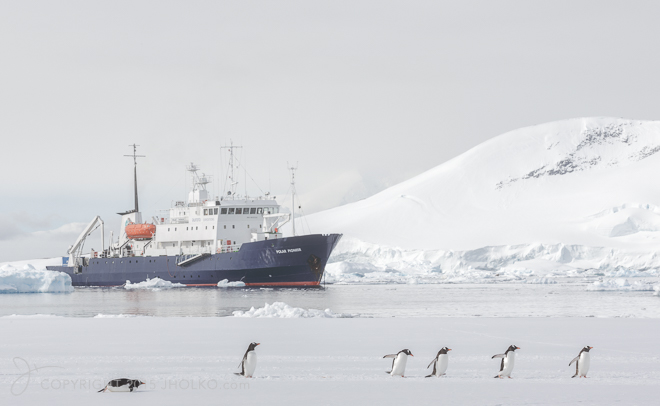 One thing you should be acutely on the look out for is generic expeditions that offer a photographic component as part of their overall program; or expeditions that comprise in the majority of general tourists with what is marketed as an additional small dedicated photography group that plans to co-exist on the same ship. These expeditions are disasters for photographers who are dedicated to their work and who want to achieve the best possible photographs. Any expedition that comprises in the majority of general tourists will first and foremost have to cater to this majority (and not the much smaller group of photographers). Such groups will not be able to rearrange their schedule to suit the best light for photography and will not be able to suitably serve the needs of the dedicated photographers. I can tell you from experience that these sort of expeditions are incredibly frustrating as you are forced to photograph during midday landings in harsh light in order to meet the standard meal times when the light would be optimum for photography. If photography is your primary goal avoid any sort of mixed expedition at all costs.
You should also do your research on your expedition leader and photographic leader. Try and find out what sort of experience they have working in Antarctica. It is of critical importance that your expedition leader have experience working with photographers and that they understand the needs and requirements of photographers looking to capture stunning images in the best light of the day. The expedition leader is in charge of daily operations and therefore is going to make all of the decisions pertaining to shore landings and zodiac cruises. If those operations are planned for midday light to accomodate standard meal times you can expect a very poor experience from a photographic perspective. You absolutely must have an expedition leader who is willing to shift meal times to ensure you are out in the best light of the day. Typically in Antarctica this is very early in the morning and very late in the evening. It is the responsibility of your photographic leader to liaise with the expedition leader to ensure you get the best opportunities. It is not uncommon for photography guides to have little to zero real world Antarctic experience. Such guides should generally be avoided as they are likely to be far more interested in their own photography than in helping you or others on the expedition. If possible, try and select an expedition that includes a photography guide who specialises in polar photography or who otherwise has significant experience operating in Antarctica. Such guides know what to look for in terms of subject and know how to position a zodiac for the best backgrounds and to take advantage of prevailing light. Such leaders also know how to liaise with expedition leaders to deliver the opportunities you would otherwise miss.
The photographic leader and expedition leader you choose are going to have as much bearing on the success of your expedition as the ship you choose to travel on. They are critical elements to your success that should not be overlooked. In fact, you should equally weight your leader and ship choice for any expedition to Antarctica.
In part three of this series we are going to look at the very important decision of what time of year you should travel to Antarctica in order to achieve your desired outcomes.
Antarctica White Nature 2017 Expedition Update
In November this year I will lead a dedicated photographic expedition to the Antarctica Peninsula in early November – Antarctica White Nature. This new and very special expedition is a co-operative effort between myself and Norwegian photographer and friend Ole Jorgen Liodden.
 The expedition is for a strictly limited number of 54 participants plus photography guides and expedition leader. We have chartered the ice hardened expedition ship M/S Polar Pioneer with a highly experienced crew so that we can get as close as possible to giant icebergs for the best photographs. Our expedition ship the ‘Polar Pioneer’ is equipped with sufficient zodiacs and crew for all photographers to be shooting simultaneously with plenty of room to spare for camera equipment. So bring what you need!
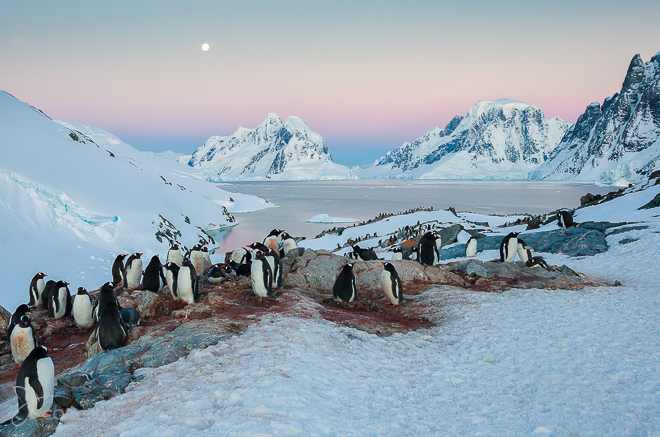 The main focus of this expedition will be Antarctic wildlife including penguins, seabirds, seals, and possibly even whales. We also plan to photograph snow and ice covered landscapes and icebergs. Our expedition has been timed as the first of the season so we expect fantastic icebergs and a breathtaking winter landscape. Very few photographers have visited Antarctica in early November, and experience has shown us that this will give you the best possible photo opportunities.
Antarctica is one of the hot-spots for photographing penguins, seals and icebergs in a great landscape. We will be landing early in the morning and late in the evening to get the best possible light conditions, which you will miss out on an ordinary tourist trip.
At this stage there are now only very places remaining before the expedition will be sold out (we have two twin-share places remaining only). Captains Suite, Mini Suite, Twin Private and Triple Share cabins are now all sold out.If you would like to join us or if you would like any additional information please do not hesitate to drop me an email to info@jholko.com.
 www.WILDNATUREPHOTOTRAVEL.com