Departing for Greenland and Finland 2019 Expeditions

My whirlwind stop at home in Melbourne, Australia has already come to an end (yes, I really do live here!) and as soon as I finish this post I am heading back to the airport to start the long haul north back to Iceland then onto Greenland for my two back-to-back expeditions to the East Coast and Scoresby Sund with Daniel Bergmann. Honestly, it feels like my feet have not even touched earth here in Australia and I am definitely not fully recovered from my Faroe Islands jet lag (Read the TRIP REPORT). Despite the fading case of jet lag I am really excited to be returning to Greenland. The massive icebergs and rugged landscape of Greenland are a a dynamic paradise for photographers. In particular the East Coast may just be my favourite place on earth to photograph.  Check out the Adobe Spark Presentation HERE.
After I finish in Greenland I will be having a few days off in Helsinki before I start my Autumn workshop in the north of Finland for Wolves, Wolverines and Bears. Autumn is a gorgeous time to photograph in the forests of Northern Finland and with a little luck we will have some fantastic photographic encounters during our time on the Russian border. Finland is in my experience one of the most underrated wildlife destinations on earth. Not only does it offer up Bears, Wolverine, Wolves, Otters, Pine Martin and more, but it is also home to White-tailed Sea Eagles, Golden Eagles, Siberian Jays, Black and Spotted Woodpeckers and a host of other Arctic and Sub Arctic birds.

Packing for the East Coast of Greenland and Finland in Autumn presents a minor challenge. Although both will be similar in terms of temperature, they require quite different photographic approaches. With the emphasis in Greenland on landscape and the emphasis in Finland on Wildlife it requires quite a bit of thought on what equipment to actually pack in order to avoid taking absolutely everything.  All of the below fits in my new Gura Gear Kiboko backpack (just!). Although I generally prefer a roller bag for airports (that I can then re-pack into a backpack) on this occasion a backpack makes more sense as I need to carry all my equipment from the airport at Constable point to our point of embarkation on our boat.

2 x Canon EOS 1DX MKII Cameras with 2 x Spare Batteries

1 x Canon 8-15mm Fish Eye

1 x Canon 11-24mm

1 x Canon 24-70mm F4L IS Lens

1 x Canon 100-400mm F3.5-5.6 IS MKII Lens

1 x 600mm F4L IS MKIII Lens

1 x 1.4 TC MKIII Teleconverter

1 x Lecia 10 x 42 HD Binoculars

If I had the space I would love to take a tilt shift lens or two with me as well as I find these really useful when working from ship. The keen eyed amongst you may notice I am not taking the EOSR or a tripod. Greenland is an active and dynamic place and I have found in the past a tripod is often more of a hindrance than a benefit; especially when things are happening quickly (such as icebergs rolling over). I will shoot handheld for these expeditions (or on a bean bag for my long lenses). For Finland I am packing my Sachtler fluid head to mount the 600mm inside the hides.

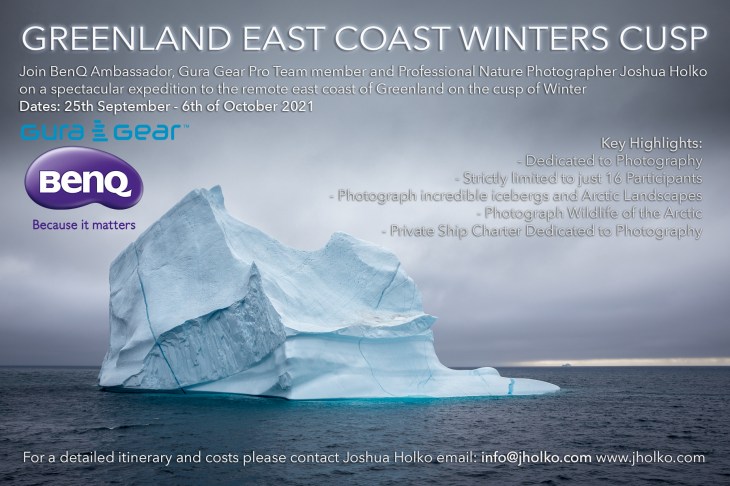
If you missed out on a place on the 2019 and 2020 expeditions but would like to travel to the East Coast of Greenland to photograph this amazing region then I will be repeating this very special ‘Winters Cusp’ expedition in September of 2021 (some places and cabins already spoken for). Full details are now available for download from my website at www.jholko.com including a complete PDF itinerary.

Lastly, there is no internet access during my time on the East Coast of Greenland; so if you contact me via email please be patient and I will get to you on my return as soon as possible. See you in Greenland!
 

Frozen in Time – New Fine Art Print Exhibition 2020 – Save the Date NSW!

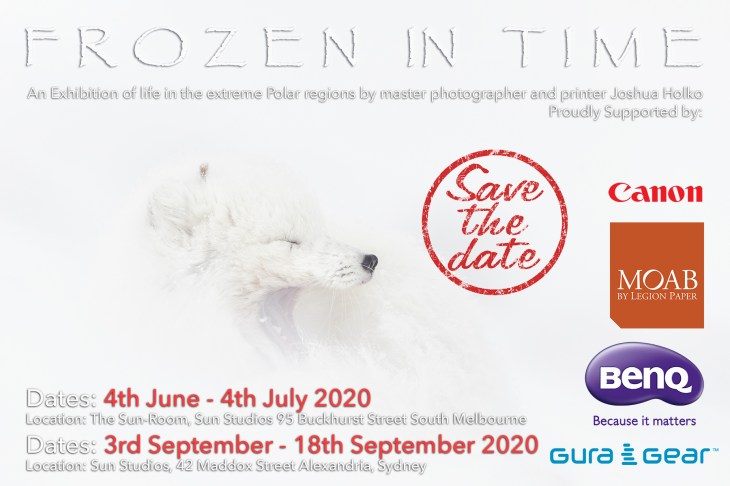
I am excited to announce today that my new exhibition ‘Frozen in Time‘ of my Polar Photography will now officially be coming to Sydney New South Wales in September of next year (after it concludes in Melbourne). The exhibition will open in Melbourne and run for one month only from June 4th until July 4th 2020. The show will include approximately three dozen of my fine art prints from both the Arctic and Antarctic captured over a period of ten years. The exhibition will be held in South Melbourne before it travels to New South Wales opening September 3rd until September 18th at Sun Studios in Alexandria. Proudly supported by Canon Australia, BenQ and Moab and Legion Paper. Previously unreleased limited edition prints will be available for sale at the exhibition.

Mystical Faroe Islands Workshop Report 2019

In August of 2019 I led my first landscape workshop to the Faroe Islands; a series of remote islands south of Iceland (north of Scotland) that offer some of the most rugged and beautiful sea cliffs I have been fortunate to experience and photograph. The Faroe islands archipelago is actually an autonomous country of the kingdom of Denmark. The islands cover a total area of approximately 1,400 square kilometres with a population of just 52,000 people. The climate is sub polar oceanic and such the weather is renowned as wet, windy, cloudy and cool (not what we experienced). Temperatures average above freezing because of the islands location in the Gulf Stream.

The landscape (specifically the sea cliffs) of the Faroe Islands is about as spectacular as one can imagine. Dramatic and plunging cliffs that rise sharply (at some points greater than 800 feet) out of the ocean make for a very dramatic back drop for photography.

Prospective photographic suiters should arm themselves with the knowledge that the Faroe Islands is ripe with locations and vistas you cant simply drive up to and photograph. You absolutely must be prepared to walk and/or hike; and often over some fairly uneven terrain at distances that can exceed ten or more kilometres. Additionally, many of the local land owners have now gated (due to the recent and steep rise in tourism) their properties and are charging admission to hikers and photographers. This currently unregulated practice means that there is quite a variation in entrance fees depending on where you choose to visit. Some locations are now closed to the public without a local guide. We had pre-scouted all of the locations for our workshop and as such avoided any nasty access surprises.

We had planned to schedule our daily activities around the often highly variable weather that the Faroe Islands is known for. As it turned out we experienced weather that could perhaps be said to be ‘too good’ with many warm sunny rain free days that were also mercifully low on wind. In fact, the only rain we experienced during our entire stay was our last morning as we made our way to the airport to say our farewells. I never touched my cold weather clothing the entire trip and lived in a light base layer with the occasional mid layer and light weight wind proof jacket.

Our daily itinerary for this workshop took us across several of the islands and included quite a bit of hiking to reach the best vantage points. The longest of these hikes was out to Drangarnir Arch and Tindholmur; a fairly arduous hike with a superb and highly rewarding vista. If you are planning to visit the Faroes please be aware that access to this location is now closed without a local guide.

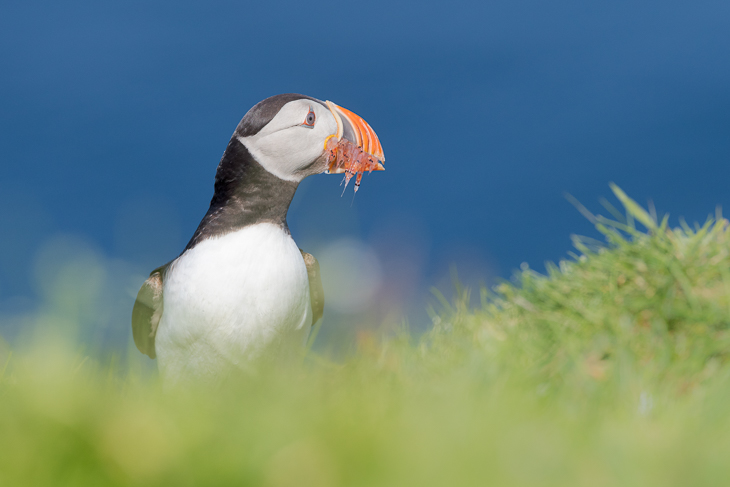
We also visited the island of Mykines where we photographed the Atlantic Puffins that nest on the sea cliffs. I have been fortunate to photograph Atlantic Puffins at two of the best locations in the world in Iceland and was pleasantly surprised to find Mykines was just about as good as any of them. The Puffins are very approachable and one can sit quietly near the cliff edge and photograph them as they come into land with food in their mouths for their chicks. Some of us also took an option hike out to the lighthouse. Although the Puffins are quite approachable the island of Mykines is a tourist hot spot and you do have to contend with a great many day trippers also keen to attempt to photograph the puffins with their smart phones (an unfortunate reality of life these days).

Some of the other locations we visited during our workshop included Traelanipan Cliffs and Bosdalafossur Waterfall and Sørvágsvatn Lake. We also visited and photographed the iconic sea stack Trollkonufingur as well as Gasadalur and Mulafossur waterfall. We also took the ferry to the island of Kalsoy for a walk and scenic photograph of the lighthouse as well as the seal lady at Mikladur. We also visited the Islands of Kunoy, Bordoy and Vidoy and hiked the hillside for amazing views over the fjord and photographed the the Risin & Kellingin sea stacks.

Generally speaking the distances between locations in the Faroe Islands are short and the road conditions mostly excellent (although the roads are very narrow in parts). Tunnels connect some islands whereas others require ferry or car ferry access. In the case of ferry access, you absolutely must either pre-book or arrive very early (in cases where booking is not possible) to avoid disappointment. The Faroes has become very popular in recent years as a photographic destination and as such it is rare to have any of the iconic locations to yourself.

Due to my travel commitments I have not as yet had the time to process many of the landscape photographs I made during our time in the Faroes (and I am leaving for Greenland and Finland in just a few days), but I hope to share more of these beautiful islands over the coming months as time allows. 

APPA 2019 Prints on Display at Frozen in Time Exhibition

For those of you interested in seeing the actual prints from my 2019 APPA entry into the Nature category they will be part of my Frozen in Time exhibition opening next year at the Sun Room at Sun Studios in Melbourne. The exhibition will be coming to Sydney after it finishes in Melbourne (Sydney Dates TBA) before it heads over to the USA. The exhibition will run for one month in Melbourne only from June 4th until July 4th 2020 and will include approximately three dozen of my photographs from both the Arctic and Antarctic captured over a period of ten years. Previously unreleased limited edition prints will be available.

APPA – Australian Professional Photography Awards Finalist Nature Category 2019

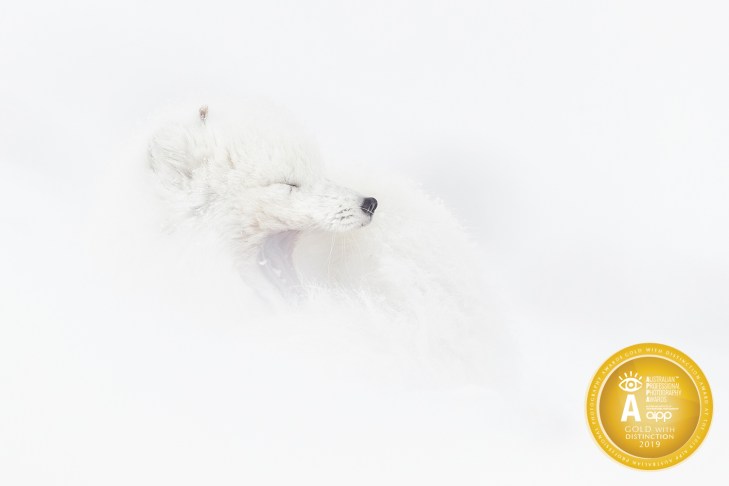
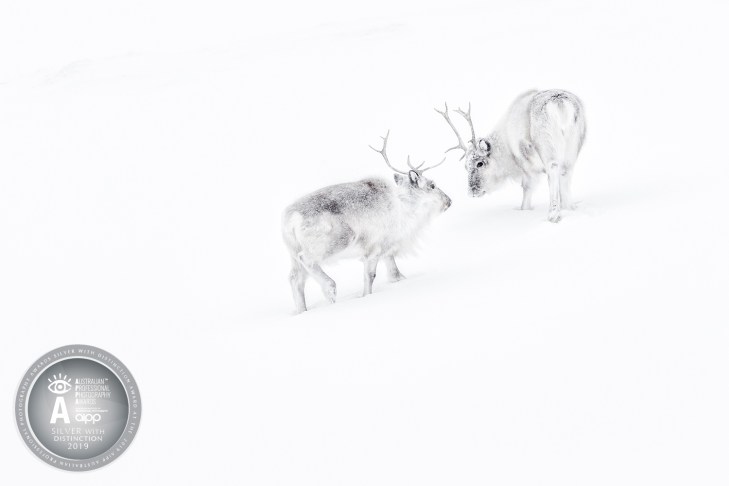
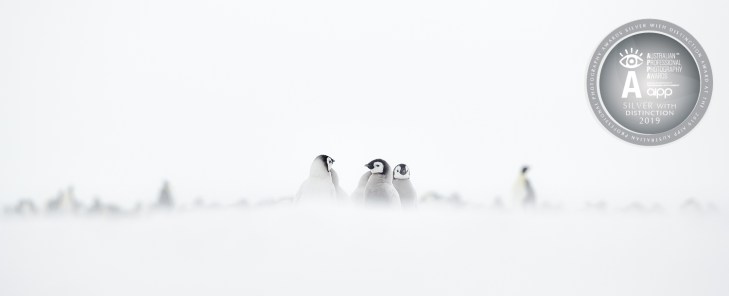
The 2019 APPA (Australian Professional Photography Awards) wrapped up a couple of days ago with the awards ceremony and Gala dinner in Sydney, Australia. Due to my workshop commitment in the Faroe Islands I was unable to attend this year so caught up on most of the judging and results through the live-stream (isn’t technology wonderful!). This year I again chose to enter my four prints into the Nature category and was pleased to have all four prints score extremely well – including a much coveted Gold and Gold with Distinction. I was also a finalist (for the second year in a row) in the Nature category. This year I achieved my stretch goal of 6 points and accrued more than enough overall points to achieve my 2nd Gold Bar and make the finals in the category. My individual prints scored 95 Gold with Distinction (2 Points), 90 Gold Award (2 Points), 88 Silver with Distinction (1 Point) and 85 Silver with Distinction (1 Point). Yes, that 88 was agonisingly close to a third Gold! I am now just five points away from my 3rd Gold Bar and a triple Master of Photography – M.Photog III. That honour will have to wait until APPA 2020 though (assuming I can amass the five points!).

All of the prints I entered were printed on Moab Somerset Museum Rag. As I wrote for the 2019 VPPY awards; this wonderfully sublime paper has continued to remain my stock of choice for all my fine art photography prints. If you love printing and are not familiar with this paper I urge you to check it out and get a sample pack.

To help provide some insight into the judging at APPA I captured and uploaded the live-stream video of the judging of my four prints in the Nature category. Keep in mind, you are listening to individual opinions – hence a panel of five judges. What is really interesting is to compare the scores and the comments from the state awards earlier this year.

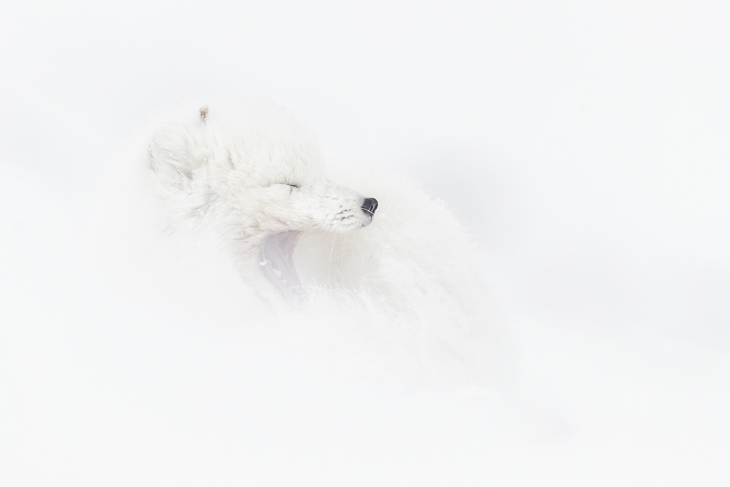
Arctic Fox Blizzard – 95 Gold with Distinction. This print went for review at the end of the judging and was successfully elevated to a final score of 95 – a Gold with Distinction Award.

Penguin Love – 90 Gold Award. This print went for review at the end of the judging and was successfully elevated to a final score of 90 – a Gold Award.

Lost in a Blizzard – 85 Silver with Distinction

Reindeer Face Off – 88 Silver with Distinction

Those of you who kindly emailed me (thank you) asking for my thoughts on the category winning images and the level of “hyper-post production” applied to them: All I can say is I personally felt it far exceeded what should be acceptable in the Nature category. I do want to thank those of you who took the time to write to me about it – thank you.