Finnish Nature photography magazine Lumo has just run a feature on the 2015 Global Arctic Awards. You can download a PDF of the Feature HERE or just click on the image below. You might need to brush up on your Finnish :-)
Category: Wildlife Photographs
Wildlife Photographs from around the World
Lofoten Island Winter Workshop Report 2016
In March this year I led a new winter landscape workshop to the Lofoten Islands in Norway with long time good friend and fellow landscape photographer Martyn Lucas. If you are unfamiliar with Lofoten let me assure you that The landscape of these islands is really quite something to behold. Precipitous and ominous peaks that rise straight out of the ocean loom over small fishing villages that comprise of bright red houses lining the shorelines. With a dusting of fresh snow and arctic winter light the entire scene is akin to a fairy tail location and subsequently the photographic opportunities can be truly superb. This workshop was a for a small group of just six experienced landscape and nature photographers. We based ourselves primarily in the small town of Reine and made daily excursions to various locations around the Island for photography. Lofoten has become quite the hot spot for photography in the last few years (some are calling Lofoten the new Iceland) and although we did encounter a few other photographers during one of of our early morning sessions near town (where the above photograph was taken), we primarily had the place to to ourselves. It has been my experience in ‘hot spot’ locations such as Iceland and Lofoten that it is not too difficult to get away from other groups if you travel with someone who knows the terrain and have an experienced guide with you. Both Iceland and Lofoten have a number of iconic locations that everyone visits and photographs. However, both also have a vast number of excellent off the beaten track locations that are rarely visited and even less rarely photographed. On the whole, we preferred to spend the majority of our time in these less visited areas as the opportunity for unique photographs is greatly improved and you don’t have to fight for tripod space.
 Like much of the Arctic, photography in Lofoten in winter is heavily weather dependant. It is entirely possible to be socked in for days with heavy cloud and bad weather in this part of the world (a risk you have to be prepared to accept when you venture so far north in winter). Its common on this sort of trip to loose at least one or two days to bad weather – its par for the course. Fortunately, we had very good weather and light for most of our trip with only a little rain on a couple of occasions. Being so mountainous and surrounded by ocean Lofoten is prone to highly variable weather; which can be both a boon and bane for photographers. The ideal scenario is a dusting of fresh snow with cold temperatures and golden light. We were fortunate to experience this on several occasions. We also had some really lovely cloud during the workshop that made for some wonderfully moody and evocative images.
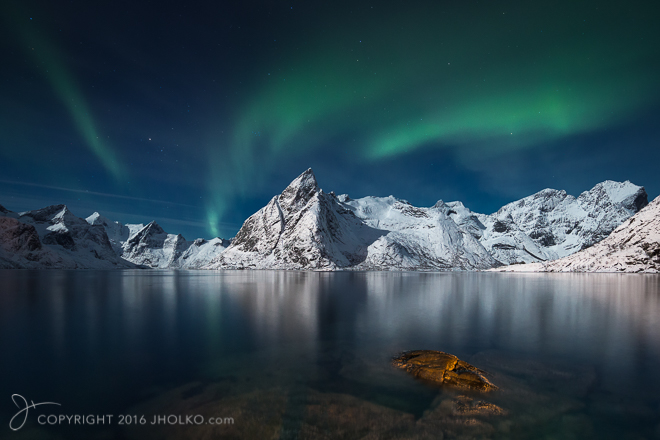
 During our workshop we also experienced and photographed the Aurora Borealis (northern lights). Lofoten is blessed with fantastic mountains that rise almost vertically straight out of the ocean and that make for a superb back drop for the Aurora. As is always the case with Aurora photography the real key to getting interesting photographs is to try and include some sort of foreground and background elements (in this case I chose a small section of partially submerged rocks as my foreground). There is a temptation to focus entirely on the Aurora itself when photographing the northern lights and it is easy to be seduced by the color and activity alone. The solution is to try and photograph the lights in the context of the environment around you. Much like wildlife, where the key is to place the animal in context; you need to put the Aurora into context with its surroundings.
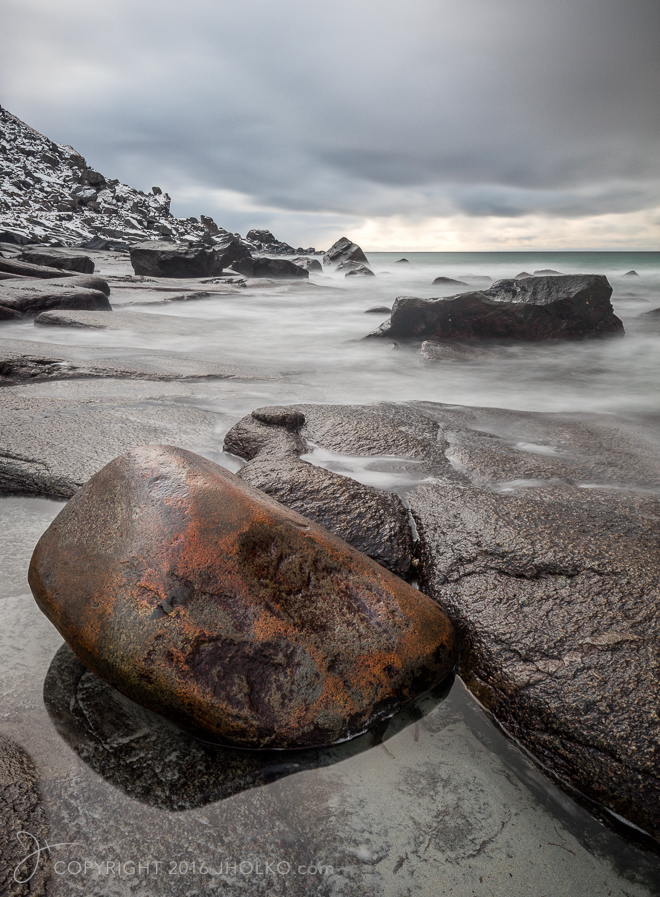
 Being surrounded by water Lofoten offers great opportunities for seascape photography at just about every turn and we took advantage of this by visiting and photographing many different beaches and areas of coastline. Much of the coastline is rocky or dotted with large boulders (JCB’s – Otherwise known as Joe Cornish Boulders) which provides limitless opportunities for foreground interest. Many of the beaches are also very accessible and only a short walk from car parks or pull off areas. We spent quite a lot time exploring and photographing various areas of coastline and some really interesting photographs resulted. In the right conditions, Lofoten in winter also has the added benefit of snow down to sea level for even more interest.
 It is worth noting that Lofoten isn’t just about landscape photography. On our last day we made the decision to mix things up and took a private charter boat out to photograph White-Tailed Sea Eagles fishing off the coastline. This proved a worthwhile gamble with a couple of hours of really wonderful eagle photography in occasional light snowfall. Photographing fishing sea eagles from boat in winter in the Arctic is a lot of fun. We were able to get quite close to some of the eagles (so close my 300mm F2.8L IS MKII was occasionally too much lens and I had to switch out to the 70-200mm F2.8L IS MKII. I did not yet have a production version of the new Canon EOS 1DX MKII so all photographs were taken on the original Canon EOS 1DX. I have subsequently sold both my original Canon EOS 1DX bodies and migrated completely to the newer MKII.
 Edit: As a side note: I have now spent three weeks in the field with the new Canon EOS 1DX MKII in the South Island of New Zealand. In my experience to date I have already found the auto focus on the new MKII to be a significant improvement over the original (and thats a significant statement) – particularly in back light and low light situations. I was photographing the rare and endangered Yellow-eyed penguins in the South Island in very difficult back light and found the camera continually nailed focus in this situation. Back lit subjects are one of the hardest tests for any auto focus system. The system also performed flawlessly for Bullers Mollymawk Albatross in Miflord Sound. More to come on the new EOS 1DX MKII in a future post including my thoughts on the high ISO capabilities.
Visiting Lofoten in Winter also provides an opportunity for cultural photography. At this time of year the cod are being fished around the Islands; they are then processed and hung to dry on the many cod racks dotted around the Islands (yes, you can smell them long before you see them). Every part of the cod is used and even the heads are hung to dry. I am personally not a street or cultural photographer but the process is nevertheless interesting to watch and photograph.
To those of you who have already contacted me asking about a future workshop to Lofoten in 2017 or 2018: At this stage I will not be running a future trip to Lofoten (due to other commitments of which I will have more to say in the next few days). I would however, like to thank Martyn for his assistance in guiding the group to some fantastic locations and to all who participated and contributed to this workshop. We were blessed with some wonderful conditions for photography and some really remarkable images resulted from our experience and time in Lofoten. Small, intimate groups for this sort of landscape photography workshop are the ideal way to ensure you capture the best possible photographs.
Semi-Finalist: Nature’s Best Photography 2016
I was very pleased to receive notification yesterday that I have had one of my photographs selected as a finalist image in Natures Best Photography competition. This is the sixth year in a row I have had my photography in the finals and am honoured to have had my photographs selected again. I can’t share which photograph has been selected at this point in the judging, but will post the image up as soon as the final judging is complete.
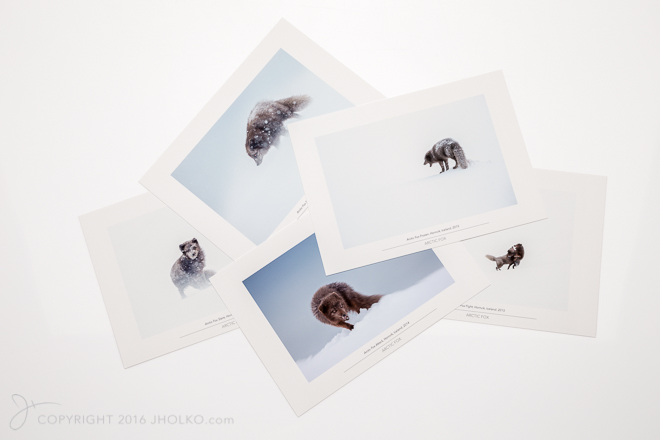
I have also just made available online an open edition portfolio on the Arctic Fox and the Polar Bear. Portfolios are a collection of loose, unbound original fine art pigment on paper prints that when viewed as a group form a collective project. Each portfolio contains a title page, then typically a colophon and statement about the project. A selection of finished fine art prints forms the project body of work. The photographs themselves are intended to be seen as a group, such as one would find in a book. However, they are loose prints designed to be held in the hand and kept together in a fine art package.
Each portfolio cover is made from custom embossed acid-free archival art paper. The assembly uses only archival, acid-free materials to ensure the long life of the prints contained inside. Prints can be stored in the portfolio cover, or removed, matted and framed.
Portfolios are printed on 100% cotton acid-free A4 Museo Portfolio Rag 300gsm Fine Art paper with a Canon IPF6350 Large format printer using Canon LUCIA long-life pigment inks. Each print is made with the same exacting care and meticulous attention to detail as my large format prints that are available exclusively through galleries. Portfolios are individually numbered, open edition and are available for $250USD each plus shipping.
The first two Portfolios to be made available are on the Arctic Fox and the Polar Bear. Each Portfolio contains six open edition fine-art prints as well as title page, colophon and statement about the project. Portfolios can be ordered online directly.
Antarctica Weddell Sea Trip Report – February 2016
In February 2016 I lead a dedicated photographic expedition into the Weddell Sea in Antarctica. Our aim was to get as far south as possible into the Weddell Sea in search of giant tabular icebergs and vast Adelie Penguin colonies. We hoped we may even visit Snow Island if conditions permitted and find the small colony of Emperor Penguins that lives on the island (As it happened the ice conditions prevented us from getting to Snow Hill).
This was the first expedition I have lead that has ventured this far south into the Weddell Sea and it turned out to be a truly excellent experience. Antarctic Sound is well known for its giant tabular icebergs and it did not disappoint with some of the largest and most spectacular tabular icebergs I have ever had the pleasure to photograph. We were particularly fortunate early one morning (around 3am) to have superb light on the icebergs near the mouth of the sound. These magical moments are the real bread and butter of these expeditions. Standing on the deck of the ship photographing gigantic tabular icebergs in wonderful pre-dawn light is an experience that just stays with you forever. This expedition departed from Punta Arenas in South America. Punta Arenas has quickly become my preferred departure point for expeditions to Antarctica. The Chileans just seem to be much better organised with their airport timing than the Argentinians and everything seems to run like a well oiled machine. Although Chile also charges a reciprocity fee on entry for Australians (and Americans) it can at least be paid on arrival without having to pre-purchase.
We did decide to delay our departure from port by a few hours due to the weather conditions on the drake passage (blowing in excess of 30 knots) which proved a wise decision and as a result our crossing was relatively mild. In the end the short delay was a boon as it placed us in a wonderful area for photography with great light.
By contrast to the Western side of the Antarctic peninsula, the rarely visited Eastern Side in the Weddell Sea offers a stark contrast that I find reminiscent of the landscapes found around Svalbard in the Arctic. The landscape on the more often visited western side of Antarctica predominantly consists of precipitous mountains with towering peaks of basalt, gigantic glaciers and rugged wild coastlines. By contrast, the eastern side is flatter, consisting of more rolling mountains with some areas free from snow and ice.
Our passage through the Lemaire channel on western side of the peninsula proved the highlight of the expedition with absolutely superb light that could only be experienced to be believed. We arrived at the mouth of the narrow channel just before sunrise and timed our entrance with first light (around 3am). As we sailed through the passage the light just continued to get better and better, reaching its peak in colour around the narrowest point in the channel. I have been fortunate to venture through the Lemaire channel on many occasions now and this was without doubt the very best light I have yet experienced in this remarkable location. The light actually proved quite challenging in post production as the color in the sky was so intense and the reflected light contained such a strong color caste from the sky that white balance selection was somewhat difficult. In the end the above photograph taken from the front bow of the ship with the cameras auto white balance best matched my recollection of the morning.
 We also visited the surreal Deception Island (one of my personal favourite places in Antarctica for photography). Conditions were misty, with low cloud and strong winds on our arrival, which provided a chance to capture some evocative moody images. Deception Island never fails to disappoint with its myriad of rusty whalers remnants that make for interesting subject matter.
Being late in the season much of the snow around Cuvehrville Island and many of the other landing sites was gone, leaving exposed rocky Penguin rookeries and a glacial scarred landscape. The penguin chicks (already large) were starting to malt and were spread far and wide throughout the colonies.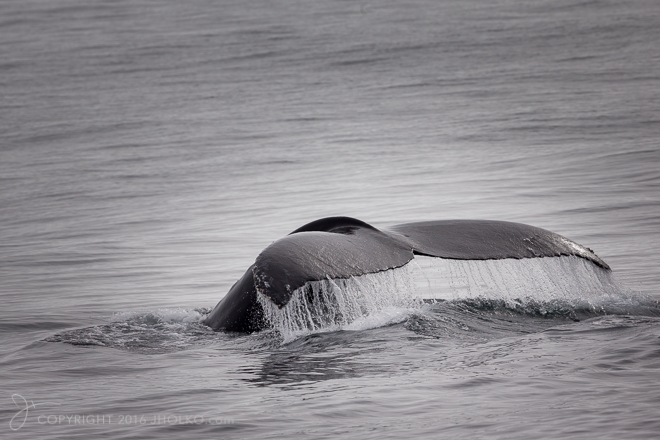 Over the course of the expedition we encountered over 100 whales including Humpbacks. Orcas, Fin whales, Hour Glass Dolphins, Peale’s Dolphins and Minke Whales. We also saw and photographed numerous Albatross including Black-browed, Grey Headed, Sooty, Wandering and Light Mantled as well as numerous other Antarctic bird species.
 Our return drake crossing proved a little bumpier than our first crossing, but on the whole was relatively mild.
This expedition to Antarctica and the Weddell Sea proved a fantastic opportunity to photograph giant tabular icebergs as well as polar landscapes and wildlife. The absolute stand out highlight for me personally was the incredible light we experienced as we made our passage through the Lemaire Channel as well as the giant tabular icebergs at the entrance to Antarctic Sound.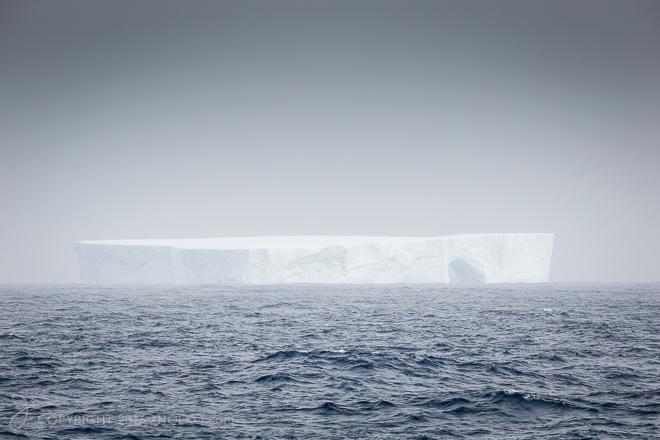 I will be leading a new Antarctica expedition in 2017 that I am code naming ‘Iceberg Hunter’, that is dedicated to photographers and the photography of icebergs and antarctic landscapes. This expedition will depart earlier than all previous trips (in late October) in order to provide us with the best chance to find and photograph icebergs of all sizes and shapes (including giant tabulars) in good light. If you would like to get the jump on this expedition you can register your interest now (no obligation at this point) by dropping me an email at info@jholko.com. Places on this expedition are already limited.
AIPP Epson Victorian Professional Photography Awards 2016
The AIPP 2016 Epson Victorian Professional Photography Awards were held here in Melbourne Victoria in February this year. This was the first time in several years that I was unable to attend due to overseas workshop and expedition commitments. Truth be told, I actually hadn’t planned to enter this year. My schedule has been so hectic that I really didn’t have ample time to devote to making prints for the awards. I felt a bit guilty about not entering at the last minute as print competitions are near and dear to my heart and I want to support the local industry and the AIPP. So in the end I opted to enter a finished print from the 2015 APPA awards along with seven other prints that I had been working on and felt were in varying stages of being finished. I split the prints across the Science, Wildlife and Wild Places category and the Documentary category. I was pleasantly surprised to find on my return that not only had the majority of the prints scored Silver or Silver with Distinction awards, but that I was also a finalist in both the categories.
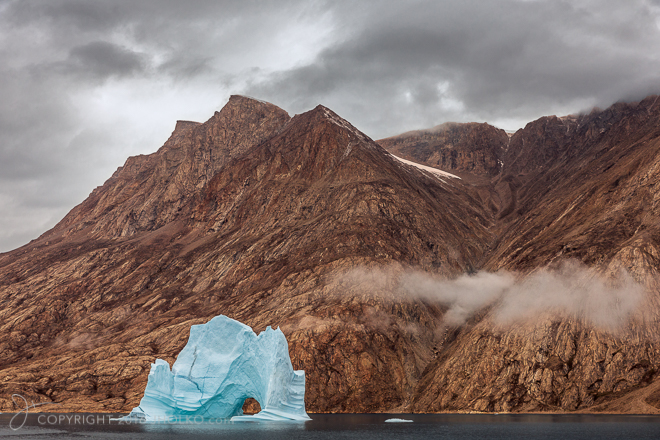
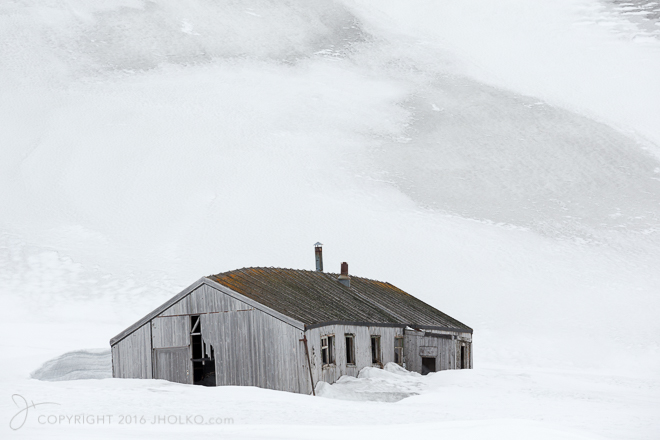
What caught my attention this year on my return to Australia was that a print I previously entered at the National Level in the 2015 APPA Australian Professional Photography Awards that had scored a high Silver with Distinction (falling just short of Gold) (and was part of the winning portfolio for 2015 Global Arctic Photographer of the Year) only scored a Silver at the State level (go figure..) Just goes to show how subjective awards can be at times. The awarded images are included below:



 www.WILDNATUREPHOTOTRAVEL.com