My photograph of the month for February is of a Penguin rookery high on the mountain side at Petermann Island in Antarctica. Petermann Island is one of those incredible Antarctic locations where it is possible to go ashore and wander amongst the many Penguin rookeries making photographs. In this instance, we landed late in the evening via zodiac at Petermann Island and spent several hours photographing the landscape and penguins as the sun slowly set in perfect weather conditions. This photograph was taken around 11pm at night and illustrates just how much light is available this late in the evening in Antarctica. We were very fortunate during this landing to have just about perfect conditions with wonderful light and atmospherics. Dedicated expeditions for photography such as this one (Read the Report) are the key difference between capturing images such as this in ideal lighting conditions and just snapshots taken in the middle of the day. If you are interested in travelling to Antarctica for photography I am running two expeditions to the great white continent this year. The first is an extended expedition to South Georgia Island and Antarctica with my good friend Andy Biggs. The second is a shorter expedition to the Antarctic peninsula with fellow Australian photographer Antony Watson. Full details, including an itinerary is available for download on the workshops page of my website at www.jholko.com There are only very limited places remaining on both expeditions. If you want to get more of an idea what it is like to travel on a dedicated photography expedition be sure watch the Polar Experience Video I produced late las year.
Category: Wildlife Photographs
Wildlife Photographs from around the World
Creating Intimate Wildlife Photographs
One of the easiest things you can do to dramatically improve your wildlife photography is to get down low. Chris Gamel who was a participant on my photography expedition to Antarctica last November touched on this briefly with his ‘Alter the Perspective‘ tip in his guest post here on my blog a week or so ago. It is worth emphasising the importance of this advice as getting down low allows the photographer to connect with the subject and create a far more intimate photograph than one taken at the average human standing height. When you get down low (to eye level) with the wildlife you have a much better chance to connect with your subject and to create a photograph that tells the viewer much more about the life of the critter and the environment in which it lives. Many banal wildlife images could easily have been improved if the photographer had made the effort to get down to the perspective of the subject. Getting down low is not always the answer of course. There are occasions when raising the perspective is the preferred approach and these instances should be relatively obvious.
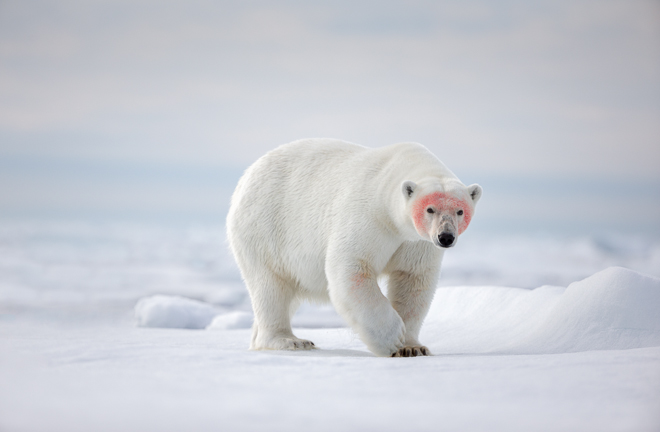
I am including an example below that illustrate the importance of getting down low and connecting with your subject in wildlife photography. I want to place particular emphasis on ‘connecting with the subject’ as this is something professional portrait and street photographers often talk about and with good reason. When you connect with your subject you have a far better chance to successfully capture their character and personality. You are going to create a photograph that tells the viewer something about the subject and perhaps gives an insight into who they are. Connecting with a subject does not always mean you have to make eye contact either. Connecting in this case simply means you are shooting the subject in a manner in which you are trying to tell their story. When it comes to telling the story of wildlife my preference is often to shoot landscape photographs that include wildlife rather than head and shoulder portraits. Photographs that include the animal in the landscape tell the viewer something about the environment in which the animal lives and helps place the critter in context. In this example I am including a photograph that is more portrait orientated to better illustrate the importance of perspective. I photographed this Polar Bear at 80º North of Svalbard at the edge of the permanent pack ice. This bear showed no fear whatsoever of the small ship (with only twelve photographers aboard) I was travelling on and approached within just a few feet of us. The opportunity to create a great photograph was a combination of being in the right place at the right time, but just as important as actually being there was getting down low. In this instance I got down as low as I possibly could and waited until such time as the bear and I made eye contact before I pressed the shutter and took the photograph. The result is an intimate and personal photograph that speaks volumes about the environment in which the animal lives and how it perceives its surroundings. The viewer perceives the sea ice and surroundings from the perspective of the bear which helps connect the viewer with the subject. In this instance, eye contact with the bear helps draw the viewer into the photograph and emphasises the connection with the subject.
 I want to emphasise that getting down low and connecting with your subject starts long before you arrive on the scene and take a photograph. You have to consider the location you are going to be shooting from and how this relates to where your subject might be when you press the shutter. And of course you have to take into account the all important background amongst a myriad of other technical, aesthetic and compositional concerns and challenges. Some forward planning can go a long way when you are planning your next wildlife photography sojourn. Give serious consideration to the places you will be able to take photographs from and the opportunities that location will provide you. Your chance to get down low and connect with wildlife could be more than hampered by a poor choice of vessel or vehicle. Large cruise ships with hundreds of people and big buses that place the photographer high up are not ideal shooting platforms if you want to get down to eye level with your subject. Be it an African Big Cat Safari or an expedition to Photograph Polar Bears take a moment and find out what your real options are for connecting with your subject. It could well be the difference between an outstanding wildlife image and just another snapshot.
Happy New Year! January Photograph of the Month
2014 has arrived! (At least for those of us living in Australia). For those of you in America and Europe you still have a few more hours to go – but I i wanted to get in early and wish all of you a very safe, happy and prosperous 2014. I hope your year ahead is full of lots of photography, wonderful light and that you make some incredible photographs.
I am kicking off 2014 here on my blog with my photograph of the month for January. An image I made in the Arctic in August last year of a large female Polar Bear on a kill on the pack ice north of Svalbard. We were fortunate to spot this Polar Bear on a fresh seal kill and to be able to manoeuvre close in our small ship M.S Origo. Incidentally, this is the same ship I have chartered for a dedicated Polar Bear photography trip in late July in 2015 and I will soon be announcing the details of this expedition here on my blog. M.S Origo is widely regarded as the best ship in the Arctic for photographing Polar Bears due to its low decks and operable portholes a mere fifty centimetres above the waterline. This enables the photographer to get down to eye level with wild Polar Bears living and hunting on the pack ice. I made this particular photograph with the Canon EOS1DX and Canon’s new 200-400 F4L IS with inbuilt 1.4 Teleconverter and photographed the bear through the open porthole in my cabin. By shooting down low through the open porthole I was able to get down to eye level with the bear and create a far more intimate photograph than would have been possible from a larger ship. There is simply no substitute for being able to get down to eye level with the target animal in wildlife photography. In this instance I used the inbuilt 1.4 teleconverter and this image was shot at 560mm full frame.
 Speaking of gear: I have been receiving sporadic emails since my pre-release video review of the 200-400 lens last year asking me if I know when Canon is going to release its new high end, high mega pixel camera. I know gear talk (and particularly rumours) is the focus of many photography websites, forums and blogs as it creates more website traffic than any other topic in photography. However, I have made a concerted effort to avoid spurious gear talk here on my blog as a general rule and prefer to focus on images rather than equipment. Canon Rumours is probably the best source on the release of new cameras from Canon and they do a good job of reporting the news and rumours. The truth is I actually have no idea when Canon will release a new high mega pixel camera and can offer nothing more than an educated guess at this point. Even if I did know Canon would likely have me under a non-disclosure agreement in any case which would prevent me from discussing it. For those of you who may be into guesses; my best guess would be an announcement by the end of March with a delivery date of sometime later in the year (but don’t take that to the bank). As to how many mega pixels the camera will have and how much it will cost I wold guess somewhere around 40 mega pixels and likely somewhere around $8000 USD provided it ships in a 1-Series body. If it ships in a 5 series body I would expect the price to be closer to $5000 USD. Quite honestly I no longer pine for such a camera and have stopped paying attention to most of the rumours surrounding its release. I am very happy shooting with the 18 mega pixel 1DX at present. It is quite simply the best DSLR I have ever used. 18 mega pixels is more than enough for most of my application needs and the high ISO and auto focus performance are blisteringly good. The Canon 1DX will remain my primary camera for 2014 along with my 1DSMKIII as a back up. The only other planned addition I will be making to my camera and lens arsenal early this year is to invest in Canon’s 600mm F4L IS MKII lens and a pair of Leica UltraVid HD binoculars for spotting wildlife.
2013 A Retrospective & 2014 Whats in Store?
This will be my last blog post for 2013 and as has become traditional I like to reflect back on the year that was and also look forward to what is in store for the coming year. 2013 was my busiest year ever in terms of sheer miles travelled. I have no idea how many miles I covered in total, how many aeroplanes I boarded, how many times I went through airport security or how many tens of hours I spent waiting around in airports for connecting flights, but it was a lot – an awful lot. There have been moments during lengthy airport layovers when I have questioned the wisdom of choosing polar photography as a speciality (especially since I live in Australia). The flip side being I have such a love and passion of photography in the Polar regions that I could not ever imagine doing anything else. Airport layovers are therefore nothing more than an unfortunate means to a much loved end.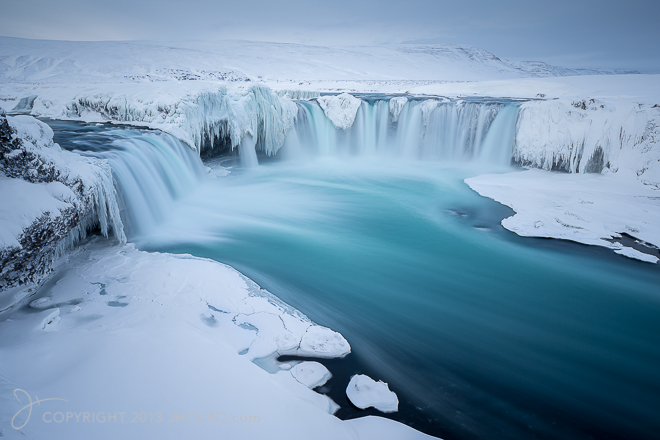 2013 began in earnest for me back in in March when I lead back-to-back workshops to Iceland in with my good friends Andy Biggs and Daniel Bergmann. These were brilliant trips with a real mix of traditional Icelandic weather and light. We were fortunate to experience more than a few days of Aurora Borealis during the first workshop that made for some stellar (pardon the pun) photography. Iceland is an incredible country in winter; snow blankets the land, the waterfalls partially freeze, and the normally colourful land takes on a more monochromatic pallet. Whilst the weather can be brutal in winter the rewards for those willing to brave the elements can be equally amazing.
 After Iceland I travelled to the remote north west of China and the Gobi desert in April with my good friend Antony Watson on a scouting trip for a possible future workshop to this area. At our most northerly point we were only around 60 kilometres from the Russian and Kazakstan borders and we did encounter some incredible landscape and had some memorable experiences. Logistically this was my most challenging trip of the year and I wrote quite extensively on my experiences in China on my return (Read the Report). There are only a few places in the world I have travelled that I have no desire to return. China is perhaps unfortunately at the very top of that list with its and utter contempt for its environment and horrendous industrial pollution.
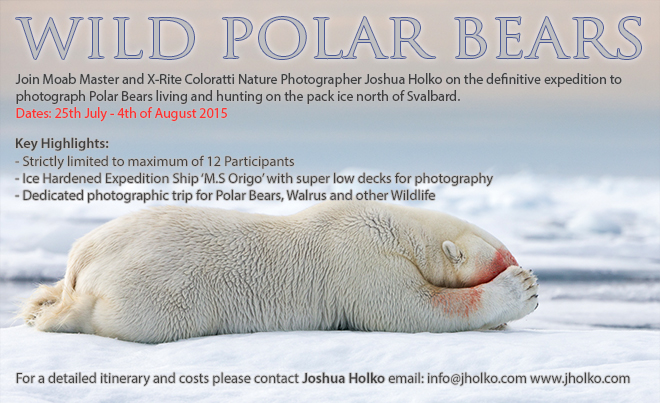
 In July I travelled back to Iceland and guided a highly successful Summer Workshop with Daniel Bergmann before heading to the Arctic to photograph Polar Bears. This expedition to photograph Polar Bears was one of the real highlights of the year for me personally and I will soon be announcing a new trip that will return to the permanent pack ice north of Svalbard in late July 2015 to photograph Polar Bears. This expedition will be limited to just twelve photographers and is sure to be a once in a lifetime experience. With the arctic sea ice shrinking fast and the number of Polar Bears dwindling the number of years left to photograph these incredible animals is unfortunately very limited. I will have more to say about this new expedition here on my blog early next year. For now, here is a brief teaser.
 On returning to Longyearbyen I then lead two back-to-back expeditions to Svalbard and Greenland (Read the Report). We explored many of the fjords in Greenland and encountered everything from Arctic Hare, Blue and Fin Whales, Bearded Seals to Polar Bear and Musk Ox. We also saw and photographed some amazing icebergs. During my time in the Arctic I also produced a short film in conjunction with Untitled Film Works on what it was like to travel on a dedicated photographic expedition. Our travels around Svalbard and Greenland yielded us some incredible footage and I am very pleased with the video we produced. Be sure to click on the image below to watch in High Definition.
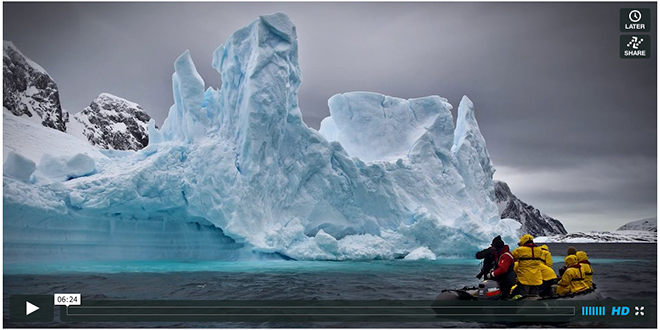
 In November I travelled to Antarctica (Read the Report) to lead an expedition with Daniel Begmann to the great white continent. Antarctica is a miraculous place – a continent of stark and beautiful desolation and I never tire of returning to this incredible continent. It is the closest experience I think most of us will ever get to travelling to another planet. On this expedition we had some stunning light including a passage through the Lemaire Channel that was unforgettable. Reflecting on the year that just passed this single day of photography was probably the stand out highlight for me personally (as many others who were aboard have also indicated). I have already seen some incredible photography emerge from many of the participants on this expedition and I am looking forward to some in depth image reviews with those participants who are travelling with me again in 2014.
 After Antarctica my friend Martyn, Daniel and I journeyed to the Chile side of Patagonia where we spent a week exploring the park by hire car. Our time in Patagonia was somewhat hampered by the relentless wind that Patagonia is notorious for delivering and an unfortunate lack of dramatic light.
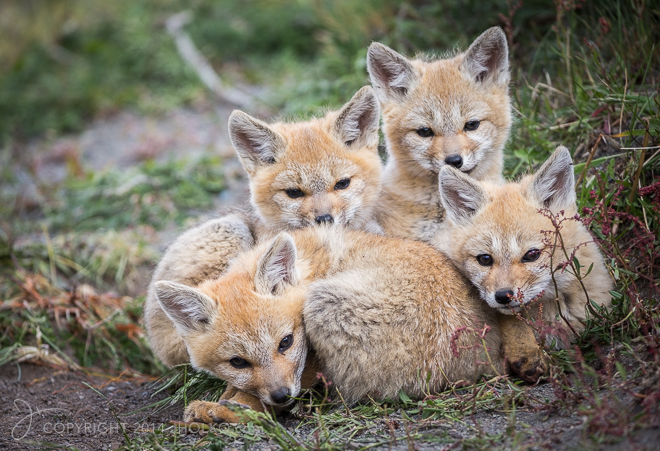
  The highlight of our trip to this part of Patagonia was stumbling across a den of Patagonian Grey Fox cubs, which we spent several hours photographing. We also hiked up to the base of the Towers of Pain – A rather arduous sustained steep hike of approximately twenty kilometres. On the whole I found Patagonia spectacular in terms of scenery, but quite a challenging location to photograph. Had we experienced more dramatic light with less wind I would likely have a different impression. I hope to return to Patagonia on the Argentinian side late in 2014 and have my fingers crossed for better light.
 2014 kicks off for me in just a couple of weeks in mid January when I will travel to the South Island of New Zealand to complete a week long assignment in Kaikoura. This was a project I was supposed to complete late 2013 before I travelled to Antarctica and Patagonia but I succumbed to pneumonia and instead spent the better part of a month recovering. After this assignment I will return home for a short time before I fly back to the South Island to guide a two week long photography expedition. The itinerary we have planned for this trip is very exciting and I am very much looking forward to our time in the South Island. On this workshop we are looking forward to a privately chartered helicopter flight over the alps with the doors removed for photography as well as a private charter to photograph Dusky Dolphins. We will also be circumnavigating the island and visiting many of its wondrous locations. To those of you who have enquired about joining this trip in the last month I apologise but it is completely sold out.
In March I will be leading my annual Iceland winter workshop with Daniel Bergmann. We have a new itinerary for 2014 that takes us into the North to some of the more remote locations accessible in winter. I always look forward to returning to Iceland in winter. Although my favourite place in Iceland (the Highlands) is all but inaccessible during the winter months there is a starkness and harshness to the coastal environment that is extremely appealing and incredibly photogenic. This 2014 workshop is sold out, but I will soon be announcing dates for 2015 for those of you who wish to book early to avoid missing out. After we complete our March workshop I am going to stay on in Iceland for another week in the north where I intend to spend my time looking for and photographing Arctic foxes for a long term project I am working on. I am then going to abandon the winter expedition clothing and fly directly to Africa to lead to back-to-back workshops in Namibia with Andy Biggs. Namibia is a long time dream of mine and it should be very interesting experience to go from the Arctic winter of Iceland to the oldest desert dunes in the world. Our Namibia safari is overland so we will be travelling in four wheel drives between our planned shooting locations. Travelling by land between locations gives us a lot of flexibility in terms of when we can stop. It also allows us to avoid the limiting weight restrictions of light planes and bring everything we need. The second workshop is sold out but there is still one place remaining on the first trip if you are interested in joining us. In July I will head back to Iceland for back-to-back summer workshops with Daniel Bergmann that will see us circumnavigating the island. Summer is my favourite time to visit Iceland with access to Landmannalaugar and the spectacular highland regions. The first trip is sold out but there are still two places remaining on the second trip if you would like to join us. This new itinerary for 2014 sees us circumnavigating the island and visiting many of Iceland’s landscape treasures.
 From Iceland I am travelling further north to Longyearbyen to lead two expeditions to Svalbard and Greenland with my friend Antony Watson. These expeditions ‘The Jewels of the Arctic‘ take in the best of Svalbard and Greenland. These ship based expeditions to the Arctic are the best way to see and photograph the incredible landscape and geology found in this part of the world. Travelling by ship in the Arctic is not without its challenges but the ability to navigate the many fjords and explore the wild coastlines of this region make the sea days worth the effort.
 On return to Australia I will have some downtime before I head back to Ushuaia in South America for a once in a lifetime expedition to South Georgia Island and Antarctica with Andy Biggs. This twenty one day expedition promises to have both incredible wildlife and landscape opportunities. Although I have been to Antarctica multiple times I have not as yet visited South Georgia Island and this is an experience I am very much looking forward to. We are close to sold out now on this expedition so if you are interested in joining please contact either myself or Andy.
On return to Ushuaia I will have just over a week of free time when I hope to explore the Argentinian side of Patagonia – this time with dramatic light! I will then lead one last expedition for the year to the Antarctic Peninsula with my friend Antony Watson. It is going to be a big year for airline miles (even bigger than 2013) and I am looking forward to getting underway. To those of you with whom I was fortunate to travel with this year I want to say thank you for sharing the adventure and making it a memorable year. To those of you with whom I am looking forward to travelling with in 2014 I look forward to sharing in some incredible experiences. I also want to say thank you to my readers and those of you who follow my photography and blog – thank you.
Over the course of the year I published my favourite twelve photographs here on my blog. Please be sure to check them out and let me know what you think. It is always hard to pick an overall favourite but I think this year I have clear personal favourite and it is is this photograph from Antarctica of Gentoo Penguins marching across the sea ice in front of giant icebergs under soft polar light.
Lastly, I want to wish all of you a very safe and happy New Year and may 2014 be one of amazing light and experiences for all of you.
December Photograph of the Month : March of the Penguins
I have been notoriously late to update my photo of the month throughout 2013 and I am again more than two weeks late with my final photograph for the year. Unfortunately my hectic travel schedule this year has played havoc with website updates and I have not been quite as timely as I would have liked with updates here on my blog. Nevertheless, I am pleased to close off my photographs of the month for 2013 with this image of Penguins marching across the sea ice in Antarctica. This is my favourite photograph from my recent expedition to Antarctica and really needs to be seen in large print to appreciate the full grandeur, splendour and scale. What I love most about this image is the sense of scale and of the environment in which these hardy creatures survive. I was also blessed with some wonderful polar light at the time we spotted these penguins marching in the distance. This photograph was made with the Canon EOS1DX and Canon 200-400mm F4L IS with inbuilt 1.4 Teleconverter and was shot at 560mm at ISO200 F8 1/500th of a second handheld. A higher resolution version of this photograph can be seen on my primary website at www.jholko.com in the Antarctica Portfolios.

