I am very pleased and excited to announce my upcoming exhibition of landscape, nature and wilderness photographs from Antarctica, Iceland and New Zealand’s South Island at Source Photographica in Brighton Melbourne. The exhibition will open on the 20th of March 2012 and will run for a strictly limited time of two weeks. The exhibition includes a number of my personal favourite works from Iceland, the South Island of New Zealand and Antarctica. The exhibition includes multiple award winning photographs including: ‘Blue Berg‘ which won Gold at the 2011 APPA awards and was World Extreme Environment Photograph of the year People’s Choice 2011, ‘Well of Life‘ which won Silver at APPA 2011, GOLD at the International Loupe Awards and was a finalist in the World Extreme Environment Awards 2011, ‘Highway to Hell‘ which also won Silver at APPA 2011 and was both a semi-finalist in the 2011 Windland Smith Rice awards and travel photograph of the week at National Geographic magazine. All of the photographs were taken within the last three years and all are printed on my two favourite papers Moab Somerset Museum Rag and Moab Entrada Rag Natural. Source Photographica is located at 1A Rose Street in Brighton, Victoria, Australia and is open seven days a week. Entry is free. I hope you can make it and please drop me a line if you enjoyed it.
Category: Antarctica
CAFFEINATED PHOTOGRAPHERS – PHOTOGRAPHER OF THE WEEK
I am pleased to have been asked by the good folks who run and operate the Caffeinated Photographers Facebook page to be their Photographer of the Week this week. Upon receipt of the invitation my interest was immediately peaked by the use of the word ‘caffeinated’ in their title since I consider myself somewhat of an amateur coffee connoisseur. The morning cup of coffee is part of my indispensable daily routine and the interesting mix of caffeine and photography in their title gave me cause to smile since a cup of coffee is invariably the first thing I reach for on an early sunrise shoot. I am fortunate in Melbourne where I live that we have some of the world’s best coffee. Our reputation (at least in Australia) precedes us in this regard. I am doubly fortunate that Iceland (one of my favorite destinations for photography) also has outstanding coffee. The opportunity to be featured on a page that mixes Photography and caffeine was instantly appealing. Caffeinated photographers feature a different photographer every week and their list of photographers includes such well-known names as Art Wolfe. I am pleased to be counted amongst their photographers of the week.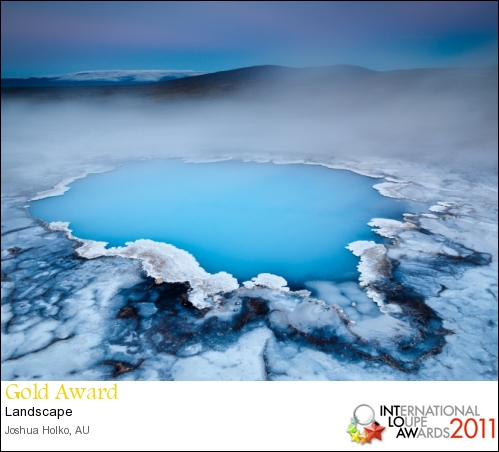
THE TIP OF THE ICEBERG – FEATURE MAGAZINE ARTICLE FEBRUARY / MARCH 2012
The current February / March edition of Australian Digital Photography magazine that is just hitting the news stands is tagged as ‘The Landscape Issue’ and has an eight page feature article on my photography (sub-titled ‘Insights into the world of extreme landscape photography’) from Iceland. This was an interesting interview for me as much of the talk was about equipment, technique and the process, rather than discussion of the actual photographs themselves. A high resolution copy of the article can be downloaded HERE.
ANTARCTICA – THE LAST BASTION : WHEN INSTINCT TRUMPS PRECONCEPTION
An overtly strong preconception of how a new location or subject will photograph is an all too-easy pitfall for the landscape photographer to fall into. It is a problem I have discussed with other photographers, and I find myself struggling with the problem every now and then. As a landscape photographer who is forever chasing the best possible light, I frequently find myself headed to new, often exotic locations with a strong preconception of, not only what I will photograph but also the quality of light I will encounter. At times this preconception will even lead me as far as framing the image in my mind. The danger of the preconception is that it is inevitably stronger than the reality. Indeed, in my experience the stronger the preconception the more likely it is to lead to disappointment. Such is the power of the human imagination. The preconception can easily lead to disappointment and even, at times, to not getting the camera gear out of the bag. Reality can sometimes have quite a sobering effect on the vision. The preconception can also blind us to the obvious. With too strong a picture in the mind’s eye, it is all too easy to spend all one’s time looking for that shot, when the real gem lies dead ahead but remains unseen for our inability to see past the preconception.
With such a long build up to my Antarctica expedition late last year, I had literally months and months to build preconceptions, hopes and dreams for my Antarctic photography. Believe me when I say my mind was running wild with thoughts of blazing sunsets and sunrises, soft pastel light and a depth of colour that would ignite a fire in even the most cynical landscape photographer’s dreams. Browsing through my collection of photography books on Antarctica did little to quell my raging imagination. I am a realist at heart, however, and even though my mind was running amok with the possibilities, I was also acutely aware that what-would-be would-be and that there was very little I was going to be able to do about it once on location, except make the most of things. Antarctica is not an easy place to get to and arranging a re-shoot is logistically impractical. When you are shooting from a ship, when time is limited and the costs are high, you must make the most of the cards you are dealt.
As it happened, there were no blazing sunsets or sunrises that would result in an explosion of fiery oranges and pink pastels during the expedition. As I am oft heard to say in such situations – ‘Sometimes you get the candy bar, sometimes you get the wrapper’. But is the lack of blazing colour really always the wrapper? Most definitely not.
Despite the lack of sunrise and sunset colour during the expedition I was nevertheless thrilled with the quality of the light. I am on record as preferring overcast and dark, moody skies in my photography rather than clear sunny days. I love the drama of storms, dark brooding skies, and racing clouds. There is a drama to such scenes that I find highly evocative and strongly emotional. There is a primordial quality to dramatic skies that I find very appealing. Hence, I found myself really struggling on the one bright and clear sunny day that we did have in Antarctica.
I have seen many photographs from the Lemaire Channel in Antarctica with wonderful golden evening or pre-dawn light, and this was indeed the preconception in my own mind’s eye as we turned into the channel for what would be one of our final shoots of the trip. The fact that the skies were dark, brooding and filled with snow did at the time give me pause to stop and think ‘damn… I wanted sunset colour!‘ However, I quickly realized that this was also an opportunity to produce a photograph that was very different to others I had seen from the Lemaire Channel. Instead of the classic channel shot bathed in golden sunset light, I could instead take advantage of the dark overcast skies to frame one of the imposing mountains overlooking the channel, one that I had not seen before.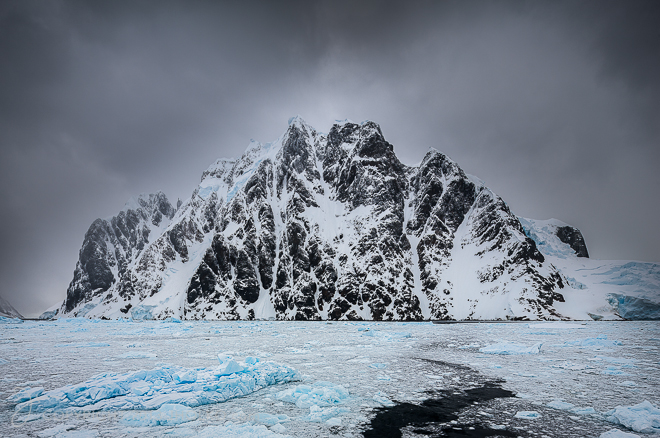 I chose to shoot this with Canon’s 17mm Tilt and Shift lens on my 1DS MKIII as I wanted to use some in-camera perspective control to prevent the mountain appearing to fall away from the viewer. I have previously blogged about this phenomenon in my post about ‘The Fortress‘ iceberg. I have found, through experience, that I prefer to accomplish my perspective control in-camera, rather than in the digital darkroom. I do not recall the exact amount of tilt I used in this photograph but it was somewhere around 1.5 degrees. As I was photographing from several stories high on the aft of the ship I also used a significant amount of lens shift to get lower to the water.
What I was aiming for in this photograph was to convey the imposing and seemingly menacing nature of the mountains that guard the entrance to the channel. I wanted the chalky blue nature of the ice to contrast against the black and frigid water. I also wanted to capture the wake left by our ship as a leading line into the frame. Lastly, I was hoping to try and give the impression of rivers of ice running down the mountain, juxtaposed against the dark skies and the back-lit mountain. Because it is impossible to use filters with the 17mm TSE due to it bulbous front element I had to add a graduated effect in post-production in Adobe Lightroom to achieve this result. I would normally have used a graduated neutral density filter in the field to achieve this.
By far the majority of photography from the world’s southern most continent consists of classic icebergs and penguins and I have many photographs of this kind that I am very pleased with. There are few photographs that I feel speak to the raw natural power and primordial beauty of Antarctica. I hope that this photograph has captured at least some of that majesty and power. A higher resolution version of this photograph can also be seen in my Antarctica portfolio at www.jholko.com
FEBRUARY PHOTOGRAPH OF THE MONTH – PENGUINS ADRIFT IN SNOW STORM II
I have updated the photograph of the month for February with one of my favourite landscape / wildlife images from my expedition to Antarctica late last year. This photograph of penguins adrift on an iceberg was taken during overcast conditions and very heavy snow fall from the deck of our ship the Ocean Nova. What particularly appeals to me about this photograph is the placement of the penguins in their environment. There is a vastness and emptiness that speaks to me about the struggle to live in such an open exposed environment. A higher resolution version of this photograph can also be seen on my portfolio website at www.jholko.com
 www.WILDNATUREPHOTOTRAVEL.com