Last night I received some very exciting news that my book Melrakki on the Icelandic Arctic Fox has just won multiple Gold Awards at the Australian National Print Awards. Melrakki took out the Gold Award with High Commendation for excellence in print and the Gold Award for Limited Edition Books. 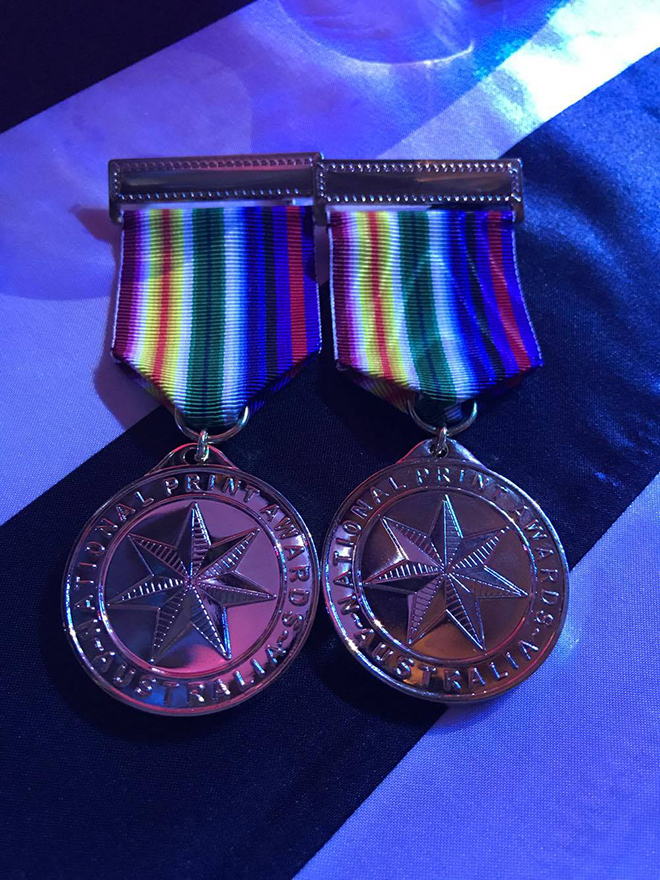 The entry edition for the Australian Print Awards was produced by Nulab in Melbourne after extensive consultation on specialised custom finishes to ensure an absolute no compromise deluxe limited edition with the highest possible quality and finish. The final edition includes a hand bevelled glass cover, with leather spine with deluxe lay-flat album pages. Each page in the album represents the pinnacle of digital printing and matches the subtleties and nuances of the original fine-art inkjet prints.
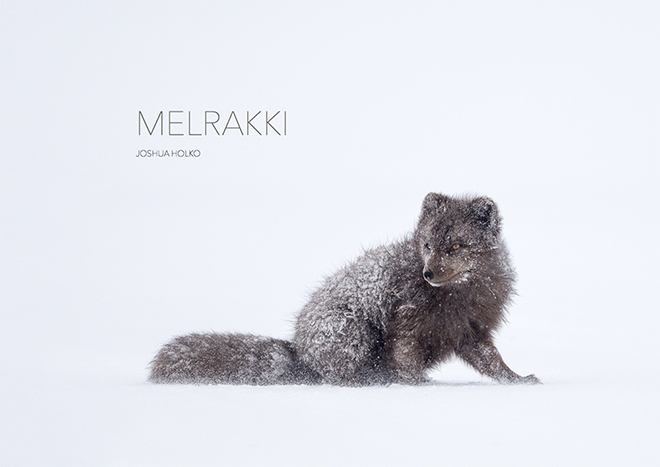 I want to thank Michael Warshall and his amazing team at Nulab for all of their efforts in the production of this super deluxe limited edition. Originally produced as a single one off edition just for these awards we have decided to make this super deluxe limited edition available for sale in the limited quantity of just five (5) copies (the first edition is already sold). The remaining four will be made available for sale on my website over the coming weeks. Each of these four editions will be hand signed, numbered and include a 20″ x 30″ fine art print from the book printed on Moab Somerset Museum Rag. Each edition comes in a presentation box. For existing owners of the Limited Edition there will be an upgrade offer to upgrade your copy to this new edition if you so desire. The remaining four editions will be sold on a first come, first served basis.
Category: Iceland
Wrapping up Australia and Packing for the Ultimate Puffins of Iceland Workshop
Yesterday I wrapped up a private workshop to the Great Ocean Road in Victoria with a week long extension around Tasmania. Both the Great Ocean Road and Tasmania offer some of Australia’s most spectacular landscapes across a wide diversity of topography. The Great Ocean road is known for its impressive and towering sandstone sea cliffs and sea stacks and Tasmania for its World Heritage forests, mountains and spectacular granite strewn beaches. Both locations make for outstanding photographic sojourns and I hope to share more images from this workshop over the coming months. The photograph below of London Bridge at sunrise is just a small sample of what is on offer in this part of the world. I had hoped to have some more time to process a few more images from both this trip and my prior New Zealand South Island Masterclass but I have run out of time (I will have full trip report on this Masterclass in the coming weeks) and tomorrow I am heading back to the airport to start the long trek to Iceland for my Ultimate Puffin workshop with Daniel Bergmann. The Iceland Puffin workshop is entirely focused on bird photography and as such my equipment for this workshop predominantly consists of longer lenses with the 600mm F4L IS MKII and 300mm F2.8L IS MKII being my main weapons of choice. Two Canon EOS 1DX MKII bodies will suffice as my cameras for this workshop. I am also taking a wide angle for close up images as well as my 85mm F1.2L MKII for some shallow depth of field work.
Gura Gear Bataflae 32L Camera Bag (Carry on Luggage)
– 2 x Canon EOS 1DX MKII bodies
– 1 x Canon 16-35mm F4L Lens
– 1 x Canon 85mm F1.2L IS MK II Lens
– 1 x Canon 70-200mm F2.8L MKII IS Lens
– 1 x Canon 300mm F2.8L MKII IS Lens
– 1 x Canon 600mm F4L IS MKII Lens
–
Gura Gear Chobe (Carry on Luggage)
– 1 x Apple MacBook Pro 15″ Retina (I plan to upgrade this to the new 13″ model early next year)
– 1 x Apple laptop charger
– 2 x USB 3 2TB external portable Sandisk SSD Drives
– 1 x Thunderbolt CFast card reader and CF card Reader
– 1 x Sunglasses and sunglasses case
– 1 x Leica Ultra-vid 10×42 HD Binoculars
– 1 x iPad Pro 9.7″ Tablet
See you in the Iceland!
Canon Australia – No One Sees it Like You Feature
Canon Australia have just published a short feature on their Facebook Page on some of my polar photography. The feature series ‘No One Sees it Like You’ is designed to showcase the work of professional Australian photographers working with Canon equipment around the world.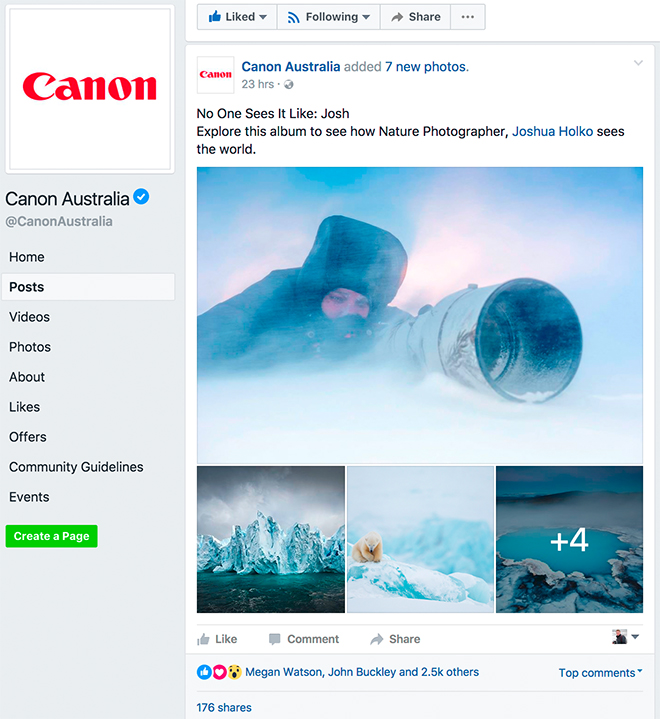
Iceland Winter Workshop 2017 – The Frozen North Trip Report
In late February 2017 I lead my annual Iceland Winter workshop with Daniel Bergmann. We have been running this workshop for the last five years now and have continually been refining our itinerary. For our 2017 workshop we based ourselves predominately in the north-east of Iceland which gave us access to some of the areas less frequented by the plethora of tourists that are flooding the south of Iceland these days (I will have more to say on this in a future post).
We kept our daily itinerary moderately flexible in order to allow us to take advantage of the best conditions, weather and light. As it turned out, this approach has continued to provide us with fabulous opportunities. In particular this years workshop included a unique opportunity to access and photograph the spectacular waterfall Selfoss in a winter setting. I have been wanting to visit and photograph both Detifoss and Selfoss in winter for many years but conditions have hampered access in recent times. This year we were able to drive all the way to the car park and walk the kilometre and a half through compact snow to the very edge of Selfoss. The waterfall was in superb condition with some spectacular icicles hanging from its rocky edges and fresh snow along its banks. Iceland is well known for its waterfall photography and in my experience winter frequently offers the most interesting and dramatic opportunities to photograph them.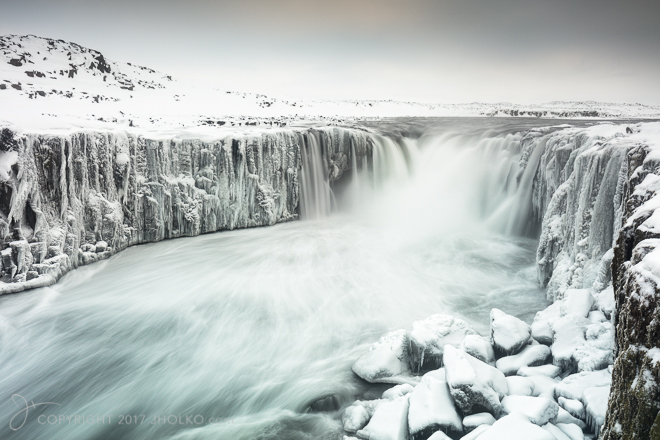 As is often the case in winter we lost one day during our workshop to bad weather (our very first day). We had a huge storm hit the south coast as we were leaving Reykjavik which delayed us for several hours due to road closure. Fortunately we were still able to make it to our planned accomodation on the first evening which meant we didn’t loose any real photography time. The Iceland SAR (Search and Rescue) have taken to closing the roads in recent times due to the high number of tourists who often ignore the weather warnings. Whilst the closed road caused us some delay it was better than spending our time rescuing stranded tourist vehicles. It actually never ceases to amaze me the number of people who travel to Iceland in winter and then expect to drive the roads during Arctic storms in little Toyota Yaris rental cars. Do yourself a favour if you are planning a future trip to winter in Iceland and make sure you are properly equiped with a real 4-wheel drive and always keep an eye on the weather.
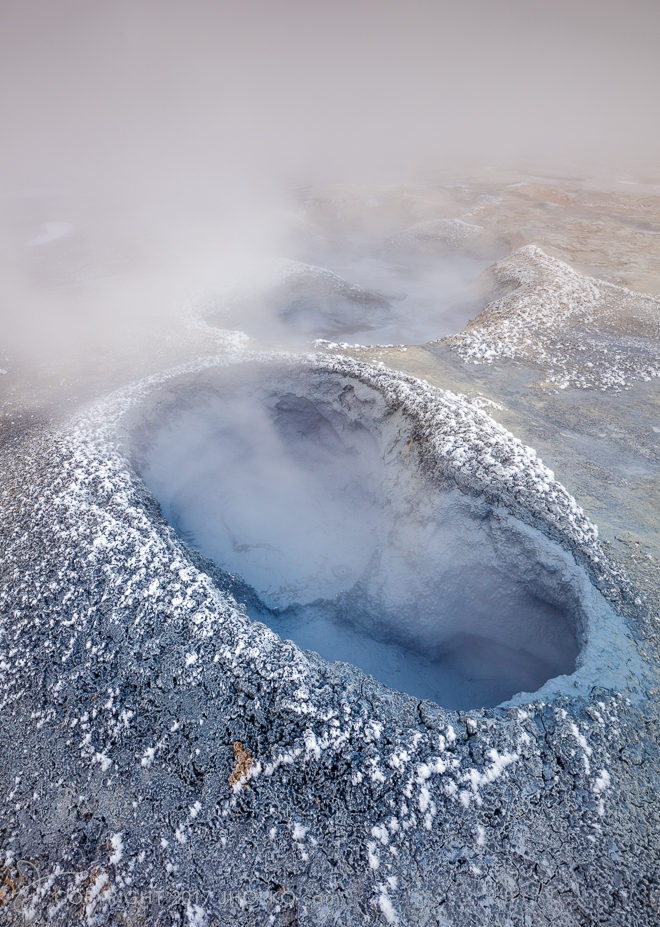
During our workshop we had several opportunities to photograph Northern Lights (Aurora Borealis). Aurora photography is hot right now and is one of the primary reasons many photographers actually travel to Iceland in Winter. To be honest, much of what I see in the way of aurora imagery leaves me pretty cold. Frequently there is little if any foreground interest and the viewer is left with nothing but some pretty colour in the sky. The key to strong Aurora photographs is to use the lights in the sky to add interest to what is already a strong composition. A well composed Aurora photograph should work well without any actual Aurora! The addition of the Aurora can take the image from good to great though and as such we spent some time trying to make sure we had strong and interesting foreground. We were fortunate to have some strong Aurora at Godafoss waterfall (although I did not personally make any Aurora images of it as I was instructing) which remains one of the most picturesque waterfalls in Iceland.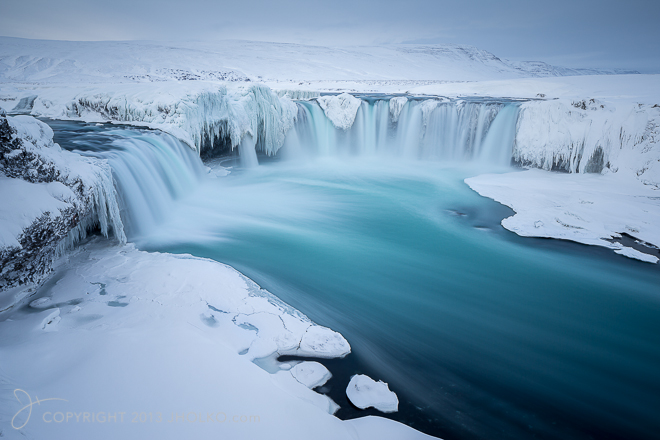 We had several opportunities in the north of Iceland to photograph the geothermal fields in a winter setting. The geothermals of Iceland are one of the most photogenic areas in the country in my opinion. The landscape is a constantly changing sea of fumaroles and boiling mud pits that never ceases to disappoint. We were fortunate this year to have a fresh dusting of snow which added another element to an already dramatic landscape. One of the real pleasures of landscape photography in this area of Iceland is that the area is never the same between visits. Its possible to make truly unique and dramatic photographs by spending a little time exploring the area.
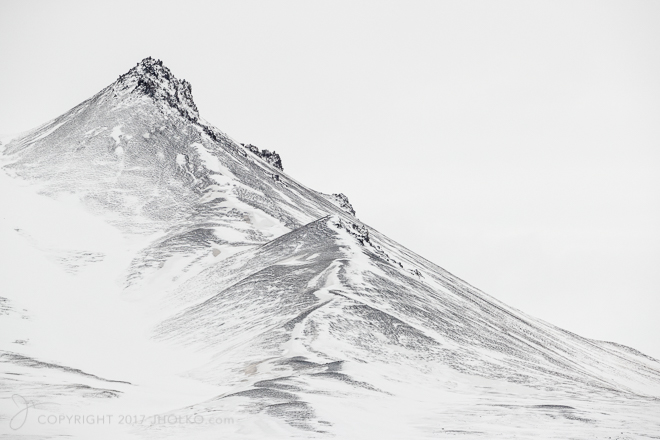
  My favourite photograph from this workshop was actually a drive by shooting in the north of Iceland. We stopped by the side of the road on our way to Myvatn to photograph one of the spectacular snow covered mountains looking south towards Askja. This particular scene reminded me of pencil sketch with its monochromatic colour palette and soft lines. Simple photographs such as this are often the strongest and usually connect with the viewer on a much deeper emotional level. As is often the case, the best photographs need very little in the way of post production. All I did to this photograph in post was to set the colour balance, white and black points and sharpen it. The rest was taken care of by mother Nature.
 Iceland in winter can be quite challenging with weather, but the opportunities in a snow covered landscape can be exceedingly beautiful. This was actually the last landscape photography workshop I plan to lead in Iceland for the foreseeable future. Tourism has exploded in Iceland in recent time to the point where it has become exceedingly difficult (even in winter in my opinion) to properly photograph many of the more commonly known and accessible locations (there are just tourists everywhere). The more accessible ice caves are now flooded with tourists throughout the day and the glacial lagoon and black sand beach are now overly saturated with tourists and photographers. Whilst many of these common locations remain absolutely superb for photography they now lack the remoteness and tourist free experience I prefer to offer those that travel with me on my workshops.
I will still be traveling to Iceland and photographing in this incredible country, but it will now be on far more specialised niche workshops that take us far into remote areas of the country where tourists cannot reach. These workshops and expeditions will be for small groups only and are designed to net us photographs that others simply cannot achieve (such as my Arctic Fox expeditions – read the recent trip report) and my upcoming Puffin workshop. These new workshops offer opportunities in areas otherwise inaccessible and provide participants with unique photographs that really set their work apart from the average Iceland visit.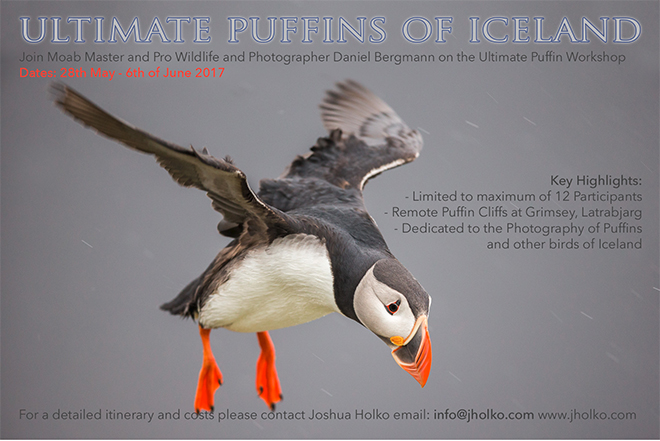
Iceland Winter Arctic Fox Expedition 2017 Expedition Report
In early March 2017 I lead a new expedition to the extreme north west of Iceland for a small group of five photographers to photograph what is perhaps Nature’s greatest survivor: Vulpes lagopus – The Arctic Fox.
I have been travelling to the Hornstrandir Nature Reserve (Hornstrandir is Iceland’s northernmost peninsula, covering 580 km² at the northern end of the Westfjords, to the north of the Jökulfirðir and to the northwest of Drangajökull) in Iceland during the winter months for four years now specifically to photograph Arctic Fox in winter. Late last year I released a new limited edition book on the Arctic Fox (Melrakki) which was the culmination of three years of winter photography.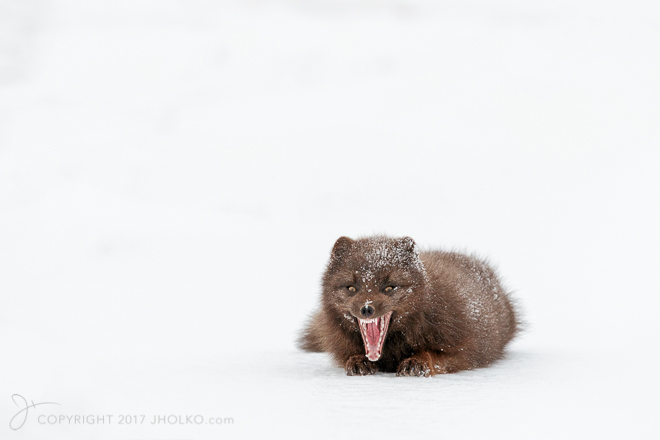 For the uninitiated, Arctic Foxes are unfortunately hunted and shot across most of Iceland making them extremely shy and difficult to find (and even more difficult to photograph). In the remote north-west however the Arctic Foxes are protected inside the Hornstrandir Nature Reserve and can be more easily approached and photographed. What is especially compelling for wildlife photographers is that Iceland is one of the very few places in the world where it is possible to reliably photograph the Blue Morph Arctic Fox (the rarer of the two colour morphs across most of the Arctic). White morphs are also found in Iceland, but in smaller numbers.
 We began our expedition in the small town of Isafjord in the north-west of Iceland on the morning of the 8th of March with a visit to the Arctic Fox centre in the nearby town of Sudavik. Here we all had an opportunity to learn a little bit more about the biology and history of the Arctic Fox in Iceland before we departed on our expedition in the early afternoon.
From the small town of Isafjord, we travelled by private charter boat to the remote north-western Hornstrandir Nature Reserve (approximately one and a half hours by boat) where we stayed for the next six nights in a small remote private cabin. The Hornstrandir Nature reserve can only be accessed by private charter boat (there are no roads or other services into this part of Iceland – and hence no tourists). Once we arrived in the reserve we had no contact with the outside world except via satellite phone for emergencies. The cabin we stayed in for the duration of the expedition is privately owned and facilities include shared bathroom, toilet and shower as well as a kitchen with hot and cold water, a communal eating area and lounge. There is even an outdoor sauna available for use. Bedrooms are a shared bunk bed arrangement. The cabin is heated with both a hydronic heating system and a log fire. During our stay in the cabin we had a dedicated person to clean and prepare breakfast, lunch and dinner for us each day; which enabled us to focus solely on our photography. The house was originally built in 1921. In 1948 (just 27 years later), the last inhabitants left this isolated arctic peninsula in search of a better life. The cabin was abandoned for many years and has only recently been restored. Although no one lives there permanently, the cabin was a great getaway and the perfect place to accommodate us whilst we searched for and photographed Arctic Foxes. Curious Arctic Foxes frequently stopped past the cabin to investigate during our stay and it was even possible to photograph them from right outside the cabin on several occasions. Arctic Foxes are predominantly territorial animals that roam and patrol vast areas of the Arctic. The Arctic Foxes of Iceland are particularly tough and hardy. They have to deal with constant freezing and thawing conditions throughout the winter months in areas where this is little or no food available. During our winter expedition we experienced temperatures a few degrees either side of freezing (0º Celsius) plus wind chill. Although this was a low snow year we were fortunate to still have sufficient covering during most of the expedition. We also had a real mix of weather and light which provided us with a lot of different opportunities during our time in the reserve.
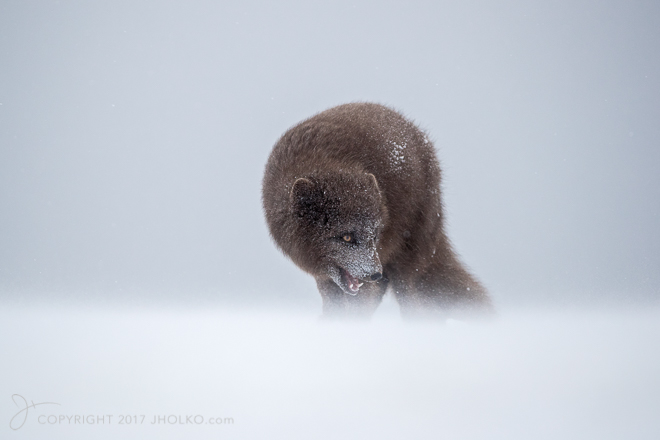 During our expedition we saw and photographed four individual blue morph foxes. As the foxes are territorial they visited us repeatedly on a daily basis (often several times per day) which provided us with multiple opportunities to photograph them. Arctic Foxes are by their nature inherently very curious animals and on many occasions approached within just a few feet of our cameras. Best of all the foxes are most active in the morning and evening – when the light is usually at its best for photography.
In addition to the Arctic Foxes there was also bird life along the coastline including Iceland Gulls, Eider Ducks, Ravens and Ptarmigan in winter plumage. I have in the past also seen and photographed Gyr Falcon in this area of Iceland and Eagles are also seen on occasion. The winter landscape in this part of the Hornstrandir Nature Reserve is simply stunning in its wild beauty. As a result, there were also many opportunities to make landscape photographs during this expedition. Several participants also took advantage of clear skies and solar activity to make some wonderful Aurora Borealis images.
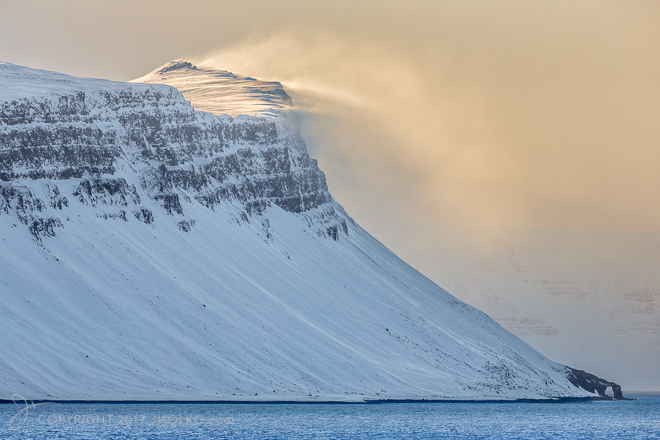 We were met by the boat again on the morning of the 15th of March for our return trip back to Isafjord and were transferred to the airport in time for our return flights to Reykjavik. We concluded our expedition in the evening of the 15th of March in Reykjavik.
During the expedition the participants made between ten and twenty five thousand plus photographs per person which gives you a really good idea of just how many incredible opportunities and encounters with Arctic Foxes we experienced during our time in the Nature reserve. Many of our encounters lasted several hours and on multiple occasions we had the luxury of choosing our backgrounds and angle of view for our photographs.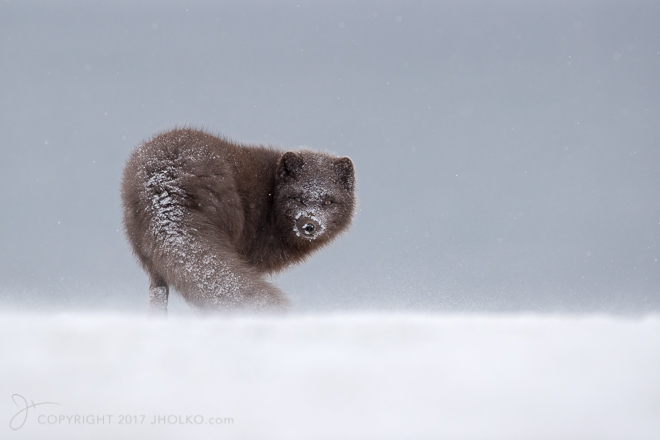 If you are interested in photographing wild Arctic Fox I will be repeating this expedition early next year (2018) for a small group of just five photographers (only two places remaining before the expedition will be sold out). Full details are on my website at www.jholko.com or you can register your interest in one of the two remaining places by dropping me an email.
 www.WILDNATUREPHOTOTRAVEL.com