Following on from my Lofoten photograph of the month for July is another image from the Island archipelago. This time its a midnight photograph of the Aurora Borealis over the Lofoten mountains. Taken during my March winter workshop earlier this year (Read the Trip Report) we were fortunate to encounter some pretty good aurora on a clear evening. The landscapes of the northern islands of Lofoten are really quite something to behold. Precipitous and ominous peaks rise straight out of the ocean and make for the perfect back drop for the Aurora Borealis. With a dusting of fresh snow and arctic winter light the entire scene is akin to a fairy tail location and subsequently the photographic opportunities can be truly superb. I have found over the years that one of the keys to Aurora photography is to vary your shutter speed. The lights can come and go at varying speeds and its important to keep shape and definition in the patterns. In this instance, I settled on a shutter speed of 15 seconds after some experimentation as I felt this yielded the best balance of shape and color blur. I am looking forward to returning to Lofoten in March 2018 for a second winter workshop.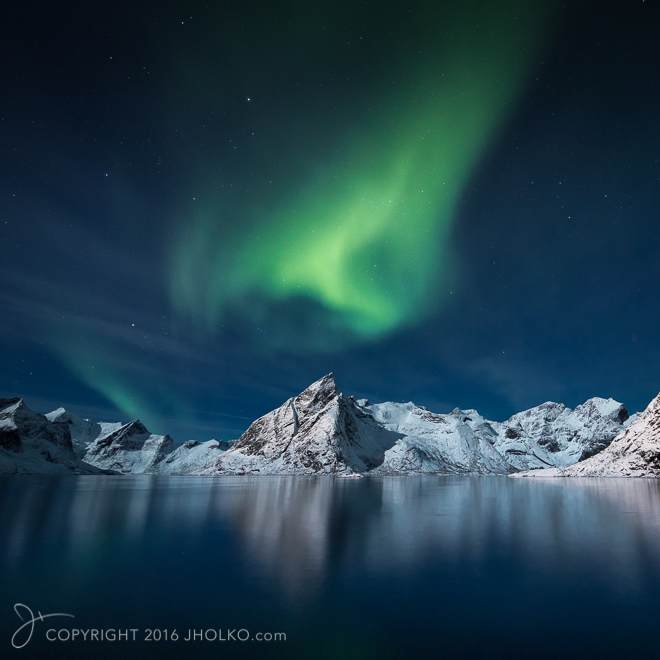
Category: Lofoten
Photo of the Month July 2016 – Lofoten Winter Wonderland
In March this year I led a new winter landscape workshop to the Lofoten Islands in Norway (Read the Trip Report) with long time good friend and fellow landscape photographer Martyn Lucas. If you are unfamiliar with Lofoten let me assure you that the landscapes of these northern islands of Norway are really quite something to behold. Precipitous and ominous peaks that rise straight out of the ocean loom over small fishing villages that comprise of small bright red houses lining the shorelines. With a dusting of fresh snow and arctic winter light the entire scene is akin to a fairy tail location and subsequently the photographic opportunities can be truly superb.
This particular photograph is in no-way unique (It has been shot countless times ) but it is for me ‘iconic’ and captures the splendid beauty of this fairy tale like location. I plan to return to Lofoten early 2018 and will have more to say about this trip at a future date.
Lofoten Island Winter Workshop Report 2016
In March this year I led a new winter landscape workshop to the Lofoten Islands in Norway with long time good friend and fellow landscape photographer Martyn Lucas. If you are unfamiliar with Lofoten let me assure you that The landscape of these islands is really quite something to behold. Precipitous and ominous peaks that rise straight out of the ocean loom over small fishing villages that comprise of bright red houses lining the shorelines. With a dusting of fresh snow and arctic winter light the entire scene is akin to a fairy tail location and subsequently the photographic opportunities can be truly superb.This workshop was a for a small group of just six experienced landscape and nature photographers. We based ourselves primarily in the small town of Reine and made daily excursions to various locations around the Island for photography. Lofoten has become quite the hot spot for photography in the last few years (some are calling Lofoten the new Iceland) and although we did encounter a few other photographers during one of of our early morning sessions near town (where the above photograph was taken), we primarily had the place to to ourselves. It has been my experience in ‘hot spot’ locations such as Iceland and Lofoten that it is not too difficult to get away from other groups if you travel with someone who knows the terrain and have an experienced guide with you. Both Iceland and Lofoten have a number of iconic locations that everyone visits and photographs. However, both also have a vast number of excellent off the beaten track locations that are rarely visited and even less rarely photographed. On the whole, we preferred to spend the majority of our time in these less visited areas as the opportunity for unique photographs is greatly improved and you don’t have to fight for tripod space. Like much of the Arctic, photography in Lofoten in winter is heavily weather dependant. It is entirely possible to be socked in for days with heavy cloud and bad weather in this part of the world (a risk you have to be prepared to accept when you venture so far north in winter). Its common on this sort of trip to loose at least one or two days to bad weather – its par for the course. Fortunately, we had very good weather and light for most of our trip with only a little rain on a couple of occasions. Being so mountainous and surrounded by ocean Lofoten is prone to highly variable weather; which can be both a boon and bane for photographers. The ideal scenario is a dusting of fresh snow with cold temperatures and golden light. We were fortunate to experience this on several occasions. We also had some really lovely cloud during the workshop that made for some wonderfully moody and evocative images.
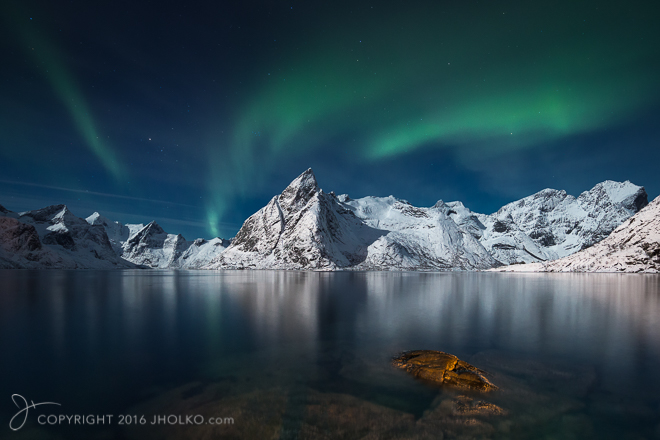
 During our workshop we also experienced and photographed the Aurora Borealis (northern lights). Lofoten is blessed with fantastic mountains that rise almost vertically straight out of the ocean and that make for a superb back drop for the Aurora. As is always the case with Aurora photography the real key to getting interesting photographs is to try and include some sort of foreground and background elements (in this case I chose a small section of partially submerged rocks as my foreground). There is a temptation to focus entirely on the Aurora itself when photographing the northern lights and it is easy to be seduced by the color and activity alone. The solution is to try and photograph the lights in the context of the environment around you. Much like wildlife, where the key is to place the animal in context; you need to put the Aurora into context with its surroundings.
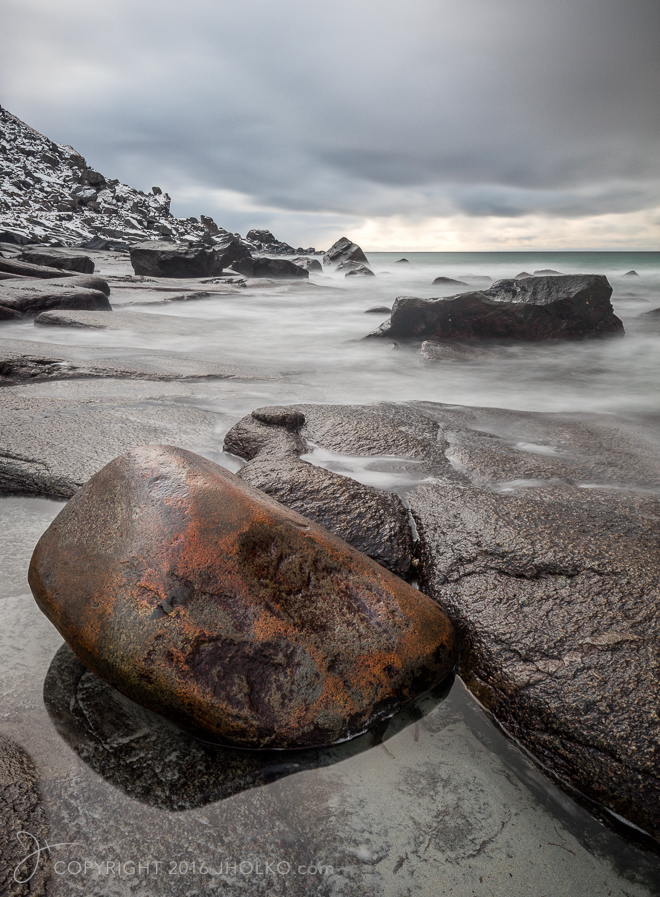
 Being surrounded by water Lofoten offers great opportunities for seascape photography at just about every turn and we took advantage of this by visiting and photographing many different beaches and areas of coastline. Much of the coastline is rocky or dotted with large boulders (JCB’s – Otherwise known as Joe Cornish Boulders) which provides limitless opportunities for foreground interest. Many of the beaches are also very accessible and only a short walk from car parks or pull off areas. We spent quite a lot time exploring and photographing various areas of coastline and some really interesting photographs resulted. In the right conditions, Lofoten in winter also has the added benefit of snow down to sea level for even more interest.
 It is worth noting that Lofoten isn’t just about landscape photography. On our last day we made the decision to mix things up and took a private charter boat out to photograph White-Tailed Sea Eagles fishing off the coastline. This proved a worthwhile gamble with a couple of hours of really wonderful eagle photography in occasional light snowfall. Photographing fishing sea eagles from boat in winter in the Arctic is a lot of fun. We were able to get quite close to some of the eagles (so close my 300mm F2.8L IS MKII was occasionally too much lens and I had to switch out to the 70-200mm F2.8L IS MKII. I did not yet have a production version of the new Canon EOS 1DX MKII so all photographs were taken on the original Canon EOS 1DX. I have subsequently sold both my original Canon EOS 1DX bodies and migrated completely to the newer MKII.
 Edit: As a side note: I have now spent three weeks in the field with the new Canon EOS 1DX MKII in the South Island of New Zealand. In my experience to date I have already found the auto focus on the new MKII to be a significant improvement over the original (and thats a significant statement) – particularly in back light and low light situations. I was photographing the rare and endangered Yellow-eyed penguins in the South Island in very difficult back light and found the camera continually nailed focus in this situation. Back lit subjects are one of the hardest tests for any auto focus system. The system also performed flawlessly for Bullers Mollymawk Albatross in Miflord Sound. More to come on the new EOS 1DX MKII in a future post including my thoughts on the high ISO capabilities.
Visiting Lofoten in Winter also provides an opportunity for cultural photography. At this time of year the cod are being fished around the Islands; they are then processed and hung to dry on the many cod racks dotted around the Islands (yes, you can smell them long before you see them). Every part of the cod is used and even the heads are hung to dry. I am personally not a street or cultural photographer but the process is nevertheless interesting to watch and photograph.
To those of you who have already contacted me asking about a future workshop to Lofoten in 2017 or 2018: At this stage I will not be running a future trip to Lofoten (due to other commitments of which I will have more to say in the next few days). I would however, like to thank Martyn for his assistance in guiding the group to some fantastic locations and to all who participated and contributed to this workshop. We were blessed with some wonderful conditions for photography and some really remarkable images resulted from our experience and time in Lofoten. Small, intimate groups for this sort of landscape photography workshop are the ideal way to ensure you capture the best possible photographs.
Packing for the Desert of Antarctica and the Desert of Namibia
In a few hours I will start the trek to South America where I will lead a twelve day photography Weddell Sea Expedition to Antarctica. On this expedition we are looking forward to giant tabular icebergs in the Weddell Sea as well as vast Adelie Penguin colonies. At the conclusion of this expedition I will travel to Iceland (poles apart) where I am going to spend ten days completing my project on the Arctic Fox before guiding my annual Winter Workshop with friend Daniel Bergmann. At the conclusion of our workshop I am flying to Lofoten where I will lead a new workshop for landscapes in winter with my good friend Martyn Lucas. I then fly to Namibia for a ten day workshop in the oldest desert in the world – the Namib. Its going to be quite the adventure!
This extensive travel schedule means I need to pack my Arctic / Antarctic winter gear as well as clothing suitable for the deserts in Namibia. I have juggled this packing challenge before (two years ago when I co-led a trip to Namibia with Andy Biggs) and found that it was possible to survive in Namibia with just a couple of pairs of light weight trekking pants and shirts (which thankfully don’t take up much space). As a specialised Polar photographer it does feel a tad strange to be packing a wide brimmed sunhat and sunshirts with my arctic boots and winter clothing. The issue of packing is somewhat compounded by the fact that Antarctica, Iceland, Lofoten and Namibia require very different approaches in terms of camera gear which adds both weight and complexity. Perhaps doubly so as I am carrying long and heavy telephoto lenses for my project on the Arctic Fox.
Two Canon EOS 1DX’s and a EOS 5DSR will be my cameras of choice for these trips. Although the new Canon EOS-1DX MKII has been announced it will be some time before actual delivery and as such I will continue to shoot with the EOS 1DX as my primary cameras.
Gura Gear Bataflae 32L: (carry on luggage – Believe it or not this does all fit in the one camera bag!)
- Canon EOS 1DX Pro Body Camera x2
- Canon EOS 5DSR Body
- Canon 16-35mm F4L IS
- Canon 11-24mm F4L
- Canon 24-70mm F2.8L MKII Lens
- Canon 70-200mm F2.8L IS MKII Lens
- Canon 6000mm F4L IS MKII Lens
- 1 x Spare Battery for the 1DX’s
- 2 x Spare Batteries for the 5DSR
- Leica Ultra-Vid HD Binoculars
- Cable Release
- Assorted CF and SD Cards totalling around 100 Gigabytes
- Rocket Blower and Dust Cleaning paraphernalia
- Complete LEE Foundation and Filter Kit with Soft and Hard ND Graduated filters and LEE Polariser
On my last visit to Namibia I carried two TSE lenses specifically for photography at Kolmanskop ghost town in Namibia. This abandoned town is the ideal location for Tilt and Shift lenses and I found them extremely useful during my time there. However, I decided against TSE lenses for this trip as I am already carrying an extensive array of lenses and I want to try a different approach to this location on this trip.
Gura Gear Chobe Bag: (carry on luggage)
- 15″ Macbook Pro with Lightroom 5 and Photoshop CS6 with the Nik Plugin suite
- MacBook Power Adapter
- Canon 200-400mm F4L IS Lens with inbuilt 1.4 TC (Watch the Unboxing Video)
- 1 x LACIE Thunderbolt External 1TB Hard Drive for in the field Back Up.
- Various Power Adapters / Chargers and Associated Cables
- Canon 1DX / 1DS MK3 Battery Charger
- Sandisk USB CF and SD Card reader
- Passport / iPhone / Wallet
- Portable battery for charging iPhone and other devices
- A lot of these items I store inside Gura Gear Etcetera cases inside the Chobe. (These cases are fabulous for organising accessories)
On top of the above I have two North Face duffle bags with the rest of my clothes and gear. Getting all of this to Antarctica and then onto forward destinations is always a challenge, but once on location the benefit of having the right equipment makes all the hardship worthwhile. See you in South America…
Lofoten Islands Workshop 2016 SOLD OUT
I have been meaning to announce a new workshop to the Lofoten Islands for sometime now but due to my travel commitments it has been sitting on the back burner along with a number of other projects. The Lofoten Islands are approximately 100 miles north of the Arctic Circle, west of Norway. The village of Reine on the island of Moskenesoya will be our base for six nights situated in some of the most picturesque mountain scenery rising precipitously out of the fjords. Reine has often been described as one of the most beautiful places on earth. If we are lucky and blessed with clear skies, we will be able to witness the Aurora Borealis and the magic of the Northern Lights as they flicker across the night skies. Besides the incredible wealth of photographic locations in the vicinity of Reine, we will use local Fjordskyss ferry service to Vinstad and to the tiny hamlet of Kjerkfjorden, both of which are surrounded by towering granite mountains. Our private transportation will allow to access some of the iconic beaches near Leknes which might be covered in snow.
During March, the days are short with sunrise at approximately 6:30am and sunset around 6:00pm. Given our northern location, the sun will be low in the sky providing soft, magnificent light conditions, for all day photography. Please note that due to the initial expressions of interest and subsequent bookings the trip is already sold out. If you would like to be added to the wait list please just drop me an email at info@jholko.com. You can download more information including a detailed itinerary and PDF from my website at www.jholko.com.
 www.WILDNATUREPHOTOTRAVEL.com