Redwoods at the Otways

Whilst down the coast for work last weekend I took the opportunity to squeeze in some photography at a relatively unknown location deep in the Otway forest. The area is simply known as ‘The Redwoods’ and is comprised of a relatively small plantation of the giant Californian Sequoia Redwood trees. These trees grow to be some of the largest in nature. Their girth and height can be truly immense. This small plantation is approximately sixty years  old and as  yet no where near fully grown, however, it already stretches more than a hundred feet into the sky.

The weather was overcast and drizzly for most of the weekend, ideal for forest photography. Direct sunlight creates too much contrast under a forest canopy. In full sunlight under the canopy the camera’s sensor is unable to capture the full dynamic range of light and dark areas. This leads to either blown highlights or complete loss of shadow detail. A cloudy overcast sky greatly reduces the contrast and gives a soft-box effect to the light that is far more suitable and pleasing. The rain and drizzle adds a lovely saturation to the foliage and forest floor. The inclusion of the small forest fern in the foreground, dwarfed by the Sequoias completes the composition and results in a very pleasing photograph to my eye.

Tasmania – Crescent Bay

Sometimes it takes several edits to make sure I have selected all the best frames from a given shoot and today was no exception. While reviewing some of the photographs from my recent Tasmania trip this one jumped out at me. I had initially passed it over, but on reflection feel the combination of composition and light is strong and that there is indeed a story to be told.  The photograph was taken at Crescent Bay near Port Arthur (close to the South Eastern most tip of Tasmania). The foreground rocks that mimic the shape of the bays name greatly appeal to me. As does the thin band of cloud between the horizon and the soft upper clouds.  The confused seas add a storm element that completes the photograph. This was quite a difficult location to get to as it required scrambling down quite a steep cliff to access this rocky ledge. I used a tripod with a three stop graduated neutral density filter to hold back the sky and a slow shutter speed to semi blur the water. I then timed the waves to set up and get the photograph before the next big set rolled over the rocks. Tasmania is one of my favorite locations for photography in Australia and I already can’t wait to go back.

New Zealand – Last Light over Cook and Tasman

Nothing else quite says ‘Alpine’ like the last rays of sunlight reflected on snow capped mountains. With temperatures plummeting to a frigid -19 degrees Celsius as the sun dipped below the horizon this was one of the last frames I reeled off from the small mountain helicopter before we returned to base for the evening (for some serious thawing out!). This photograph includes Mount Cook (on the right) and Mount Tasman (on the left) as well as the Fox Glacier and for me captures the essence of New Zealand’s grand Alps. To be at an altitude of eleven thousand feet over the Alps in a small helicopter with the doors off in the dead of winter with perfect weather and light is remarkable to say the least.

Mount Buffalo – The Castle

It’s December and it is now summer here in Australia – my least favourite time of year for photography. Autumn and Winter are my preferred seasons for landscape work. I far prefer the cooler weather and the snow and ice of the alpine regions to the blazing heat and humidity of the Australian summer (I should live in Scotland!). During Autumn and Winter the air is usually cleaner and the light tends to have a more transparent quality to it that lends itself very well to landscape photography. Looking back at some of the photography from the cooler months of the year this one jumps out as one of my favourites.

This photograph was taken at a location known as ‘The Castle’ at Mount Buffalo in the Victorian alps at sunrise. The location is not often visited as the walk in is fairly steep and arduous; particularly in winter. This is not the first time I have photographed here but it is the first time I have been lucky enough to get really beautiful light in combination with a lovely hoar frost. Combined with the reflection in the icy pool and the wildflowers this is a photograph I like very much.

New Zealand – Ice Spire

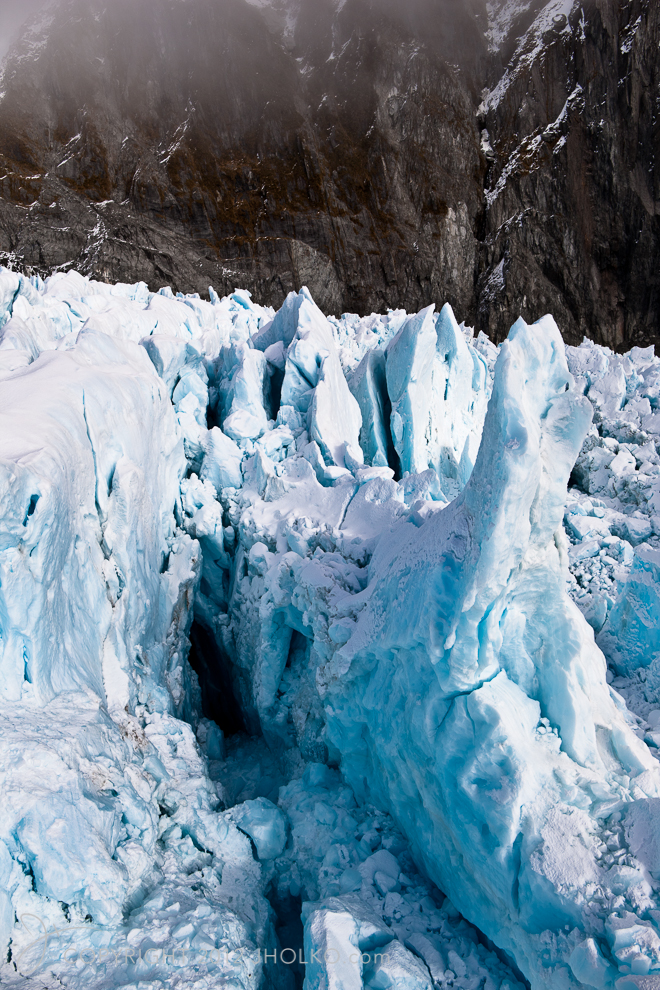
One of any glacier’s most unique and remarkable structures are it’s seracs and Fox Glacier was and is no exception. Its crevasse  and serac field is littered with unique and unusual ice formations. This natural ice spire caught my eye as we skimmed over the glacier in the small mountain helicopter. I focused my attention on it trying to capture it from just the right angle to show its precarious stance and unusual flutings. These ice formations are often very unstable and dangerous. Pound for pound glacial ice weighs about the same as concrete so these formations are really only accessible safely for photography by helicopter. I photographed this with a 24mm wide angle lens to capture enough surrounding ice to keep the spire in context. The sense of scale gets somewhat lost in a small jpeg – but you could have driven a semi-trailer through the ice cave with ease.