ATA Carnet – A Passort for your Camera Equipment

There has been quite a lot of chatter and confusion recently on some of the forums and social media platforms here in Australia about ATA Carnet’s for international travel with photography equipment.

Let me say right at the start that I have never used an ATA Carnet (or even a Customs Declaration form) in all of my travels and not once to date have I ever been pulled up by customs and immigration in relation to the extent of my photography equipment. This could easily change though and it is worth taking a bit of time to discuss both Carnet’s and Customs declaration forms to both correct some of the misinformation out there, but also to ensure you are covering yourself in a suitable manner should you find yourself in a situation where you are asked if you are holding one of these documents or being asked to pay duty on equipment.

Lets start at the beginning with what is a Carnet?

Carnet or ATA Carnet (pronounced kar-nay) is an international customs and temporary export-import document. It is used to clear customs in 84 countries and territories without paying duties and import taxes on merchandise that will be re-exported within 12 months.  Carnets are also known as Merchandise Passports or Passports for Goods. See “What is a Carnet?” Video. In effect, a Carnet is a passport for your photography equipment that protects you from having to pay duty on equipment you export and re-import. Carnets facilitate temporary imports into foreign countries and re-importation into your home country. There are 84 countries and territories that accept carnets. See a complete list of Carnet countries here.

A Carnet effectively consists of two parts, the first of which is an export document that is presented to customs when you are leaving your country of origin. It includes a list of your equipment as well as your intended use for that equipment and is stamped by customs to show you are taking the equipment out of the country and that the equipment is not subject to import duty when you return. The second part of the Carnet is presented to customs on your arrival into a foreign country that is part of the Carnet system. This document also lists your equipment and protects you from being charged import duty by the foreign country on both entry and exit from the country. It must be shown at the time of entry into the country and at the time of exit. If you fail to exit the country with the equipment you imported you will be charged duty (which will be taken form your Carnet security deposit). See below about the Carnet security deposit and how this duty is charged. See also International Chamber of Commerce.

Here in Australia it presently costs $451 AUD to have documentation prepared for a Carnet by VECCI and you need to apply for a Carnet not less than three business days before you depart (and they recommend two weeks). There are processing fees over and above the $451 dependant on wether you take out a Carnet for three, six or twelve months. A Carnet must list all of the countries you plan to take the equipment that are part of the 84 countries in the Carnet system as well as your intended use for the equipment. There is also a bond that is taken by VECCI to secure your equipment against possible duty charges. This bond is equal to 50% of the commercial value of the goods you plan to travel with. So if you are travelling with $50,000 AUD worth of camera gear you are required to leave a deposit here in Australia with VECCI of $25,000 AUD. VECCI justify this ridiculous security bond because they are covering themselves for the variance in customs duties per country. If you know the specific duty that the country you will be visiting charges you can have this 50% bond amended by VECCI to the same as the country charges. For example: If you are visiting ‘X’ country and ‘X’ country charges 10% duty then VECCI can amend the bond to be 10% in this instance.

The reality of the situation is that a 50% security bond deposit is well above any potential customs duty you may be charged should you find yourself in the unfortunate position of being charged import duty on equipment you are carrying internationally. The positive of the ATA Carnet is that you protect yourself from being charged duty and that you will receive back 100% of your bond on return to your home country with all of your equipment. You just have to be prepared to tie up 50% of the commercial value of your goods in a security bond. VECCI do not consider a credit card number a suitable security bond – you have to leave them the actual money.

It is important to note that there is no dollar value minimum or maximum on a Carnet. You do not suddenly need one because the value of your goods has reached a certain amount – there is no minimum threshold and no maximum. A Carnet can be requested for something as small as $100 trade show samples or as large as multi-million dollar private jet. Now, if you are importing a multi-million dollar yacht for an international yachting race, or you are Peter Jackson filming Lord of the Rings and you need to import a few million dollars of equipment for clear commercial purposes then an ATA Carnet is pretty much a mandatory document. But if you are an amateur or professional still photographer like myself who travels extensively with a reasonable amount of camera gear this document is optional. It is worth noting VECCI recommend you do take a Carnet with you, but they also note it is not mandatory and that there is an alternative you can use at least in Australia. You should also note that different countries enforce Carnet’s differently. Presently both New Zealand and the USA are noted by VECCI as rigorous enforcers of Carnet’s.

The alternative to an ATA Carnet is an Australian Customs Declaration Form. An Australian customs declaration form is designed to protect you from having to pay duties on equipment you leave Australia with and then bring back into Australia on your return. Unlike an ATA Carnet, an Australian customs declaration form is free, requires no bond and you can complete this document yourself without a third party. You present this document to Australian customs when leaving the country and have it stamped and your equipment inspected. You then present this document on your return to Australia if you are challenged to pay duty on your equipment on re-entry.

There is a very clear difference between an ATA Carnet and a Customs Declaration Form. The former is designed to protect you from paying duty in both your home country as well as the participating Carnet country you will be visiting – it is in effect a passport for your equipment. A Customs Declaration Form is designed to protect you only in Australia; although you could certainly present this document internationally if you are challenged to pay duty in a foreign country as proof you intend to take all of the equipment home. It is important to note that the foreign country is not in any way obligated to accept an Australian Customs Declaration form and could still legally charge you the full duty amount. Only you can decide if you need a Carnet or an Australian Customs Declaration form. You can download the Australian customs declaration form HERE.

All of this red tape could be a real headache if you are unfortunate to be pulled up by a grumpy customs official who decides to exercise his overt powers and charge you import duty on photography equipment you intend to take home with you. So at the very least you should know how the Carnet system works, what it is and why you should consider if you need one.

It is also important to note that individual countries have their own policies for import duty, their own documents and procedures. You should do your own research on the country you plan to visit and find out what their requirements are for bringing in camera equipment and what can happen if you are challenged and are not able to produce documentation to protect yourself from duties. You should also research the specific laws in your own home country for export and re-import of photographic equipment – even just for personal use abroad.

Personally, I intend to take Customs Declaration forms with me from now on to at least protect myself from duty in  my home country. The ATA Carnet system would me by preferred approach but frankly the cost of doing so is ridiculous and I have no desire to tie up large amounts of cash in security bond deposits with VECCI.

Apple Thunderbolt Upgrade with Legacy Firewire Computers

I ran into quite a nasty little ‘gotcha’ experience with the upgrade path from Firewire to Thunderbolt last night that I think is worth sharing for anyone who might be considering purchasing a new Thunderbolt device and owns and uses legacy Mac computers with Firewire800 ports.

In my studio I am currently running an 8-core 2010 ‘Big Iron’ Mac Pro Server as my main photography editing and printing machine. It has 64 Gigabytes of RAM and is loaded up with a super quick OWC SSD Card as well as four internal hard drives in a RAID10 Array. Its a very quick machine and not really in need of an upgrade any time soon. I had also been running an external Drobo Pro with 8 x 1TB drives in it connected via Firewire800. The sole purpose of the Drobo was a daily back-up of the internal Mac Pro RAID10 Array. Its the old belt suspenders and a piece of string and this set-up has worked well now for years.

In preparation for a new Thunderbolt Mac Pro next year (which has no firewire800 ports) I purchased one of the new Promise Pegasus2 R4 Thunderbolt2 Disk Attached Storage (DAS) Chassis and loaded it up with 4 Western Digital Red Hard Drives in a RAID10.  I also purchased a Thunderbolt to Firewire 800 adapter from Apple to enable me to connect the new Promise DAS directly to the Mac Pro’s Firewire800 port. And that is where I hit a major roadblock.

As it turns out the Apple Thunderbolt to Firewire800 adapter is a one way adapter only. That is, you can connect it to the Thunderbolt port of a new Thunderbolt equipped Apple Mac and use it to connect to a legacy Firewire800 device (like a hard drive). However, you cannot connect a Thunderbolt device (such as the Promise Pegasus2 R4) to a Firewire800 Apple Mac with this adapter. It will not work. The reason it will not work is the adapter is designed to create a Thunderbolt port for a non-Thunderbolt equipped Firewire device. It cannot create a Firewire port for a Thunderbolt device and thats a very important distinction.

According to the description on Apple’s website:ThunderboltNow it does say ‘Connect your Thunderbolt equipped Mac to a Firewire device’. I just assumed (incorrectly) that you could therefore connect a Thunderbolt device to a Firewire equipped Mac; which is not the case. It is a fairly easy assumption to make as the text does not say it cannot be done and adapters usually work both ways.

This left me in some what of a quandary as I really did not want to shell out more than six thousand dollars for the new Mac Pro just yet. I simply wanted to bed in the new Thunderbolt storage array so that when I did upgrade to the new Mac Pro at some stage next year I was ready to go with Thunderbolt storage that was tested and bedded down. What to do?

The good news is that there is a solution; although it is not very elegant and does require you to own some sort of Thunderbolt equipped Mac in addition to your Firewire equipped Mac. Thankfully I have a new MacBook Pro that has several Thunderbolt ports that I use when travelling. Step one is to connect the Thunderbolt storage device (in my case the Promise Pegasus2 R4) to the Thunderbolt equipped Mac with a standard Thunderbolt cable. Step two is to connect the Thunderbolt equipped Mac to the Firewire equipped Mac and start the Firewire equipped Mac in ‘Target Disk Mode’. In order to do this you will need a Firewire 800 cable and a Firewire to Thunderbolt Adapter available from the Apple store. Once started in Target Disk Mode the Firewire800 equipped Mac Pro will then show up as a mounted disk on the Thunderbolt equipped Mac Pro and you can then copy the files from the Firewire equipped Mac Pro to the Thunderbolt Pegasus2 DAS. It is not the cleanest solution, but it works and it is quite fast (Firewire800 speed is the limitation).

October Photograph of the Month: Ominous Skies in Greenland

I have been late for the last two months (as I have been on the road) updating my photograph of the month, so I am trying to stay ahead of the curve this month and post early. This photograph was taken on my recent Greenland expedition (a trip report is in the works) from zodiac of a large iceberg off the Greenland coast. This is the first image I have processed from this expedition since I returned. With over 3000 images shot on this expedition alone the process of editing is tedious and laborious. I like to do a quick first pass and grab an image or two that really jumps out at me – in this instance this wonderful iceberg juxtaposed against the dark skies is very evocative for me of what the conditions can be like in the Arctic. These kind of dark and ominous overcast conditions are actually my preferred choice for photographing icebergs. Greenland Iceberg

Capture New Zealand Photography Tours Partnership

I am very excited to announce that I will be joining forces with New Zealand’s most well known and respected photography tour company ‘Capture New Zealand Photography Tours‘ over the coming months.  Phillip Bartlett from Capture New Zealand has been at the forefront of the best and most exclusive photography workshops in New Zealand over the past decade and has been responsible for opening up and unlocking some of New Zealand’s most magical locations for photographers. I was fortunate to travel with Phillip through the South Island of New Zealand in 2009 to many stunning locations that are well off the tourist track and that would otherwise have been impossible for me to find. His local knowledge of the best locations in New Zealand has elevated Capture New Zealand to the forefront of photography tours in his beautiful country and makes him the perfect guide for those photographers looking to get the very best images from their travel.Partnering with Phillip and Capture New Zealand is allowing us to offer an exclusive workshop  for a limited number of photographers (just 9 people) in the late summer of 2014 (February – exact dates: TBA). This workshop will combine the critical local knowledge of Phillip’s life-long experience in New Zealand along with my own workshop style and New Zealand experience. Local knowledge is a critical key ingredient to any photography trip to the South Island of New Zealand. The ability to read and understand the local weather and light is the key difference to being in the best locations when the ‘magic’ happens and being caught in poor conditions for photography. We will be using dedicated 4-wheel drives outfitted for photography and getting into the back country, where the very best locations are to be found. We will have access to a privately chartered helicopter that is going allow photography over the southern Alps (with the doors removed) and a privately chartered boat in Kaikoura for marine wildlife including dusky Dolphins. We are not quite ready to start taking bookings, but if the idea of a twelve day exclusive landscape, nature and wilderness photography tour that lets you experience the very best the South Island is exciting to you, then you can register your interest by sending me an email to info@jholko.com. No obligation at this point.

2013: Whats in Store?

As has become somewhat traditional on my blog I like to do a post toward the end of each year that looks forward to whats in store for the coming year. Its a good opportunity for me to ready myself mentally for the year ahead and to also close off the previous year. 2013 is shaping up to be very busy with a significant number of workshops and expeditions that I am very much looking forward to. Although I very much choose to specialise in the Polar and sub-Polar regions (which remain my focus) I do have a new exploratory trip planned for 2013 into China. More on this below.

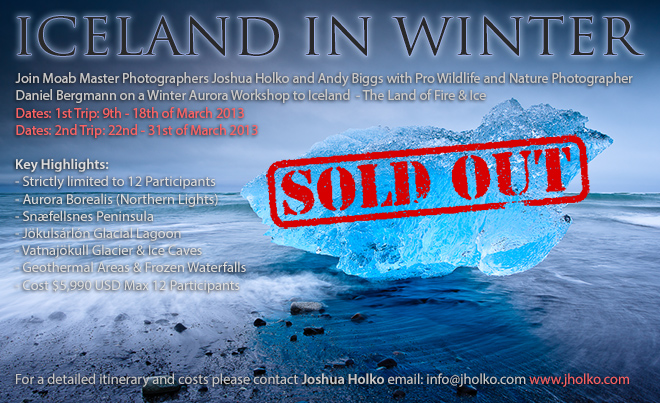
In March I will be co-leading two back-to-back Winter Aurora workshops to Iceland with my good friends Andy Biggs and Daniel Bergmann. These workshops are going to focus on the coastal regions of Iceland including the Snæfellsnes Peninsula, the mighty sea stacks at Vik and the spectacular Jökulsárlón glacial lagoon. We are looking forward to frozen waterfalls, glaciers, icebergs and with a little luck the Aurora (Northern Lights). We are going to be in Iceland at the peak of the eleven year solar cycle which should mean some intense solar activity. Fingers crossed for clear skies and blazing Aurora!In May I will be headed to the remote Xinjiang province in China with my good friend and fellow photographer Antony Watson on an exploratory expedition to the Gobi Desert, Tian Shan mountain range, Kanas Lake and Kanasi. This investigative trip is the culmination of over a year of logistical arrangements and I hope will open up some incredibly beautiful and remote wilderness for a future expedition workshop to this region.

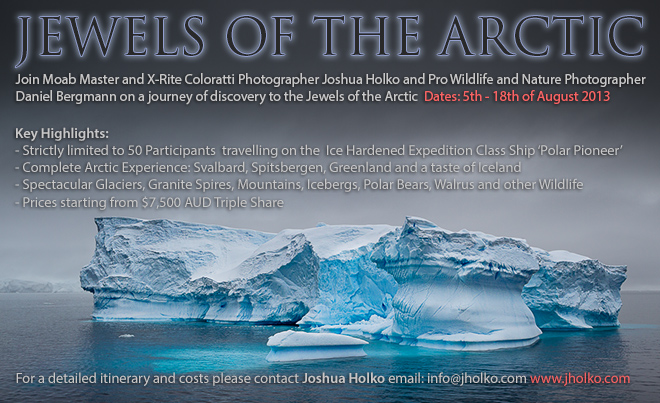
In July I will be headed back to Iceland to lead a summer workshop with Daniel Bergmann into the Highland Regions. We will be travelling into Landmannalaugar; which is one of my favourite locations in Iceland as well as visiting the mighty Dettifoss and Selfoss waterfalls and the iconic Jökulsárlón glacial lagoon. Normally inaccessible in Winter, the Highlands of Iceland are a very special place and simply incredible for photography.In August I will fly from Iceland to Oslo and Longyearbyen for a personal expedition to Svalbard to photograph Polar Bears and Walrus before I return to Longyearbyen to lead two back to back expeditions to Svalbard, Greenland and Iceland – The Jewels of the Arctic. The first of these expeditions will be co-led with Daniel Bergmann and the second co-led with Australian Grand Master of Photography Peter Eastway. Abraham Joffe’s award winning film and production company ‘Untitled Film Works‘ has been secured to join us on the second expedition and will be producing a video of the trip which I hope to share freely here on my blog late next year.In November I am travelling to Ushuaia in South America and will lead an expedition to Antarctica and the Falkland Islands with Daniel Bergmann. This 15 day / 14 night expedition was more than eight months in the planning and is something I am very much looking forward to. We have been able to arrange access into areas normally off limits that are dedicated to Science which is going to provide us with some really unique opportunities. We are travelling early in the season which should give us the best possible opportunities for spectacular icebergs, dramatic weather and great light.In late November I will travel to Patagonia with my friend Martyn Lucas on a personal trip to photograph the spectacular Torres Del Pine and surrounding landscape. Patagonia boasts some of the most dramatic landscapes on Earth with precipitous mountains, jagged granite spires and enormous glaciers. During our time in this area we plan to hike up to the Torres and bivouac to give ourselves the best opportunity for great light. This will be my first visit to Patagonia and will fulfil a life-long ambition to photograph in this spectacular area.

I will then return home to spend Christmas my family. All up, I will be away from my studio for around 4-5 months in total next year which means I am not going to be offering much in the way of printing workshops or Lightroom instruction in 2013. If you are already booked in for one-on-one Lightroom and Fine Art Printing then those dates stand as I will be in Australia during these times.

To those of you who are travelling with me on one (or more) of these trips I am very much looking forward to spending time shooting together. It is going to be a very exciting year for photography. Roll on 2013!