On Wednesday, November 8th, 2023, at 6pm AEST, I will present another webinar for BenQ – RAW Processing for Optimal Results. This will be a deep dive into the Lightroom / Camera RAW pipeline and will include a look ‘under the hood’ for many of the control sliders to help get a better understanding of what is really going on and how and when to use different adjustments for optimal results. The webinar is free to attend, but you do need to register HERE for the event.
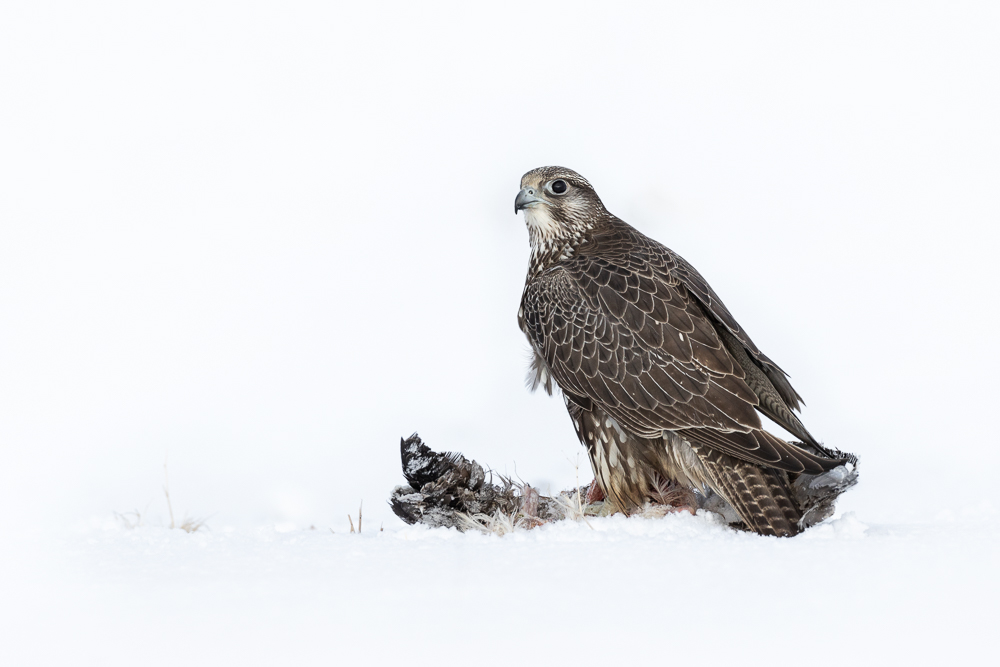
The 2023 8th annual edition of the Bird Photographer of the Yearbook has landed on my desk in Australia. This was the first time I entered Bird Photographer of the Year, and as I wrote on receipt of the news, I am thrilled to have had three images selected for inclusion in the annual book. Of the thousands of entries in the competition, fewer than three hundred (or less than 1%) are selected for inclusion in the book. Having three photographs chosen from the few I entered is lovely news, and I could not be happier with the result. The Gyr Falcon photograph was commended in the Bird Behaviour category, the Kittiwakes in front of the glacier in Svalbard was also commended in the Birds in the Environment category, and lastly, the Adelie was commended in the Comedy Bird category. You can order the Bird Photographer of the Year Book 8 online at the BPOTY website (www.birdpoty.com). The BPOTY books are fantastic references and an absolute must-have for any bird enthusiast or photographer interested in birds. I also reviewed the previous editions of Bird Photographer of the Year in Podcast number 57 – available HERE. I will review the 2023 edition in an upcoming podcast. Congratulations to all those included in the book, and I look forward to entering again in 2024!
October 2023: Adobe has released a significant new update for Lightroom that facilitates taking advantage of displays capable of HDR (High Dynamic Range). HDR displays such as Apple’s XDR (Expanded Dynamic Range) are required to take advantage of this new feature. If you do not have a HDR / XDR display you can effectively ignore this update since you cannot process images accurately into this expanded dynamic range space without a display capable of this technology. This new feature is bound to cause significant confusion in the marketplace as the terminology HDR is very likely to be confused with the traditional HDR approach of stacking images for an expanded dynamic range. However, this new feature is totally new and not related to the traditional HDR approach of stacking images. To further add to the confusion, Apple has called their display technology ‘XDR’ to further muddy the waters. Whilst the manufacturers and software companies play with different terminology for the same technology, there will be significant confusion in the marketplace. So what is this new HDR / XDR technology in Lightroom?
Friend and fellow photographer Eric Chan (engineer and architect at Adobe) has posted a very informative blog explaining the new technology and how and when you can take advantage of it. Just keep in mind that you need an XDR or HDR display to take advantage of this capability and that virtually all of the people who may view your HDR work online will NOT be able to see the expanded dynamic range. And, of course, it goes without saying that no printer can print it (HDR/XDR) either. Eric’s article goes point-by-point and explains how this new technology works and how you can take advantage of it. I highly recommend taking some time out of your day to read his article. Read Erics’ Article HERE.
How does this new technology fit into your workflow? The answer depends on your output and what you plan to do with your photographs. If you print your photographs, you can ignore this new feature since no printer can print photographs processed in HDR/XDR and display the full dynamic range on paper. The printer will simply print in its own SDR space since it is not possible to print whiter than than the white of the paper. If you are processing images to view on your own HDR / XDR display, then you can of course take advantage of this new technology. If you are outputting images to the web then it will depend on thew viewers’ display as to what they see at their end. So now, instead of just worrying our what color space the viewer is using we also need to worry about wether they are using a HDR / XDR display. I suspect we may see photographers start to build websites that ask the viewer to make a selection about their display – are you using a SDR or HDR/XDR display? All of this makes it an interesting (and somewhat confusing) time to be a photographer!
Also of significant importance (and quite honestly a much bigger deal to me personally), Adobe has added HSL capability to local adjustments via a new tool called ‘Point Color’. This is a huge upgrade and something I have been asking for since the new masking tools were released. Thank you Eric and Adobe!
Yesterday evening, I wrapped up my Iceland landscape extension workshop off the back of my 2023 Scoresby Sund, East Coast Greenland expedition. I will have full trip reports on both over the coming weeks on my return to Australia. Iceland threw up its usual assorted mixed bag of weather, and we had everything from sunshine to snow and rain. Iceland is certainly never boring and never fails to impress with its lunar landscapes and ever-changing weather.
For those of you who have been left hanging for the next podcast – My apologies, I have just been snowed under with guiding over the last month. I promise though it is coming! Now that I have finished up my two workshops and have a little more free time, I should be able to get to my next topic in the next few days, ‘Technology meets Serendipity’. By way of a short preview – The current generation of mirrorless cameras now facilitates the capturing of photographs that were simply impossible only a generation of cameras ago. What happens when this technology runs into a little luck?
Today, Australia, a leader in digital imaging solutions, announced the launch of the RF10-20MM F4 L IS STM lens, a full-frame ultra wide-angle lens that can help the work of a professional photographer or serious enthusiast stand out from the crowd.
Opening the door to supreme full-frame visual possibilities, the RF10-20MM F4 L IS STM lens continues Canon’s respected reputation for optical excellence associated with L-series lenses. This new addition enhances optical performance with a modern mirrorless lens design that is fully equipped with key features, including:
New Image Stabilization (IS) technology to help minimize wide-angle “fluttering” at outer areas of the frame
Impressively compact size and lightweight (1.25lbs/570g) at half the weight of EF series 11-24mm f/4 L lens
Super quiet Canon STM focus drive motor, which is ideal for video and marks the first time this technology appears in a Canon L-series lens
Speaking directly to the professional video and stills visual storyteller, the RF10-20MM F4 L IS STM features a built-in lens hood and lens function button on the barrel for customizing functions such as AF settings, Pre-Recording, Zebras and more. For landscapes, cityscapes, architecture, real estate and weddings, the RF10-20MM F4 L IS STM lens is a widely important lens for any professional to have at the ready.
Although I have not confirmed it – the RRP in Australia has been mentioned at $4,199 AUD. MSRP in the USA is $2299 USD.




 www.WILDNATUREPHOTOTRAVEL.com