Many of you are patiently waiting for me to finalise the creation of the new A.I Noise Reduction presets for Canon’s professional mirrorless cameras. The good news is I have now finished all of the colour checker analysis over the last week, and I have also finalised and optimised A.I Noise Reduction settings for every single ISO for the Canon EOS R1. This was a painful, painstaking process of analysis that involved many days of staring at my computer screens. Whilst it may seem a simple process to tweak the single A.I noise reduction slider for each different ISO, the reality of getting it optimal is anything but. Different colours respond differently at different ISO settings, and optimising the amount slider is an agonising back-and-forth process that has taken much more time than I anticipated.
Today, I was planning to finish the last step and create the A.I NR preset and post my results, and the preset for sale. However, I have run into a significant problem. Adobe has not enabled the ‘Support Amount Slider’ for A.I Denoise, which means, in practice, the application of the preset does not set the amount slider for A.I noise reduction! You can see the screenshot below, the tick box is greyed out.
What this means in practice is that the preset will apply A.I Noise Reduction, but will set the slider amount to its default setting only. This effectively makes an A.I NR preset useless as you would have to manually adjust the slider (which defeats the entire purpose of a preset). I am unsure why Adobe has not supported the amount slider, but I have an email in with Adobe on this issue at present. More to come once I hear from Adobe.
I have just published episode 127 of my Wild Nature Photography Podcast. In this episode, I review David Neilson’s new book ‘Restless Fury’. A photographic study of Prairie Chickens from Nebraska in the United States. In short, ‘Restless Fury’ is an outstanding example of photographic passion, commitment and dedication to one’s craft. This book is highly recommended for anyone interested in wildlife photography.
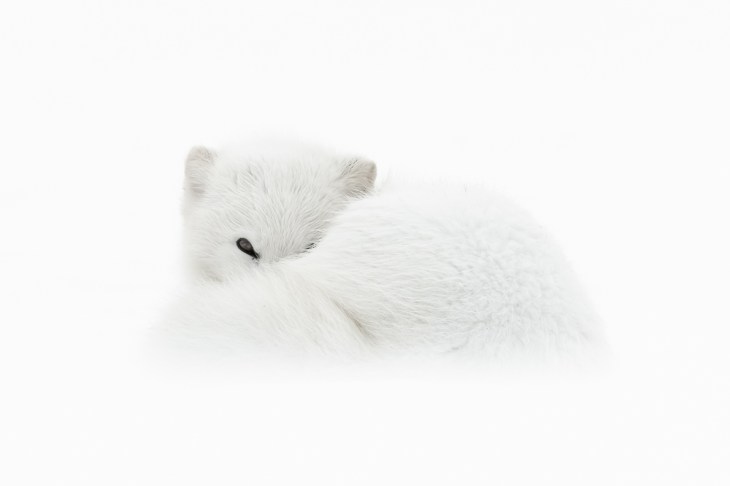
There are places in the world where time seems to be all but irrelevant—where silence has weight, and where life exists on the knife’s edge of wilderness. The Hornstrandir Nature Reserve, perched at the extreme northwestern edge of Iceland, is one such place. It’s here, amid weathered fjords and wind-bent tundra, that the elusive Arctic fox raises its young—unhunted, unharried, and at peace in one of the last true wilderness sanctuaries of the North.
From July 1st to 7th, 2025, I had the privilege of leading a small group of photographers deep into this forgotten corner of the world for a summer workshop focused on Arctic fox cubs. What unfolded over those seven days was extraordinary: four healthy, playful cubs, fresh out of their den, exploring the world for the very first time. We had timed our arrival perfectly.
Our journey began in Ísafjörður, a sleepy town surrounded by steep fjords that comes alive in the summer months. From there, we boarded a privately chartered boat, cutting across the still ocean waters to Hornstrandir—a region completely uninhabited, unreachable by road, and where nature reigns supreme.
Upon landing on the shoreline, we were met with calm winds, mild temperatures, and the telltale silence that defines this place. The weather, often a wildcard in the Icelandic summer, held beautifully in our favour—a perfect mix of overcast skies for soft light and clear days for contrast and depth.
We walked in with our gear, a short but deliberate walk through tundra meadows and coastal cliffs until we reached our remote cabin—our “home away from home” for the week. Modest, but wonderfully cozy, the cabin offered reliable power, heat, and a warm shower, giving us a comfortable base from which to photograph and recharge both batteries and bodies.
The Arctic foxes in Hornstrandir are protected under Icelandic law and unaccustomed to human threat. This gives us a unique window into their lives—a rare chance to observe them with minimal disturbance. We knew from previous years where a known female fox maintained her territory, and it was near this location that we carefully established our viewing distances, always respectful, always still. And then, like a miracle borne of silence: four cubs.
Emerging from the mossy lip of their den, blinking in the soft summer light, they appeared with hesitant steps and twitching ears. They were healthy, inquisitive, and full of energy, bounding across the lichen-covered rocks, chasing each other through patches of Arctic thyme, and occasionally collapsing in an exhausted heap under the watchful gaze of their mother.
The timing could not have been better. They had just begun venturing out from the den—still clumsy and unsure, but filled with curiosity. For a wildlife photographer, this is the golden moment: when behaviour is at its most revealing, when innocence radiates through every movement, and when images tell stories as ancient as nature itself.
What makes photographing foxes in Hornstrandir so special isn’t just the opportunity to see them—but the privilege to be so close to them. These animals, free from hunting pressure, exhibit a calm curiosity rather than fear. They observe, approach, and sometimes come so near you can hear the soft pad of their feet over the tundra.
Each day we returned to the den, observing routines and behaviours. The mother—sleek, somewhat shy, and blue-morph—would occasionally trot off on short hunting forays, returning with fish scraps or shellfish to feed her litter. The father appeared more often, showing no fear and regularly approaching for an inquisitive look at our cameras.
Photographically, we were gifted beyond measure. Overcast days gave us beautiful softbox light, perfect for portraits and detail-rich imagery. On clearer days, the drama of shadow and contrast lent itself to more stylized compositions. Whether it was cubs backlit in the golden light of an endless Arctic evening, or nestled in the moss under moody skies, every session offered something new.
The joy of these moments wasn’t just in the photography—but in the quiet communion with the land and its wild inhabitants. No roads, no cars, no noise. Just wind, sea, and the faintest rustle of foxes through grass. Arctic summer light is both gift and challenge. With nearly 24 hours of daylight, we were afforded unparalleled flexibility in our shooting schedule. We often chose to photograph in the “shoulder hours”—early mornings and late evenings when the light was most flattering and the cubs most active. Remarkably, the weather held throughout the trip. Overcast periods were long enough to allow deep exploration without ever feeling rushed. For a workshop in a location as volatile as the Hornstrandir coast, this was a blessing not to be understated.
One early morning brought backlit opportunities near to the den. The effect was sublime—foxes outlines luminous against the dark backdrop. We whispered to each other that it felt like being inside a dream, and the resulting images remain among the most evocative of the trip.
Our remote base was everything a field workshop should be: rugged, warm, and welcoming. After long hours on the tundra, we would return to hot meals, shared stories, and laughter around the table. We reviewed our images, shared techniques, discussed post-processing ideas, and most importantly, connected as a group of like-minded creatives driven by a shared love of wild places.
There is something profound about being unplugged from the world, present only in the moment and the landscape. No internet. No distractions. Just photography, nature, and the camaraderie that grows from shared experience.
While the fox cubs were our primary focus, Hornstrandir never fails to deliver more to the attentive eye. Ptarmigans, still in mottled plumage, clucked their way through the underbrush. Seabirds wheeled overhead—kittiwakes, Arctic terns, and the ever-charismatic black guillemots. Occasionally Harlequin ducks could be found and photographed at the river mouth.
One evening, as the sun dipped low across the fjord, a group of common seals surfaced near the shoreline, curious about our presence. And once, in the quiet hour just after midnight, I watched a white-tailed Eagle glide silently along the ridge—not common, but not impossible here.
Yet, no sighting ever pulled our hearts away from those cubs. Every time we returned to the den, it felt like a reunion. The trust they showed us grew stronger each day, and by the end of the week, we felt like we were witnessing the emergence of a new generation—one that had accepted our quiet presence as part of their world.
On our last morning, the light broke crystal-clear over the fjord. We made our way back to the den one final time. The cubs were more adventurous now, ranging further, playing harder, their confidence growing with every hour. We spent our final moments watching them tumble and yip, playing in the morning light. I watched through the viewfinder, but also over the top of the camera, wanting to etch this memory into my mind as much as onto my memory card.
Then, slowly, we packed our gear, said our goodbyes to the family we had quietly shared space with for a week, and began the walk back to the coast. Our private boat met us in the calm waters, and as we pulled away from Hornstrandir, the reserve faded into mist and memory.
This workshop was, without doubt, one of the most intimate, joyful, and meaningful I’ve ever had the privilege to lead. To witness and photograph Arctic fox cubs just as they emerge into the world is to be part of something deeply elemental—life at its beginning, in one of the world’s last great refuges. For all of us on the trip, the experience will echo long after the images are printed and the gear cleaned. It was more than photography. It was connection—to nature, to the wild, and to each other.
For those who feel the pull of the wild, who seek authenticity, silence, and the raw beauty of life on the edge—Hornstrandir awaits. Please get in touch with us to express your interest in a future workshop to this wonderfully wild and remote location.
Canon Australia has this afternoon reposted the new firmware update for the Canon EOS R1.
This firmware (Version 1.1.2) includes fixes for the following issues identified in Version 1.1.0: 1. Fixes an issue where video could not be recorded correctly when using a memory card larger than 2TB with the [Pre-recording] setting enabled. 2. Fixes an issue where the camera failed to operate properly after updating to Firmware Version 1.1.0 if the still photo shooting/movie recording switch function was set to [Silent shutter function switching] or [Disable].
This firmware also incorporates the following changes introduced in Firmware Version 1.1.0: 1. Improves security features. A password must be set initially. •Adds the ability to review the history of any changes made to the password, network information, or other settings. *For more information, please refer to the ‘Setting a Password’ section in the Advanced User Guide on cam.start.canon. 2. Enables firmware updates to be performed when the camera is connected to the internet and new firmware is made available on Canon servers. 3. Adds [Viewfinder Priority] mode, which activates the viewfinder when a user is detected by the rear sensor. 4. Adds the ability to automatically detect Flicker at 100 or 120 Hz during Live View display. 5. Adds the ability to register focus position as a presets on the CR-A100 Camera Remote Application. This ability makes it easier to focus on subjects at the intended distance when the application is used with Robotic Camera System CR-S700R. 6. Adds the ability to select [Panning Assist]. When users pan with compatible lenses, image stabilization and subject blur correction are applied during exposure. 7. Adds the ability to select [Case Special] to expand Servo AF characteristics which is effective for subjects located behind a net in sporting events, such as badminton or volleyball. 8. Adds support for the Software Development Assistance Kit (EDSDK/CCAPI). 9. Adds a function that simultaneously protects images when they are rated. 10. Adds the ability to use up to 8TB of CFexpress cards. Note – Cards larger than 8TB require low-level formatting by the camera. – Cards larger than 8TB are treated as 8TB cards. – Cards larger than 2TB cannot be used for firmware updating. 11. Adds to lower the image capture frame rate to help prevent overheating when connected to CR-A100 in extended remote shooting. 12. When transferring images with voice memos via FTP, the transfer order priority has now changed with voice memo (Wav) file being sent first followed by image file. If a voice memo is added to an image queued for transfer, the image and voice memo are now sent last. 13. Adds the ability to set the number of shots captured in pre-continuous shooting mode. 14. Adds the ability to set [Airplane mode] to shooting button customization. 15. Adds the ability to enable [Exposure Simulation] when a flash unit is attached. 16. Improved AF tracking during video capture for subjects that are difficult to focus on. 17. Fixes an issue in which Err70 may occur when enlarging an image after shooting with [Blackout-Free Display] set to “On” and [Servo 1st image priority/One-Shot AF release priority] set to “Release priority”. 18. Fixes an issue in which Err70 may occur during Bluetooth communication due to interference from other Bluetooth devices. 19. Fixes an issue in which Err70 may occur when repeatedly shooting in the “High-speed continuous shooting +” mode. 20. Fixes an issue in which Err70 may occur immediately after startup when shooting with the electronic shutter. 21. Fixes an issue in which Err70 may occur during video recording in “FHD239.8P/200.0P”. 22. Fixes an issue in which Error 70 may occur while filming in video mode with frame rate set to “50.00P” and [Movie Digital IS] set to “On” or “Enhanced”. 23. Fixes an issue in which Err70 may occur during shooting when both [Pre-recording] and [Auto send] to image.canon are set to “Enable”. 24. Fixes an issue in which the camera may stop functioning properly when [Image Review] is set to “Off” and the monitor entered low brightness mode after pre-continuous shooting. 25. Fixes an issue in which video recording may not be possible when using Remote Live View shooting in EOS Utility while outputting via HDMI. 26. Fixes an issue in which large RAW image files may not be transferred via Camera Connect. 27. Fixes an issue in which the camera may not connect to Wi-Fi 7-compatible routers.
If you are considering updating to the latest firmware, I recommend waiting at least two weeks in case any further issues are detected. Unless you have an urgent need for password protection, its always prudent to wait a bit on firmware updates.
I have just published episode 125 of my Wild Nature Photography Podcast. In this episode, I discuss some of the upcoming Wild Nature Photo Travel workshops and expeditions, as well as my latest lens acquisition (hint – it’s a zoom!). Also in this podcast, some exciting news on my new exhibition at Xposure in the United Arab Emirates early next year, as well as pre-orders for the new Bird Photographer of the Year Volume 10, Canon Firmware fiasco, and my thoughts on the judging of the recent Australian Photographic Prize.