
There has been quite a lot of chatter and confusion recently on some of the forums and social media platforms here in Australia about ATA Carnet’s for international travel with photography equipment.
Let me say right at the start that I have never used an ATA Carnet (or even a Customs Declaration form) in all of my travels and not once to date have I ever been pulled up by customs and immigration in relation to the extent of my photography equipment. This could easily change though and it is worth taking a bit of time to discuss both Carnet’s and Customs declaration forms to both correct some of the misinformation out there, but also to ensure you are covering yourself in a suitable manner should you find yourself in a situation where you are asked if you are holding one of these documents or being asked to pay duty on equipment.
Lets start at the beginning with what is a Carnet?
A Carnet or ATA Carnet (pronounced kar-nay) is an international customs and temporary export-import document. It is used to clear customs in 84 countries and territories without paying duties and import taxes on merchandise that will be re-exported within 12 months. Carnets are also known as Merchandise Passports or Passports for Goods. See “What is a Carnet?” Video. In effect, a Carnet is a passport for your photography equipment that protects you from having to pay duty on equipment you export and re-import. Carnets facilitate temporary imports into foreign countries and re-importation into your home country. There are 84 countries and territories that accept carnets. See a complete list of Carnet countries here.
A Carnet effectively consists of two parts, the first of which is an export document that is presented to customs when you are leaving your country of origin. It includes a list of your equipment as well as your intended use for that equipment and is stamped by customs to show you are taking the equipment out of the country and that the equipment is not subject to import duty when you return. The second part of the Carnet is presented to customs on your arrival into a foreign country that is part of the Carnet system. This document also lists your equipment and protects you from being charged import duty by the foreign country on both entry and exit from the country. It must be shown at the time of entry into the country and at the time of exit. If you fail to exit the country with the equipment you imported you will be charged duty (which will be taken form your Carnet security deposit). See below about the Carnet security deposit and how this duty is charged. See also International Chamber of Commerce.
Here in Australia it presently costs $451 AUD to have documentation prepared for a Carnet by VECCI and you need to apply for a Carnet not less than three business days before you depart (and they recommend two weeks). There are processing fees over and above the $451 dependant on wether you take out a Carnet for three, six or twelve months. A Carnet must list all of the countries you plan to take the equipment that are part of the 84 countries in the Carnet system as well as your intended use for the equipment. There is also a bond that is taken by VECCI to secure your equipment against possible duty charges. This bond is equal to 50% of the commercial value of the goods you plan to travel with. So if you are travelling with $50,000 AUD worth of camera gear you are required to leave a deposit here in Australia with VECCI of $25,000 AUD. VECCI justify this ridiculous security bond because they are covering themselves for the variance in customs duties per country. If you know the specific duty that the country you will be visiting charges you can have this 50% bond amended by VECCI to the same as the country charges. For example: If you are visiting ‘X’ country and ‘X’ country charges 10% duty then VECCI can amend the bond to be 10% in this instance.
The reality of the situation is that a 50% security bond deposit is well above any potential customs duty you may be charged should you find yourself in the unfortunate position of being charged import duty on equipment you are carrying internationally. The positive of the ATA Carnet is that you protect yourself from being charged duty and that you will receive back 100% of your bond on return to your home country with all of your equipment. You just have to be prepared to tie up 50% of the commercial value of your goods in a security bond. VECCI do not consider a credit card number a suitable security bond – you have to leave them the actual money.
It is important to note that there is no dollar value minimum or maximum on a Carnet. You do not suddenly need one because the value of your goods has reached a certain amount – there is no minimum threshold and no maximum. A Carnet can be requested for something as small as $100 trade show samples or as large as multi-million dollar private jet. Now, if you are importing a multi-million dollar yacht for an international yachting race, or you are Peter Jackson filming Lord of the Rings and you need to import a few million dollars of equipment for clear commercial purposes then an ATA Carnet is pretty much a mandatory document. But if you are an amateur or professional still photographer like myself who travels extensively with a reasonable amount of camera gear this document is optional. It is worth noting VECCI recommend you do take a Carnet with you, but they also note it is not mandatory and that there is an alternative you can use at least in Australia. You should also note that different countries enforce Carnet’s differently. Presently both New Zealand and the USA are noted by VECCI as rigorous enforcers of Carnet’s.
The alternative to an ATA Carnet is an Australian Customs Declaration Form. An Australian customs declaration form is designed to protect you from having to pay duties on equipment you leave Australia with and then bring back into Australia on your return. Unlike an ATA Carnet, an Australian customs declaration form is free, requires no bond and you can complete this document yourself without a third party. You present this document to Australian customs when leaving the country and have it stamped and your equipment inspected. You then present this document on your return to Australia if you are challenged to pay duty on your equipment on re-entry.
There is a very clear difference between an ATA Carnet and a Customs Declaration Form. The former is designed to protect you from paying duty in both your home country as well as the participating Carnet country you will be visiting – it is in effect a passport for your equipment. A Customs Declaration Form is designed to protect you only in Australia; although you could certainly present this document internationally if you are challenged to pay duty in a foreign country as proof you intend to take all of the equipment home. It is important to note that the foreign country is not in any way obligated to accept an Australian Customs Declaration form and could still legally charge you the full duty amount. Only you can decide if you need a Carnet or an Australian Customs Declaration form. You can download the Australian customs declaration form HERE.
All of this red tape could be a real headache if you are unfortunate to be pulled up by a grumpy customs official who decides to exercise his overt powers and charge you import duty on photography equipment you intend to take home with you. So at the very least you should know how the Carnet system works, what it is and why you should consider if you need one.
It is also important to note that individual countries have their own policies for import duty, their own documents and procedures. You should do your own research on the country you plan to visit and find out what their requirements are for bringing in camera equipment and what can happen if you are challenged and are not able to produce documentation to protect yourself from duties. You should also research the specific laws in your own home country for export and re-import of photographic equipment – even just for personal use abroad.
Personally, I intend to take Customs Declaration forms with me from now on to at least protect myself from duty in my home country. The ATA Carnet system would me by preferred approach but frankly the cost of doing so is ridiculous and I have no desire to tie up large amounts of cash in security bond deposits with VECCI.
 I am looking forward to adding Polar photography to the list of genres for Aquatech and will be taking one of their Delphin 1D underwater sport housings along with dome port and ancillary accessories with me to Antarctica and South Georgia Island in a little under two weeks time. I have long wanted to pursue some underwater and split (half above water / half below water) photography in Antarctica and am very excited about this new opportunity.
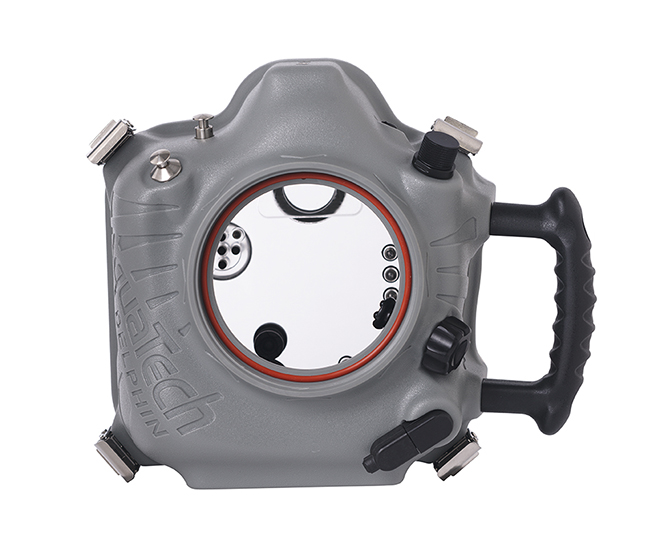 For those of you travelling to South Georgia Island and Antarctica with me this year who are interested in learning more about underwater photography and the use of housings, the equipment will be available to see, use and try for the duration of the expedition. I will also have several of the
  This series of feature articles is sponsored by my good friends and manufactures of my preffered camera bags –




 www.WILDNATUREPHOTOTRAVEL.com