Outdoor Photographer magazine are running a multi-issue (six + issues) feature on the expedition I am leading this November to South Georgia Island and Antarctica with Andy Biggs. This series of feature articles is sponsored by my good friends and manufactures of my preffered camera bags – Gura Gear. The first part of the new series is featured in the brand new July 2014 issue. Subsequent issues will include everything from what one can expect to see and photograph in Antarctica, what gear and equipment we are taking, what accessories, clothing and other items are required for this sort of expedition, how to pack and then at the conclusion of the expedition there will be an issue reporting on our experiences along with a number of photographs taken during the expedition. You can click on the image below to Download a PDF of the first article. Be sure to Subscribe to Outdoor Photographer magazine for the follow up issues. Subscriptions are available in single issue or multi-issue in Print, iPad, Zinio and more. Just choose your favourite reading medium, subscribe and enjoy. The South Georgia and Antarctica expedition is sold out, but if you are interested in being put on the waiting list please Contact Me with your expression of interest.
Namibia Overland Workshops April and May 2014 Report
In March and April 2014, I co-led back-to-back workshops with Andy Biggs to the Namibia desert in Namibia, Africa. The goal of these safaris was to photograph the breathtaking desert landscapes of Namibia in a different way than Andy has offered on his Namibia trips in the past: in an overland fashion. These were overland photographic journeys, and we had complete flexibility to stop to take photographs at any time along the way. We wanted to put these trips together that had a good balance between flexibility, photographic opportunities and comfortable accommodations – And we did indeed stay in some very swish camps! This approach also enabled us to carry more than enough camera gear, so we were able to bring everything we needed. Personally this meant I was travelling with lenses as long as 600mm as I had travelled directly from Iceland in winter where I had been photographing Arctic Foxes at the conclusion of my annual winter workshop (You can read the Iceland Winter Report HERE). On the South Western Coast of Africa, where the icy Atlantic ocean meets the world’s oldest desert lies a place that is known for its landscapes as much as the Serengeti is known for its abundant wildlife. The unique combination of desert, grassland and cold ocean current form a one-of-a-kind terrain found only here. For this reason landscape photographers from all over the world journey to the Namibia Desert to try and capture its ethereal beauty.
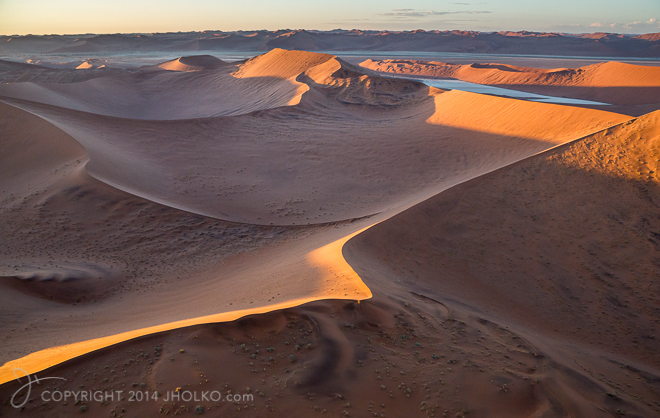 In this captivating region of Namibia lies a maze of mountainous valleys that look like they were carpeted from slope to slope by ivory coloured grass, criss-crossed by ancient riverbeds and dotted with a collection of photogenic acacia trees. The final unique touch is added by the large snake like dunes that rise from the grasslands like the roof of some subterranean world. These stark and compelling landscapes are something to behold with the human eye, but when it’s sweeping meadows, barren mountains and blood red dunes are captured and transformed into a two dimensional image, it becomes obvious why this place is so beautifully addictive to photographers.
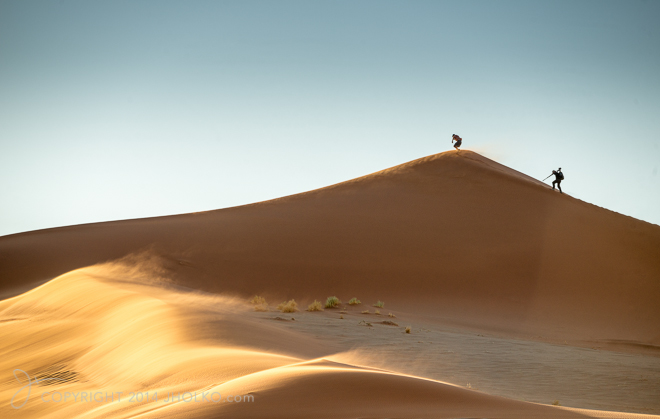 These new safaris were custom tailored to take in the very best of Namibia and included such iconic areas as the mystical Deadvlei, the ghost town of Kolmonskop and the Dune landscapes of Sossusvlei.
We began our adventures in Windhoek, the capital city of Namibia. From here we travelled to the abandoned ghost town of Kolmonskop with a detour along the way to the Quiver tree forest at Keetmanshoop.
I admit to struggling with my photographs at the Quiver tree forest. As the first stop on our Namibia workshop my shutter finger was not yet up to speed with my artistic vision and as such I felt my images from this location were really just snaps and not worthy of publication. On the second workshop I had more success but still felt my photographs did not do the area justice. The location itself is interesting, but challenging to make sense of photographically. There is some good potential if you are willing to put the work in but its one of those locations that you mot definitely have to think outside of the box to get the best from. My feeling is that the best images from this location are more about intimate detail of tree bark than grand landscape and I have seen several successful images from participants that adopted this approach. I would have preferred to have overcast conditions at this location as I found the blue skies counter productive to my style of photography. Circumstances did not permit, but I also felt that this would have been a good location for night time star trail photography. This location did however serve as a good warm up, chance to loosen the shutter finger and to break up the drive between Windhoek and Kolmonskop.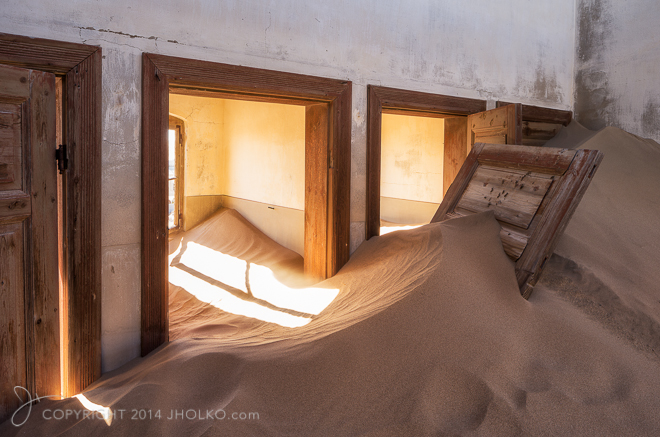 Kolmonskop has become an iconic Namibian location over the last decade or so and it was one of the locations I was really looking forward to visiting and photographing during these workshops. This abandoned diamond mining town offers limitless opportunities for photography and it was great fun to share this location with such passionate photographers on both workshops. One of the really beautiful things about Kolmonskop is its sheer size. With so many houses and so many rooms within those houses you rarely bump into other photographers and it very much feels like you have the place to yourself. We were fortunate during both workshops to experience strong winds which resulted in lots of sand and dust in the air to catch the light and make for dramatic images. I endeavoured to take advantage of this whenever I could as I felt Kolmonskop really needed these sort of atmospheric phenomena to help bring the images alive. The blowing sand made for tough working conditions but I really felt it added the missing element to complete the scene. I have seen images of Kolmonskop in fog and was hoping we might be lucky enough to experience this but it was not to be.
 One of the fascinating things about Kolmonskop that appeals to photographers is the weathered and peeling paint, worn wallpaper and pastel colours found inside many of the stone houses. All of us found this subject matter fantastic for photography and we spent many hours exploring and photographing in and around the old buildings. We photographed at both sunrise and sunset at this location across multiple days and I quickly figured out which houses and rooms were better at a given time of day. By 10am there are shafts of hot light coming through many of the slats in the roofs that provides for pretty dramatic light and shadow. This is fairly typical of much of the photography one sees from Kolmonskop but I preferred and opted for the first and last light of day when the light was softer.
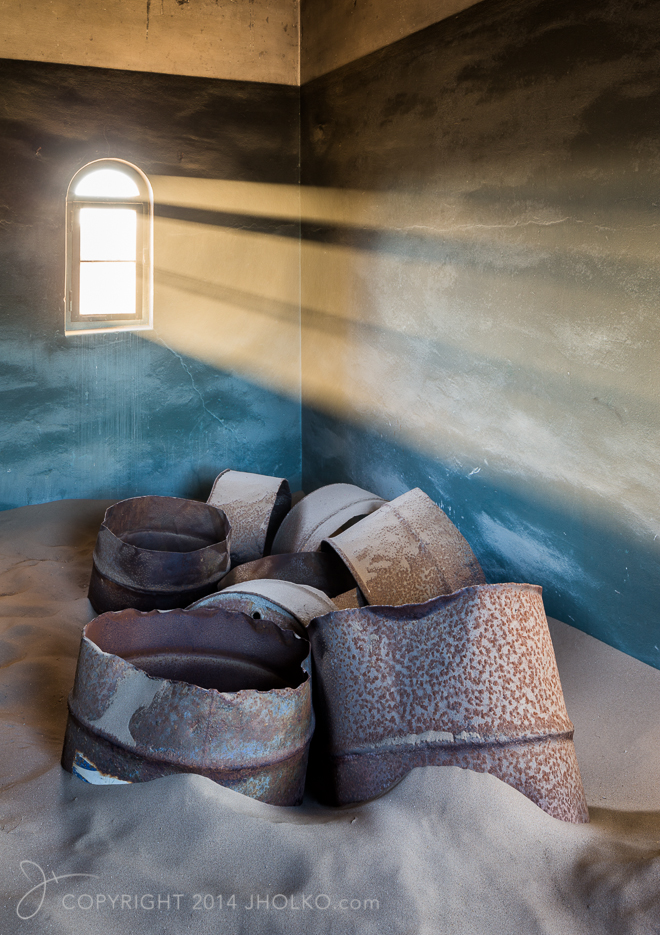 Kolmonskop is one of those locations that all of us felt we could repeatedly return to and continue to make new and interesting images.
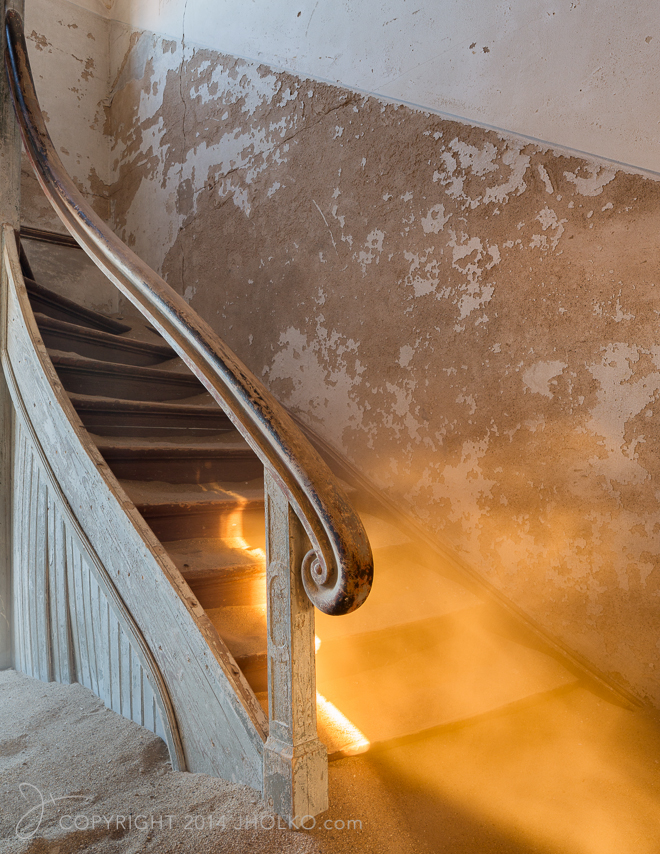 After Kolmonskop we travelled to Sossusvlei where we photographed a sea of gigantic red and golden sand dunes along with the well known salt pan of Deadvlei with its ancient fossilised dead trees. Sossusvlei and Deadvlei are without question the big two locations for landscape photography in Namibia and in many ways were the highlight of these two workshops.
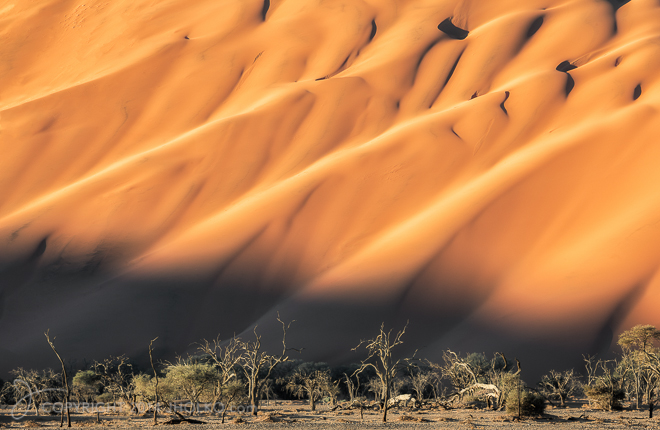 During our days in this area we chartered a small Robin helicopter during both workshops to take us up and over the dunes with the doors removed for both sunrise and sunset photography. This was in my opinion the real highlight of both workshops. An aerial view really helps give a sense of place, perspective and scale. The immensity of the dunes really cant be appreciated any other way and some really interesting photographs resulted from our helicopter flights. The helicopter is a recent addition to this area and it was extremely welcome. As nice as hot air balloons and light aircraft are for an aerial experience there is simply no substitute for a helicopter with the doors removed when it comes to aerial photography.
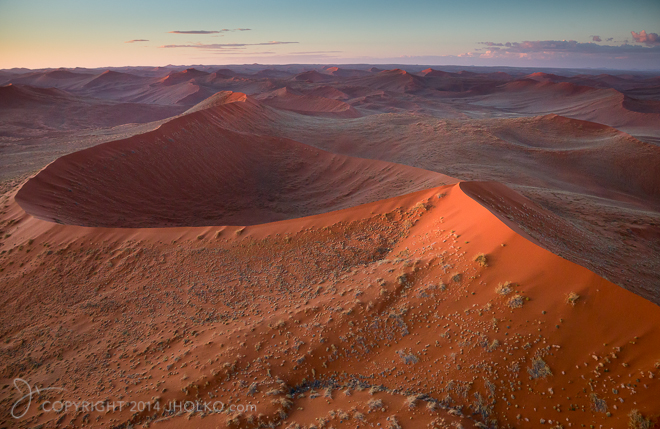 I personally found the journey out to the Skeleton Coast in the helicopter the most fruitful photographically. Near the coast the dunes turn a sinuous golden yellow and there are incredible patterns and textures which are wonderfully juxtaposed against the ocean waves.
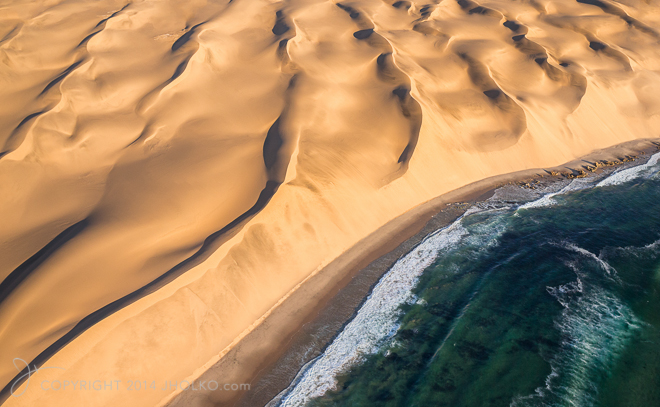 One of the things I tried personally very hard to do whilst shooting at Sossusvlei was to really focus on the light and to avoid getting sucked into the postcard scene. As a result I tended to avoid the grand vista and focus on more intimate landscapes where the sand was blowing and was often back lit from the setting sun. My intention was to capture more of the feeling and emotion of the landscape in my images and as such I made quite a number of images with the 200-400mm zoom lens to really hone in on the areas that I found most interesting. I found from experience the most interesting images resulted when I hiked up into the dunes into the blowing sand. This if course was also the most difficult conditions to shoot in and resulted in all of my camera gear needing some professional cleaning on return to Australia.
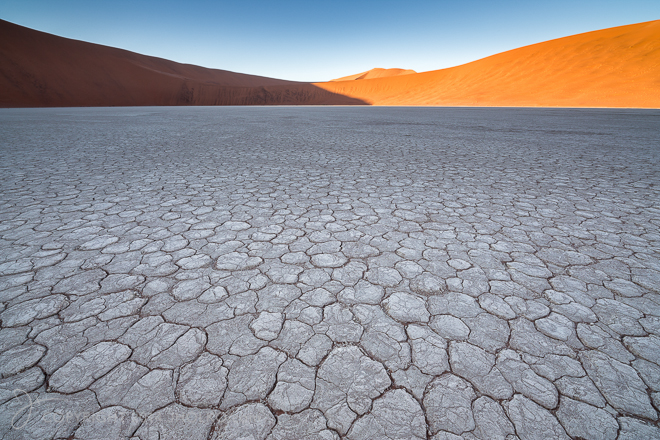
 Personally, I found Deadvlei quite a challenging location to photograph. Although we were staying inside the park on both our workshops and were able to be on location before sunrise and before the tourists arrived there is only so many different interpretations you can do of the ancient and fossilised dead trees on the salt pan before it starts to become somewhat cliche to me. I opted to use large amounts of empty space in my images in this location to try and give an impression of the sheer vastness of the pan, the desolation and the wonderful texture in the cracked earth. The challenge at Deadvlei in my view is to create a photograph that is both iconic and unique. I admit I would just about give up my first born to have a sunrise at Deadvlei in fog but such an atmospheric phenomena in the desert is rare at best.
 Andy and I had deliberately chosen April and May for our workshops as this is typically the best time of year for clouds at Sossusvlei. We did indeed have sporadic cloud cover for some of our time in this area and we even witnessed the rare collision of a sand storm and rain storm which resulted in some pretty spectacular light.
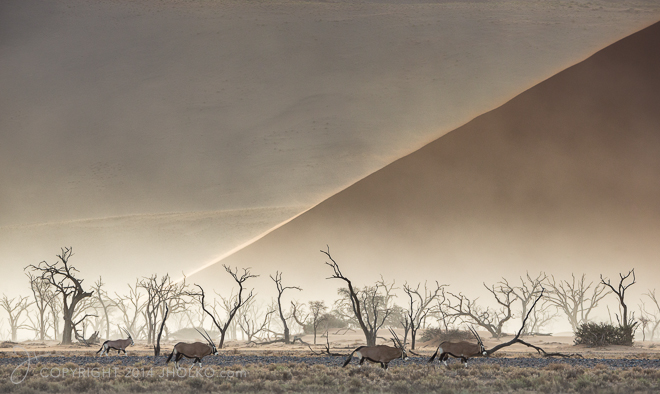
 After Sossusvlei and Deadvlei we journeyed further afield to the Wolvedans area and a location known as Drifters. This was a very subdued landscape in comparison to the mighty dunes of the desert and it offered an opportunity for more intimate landscapes in a relaxed environment. We also had several successful game drives in this location and many of the species sighted are in the attached Namibia species list. The Oryx in particular are an incredibly regal animal and we saw a great many in this area of Namibia.
 In terms of gear failure I can report that across both workshops of twenty people the only gear failure was my own and it was the result of sheer carelessness. I inadvertently swung my still open camera backpack across my shoulders at the Quiver tree forest on day one of the workshop which promptly saw three lenses fly out of the bag at fatal velocity into three strategically positioned boulders. Net result – three smashed lenses on day one (Canon 17mm TSE, 24-70mm F2.8L MKII and 1.4 TC MKIII). This was a careless mistake I have not made before (and will not make again!). Thankfully my camera insurance covered it and I was able make do without the lenses for the rest of the trip.
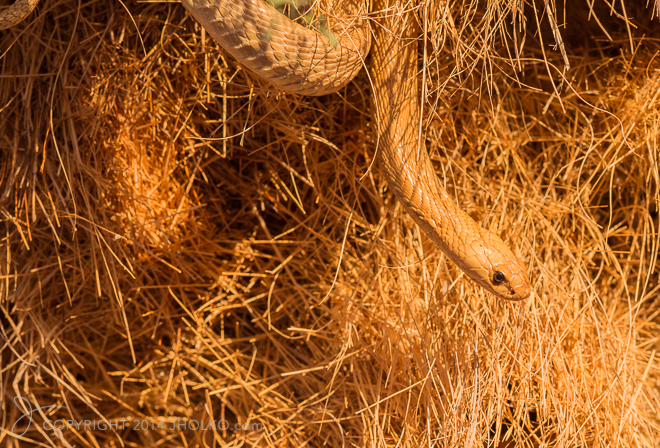
At the conclusion of the second overland workshop Andy and I ran a short extension for several of the group with an emphasis on wildlife photography at Erongo and Etendeka. This was my first taste of big Africa game driving and I was not disappointed – in fact, the experience was thrilling. The highlight of this extension was coming across three lionesses right on sunset as they were setting off on their evening hunt. We also encountered many other birds and mammals including the Pygmy Falcon (the world’s smallest Falcon) and the Hartman’s Mountain Zebra.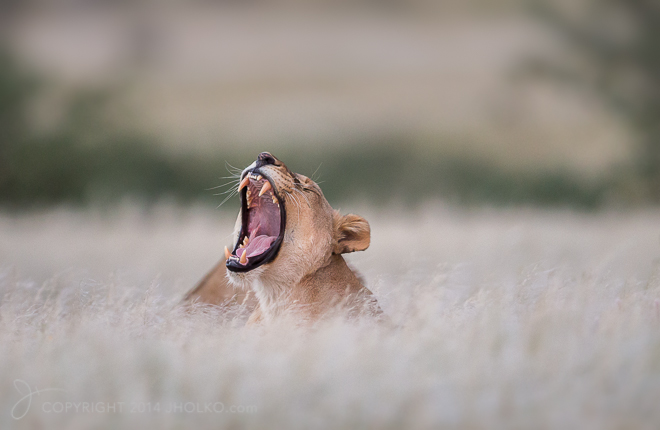 One of the most surprising elements of these two workshops for me was the sheer number of different species we encountered during our time in Namibia. I had not expected to see desert Lions, Elephants, Giraffe, African Wild Dogs and more. We even came across a Caped Cobra high in a tree raiding a Sociable Weaver nest. I spent a good hour photographing the Cobra as it went from chamber to chamber in search of prey. Finally, just after sunset the snake became exhausted and fell from the tree against the backdrop of a desert lightning storm. It was an incredible experience. You can download a complete list of species I personally sighted and confirmed during our time in Namibia.
 Camera equipment across these two workshops included everything from my own Canon system to Nikon, Hasselblad, Phase One (including technical camera systems from Alpa), Sony, Leica, Panasonic and just about every other major brand. This was the first chance I had to really play around with the Sony A7R and I have pretty mixed feelings about the viability of this camera in the field.
It is a testament to the quality of camera gear these days that there were no mechanical or electronic failures during these workshops. Namibia is one of the harshest environments I have encountered for photographic equipment. The blowing sand and dust is incredibly pervasive and it is a real trial to keep it out of cameras and lenses. I worked extensively with my 17mm and 24mm tilt shift lenses in Namibia and both required professional cleaning on return to Australia by CPS.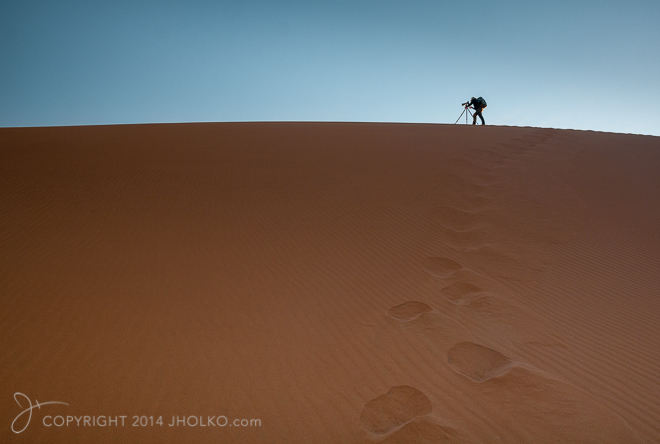 The deserts of Namibia have been high on my list for photography over the last few years. They are an incredible place for both landscape and wildlife photography. Although I personally struggled with the sweltering temperatures (I am after all a Polar photographer at heart) I look forward to returning again in the future. Namibia offers the intrepid photographer many opportunities for producing really fabulous landscape and wildlife photography. To those of you who have asked if I will be leading a future trip to this part of the world the answer is unfortunately not in the foreseeable future. I simply have too many other commitments that I wish to see through in the Arctic and Antarctic. I will have more to say about these over the coming months.
You can see the full portfolio of my photography from Namibia at www.jholko.com
New Zealand South Island MasterClass Workshop May 2nd – May 13th 2015
In May 2015 I will be co-leading a new landscape Masterclass workshop to the South Island of New Zealand with good friend and Pro Landscape Photographer Phillip Bartlett. Our workshop will take us on a photographic journey into ‘Middle Earth’ – The spectacular South Island of New Zealand. We will be photographing in the style of professional landscape photographers, setting ourselves up with three main ‘base camps’. This means we will have extended stays in areas which offer exceptional photography in all directions, allowing us to select our shoot locations based on the prevailing weather. This approach will give us the best possible chance to capture the highest quality imagery. 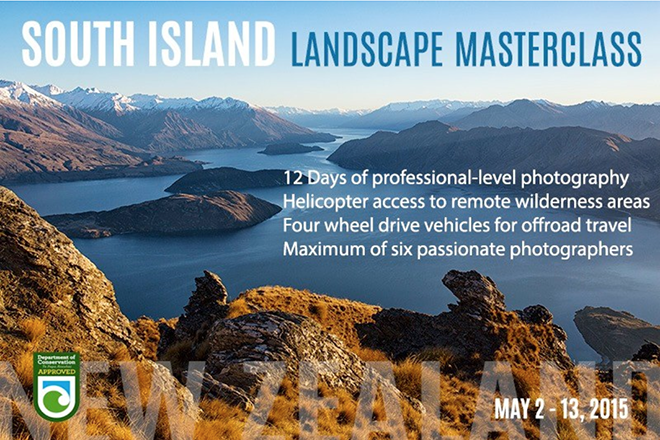 This 2015 Landscape Masterclass is the follow-up to the very successful 2014 Introduction to New Zealand Workshop I led in February this year (You can read the Trip Report Here). To get an idea of what we will see and experience on this masterclass workshop just click on the image below to play the short preview movie.
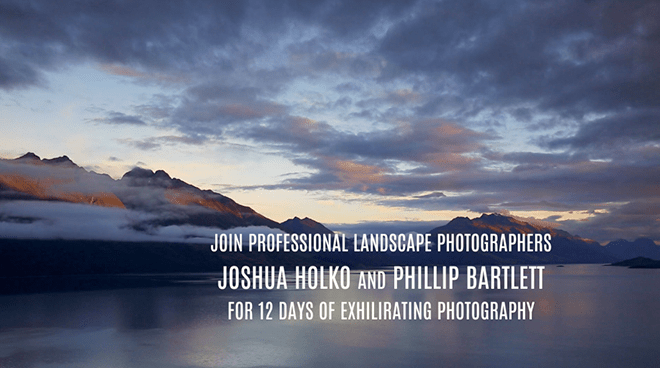 Our South Island born guide, Phillip Bartlett, is a seasoned New Zealand landscape photographer. Our itinerary has been carefully put together and includes many of his favourite locations, which by definition are a world apart from the usual tourist areas. To access these remote wilderness areas we need to travel by 4-wheel drive vehicles and helicopters, to where few others, both visitors and New Zealanders alike, have been. Our shoots will be concentrated in the regions of the MacKenzie country, Fiordland and the West Coast, with a side trip to the East Coast!
 The South Island of New Zealand is home to some of the most spectacular scenery and landscapes in the world. It is no co-incidence that Peter Jackson chose the South Island of New Zealand to film the Hobbit and the Lord of the Rings movies. Perhaps nowhere else in the world can one see and photograph precipitous alpine mountains plunging into temperate rain forest and wild ocean beaches in so short a space. New Zealand is home to an incredibly diverse range of subject matter in a small island. Glaciers, waterfalls, spectacular valleys, imposing mountain ranges and black pebble beaches. It is an island of ever changing weather and spectacular light conditions. It is a country made for photography.
 This masterclass workshop is strictly limited to just six photographers. We welcome all level of photographers; however it is best suited to those who have a good understanding of their camera and photographic technique. Due to prior expressions of interest and bookings there are only three places remaining before this workshop will be sold out. You can download a PDF with information including an itinerary at my main website at www.jholko.com. Please contact me if you have any questions or would like to register your interest for this masterclass workshop.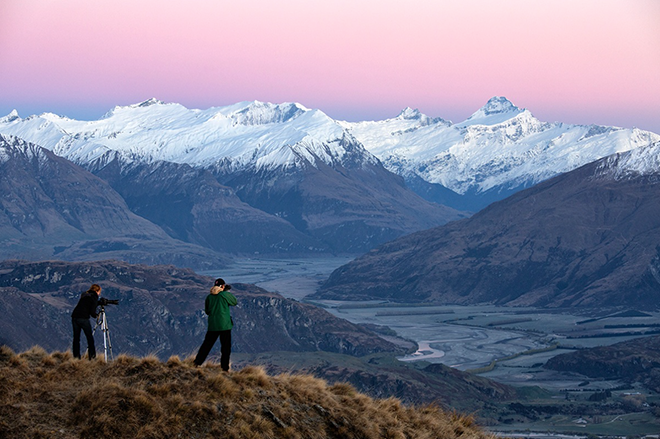
June Photo of the Month: White Angel
I launched the first part of a brand new service for RAW file optimisation and production of high resolution finished PSD files this week and the response so far has been almost overwhelming – thank you. For those of you who have sent me files for processing I am currently working through them in the order they were received and I hope to get them back to you within three-to-five days of you having sent them. Over the next few days I will be launching the second part to this service where you can have a fine art print of your photograph made here in my studio and shipped to you anywhere in the world. If you are considering entering APPA this year and are looking for someone to print your images please contact me for details. The prints I entered this year in the State awards scored Gold and Gold with Distinctions and I was also fortunate to take out the overall Highest Scoring Print of the Year. I also have some other exciting announcements coming up on my blog over the next couple of weeks and am looking forward to sharing them.
In the meantime I have been retrospectively trolling through some of my photographs from the Arctic last year and came across this one of an Ivory Gull coming into land on an ice flow north of Svalbard. This was one of half a dozen or so Ivory Gulls we encountered last year whilst we were photographing Polar Bears at the edge of the pack ice. Ivory Gulls are incredibly angelic birds with pure white plumage and jet black feet. With a little luck I hope to see them again this year in August when I lead my Arctic expedition to Svalbard and Greenland. This is one of those photographs I have absolutely no recollection of taking and I am not sure why it did not jump out at me on my initial and subsequent pass through edits. Nevertheless, ‘White Angel’ is my photograph of the month for June.
RAW File Processing and Image Optimisation of Your Photograph
A great photograph always starts with a great capture in the field and capturing stunning Landscape, Nature and Wildlife photographs in the field is a skill in and of itself. Once you have captured the RAW data in the field though how do you interpret it and fulfil your vision in file and finished print?
RAW FILE PROCESSING AND IMAGE OPTIMISATION
Processing your RAW file optimally is the key to getting stunning images that realise the captures full potential and your vision for the finished photograph. Workflow and how to best optimise your capture are two of the questions I am most often asked on my workshops. The reality is there is no one simple answer that can be applied to all captures to really coax them to their full potential. It takes time, practice and experience to know which tool to use when, whilst processing RAW files. A one-trick filter or preset might work for some images but it falls well short of optimal image processing. To help with your RAW files I am very pleased to now offer a service where you can have your RAW file optimally processed and if you so choose, have a Fine Art Print of your photograph lovingly crafted right here in my studio. The purpose of this service is to be able to provide a finished optimised and processed RAW file complete with all meta-data of exactly what was done to the image during post production. A layered PSD file is also provided along with the processed RAW file that includes any and all adjustments made in Photoshop so that you can see exactly how the image was processed and then if you wish apply this process to more of your own files. Importantly, all post processing faithfully reproduces the intent of the original file in accordance with my own ethics for RAW image processing. This includes any adjustments normally allowed by competitions including Nature’s Best Photography and BBC wildlife Photographer of the Year.
The process of having your own RAW file processed is very simple. You simply send me an email with your request and then upload the RAW file/s to a drop box or other file sharing program of your choice for processing. Processing is done in Adobe Lightroom Creative Cloud and Adobe Photoshop Creative Cloud. Once the image has been processed you will be able to download the RAW file complete with an XMP sidecar file that gives you a step-by-step process on how the image was processed. In addition, you will be able to download a high resolution 16 bit layered PSD file that contains any and all adjustments that may have been made in Photoshop. The purpose of providing the layered PSD file is to allow you to see exactly what adjustments were made to the image and in what order. You can then use these same techniques on more of your own images if you wish. Once you have uploaded your RAW file and sent me an email you will receive an invoice for payment which can be paid either via Paypal or Credit Card (Visa or Mastercard).
Ultimately the purpose of this service is to provide you with the finished optimised RAW file complete with all metadata changes as well as the layered PSD file so that you can use this information to better improve your own image processing techniques.
THE ORIGINAL RAW FILE
Turn This: Original Canon EOS 1DX .CR2 RAW File Capture with Canon 200-400mm F4L IS Lens with inbuilt 1.4 Teleconverter ISO200 F11 1/400 of a second – On a Really Right Stuff TVC24L Tripod with Jobu Gimbal Mount.


THE FINISHED HIGH RESOLUTION PSD FILE
Into This: Finished High Resolution Processed PSD File 
WHAT YOU GET
- Faithful processing of your original RAW file in Adobe Lightroom with sidecar XMP containing all the meta data adjustments
- A High Resolution Layered 16 bit PSD file containing any and all adjustments made in Adobe Photoshop
- If any cropping is recommended you will be supplied with two versions – the original uncropped image and a cropped version
WHAT YOU WONT GET
- No HDR High Dynamic Range or multi-image composites. If you have these sort of requirements for your finished images you are better off engaging someone who specialises in this sort of post production work
- A processed image that does not adhere to the original colour and integrity of the RAW file capture
- Any cloning or removal of objects outside of sensor dust
- Any digital manipulation that falls outside of that normally allowed by competitions such as Natures Best Photography and BBC Wildlife Photographer of the Year
COST
The cost to have your RAW file optimally processed and delivered along with a high resolution 16 bit layered PSD file is $110 AUD inclusive of GST per image.
FAQ
1. How long does it take you to process a file?It takes anywhere from fifteen minutes to an hour or more to properly process a RAW file and produce a PSD that I consider to be finished and optimised. Much of that time is often taken up with deciding how to get the optimum result and it often takes some experimentation to really bring out the best in each file. 2. How long from when I upload my RAW file until you can process it and return it?
This depends on my current workload and travel schedule. If I am currently in my studio in Australia the typical turnaround is 3-5 days depending on my current workload. If I am travelling I will send you an email with an updated time of when I can work on your file/s.
3. What do you do with the RAW file afterwards?
All RAW files are deleted along with the PSD files once they are returned to you. I do not keep copies after they are returned. Please note that you need to back-up your own images.
4. My RAW file was returned to me unprocessed?
If your RAW file was returned to you unprocessed you will have also received an email explaining that it could not be processed for some technical reason. These include but are not limited too ‘poor exposure with blown highlights or blocked up shadows’, ‘out of focus’, ‘corrupted file’ or similar technical reason.
5. What if I am not happy with the result?
You will receive a full refund.
6. Do you process the file or do you have someone do it for you?
I personally process and handle your RAW file. No one else will touch it.
7. Can I send you multiple RAW files and ask you to choose the best one?
Please don’t upload multiple RAW files and ask me to choose the best one. This is not an image editing service. The purpose of this service is to provide an optimally processed RAW file and a high resolution layered PSD file so that you can see exactly what was done to the file to eek out the very best from it. If you wish to have your work edited it is better to engage the services of an image editor.
8. I have a lot of images the same. How do I choose the best RAW file to send you?
Check your images for exposure. The best exposure will likely be the one where the histogram is biased towards the right without clipping. Also check your RAW files for sharpness. The best RAW file will be the one that combines the best exposure with the sharpest result.
9. Can I send you Portraits or photographs that don’t fall into the Landscape, Nature or Wildlife Categories?
No. This service is only offered for the processing of RAW files that fall into the Landscape, Nature or Wildlife categories. If you have portrait or other images that require processing or retouching you are better off contacting someone who specialises in the respective genre. 10. Can you make a Fine Art Print of my finished PSD file and send it to me?
Yes. Fine Art Printing of your finished PSD file is available. Please contact me for details.


 www.WILDNATUREPHOTOTRAVEL.com