Those of you who follow my blog regularly know that it is not often that I write about new equipment. Equipment and gear are hot topics in photography and in a nutshell ‘gear talk’ equals ‘internet hits’ so there is good reason to throw in regular equipment posts (and many websites do just this). However, I view lenses and cameras very much as tools of the trade. Outside of the service they provide to help me create photographs they are not something I feel compelled to write about all that often. Every now and again however, a new piece of equipment gets announced that catches my attention and today was one of those days.
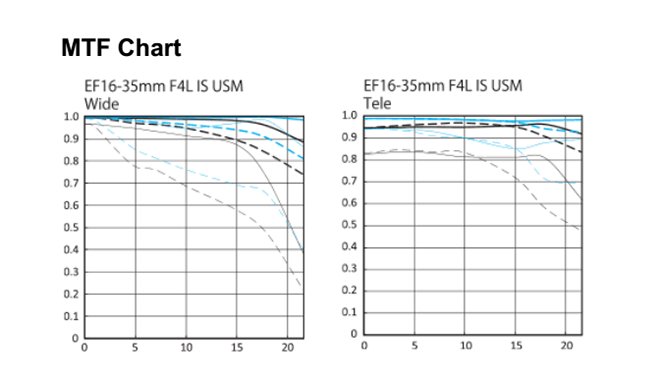
If you are a Canon shooter like myself you are no doubt well aware of the gaping hole in the current lens line-up. Specifically, a good (sharp to the corners) wide angle zoom lens suitable for use on a full frame sensor. The current 16-35mm F2.8L MKI and MKII and 17-40mm F4L are sadly lacking in this area (and thats being polite). A high quality wide -angle zoom is really the only lens missing from Canon in what is otherwise an outstanding lens line up. The 24-70mm F2.8L MKII is arguabley the best mid range zoom on the market for 35mm cameras and the 70-200mm F2.8L IS MKII is also outstanding. The 200-400mm F4L IS with inbuilt 1.4 Teleconverter simply has no peer and stands alone as the ultimate telephoto zoom lens. Add a high resolution wide angle to this mix and Canon really does have the perfect lens line-up where flexibility of zooms is required. And the great news is we just might get such a lens with this new announcement: Canon today announced the new 16-35mm F4L IS lens and the initial MTF charts (although theoretical) look very promising.

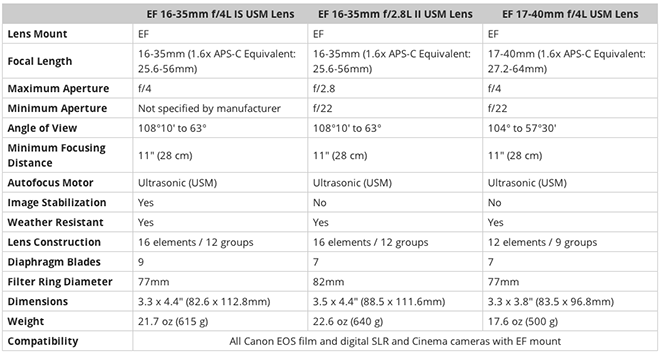
According to Canon: The 16-35mm F4L IS lens has been introduced as an alternative to the current 16-35mm f/2.8L II USM lens and incorporates an Optical Image Stabilizer. While the f/2.8 lens offers a faster maximum aperture, the stabilization system in the new lens compensates up to 4 stops to reduce blur when shooting with slower shutter speeds. And as an L-series lens, it provides the best Canon has to offer in terms of dust and water resistance, as well as overall durability.
Optically, its combination of three aspherical and two UD lens elements minimizes aberrations throughout the zoom range and contributes to the creation of beautiful high-contrast images. A flourine lens coating reduces ghosting and flares and its circular 9-blade aperture enables pleasing background blur. The Lens Hood is included with the lens to block stray light from entering the lens.
An inner focusing system, combined with ultrasonic autofocus motor (USM), realizes fast, quiet, and accurate autofocus and, when necessary, full-time manual focus is available. The minimum focus distance throughout the zoom range is 11″ and its filter thread diameter is 77mm. L-series lenses are designed to meet the utmost in physical and optical standards and are regarded as a high point in the Canon DSLR lens line. The EF mount of this 16-35mm f/4L is designed for full-frame cameras, such as the current Canon 1DX and 5DMKIII cameras. There will probably be much ado on the internet over the coming days about this lens sporting an F4 aperture, but quite honestly for landscape F4 is just fine. For the sort of photography I do where I am often shooting from zodiac or ship the flexibility of a 16-35mm is a huge boon and an F4 aperture is plenty fast enough with high ISO cameras like the 1DX. I would envision most landscape images being shot around F5.6 – F8 with this lens. The observant amongst you may note from the specifications that this new lens sports a nine blade aperture diaphragm where as the current 16-35mm F2.8L IS MKII uses seven. I would not be surprised if we see a MKIII version of the 2.8 lens announced this September at Photokina complete with all new optics and nine-aperture blades (just saying).
In the meantime, the new 16-35mm F4L IS lens is already available for pre-order from B&H Photo for $1,199 USD. Am I going to buy one? You bet – I already placed my pre-order.





 www.WILDNATUREPHOTOTRAVEL.com