
I received an email today from one of the participants on my winter Iceland workshop this year asking me if I new a good way to remove a really nasty lens flare from a photograph. It has been a while since I worked on an image with lens flare, but the email got me thinking about a frequency separation technique that is often used for retouching skin and can work equally well for removing really nasty lens flares. Its a relatively simple technique that takes just a few steps to achieve in Photoshop but that can really save a file that might otherwise be destined for the trash. The key to this technique is the separation of colour and texture into different layers. This is a really important step as it enables us to work on just the colour component of the photograph without affecting the texture (lens flares are just colour aberrations and contain no texture). This makes this technique especially useful for photographs that have textured areas overlaid by lens flare and the image I received today was a perfect example. To make things easy I have recorded a short video that shows how this process works and what the steps are in Photoshop Creative Cloud to use this technique. Just click on the image below to watch the video.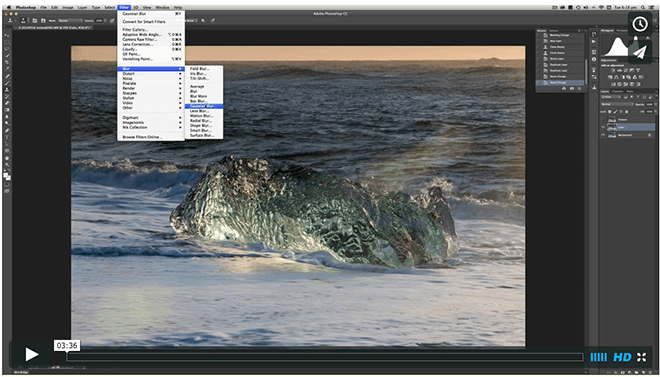 I realised after I had uploaded the video that I neglect to mention that you must ensure that you have sample set to: Current and Below when using the Clone Tool. If you only have ‘current’ set you will not get the desired effect. So there you you have it, a simple technique that might just save a photograph you might have otherwise discarded.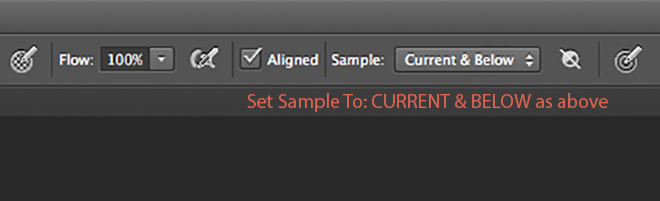

Antarctica’s Ice Losses Double According to Esa’s Cryosat Mission
In a very concerning report just published by the BBC, Esa’s Cryosat mission reports that Antarctica recent ice losses have doubled. Antarctica is now losing about 160 billion tonnes (the’s billion with B) of ice a year to the ocean – twice as much as when the continent was last surveyed. This is an incredible increase and should be a huge wake up call to governments around the world. The full report is well worth the five minutes it will take you to read.
“The new assessment comes from Europe’s Cryosat spacecraft, which has a radar instrument specifically designed to measure the shape of the ice sheet. The melt loss from the White Continent is sufficient to push up global sea levels by around 0.43mm per year. Scientists report the data in the journal Geophysical Research Letters. The new study incorporates three years of measurements from 2010 to 2013, and updates a synthesis of observations made by other satellites over the period 2005 to 2010. Cryosat has been using its altimeter to trace changes in the height of the ice sheet – as it gains mass through snowfall, and loses mass through melting.”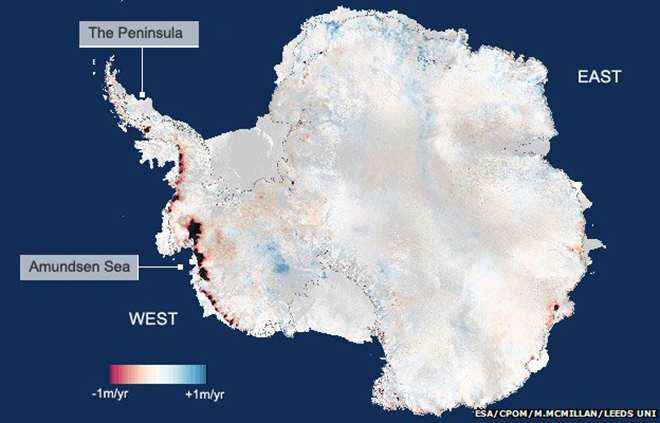
J-Air : Focus on Photography Radio Interview
Kendra Abay who hosts ‘Focus on Photography’ on J-Air radio here in my hometown of Melbourne kindly invited me into the studio last week to spend an hour talking about my love for Polar Photography, workshops, expeditions and all things photography related. You can listen to the interview online here: Kendra Abay and Joshua Holko 2014

Australian Photography + Digital Magazine Features: My Favourite Photo Location
Australian Photography + Digital magazine has been running a series of articles over the last two issues on photographers favourite shooting locations around the globe. Every photographer has at least one favourite photo location – a place that never fails to inspire them. The current May 2014 issue features two of my favourite locations as the lead in to the article – Iceland and Antarctica ‘Poles Apart’. Just click on the image to download a high resolution copy.
Canon Announce new 16-35mm F4L IS Lens – The Last Piece of the Puzzle?
Those of you who follow my blog regularly know that it is not often that I write about new equipment. Equipment and gear are hot topics in photography and in a nutshell ‘gear talk’ equals ‘internet hits’ so there is good reason to throw in regular equipment posts (and many websites do just this). However, I view lenses and cameras very much as tools of the trade. Outside of the service they provide to help me create photographs they are not something I feel compelled to write about all that often. Every now and again however, a new piece of equipment gets announced that catches my attention and today was one of those days.
If you are a Canon shooter like myself you are no doubt well aware of the gaping hole in the current lens line-up. Specifically, a good (sharp to the corners) wide angle zoom lens suitable for use on a full frame sensor. The current 16-35mm F2.8L MKI and MKII and 17-40mm F4L are sadly lacking in this area (and thats being polite). A high quality wide -angle zoom is really the only lens missing from Canon in what is otherwise an outstanding lens line up. The 24-70mm F2.8L MKII is arguabley the best mid range zoom on the market for 35mm cameras and the 70-200mm F2.8L IS MKII is also outstanding. The 200-400mm F4L IS with inbuilt 1.4 Teleconverter simply has no peer and stands alone as the ultimate telephoto zoom lens. Add a high resolution wide angle to this mix and Canon really does have the perfect lens line-up where flexibility of zooms is required. And the great news is we just might get such a lens with this new announcement: Canon today announced the new 16-35mm F4L IS lens and the initial MTF charts (although theoretical) look very promising.


According to Canon: The 16-35mm F4L IS lens has been introduced as an alternative to the current 16-35mm f/2.8L II USM lens and incorporates an Optical Image Stabilizer. While the f/2.8 lens offers a faster maximum aperture, the stabilization system in the new lens compensates up to 4 stops to reduce blur when shooting with slower shutter speeds. And as an L-series lens, it provides the best Canon has to offer in terms of dust and water resistance, as well as overall durability.
Optically, its combination of three aspherical and two UD lens elements minimizes aberrations throughout the zoom range and contributes to the creation of beautiful high-contrast images. A flourine lens coating reduces ghosting and flares and its circular 9-blade aperture enables pleasing background blur. The Lens Hood is included with the lens to block stray light from entering the lens.
An inner focusing system, combined with ultrasonic autofocus motor (USM), realizes fast, quiet, and accurate autofocus and, when necessary, full-time manual focus is available. The minimum focus distance throughout the zoom range is 11″ and its filter thread diameter is 77mm. L-series lenses are designed to meet the utmost in physical and optical standards and are regarded as a high point in the Canon DSLR lens line. The EF mount of this 16-35mm f/4L is designed for full-frame cameras, such as the current Canon 1DX and 5DMKIII cameras.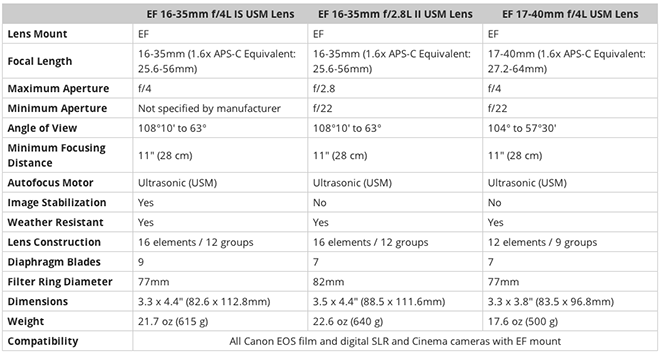 There will probably be much ado on the internet over the coming days about this lens sporting an F4 aperture, but quite honestly for landscape F4 is just fine. For the sort of photography I do where I am often shooting from zodiac or ship the flexibility of a 16-35mm is a huge boon and an F4 aperture is plenty fast enough with high ISO cameras like the 1DX. I would envision most landscape images being shot around F5.6 – F8 with this lens. The observant amongst you may note from the specifications that this new lens sports a nine blade aperture diaphragm where as the current 16-35mm F2.8L IS MKII uses seven. I would not be surprised if we see a MKIII version of the 2.8 lens announced this September at Photokina complete with all new optics and nine-aperture blades (just saying).
In the meantime, the new 16-35mm F4L IS lens is already available for pre-order from B&H Photo for $1,199 USD. Am I going to buy one? You bet – I already placed my pre-order.
 www.WILDNATUREPHOTOTRAVEL.com