In March 2014 I led my annual winter workshop in Iceland with my good friend and fellow Nature photographer Daniel Bergmann. Winter is perhaps my favourite season to visit Iceland (although I do miss access to the highland regions. Look for a brand new Highlands workshop for 2015 I will be announcing here in the coming days). During winter the normally vivid green landscape of Iceland is transformed into a monochromatic moonscape. Waterfalls and glacial lagoons partially freeze, and the landscape is often covered in fresh snow making for superb landscape imagery. The entire country is evocative of a winter scene from Tolkien’s Lord of the Rings and it provides superb opportunities for landscape photography.
During the workshops ten day duration we travelled from the capital city of Reykjavik to Mývatn in the north where we spent several days photographing spectacular winter scenes including the geothermal region of Námafjall and what I regard as Iceland’s most beautiful waterfall – Goðafoss (which roughly translates as the waterfall of the Gods). Goðafoss is located in the Mývatn district of North-Central Iceland at the beginning of the Sprengisandur highland road. The water of the river Skjálfandafljót falls from a height of 12 meters over a width of 30 meters. This winter photograph of Goðafoss scored a Gold Award at the recent Victorian State Print Awards here in Australia.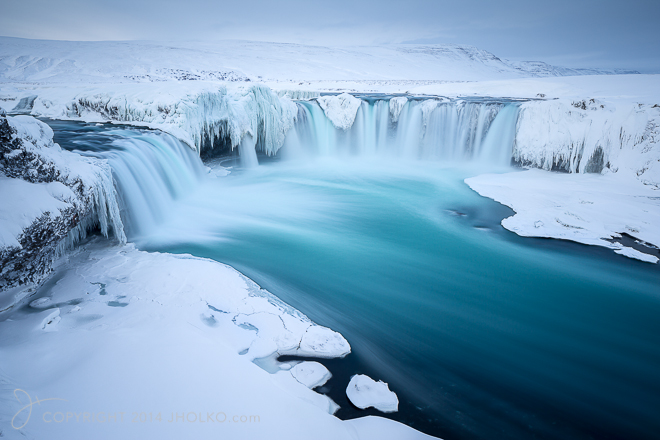 We also photographed at several locations around the partially frozen lake Mývatn. Mývatn is a lake near Akureyri in North Iceland. The lake was formed during a massive eruption some 2300 years ago. Today the area is best known for the huge numbers of birds that visit in the summer, and for the weird and inspiring volcanic features that surround the lake. The geothermal features at Námafjall are some of my favourite in Iceland. Sulphur belches from the boiling mud pits and fumaroles giving the whole location and incredibly alien off-world feeling. In winter the vents and mud pits are surrounded by snow and ice and there is a fabulous juxtaposition between the pristine snow and the orange mud and rock. Check out the video below shot just for fun of one of the participants walking through one of the larger fumaroles.
 Some of the participants were fortunate to see and photograph both male and female Gyr Falcon by the side of lake Mývatn. The Gyr falcon is the worlds largest falcon and I have been wanting to see and photograph them for some years now. Although I was finally fortunate to spot one during this trip I was not able to get a photograph. Several of the participants however did get some fantastic images of a female Gyr Falcon by the shore of lake Mývatn where she was perched out of the buffeting wind. Daniel and I raced to this location with our long lenses but she had already left by the time we arrived.
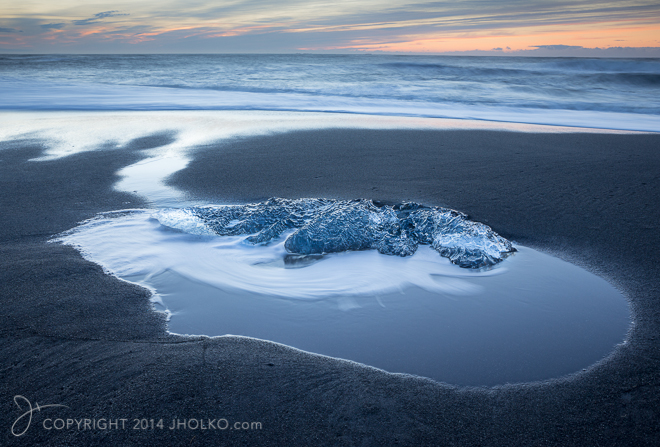
The north of Iceland can be a crazy place in winter with frequent snow storms and regular road closures and thus when the opportunity arose to head south during a twenty four hour weather window we were quick to bug out and make our way to Egilstadir on our way to Höfn and Gerði and the renowned Jökulsárlón glacial lagoon. Our timing was perfect with the road east opening just in time for our departure (the road closed again the following day due to another wild snow storm). Along the way we photographed spectacular mountain scenery in this part of the north of Iceland under fresh snow in ideal conditions. The mountain passes of Iceland are incredible in winter and we were well equipped to deal with the snow and ice conditions in our modified super jeeps. At Gerði in the south we spent three days photographing around the Jökulsárlón glacial lagoon, Fjallsárlón and the Vatnajökull glacier. These areas are perhaps Iceland’s most well known photography destinations and with good reason. The icebergs that calve off the terminal face of the Vatnajökull glacier and are washed out to sea through a narrow channel and then deposited onto the black sand beach provide limitless opportunities and we spent many hours wandering the shore of the lagoon and beach making images. Along with the lagoon itself and the myriad of icebergs that drift in in its half frozen surface there is a lifetime of photography in just this small area.
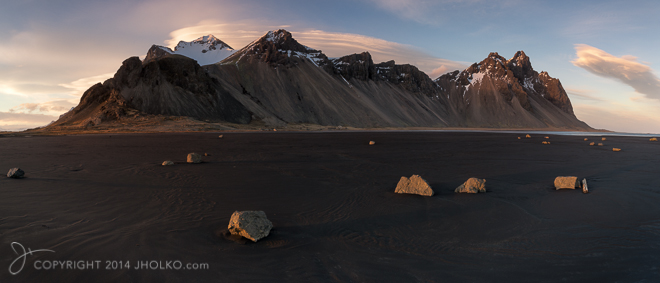
 We also visited the remote Stokksnes peninsula where we photographed dramatic storm light and lenticular clouds over the jagged mountain peaks. Stokksnes is a fabulous location in Iceland that has only recently started to become well known amongst landscape photographers. The black san dune hummocks and tussock grasses makes for wonderful foreground set against the dramatic mountain peaks. I have visited this area many times over the last few years and I have never known it to be free from wind. Our visit this year was no exception with strong winds, racing clouds and dramatic light.
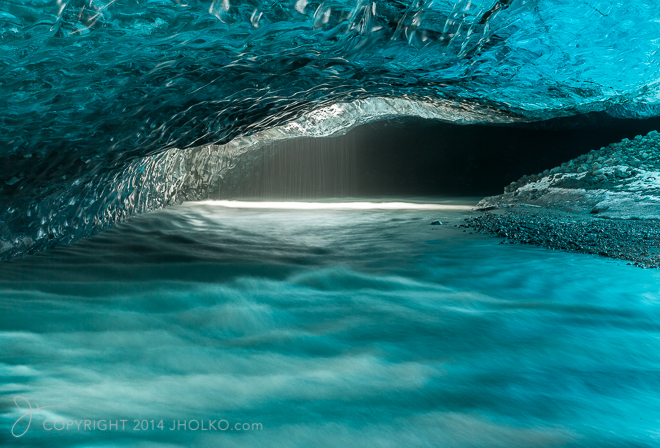
 We also headed into a spectacular and wondrous ice cave under the Breiðamerkurjökull glacier where we spent several hours photographing the incredible formations, colour and texture found in the glacial ice. This was one of the largest and most impressive ice caves I have ever experienced. The cave extended for more than three hundred metres and through the use of a zodiac and our mountain guide we were able to navigate quite a distance into the cave via the river. The river in this cave rises and falls with swings in the temperature and we were fortunate to be able to penetrate quite deeply into the cave.
 The ice cave provided us limitless possibilities for macro detail and abstract photography with the inside of the ice cave akin to some sort of alien spaceship.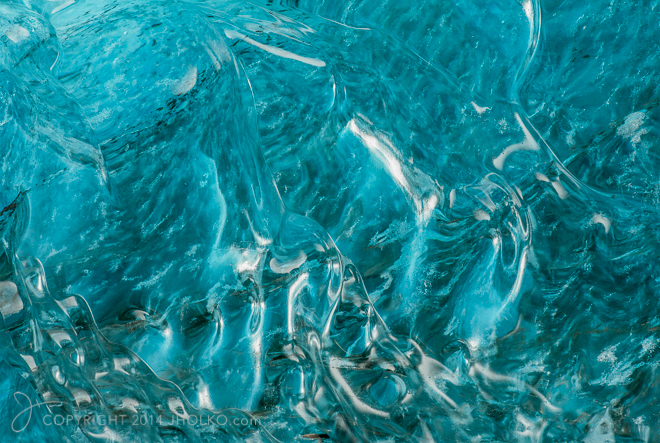
We also travelled up to the terminal face of the Svínafellsjökull glacier where we photographed some large seracs and ice stacks during a clearing winter storm. From the Jökulsárlón lagoon we travelled to the small sea side town of Vik where we photographed the incredible Reynisdrangar sea stacks and basalt column formations along the coastline. This is perhaps my favourite beach for photography in Iceland. There are quite often large rocks in the sand that make for ideal foreground material and the wild surf makes for fantastic imagery.
 Iceland in winter can be a real mixed bag of weather but we were fortunate to have some very cooperative weather during our trip that resulted in some wonderful photographic opportunities. The workshop was capped off with a nearly on demand showing of the Aurora (northern lights) over the glacier on our last night at Vik.
Our participants for this workshop came from North America, Australia, and Hong Kong and represented a broad range of experience and skill set. With a ratio of just six to one Daniel and I were able to ensure that those who needed more assistance or were learning to use filters and other equipment for the first time were able to get some fantastic images.
Daniel Bergmann and I have just opened bookings for our 2015 Iceland Aurora Workshop which will focus on the dramatic coastal landscapes of the Snæfellsnes peninsular as well as the east cost including Vik, the spectacular Jökulsárlón glacial lagoon and night time Aurora photography. If you would like to reserve a place please drop either myself or Daniel an email at info@jholko.com. There are limited places remaining.
Don’t forget you can now download a free copy of the Visionary Insights eBook directly from this website.





 www.WILDNATUREPHOTOTRAVEL.com