If you are headed to New York City for PhotoPlus Expo this week at the Javits Center be sure to stop past the Moab and Legion Paper stand where Moab are going to be displaying one of my large prints from Iceland ‘Selfoss under Storm‘ along with Prints from the other Moab Masters. The photograph I chose for the show this year is one of my favourites from my 2010 Iceland trip and was taken at Selfoss Waterfall, just upstream from Dettifoss where glacial meltwater thunders through a martian like canyon. It is an amazing location and one I am very much looking forward to re-visiting on my summer workshop in July next year.
‘THE JEWELS OF THE ARCTIC’ EXPEDITION : 5th – 18th of AUGUST 2013 BOOKINGS OPEN
Bookings are now open for the new 14 day / 13 night photographic expedition I am leading to the Arctic in August next year – The ‘Jewels of the Arctic’. This dedicated photographic expedition departs on the 5th of August 2013 and docks on the 18th of August. The trip will set sail from Longyearbyen in Svalbard and will be taking in the very best of Spitsbergen and Greenland before docking in Isafjordur in Iceland. A connecting flight will then take you to Keflavik International airport for connecting flights home.
This expedition will combine the very best of Spitsbergen and Greenland with a taste of Iceland and has been structured to provide the best possible photographic opportunities. Spitsbergen’s rugged northwest coast comprises mountains, tundra and fjords. Greenland’s remote east coast shows off the immensity of the icecap, fantastic icebergs and massive granite spires rising over 1000 metres above the fjords.
This expedition offers a complete Arctic experience for photography: tundra walks amidst reindeer and exquisite dwarf vegetation, zodiac cruises near calving glacier fronts, hikes to breathtaking mountain vistas and warm welcomes into indigenous communities. We will likely see and photograph Polar Bears, Reindeer, Arctic Foxes, Walrus, Glaciers, icebergs and more. It is going to be a truly spectacular photographic trip for a very limited number of photographers aboard an ice hardened expedition class ship. The expedition is for a strictly limited number of 50 participants plus leaders and expedition guide. Whilst many trips to the Arctic take 100+ tourists this expedition is capped at a maximum of 50 dedicated photographers in order to ensure the best possible experience and photographic opportunities. We will be using an ice hardened expedition ship with a highly experienced crew in order to ensure we can get as close as possible to big ice and place you in the best locations for making photographs. Our expedition ship the ‘Polar Pioneer’ is equipped with sufficient zodiacs and crew for all photographers to be shooting simultaneously with plenty of room to spare for camera equipment.
There will be informal talks and image reviews and plenty of opportunity for one-on-one instruction for those who wish it throughout the length of the trip. As well as informal side by side shooting from the deck of the ship, on zodiac and during shore landings there will be lots of opportunity to discuss all aspects of photography and image making with like-minded individuals. If the idea of photographing the stunning Arctic landscape and amazing wildlife is appealing then now is the time to secure your place.
PRICE
Prices quoted are in Australian Dollars, per person, twin share. Single Occupancy is 1.7 times the twin share price. No single supplement applies if you are willing to share your cabin (triple and twin cabins only). Deposit to secure your place is $1,250 AUD with balance not due until 90 days before date of departure.
- Triple Share Cabin $7,500 per person (two cabins available)
- Twin Share Cabin $8,950 per person (1 x female berth remaining)
- Twin Private $10,700 per person (7 cabins remaining)
- Mini-Suite $11,975 per person (Only One Left)
- Captains Suite $12,950 per person (Sold Out)
Due to initial expressions of interest and registrations there are only limited places remaining. If you would like to join me on what is going to be an amazing Arctic photography expedition please drop me an email for a detailed itinerary and booking form to info@jholko.com. Please note that places are filled strictly on a first come, first served basis and once they are spoke for thats it.
NEW EXPEDITION : THE JEWELS OF THE ARCTIC – AUGUST 2013
I will shortly be announcing a new and very exciting 14 day / 13 night photographic expedition titled ‘Jewels of the Arctic‘. Departing on the 5th of August 2013 and docking on the 18th of August the trip will set sail from Longyearbyen in Svalbard and will be taking in the very best of Spitsbergen and Greenland before docking in Isafjordur in Iceland. A connecting flight will then take you to Keflavik International airport for connecting flights home. This expedition will combine the very best of Spitsbergen and Greenland with a taste of Iceland and has been structured to provide the best possible photographic opportunities. Just as a teaser: Spitsbergen’s rugged northwest coast comprises mountains, tundra and fjords. Greenland’s remote east coast shows off the immensity of the icecap, fantastic icebergs and massive granite spires rising over 1000 metres above the fjords. We will likely see and photograph Polar Bears, Reindeer, Arctic Foxes, Walrus, Glaciers, icebergs and more. It is going to be a truly spectacular photographic trip for a very limited number of photographers aboard an ice hardened expedition class ship. I am not quite ready to start taking bookings, but you can register your interest to have first option to join by sending me an email to info@jholko.com. No obligation at this point.
OCTOBER PHOTOGRAPH OF THE MONTH: OF FIRE AND BRIMSTONE
Without doubt one of the most otherworldly and alien locations I have ever had the pleasure to visit and photograph is Hveravellir in Iceland. I first became fascinated with this remote area many years ago when I saw a photograph of the iridescent blue geothermal pool that lies in the middle of the barren Icelandic wilderness. Sulphur was rising from its boiling surface with what looked like ice or snow around the edge of the pool (what looks like ice or snow is in fact volcanic silica deposits). How could such a place exist on Earth? I simply had to get there one day and see it for myself.
I finally did get to Hveravellir in 2010 just as the sun was setting and made a number of photographs of the geothermal features. This visit resulted in a photograph I titled “The Well of Life” that won a Silver Award at the 2011 APPA Australian Professional Photography Awards and that subsequently went on to win a Gold Award at the International Loupe Awards. It is one of the favourite photographs in my collection and a large 20 x 30″ Artist Proof print hangs in my studio today. I had a real epic getting out of Hveravellir on this first trip and subsequently wrote a short blog piece about my experience and the travel that went into the making of this image. I recently retold this story to Resource Photo.Video.Lifestyle magazine as part of an interview for their website.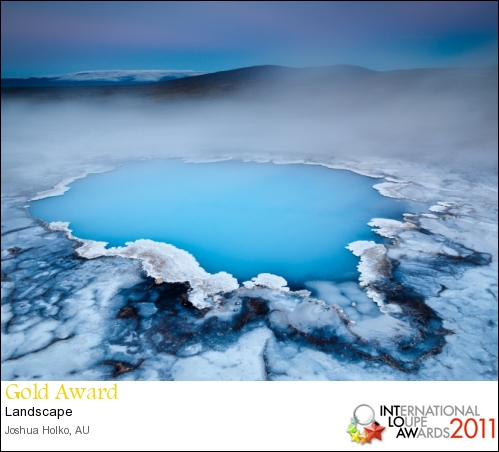
I had an opportunity to return to Hveravellir in August this year during my 2012 Iceland Workshop. This was an unplanned treat for those on the trip as the area is very remote and getting there (and back) is somewhat logistically difficult. However, we had deliberately left our itinerary very open on this expedition to enable us to take full advantage of the prevailing weather and light and it just so happened that we ended up in Hveravellir an hour or so before sunrise. The conditions were very different this time however and consisted of a fiery sunrise that has resulted in a very different image to my previous photograph. This new image of the geothermal pool at Hveravellir titled “Of Fire and Brimstone” is my photograph of the month for October. A higher resolution version of this photograph can be seen on my main website at www.jholko.com in the Iceland II Portfolio. If you are interested in travelling to Iceland with me to photograph its wondrous landscape there is one spot that has just become available on my 2nd Winter trip that departs on the 22nd of March next year. If you would like to register for this last spot or would like any additional information just drop me an email at info@jholko.com
I will be running both Summer and Winter expeditions to Iceland in 2014 and have already received pre-registration requests to hold spaces on these trips. I am not quite ready to announce dates and details for these 2014 trips but if you are interested you can also email me at info@jholko.com to be amongst the first to be notified when bookings are opened.
RESOURCE PHOTO.VIDEO.LIFESTYLE INTERVIEW
I was recently interviewed by Resource Photo.Video.Lifestyle magazine about my landscape photography and the content of the interview is now online at their website HERE. This interview was particularly good fun for me as the nature of the questions gave me an opportunity to talk about how I got my start in photography, in addition to my thoughts on working in the field in remote locations, the importance of the right equipment and the opportunity to talk about my workshops – including the recently announced 2013 Antarctica expedition. I hope you enjoy the read over a morning / afternoon cup of coffee.
I am including below an image I shot on my last Iceland workshop in Landmannalaugar in August this year. Photographed from the top of one of the regions highest peaks in overcast misty conditions it was a very stark contrast to my visit two years earlier (during which time I witnessed some of the most amazing light I have yet had the pleasure to experience). I thought at the time that the grey misty skies of this trip were conspiring against me and that there was going to be little in the way of opportunity. I photographed anyway and found when I got back to the studio and was reviewing my images that I actually really liked the soft lighting which seems to work so well with the pastel pallet of Landmannalaugars amazing volcanic mountains. This is an area of Iceland very near and dear to my heart and one I am very much looking forward to revisiting next year during my summer workshop. A higher resolution version of this photograph can be seen in my portfolio at www.jholko.com under Iceland II.
I am currently working on dates for the 2014 Iceland Workshops and hope to have these finalised and online in the next month or so.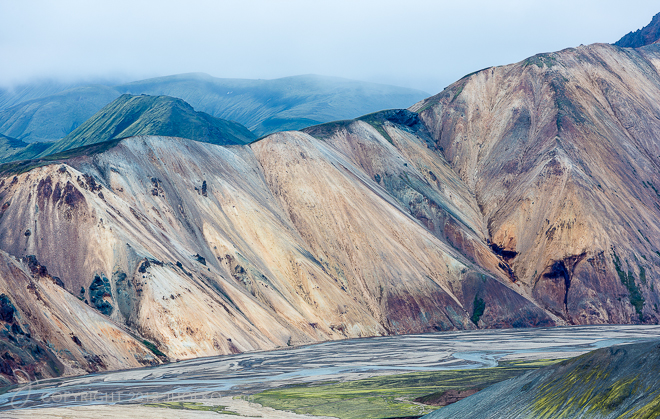
 www.WILDNATUREPHOTOTRAVEL.com