
Dettifoss is both Iceland’s and Europe’s largest waterfall – more cubic water per second spills over it than any other waterfall in all of continental Europe. It is both spectacular and awe inspiring for its sheer power and majesty. Fed by glaciers upstream the glacial silt that is carried down river gives the water at Dettifoss a wonderful colour and texture. This photograph was taken shortly before dawn about a week into my trip to Iceland. The pre-dawn glow in the sky and soft warm light on the distant rocks, combined with the texture in the water appeal to me on many levels.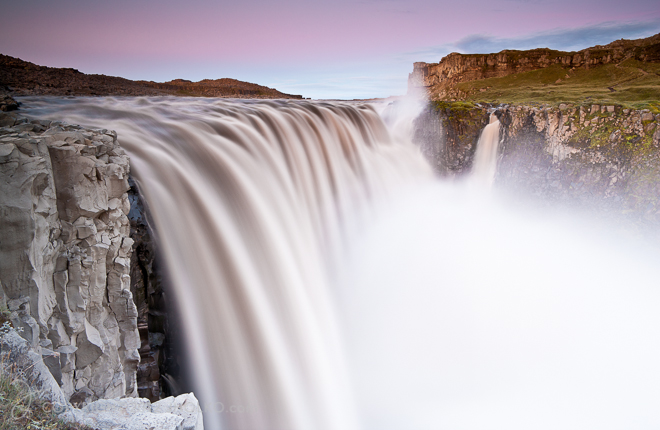 As is typical in Iceland there are no safety fences and no warning signs to be careful or wary of cliff edges. You can quite literally walk right up to the edge of the falls and stare down at the hundred plus foot drop into the rocks and plumes of spray below. This photograph was taken standing right at the cliff edge – not the place to be if you suffer from vertigo. Dettifoss is quite literally a breath taking waterfall that I enjoyed photographing immensely. A high resolution version of this photograph is on my portfolio website at www.jholko.com in the Iceland Portfolio. Prints are available upon request.
Iceland – Foss – Gullfoss Golden Falls
I am still deep in the sorting and editing process of the photographs I took in Iceland; but I have started to process some of my favourite selects from the trip. I plan to post them sporadically over the next few months to both my Blog and Portfolio websites as time permits. This photograph was taken during the last few days of the expedition. I was travelling and shooting alone at this point in the trip. Daniel (my guide for the first twelve days I was in Iceland) had suggested that it would be worth my while making the drive to the waterfall ‘Gullfoss’ from the geothermal area at Hveravellir after the evenings sunset shoot and in time for dawn at the waterfall. As I have already blogged about that drive back from Hveravellir was horrendous due to not only the road conditions, but the thick fog that had rolled in reducing visibility to about ten metres.
I arrived at Gullfoss shortly before sunrise and grabbed a quick power nap in the car whilst I waited for first light. Dawn bought with it cloudy overcast conditions with no sign of colour in the sky; but I took the short walk down to the falls anyway in the hope something would happen – and indeed it did. As is common in Iceland the clouds started to break up and for a period of no more than just a few minutes shortly after sunrise. The rising sun lit the waterfall and spray creating a stunningly beautiful rainbow whilst throwing gorgeous warm light across the grasses and distant hill. This is one of my favourite waterfall photographs from my time in Iceland. A higher resolution version of this photograph is on my Portfolio website at http://www.jholko.com under Iceland. Prints are available upon request.
Canon Elaborates on New Super Telephotos and Extenders
Canon has posted more information on the new 300mm F2.8L IS II USM and 400mm F2.8L IS II USM super telephoto lenses as well as the new 1.4x TC MKIII and 2x TC MKIII tel-extenders on their Digital Learning website.

It may be hard to believe that it’s been more than a decade since Canon introduced its first generation of image-stabilized super-telephoto lenses, but it’s true. The EF 300mm f/2.8L IS USM, EF 400mm f/2.8L IS USM, EF 500mm f/4L IS USM and EF 600mm f/4L IS USM, along with the Series II EF Extenders, were introduced in 1999. Even now, most photographers would agree that those products have been and continue to be state-of-the-art in terms of quality and performance.
However, there is always room for improvement. During the past 11 years, Canon has listened carefully to feedback from professional photographers, visiting various shooting locations around the world and making firsthand observations of the issues that are encountered by actual users. At the same time, the company has continued to invest significant funds in research and development, resulting in technology advancements that have made higher performance products possible.
Against this backdrop, Canon is proud to introduce its second generation of IS super-telephoto lenses, beginning with the EF 300mm f/2.8L IS II USM and the EF 400mm f/2.8L IS II USM. Along with the new lenses, Canon is introducing the Extenders EF 1.4X III and EF 2X III. All of these products are scheduled for initial shipments by the end of 2010. Canon has also issued an announcement that the EF 500mm f/4L IS II USM and EF 600mm f/4L IS II USM are currently being developed, with delivery planned in 2011.
Please see the Canon Digital Learning website for the complete story.
Canon Elaborates on New Zoom Fish Eye Lens
Canon created quite a stir yesterday on the internet when they announced their new 8-15mm F4L USM Fish Eye Lens as part of six new professional ‘L’ series lenses. There was nary a hint this revolutionary new lens was coming on any of the usual Canon rumour websites – this time Canon did a great job of keeping it under wraps. From Canons Digital Learning Centre Website:
It’s not every day that a lens comes along that can be called a new concept for the professional shooter, but Canon has done it again: the new EF 8–15mm f/4L USM fisheye lens is a remarkable design that rewrites what’s possible with a fisheye lens. Whether you’re an underwater photographer, a wedding shooter looking for that exciting way to get a “different” picture, a commercial shooter, an HD videographer or an advanced enthusiast, this is a lens with potential you need to examine.


In one move, Canon has suddenly changed the entire dynamic of what’s possible with a fisheye lens. Long regarded as a super-specialized lens for only occasional use, the EF 8–15mm f/4L USM’s stunning versatility makes it a powerful and compelling option for a broad variety of photographers. Its zoom range gives it not just composition flexibility, but literally transforms it into different lenses for different digital SLR camera bodies. Combined with a great AF system and excellent optics, it’s a lens that should find its way into the camera bags of many different shooters, pro and advanced amateur alike. Its relatively modest size, weight and a price that’s within range of many serious shooters only underline its appeal.
There is a good explanation of this lens (including diagrams on framing implications), how it operates and what its capabilities are on the Digital Learning website. This is a very exciting lens for landscape photographers and I am looking forward to getting my hands on one for testing.
Canon Announces New 500mm F4 and 600mm F4 under Development
TOKYO, August 26, 2010 — Canon Inc. announced today that it is developing two new telephoto lenses for use with its EOS lineup of single-lens reflex cameras — the EF500mm f/4L IS II USM and EF600mm f/4L IS II USM — and will display prototypes at the photokina 2010 photography and imaging industry trade fair between September 21 and 26 in Cologne, Germany.
The EF500mm f/4L IS II USM and EF600mm f/4L IS II USM are being developed as L (Luxury)-series lenses equipped with a high-performance image stabilization system. Employing fluorite and other special optical materials to correct for a variety of aberrations, the lenses aim to realize high-resolution, high-contrast imaging performance in a lighter-weight body design.
The EF500mm f/4L IS II USM and EF600mm f/4L IS II USM are under development as successors to the EF500mm f/4L IS USM (introduced in July 1999) and EF600mm f/4L IS USM (introduced in September 1999), respectively, models which earned strong praise from professionals in the field. The new lenses target improved dust-proof and moisture-proof performance in the face of harsh shooting conditions to satisfy the demands of sports, news and nature photographers, as well as high-contrast, high-resolution imaging from the maximum aperture setting.
Canon will continue to actively and flexibly respond to the diverse needs of professional and advanced-amateur users, expanding and improving the performance of its EF lens lineup to contribute to expanding the realm of photographic possibilities for SLR cameras.
 www.WILDNATUREPHOTOTRAVEL.com