Iceland Dispatch #16 – Moving on from Myvatn

We are just about to have some dinner [but I wanted to squeeze in a blog update with our plans for the next day or so] and grab a few hours shut eye before we head off at 3am to Godafoss – “waterfall of the Gods” for a sunrise photography session. I have seen many photographs of Godafoss and am very much looking forward to making my own images from this location – Hopefully the light will be very good; at the moment it’s 6pm in the evening and quite overcast. The forecast is quite good – so we shall soon see.
Magic

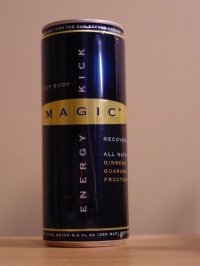
Spent an hour and a half this afternoon relaxing in the hot aquamarine mineral sulphur pools at Myvatn which was great for recharging my depleted batteries. In combination with this local Iceland energy drink called ‘Magic’ [sort of like a Red Bull – but much better] I feel almost refreshed and ready to keep up the long, long waking hours. I have long since lost track of days and my sense of time is really screwed up.

After our session at 3am at Godafoss we are taking the six hour off road ‘bone-jarring’ drive across the Sprengisandur route to reach Hrauneyjar. On the way we’ll probably make stops by Aldeyjarfoss waterfall and in Nyjidalur. In the evening we’ll visit the Veidivotn area, a cluster of crater lakes about 30 minutes from Hrauneyjar. We are going to spend a couple of days in this area; including a trip up to Landmannalaugar; where according to the guide book there are multi-coloured mountains, hot springs, lava flows and clear blue lakes.
Iceland Dispatch #15 – Askja

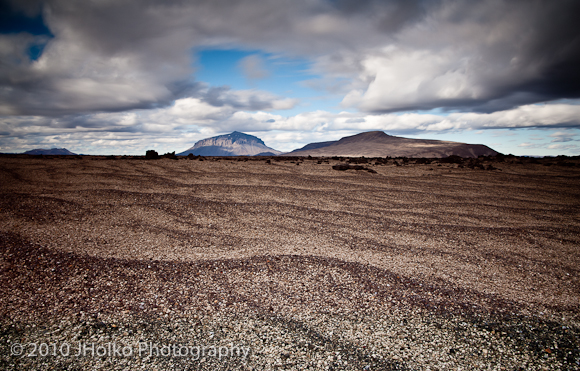
Yesterday we headed into  Askja – which is a huge volcano in a remote part of the the North-east of Iceland. Askja is an utterly desolate region of Iceland. Black lava fields extend more than 100 kms from the caldera creating a very desolate surreal landscape [Think ‘Mordor’ from JRR Tolkien’s Lord of the Rings – but on steroids]. The drive in through the lava fields is anything but comfortable; taking around two and a half hours of bone jarring rough road. The majority of Iceland’s unpaved roads are anything but friendly to cars. According to the guide book the caldera of the Askja volcano encompasses an area of more than 50 square kilometres. The explosion that caused the immense crater occured relatively recently in 1875 when two cubic kilometres of tephra was ejected from the volcano – bits of it landing as far away as Continental Europe. The size and scale of the landscape is overwhelming; it must have been one hell of a bang when Askja exploded.

After the initial eruption a magma chamber collapsed and formed an 11km square km hole, 300m below the rim of the original explosion crater. This new depression has now filled with water and is a sapphire blue in colour and is known as Oskjuvatn – the second deepest in Iceland. The water is geothermally heated and the same temperature as a warm bath. Askja has erupted as recently as 1961 and there are active sulphur vents dotted around the crater.

Tephra Field

We spent several hours photographing in overcast sunset light around the caldera before a midnight supper in the black lava fields [Daniel, that berry yoghurt was delicious!]. We then pulled an all night shoot making straight for Dettifoss to photograph the waterfall from the other side this time at sunrise. This morning we had a wonderful sunrise with some gorgeous soft pastel light with mauve tinged skies – the best light of the trip so far [But I am not going to post these shots just yet!]. After more than twenty four hours of travel and photography it was time to catch up on a few hours sleep. Now its time for some lunch before heading off for the evening sunset shoot.

Iceland Dispatch #14 – Somewhere in Iceland…

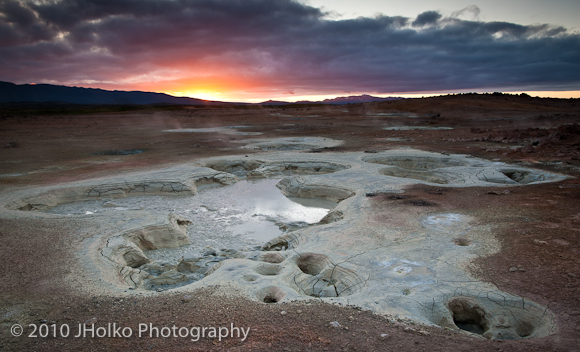
Yesterday evening we headed into what I think is part of the Jokulsargljufur National Park (or it is as least not far away from the Park – Daniel you will need to write the name down for me!) – [Update its THEISTAREYKIR]  to photograph some more geothermal active areas. This was a great location for photography with lots of geothermal activity including boiling mud pools, sulphurous gas vents and huge tapestry of texture and colour in the active landscape. Surrounding the geothermal areas are many large mountains; which themselves make for wonderful photography. We had a good sunset and some great light; which lasted more than an hour.

Primordial

We photographed from the early afternoon until roughly 11pm before getting a couple of hours sleep before the sunrise and heading back up to Namafjall for a sunrise session. Sunrise was not to be this morning however as the sun was buried behind thick layers of cloud and mist. Which, at least meant we could pack in early and catch up on some badly needed sleep. The continual long hours of travelling and photography really started catching up with me on this mornings trip up to Namafjall, so I was thankful of a ‘bug-out’ and chance to get a few more hours sleep.

Now its lunchtime (another bowl of the most excellent fish and potato stew) before we gear up and drive for a couple of hours into the Askja region in the north-east of Iceland along what is supposed to be quite a rough road in a very remote part of the country. I am looking forward to seeing Askja as it is a pristine wilderness area.

Iceland Dispatch #13 – Dettifoss

The power of Mother Nature is never so clear as when one stands on the edge of Dettifoss – Iceland’s most impressive waterfall. A massive 193 cubic meters of water thunders over its edge every second, creating a plume of spray that can be seen one kilometre away. Standing on the edge of the basalt cliffs is like being inside a jet engine; the noise is thunderous, like a continual endless explosion. The water is a churning milky-grey and is almost entirely glacial run-off. The colour is given to the water by the glacial silt carried down stream. Dettifoss has the greatest volume of any waterfall in Europe – this is truly nature at its most spectacular and awe inspiring.

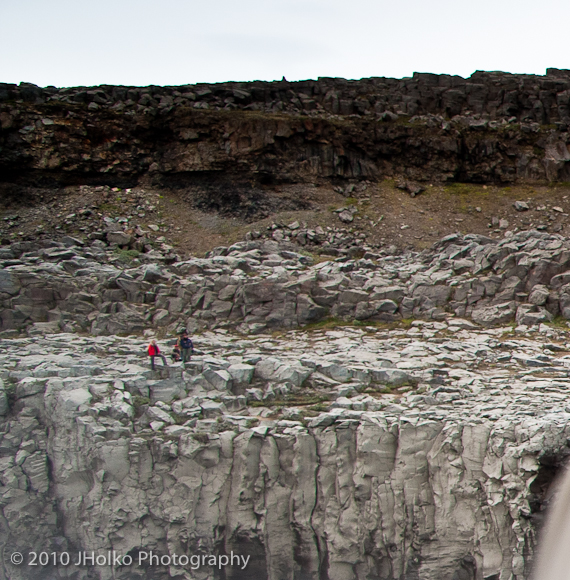
In this photograph I tried to capture both the scale and size of Dettifoss as well as its majesty and power. To help with scale I included people – which is something I do not normally do in my landscape work. However, it really is needed to help understand just how big this waterfall really is. I used the LEE 10-stop “Big Stopper” Neutral Density filter to give me a 30 second exposure to soften the water against the harsh contrast of the canyon walls. Look very carefully at this first photograph to see if you can spot the two people standing on the far bank. A 100% crop is included below for reference if you are having trouble spotting them.

Dettifoss

Now look at the 100% crop below and you will get some idea of just how massive this waterfall really is. Dettifoss is an absolute monster and I enjoyed photographing it very much.

100% Crop of Left Hand Corner

Below is some short video I shot at the falls on the pocket Canon S90 that gives an overall impression of their size, location and setting. Sorry, no commentary as it was impossible over the explosive noise of the water. Tim and Martyn can be seen setting up their cameras on the edge of the falls. Now its time to get some lunch, gear up and head back out for another nights photography.

Iceland Dispatch #12 – This is Earth… Right?

We headed up to Namafjall near Myvatn after lunch yesterday to photograph the volcanic fumerals. Namafjall is a strikingly other-worldly place dotted with steaming fumerals, sulphurous smells, volcanic vents, boiling mud pools and a dizzying array of volcanic colour and texture. It is a beautiful, macabre and menacing landscape that belongs to another time, or another planet for that matter.After a good session at Namafjall we packed up and headed into the Jokulsargljufur National Park along a very rough dirt road to photograph both Detifoss and Selfoss waterfalls. We spent several hours shooting the falls before a quick bite to eat in the field followed by two and a half hours sleep. We then headed back up to Namafjall for the sunrise. This photograph was taken at 3:30am this morning just as the sun was rising over the distant mountains. Now its time to crawl back into bed and get a few more hours sleep before we head back into the Jokulsargljufur National Park for another long night shoot.