Over the last few days the 2015 Epson Victorian Professional Photographer of the Year competition has been running here in Melbourne at 1140 studios. I attended both days to watch the judging and it was fantastic to see such a high standard of prints again this year (as well as a record number of entries). Although I won multiple categories, the highest scoring print and the overall title of 2014 Epson Victorian Professional Photographer of the Year last year I put no expectations on myself for my entries this year and decided I would enter just for the sheer joy of the print making process. Quite honestly, removing any expectation of my potential results was really quite liberating and I think I enjoyed the entire process from capture to print and competition entry more than I ever have in the past.
From my previous post on these awards: The AIPP National and State awards are two of the few remaining competitions to actually judge the finished print and they do so using a panel of judges all deemed experts in their respective genres and accredited as Masters of Photography through their years of success in this arena. Prints are judged in a controlled lighting environment and assessed for their content, originality as well as technical craftsmanship. The judging is enthralling to watch and can be quite nerve wracking if you are a first time entrant as the standard of work is incredibly high. In brief, prints are scored out of 100 with images judged less than 70 being deemed not of professional standard. Prints judged between 71 and 79 are considered strong professional practice. Images judged 80-84 are awarded a Silver and are considered strong professional practice of an award standard. Scores of 85-89 are given a Silver with Distinction and demonstrate superior imagination, craft and skill. Prints judged 90-94 exhibit excellence in visual communication, craft and skill. And finally those rare few images that reach 96-100 are considered to have exceptional vision, creativity, innovation, master craftsmanship and skill. Very few prints score Gold awards in these competitions and even fewer reach the top tier of Gold with Distinction.
This year I entered both the Landscape and Science, Wildlife and Wild Places categories. Entering the Landscape category was a really tough decision for me as this category has an anything goes post production mantra that is in conflict with my own ethos and ethics for image manipulation. I decided I would enter anyway just to see how my prints would fare against others in this category. As it turned out – they fared remarkably well. Two of my landscape images scored solid Silver with Distinctions with scores of 86 and 86 respectively. My remaining two landscape photographs also scored solid silver awards with an 81 and 83. Three of my Science, Wildlife and Wild Places photographs (my preferred category) scored Silver with Distinctions with scores of 89, 89 and 85 respectively. Two of those three were just one point removed from a Gold Award. My fourth image in the category scored an 84 Silver Award.
All of the prints were printed on Moab Somerset Museum Rag. This wonderful paper has continued to remain my all-time favourite stock for fine art photography prints.
Arctic Fox Snow Storm – 89 Silver with Distinction Award Science, Wildlife and Wild Places Category
Arctic Foxes Sparring – 89 Silver with Distinction Award Science, Wildlife and Wild Places Category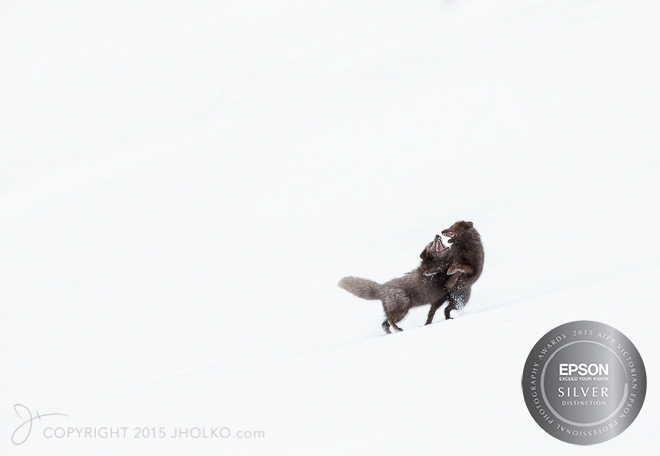
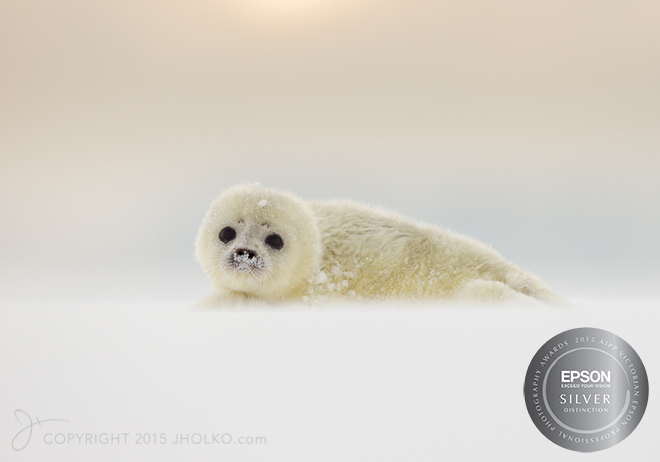
Abandoned Baby Ring Seal – 85 Silver with Distinction Award Science, Wildlife and Wild Places Category
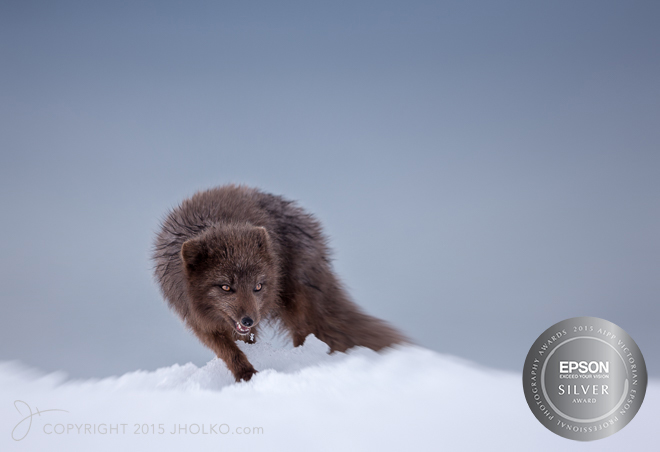
Arctic Fox Attack – 84 Silver Award Science, Wildlife and Wild Places Category
Dune on Fire – 86 Silver with Distinction Award Landscape Category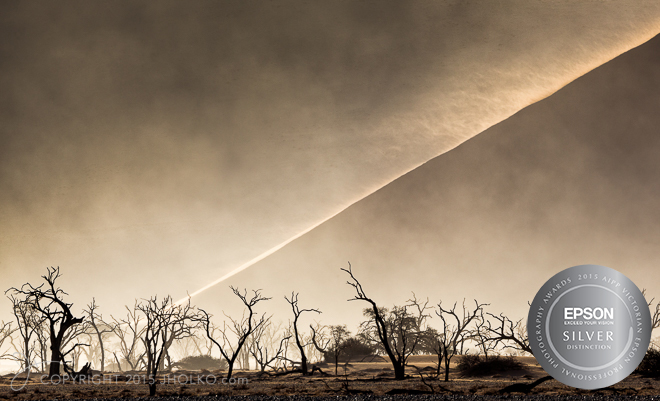
Fiery Fingers – 86 Silver with Distinction Award Landscape Category
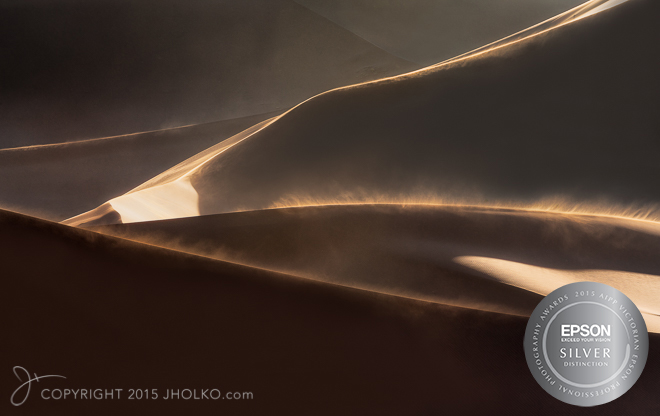
Dunes and Light – 81 Silver Award Landscape Category
Golden Dune – 83 Silver Award Landscape Category Now its time to put the 2015 VPPY Awards behind me and get some sleep. In just a few hours time I will be headed to the South Island of New Zealand for my 2015 Masterclass Workshop.

 There is an awards cocktail party being held on the Thursday evening and I will then be leaving for New Zealand first thing on Friday morning. As always, I hope to post an update or two from our workshop as we travel through the South Island.
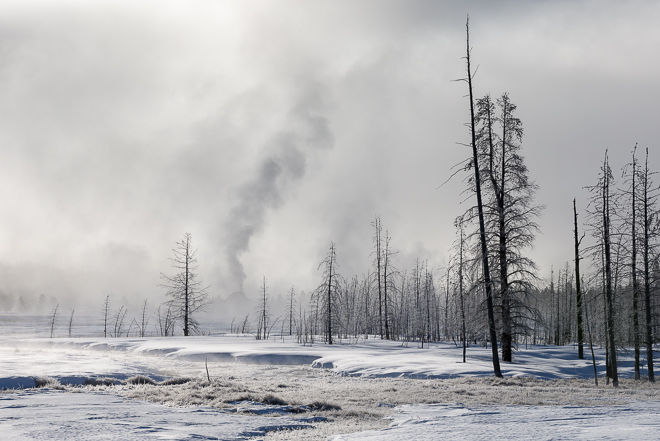 Our plan was to photograph both the landscape and wildlife found in the park and take advantage of the winter snowfall. When visiting Yellowstone in winter there is a sense that you have almost crossed to another planet. The landscape is hushed by a thick blanket of snow. The trees are wreathed in frost and loom like wraiths against the ominous winter clouds. The crisp, icy air enhances the effect of the geothermal features. There is an exotic combination of mist-shrouded hot pools, bubbling paint pots and steaming fumaroles that is the ideal setting for winter landscape photography.
 During this trip we explored the northern part of Yellowstone in the Lamar Valley as well as Mammoth Hot Springs, Old Faithful, Madison Valley and the Firehole River Basin. We also journeyed into the Grand Teton National Park. We had planned to also visit the national Elk Refuge, however the lack of snow this particular season worked against us and we decided to give this a miss and focus on areas with better snowfall instead.
 During our time in Yellowstone we spent several days in the Lamar Valley area photographing both the landscape and wildlife. We were fortunate to see and photograph the Lamar Valley wolf pack on several different occasions as well as Big Horn Sheep, Red Fox, Coyote and Moose. Although the wolves kept a respectful distance it was still a wonderful experience to watch wild wolves in the snow covered landscape. Just as an aside, It was almost as interesting to observe the cult of wolf watchers with their spotting scopes that prowl the Lamar Valley road in the hope of even a glimpse of these elusive animals. I am still sorting through the images I captured of the wolves and I hope to share a few in a future post.
 During the workshop we also spent several days in the Old Faithful area visiting and photographing many of the geothermal features. Geothermal features photograph extremely well with snow and ice. There is a wonderful contrast between rising steam and a snow covered landscape that adds that magic element and wonderful contrast to a photograph.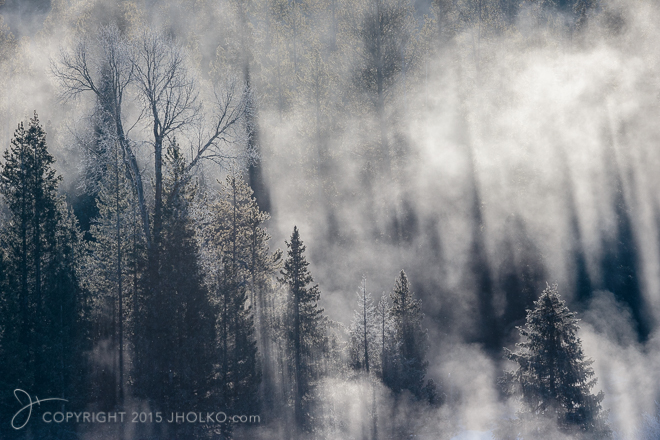

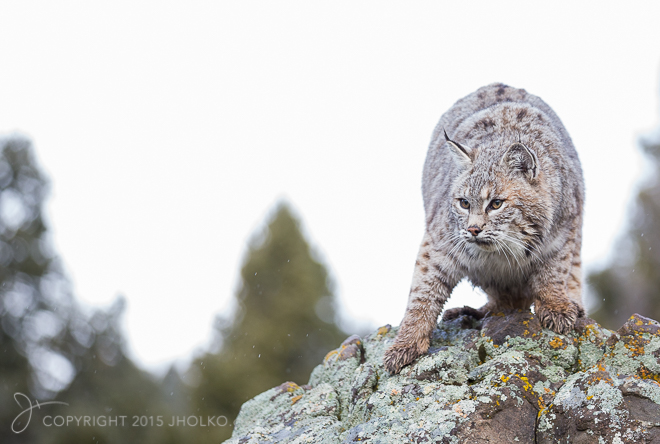 Yellowstone in winter was a fantastic experience and is a truly remarkable place that offers limitless possibilities for photography of both wildlife and landscape in winter. I will be leading a future workshop to Yellowstone for a small group of people in Winter in January of 2017. This workshop will also include an extension into the Grand Teton area that will also take us to the spectacular and iconic Mount Moran area. If you would like to get the drop on the option of securing a place when details are finalised then please just drop me an
 www.WILDNATUREPHOTOTRAVEL.com