The all new workshop we are running early next year in February 2026 in northern Iceland to ‘Sletta’ for Arctic Fox is now sold out – thank you.
We are offering this workshop again in February 2027 and have now opened this up for bookings (full details on our website). This is very much a deep dive into Arctic Fox photography that we take just four people on every year. On this workshop you can expect hours of photography opportunities every day. A rare and immersive experience tailored for photographers ready to refine their craft. Set against the dramatic coastal cliffs and windswept tundra of one of Iceland’s most remote and visually striking Arctic fox habitats, this workshop offers unparalleled access to both blue and white morph foxes in the wild. With limited group size, expert one-on-one guidance, and field-tested strategies for mastering light, composition, and animal behavior, this is not just a chance to photograph foxes—it’s an opportunity to transform your approach to wildlife photography entirely. If you’re looking for the workshop that will challenge and inspire you creatively, this is it.
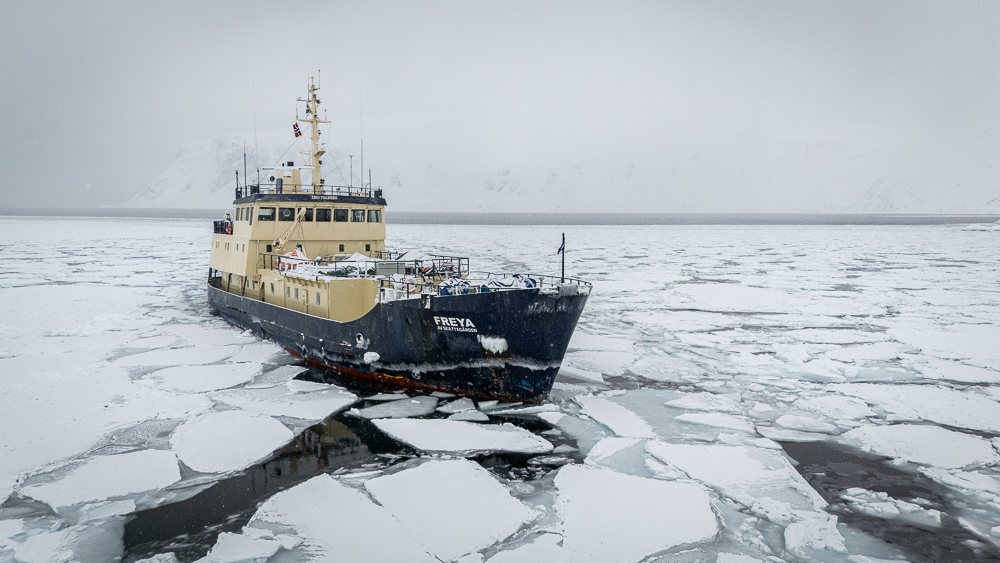
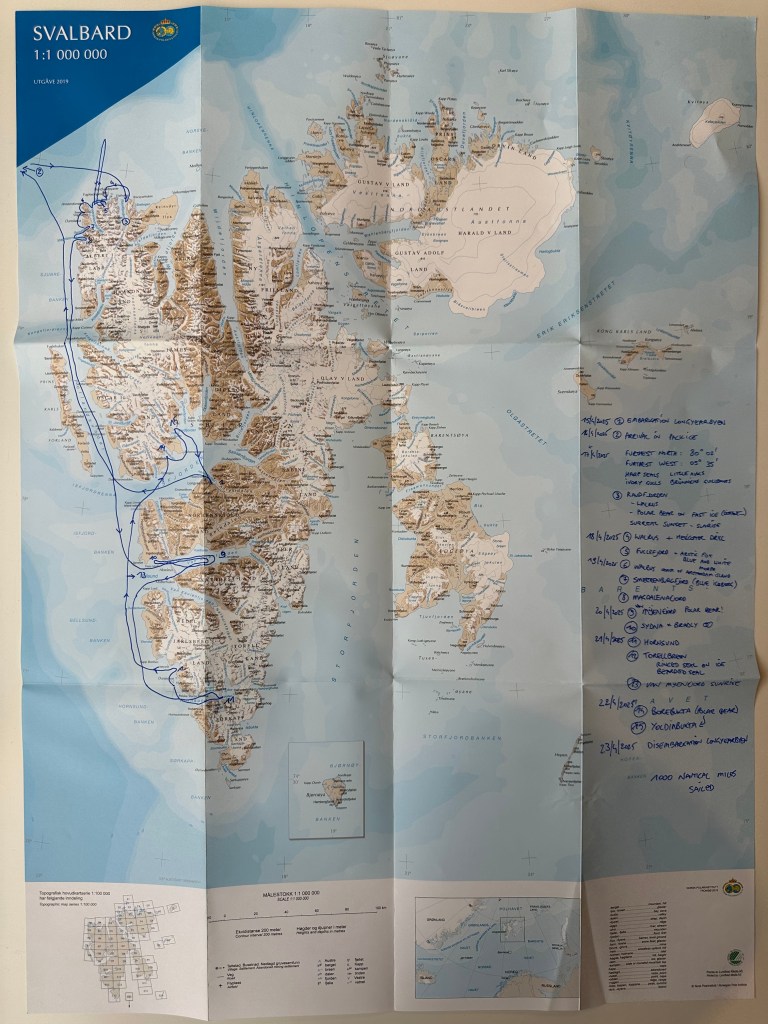
In the heart of the High Arctic, under a dome of soft grey skies and amidst the ghostly hush of falling snow, our April 2025 Svalbard winter expedition aboard the venerable M.S. Freya delivered one of the most unforgettable polar experiences in recent memory. This journey, which spanned over 1,000 nautical miles through the ice-choked fjords and remote coastlines of the Svalbard archipelago, offered a profound immersion into the raw, elemental beauty of the Arctic. Our vessel carved its way through frozen seascapes, bringing us deep into the polar wilderness, far beyond the reach of most travelers.
The expedition was marked by a gentle yet relentless Arctic quiet, broken only by the distant cracking of sea ice and the occasional calls of returning seabirds drifting on the wind. For those of us who return to Svalbard year after year, this trip stood out not for its dramatic apex predator encounters—though three polar bears were spotted at a distance—but for its rare and deeply moving walrus experiences, the likes of which we have not witnessed in over a decade.
Svalbard’s walrus populations have steadily rebounded in recent years, thanks to concerted conservation efforts. Yet it is still unusual to find them during the winter months when sea ice is more dominant and access to haul-out sites more difficult. This year, however, was different.
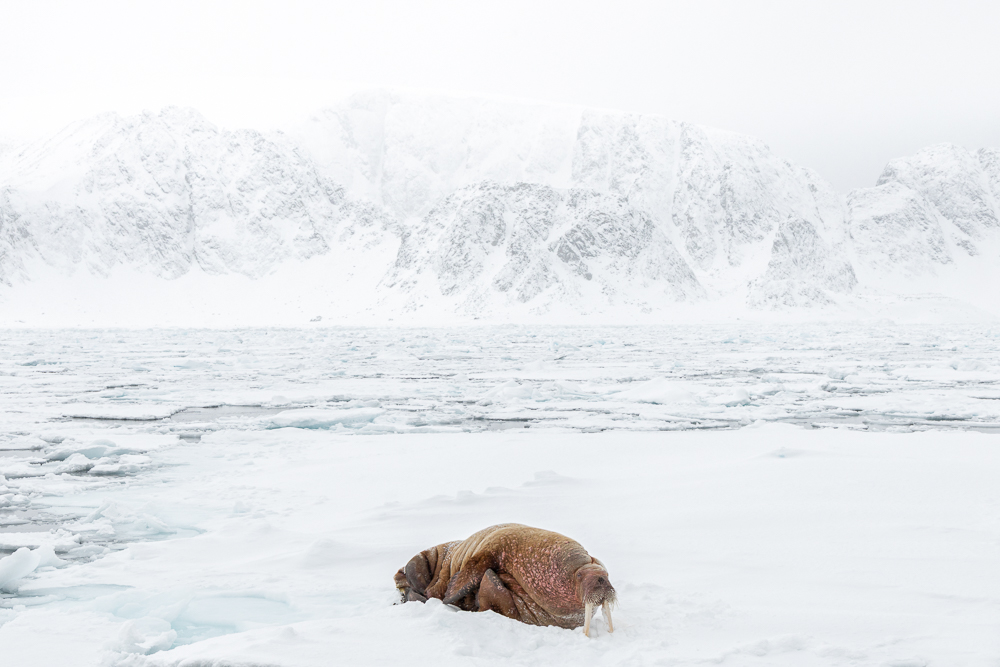
On multiple occasions, we were graced with close, extended encounters with walrus resting along snow-covered ice floes. What made these interactions truly magical was the weather: soft, steady snowfall that blanketed the entire scene in a delicate hush, muting the world and rendering the encounters almost surreal. These conditions, rarely aligned, offered dreamlike opportunities for photography. The walrus, with their richly textured hides dusted with snow, lay peacefully as we watched from our ship, their breath curling visibly in the frigid air.
Photographically, these moments were gold—low-contrast palettes of greys and blues, punctuated by the soft white of snow, created minimalist compositions that spoke of the essence of the Arctic in winter. No dramatic light was needed; the mood and texture carried everything. Many in our group expressed that these were the finest walrus encounters they had ever experienced. I would have to agree.
This expedition was never about chasing wildlife in numbers, but about immersing ourselves in whatever the Arctic chose to reveal. And although polar bear sightings were sparse—just three individuals were seen, all at significant distance—each encounter served as a poignant reminder of their quiet dominion over this landscape. Their tracks, however, told other stories. We crossed few fresh trails along beaches and sea ice, including one particularly striking set that meandered along snow-covered ice at sunrise, untouched and perfect in the soft light.
The polar bear is the undisputed icon of the Arctic, and while some may measure success by proximity or frequency, I have always believed that the real gift is simply to be in their world, to tread respectfully and recognize their sovereignty over these wild lands. With the increasing intrusion of tourism, industry and science into Arctic ecosystems, such moments—even distant—hold immense value.
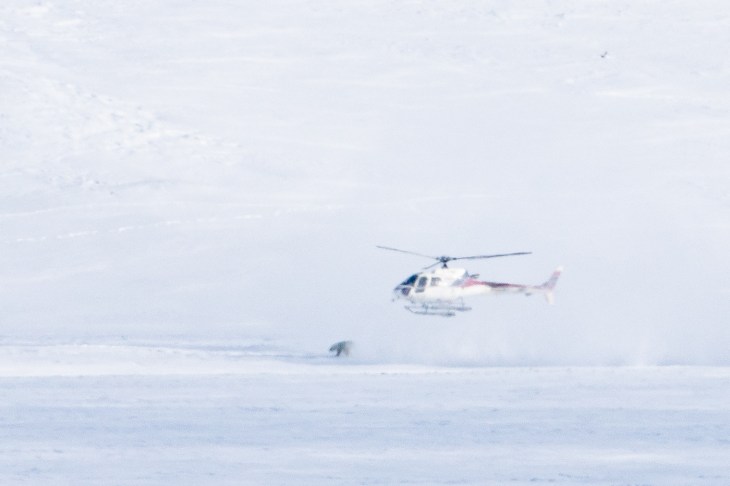
It is, however, impossible to discuss this year’s polar bear encounters without acknowledging a deeply troubling incident that occurred during our expedition. A widely condemned event involving a helicopter harassing a polar bear in the Svalbard region sent shockwaves through the wildlife and conservation communities. Images of the helicopter hovering aggressively over the bear, clearly disturbing its natural behavior, was both heartbreaking and enraging.
Such actions are antithetical to everything we stand for in responsible Arctic travel. They highlight the urgent need for stronger regulations around scientific research and more rigorous enforcement to protect vulnerable species from thoughtless human intrusion. As stewards and storytellers of this environment, we must be loud in our opposition to such behavior and unwavering in our commitment to ethical field practices. The Arctic gives generously to those who approach with humility; it turns cold and silent to those who do not. A full accounting of this encounter has been documented HERE. It has also been sent to the Governor of Svalbard, and news agencies around the world. It has been published by the NRK in Norway and the Svalbard Posten. To date, the only response from the Governors office has been a short statement that “they are looking into the incident.”
What this expedition lacked in high-density wildlife sightings, it more than made up for in landscape photography. Svalbard’s mountains, encased in thick coats of snow and ice, appeared every bit the guardians of the north—stoic, jagged, and infinitely photogenic. Every fjord we entered revealed new variations of winter’s mastery: towering cliffs draped in icicles, frozen waterfalls cascading in silent defiance of gravity, and icebergs locked in sea ice like sculptures waiting to be discovered.
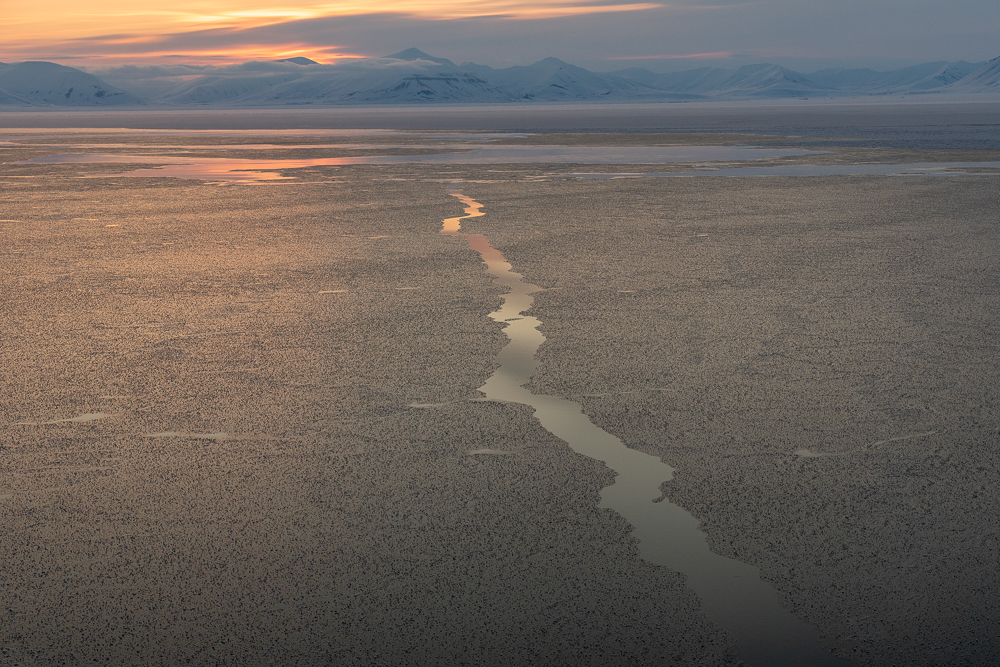
At times, the weather closed in, surrounding us in a soft monochrome mist that stripped the landscape to its essential forms. At others, the skies opened just enough to allow ribbons of pastel light to skim across the snowfields. These fleeting moments of light—never dramatic, but always subtle—offered those patient and attuned enough the chance to make quiet, powerful images.
Each evening, as we gathered in the warm dining room of the Freya, trading stories and reviewing the day’s experiences, there was a shared sense of reverence for the landscape we were privileged to explore. We had come seeking solitude, wildness, and truth—and the Arctic had provided, in its own sparse, magnificent way.
This expedition reminded me, as it does each year, that Svalbard in winter is a place of paradox: stark yet tender, harsh yet comforting, desolate yet full of life. It is a place where patience is rewarded, where minimalism sings, and where every track in the snow tells a story worth listening to.
As we completed our 1,000 nautical mile journey and began the long voyage back to Longyearbyen, I was struck once again by the importance of returning—not just physically, but mentally and spiritually—to places like this. Places where the wild still rules, and where we are reminded, as always, that the greatest gift of the Arctic is its silence—and how it teaches us to listen.
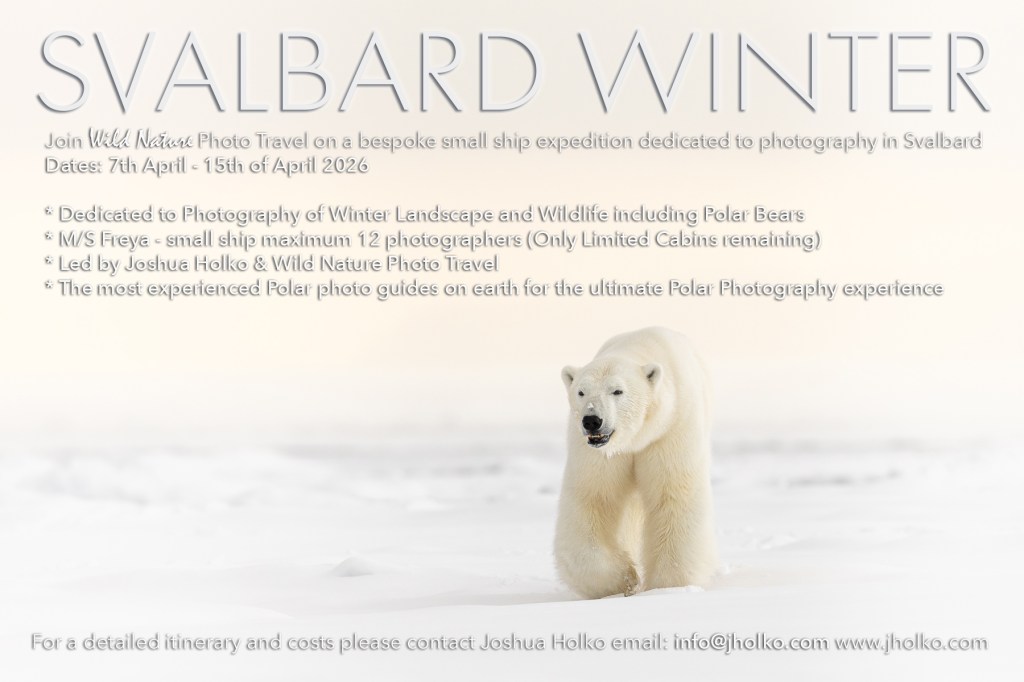
We will return again next year 2026 to lead another winter expedition aboard M.S Freya in search of miraculous wildlife encounters and ice covered landscapes. This is a rare opportunity to explore one of the Arctic’s most remote and pristine landscapes at the height of its frozen majesty. Designed specifically for keen nature and wildlife photographers, this small-group expedition offers intimate access to Svalbard’s breathtaking winter wilderness, including encounters with walrus, Arctic foxes, and polar bears, all set against a backdrop of towering snow-covered mountains and sculpted sea ice. With 24-hour twilight and the potential for moody, ethereal light, this is a once-a-year chance to capture the Arctic in its most cinematic and atmospheric state. Guided by Wild Nature Photo Travels extensive field experience and deep knowledge of polar conditions, this trip is not just a photographic expedition—it’s an immersion into the raw soul of the Arctic. Spots are extremely limited. Adventure with purpose—photograph with intention.
Today, I just wanted to share some wonderful positive feedback I received from our just completed April, 2025 Wild Nature Photo Travel expedition to Svalbard (Trip Report coming in the next few days). Shared experiences like this are the reason I started this company and continue to be the driving force for taking photographers into some of the wildest and most remote locations on our planet. Thank you to Andy and Jennifer for taking the time to write such wonderful feedback.
“Dear Fellow Pilgrims on the Svalbard Sojourn, And so it goes, as one might mutter in a post-epic journey haze, that we find ourselves penning this note, our hearts still adrift in the icy dazzle of April’s photographic odyssey to Svalbard—a place so starkly, absurdly beautiful it could make a grown man weep or a cynic reconsider their trade. We’re trying, in our fumbling, human way, to stitch together a thank-you that does justice to the kaleidoscopic wonder of what we all shared. Spoiler: words are flimsy things, like paper boats on an Arctic swell, but we’ll give it a go.
First, a nod to Joshua and Susy, our intrepid guides, who didn’t just lead us through the frostbitten wilds but opened their journey to us, letting us piggyback on their passion like hitchhikers on some cosmic road trip. You didn’t just show us walruses lolling on ice floes or the ice bear’s ghostly shimmy; you gifted us a lens—literal and otherwise—through which to see our fragile world anew. And to every soul on this expedition, from the gear-hauling, tripod-toting shutterbugs to the quiet ones who whispered awe at the edge of a glacier: you made this thing hum. You were, to borrow from that old B.W. Stevenson tune, the embodiment of “Everyone is helpful, everyone is kind / On the road to Shambala.” Svalbard, with its endless snow and light that bends time, felt like a glimpse of that place. Each click of our shutters, each shared fika of coffee in the bone-chilling cold, was a step on that road. We weren’t just chasing images; we were chasing renewal, love, the kind of adventurous spirit that makes you feel, for a fleeting moment, like you’ve cracked the code to being alive. And you all—every one of you—were kind, were helpful, were the sort of companions who make a journey feel like a destination in disguise. Our gratitude is a clumsy, oversized thing, too big for this page, but it’s real. We wish you all safe travels, continued success, and more journeys that feel like Shambala’s just around the bend. Keep chasing the light, literal and otherwise. – Andy & Jennifer”
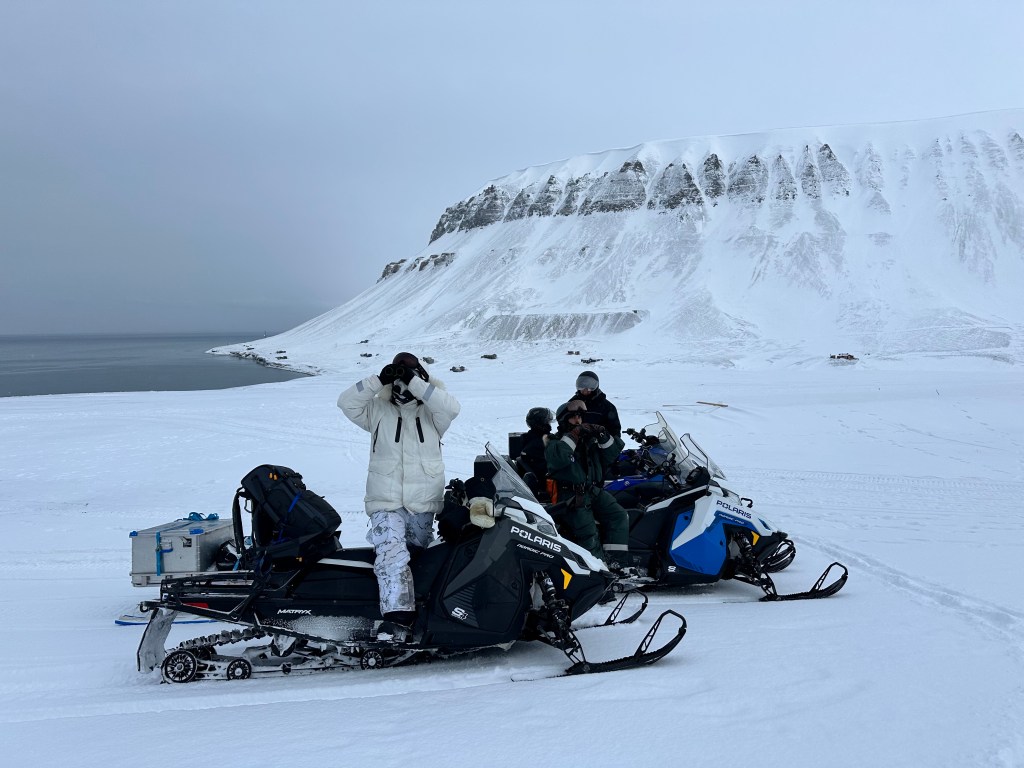
There are few places on Earth that match the wild, remote, and brutally beautiful snow and ice covered landscapes of Svalbard in winter. Nestled deep within the Arctic Circle, this archipelago is a realm ruled by ice, wind, and wildlife. This April, I had the privilege of leading a private snowmobile expedition across this frozen frontier—a journey that would see us travel over 500 kilometres, find more than a dozen Arctic foxes, encounter reindeer and ptarmigan, and face the full spectrum of Arctic weather, from golden light to whiteout blizzards.
From the moment we arrived in Longyearbyen, the sense of isolation and adventure was palpable. The eve of an expedition is always an exciting time with the great unknown ahead. The air was sharp and cold, the light already tinged with the ethereal glow of Arctic spring. With 24-hour daylight just around the corner, we were on the cusp of the long polar day, and we planned to make the most of every usable hour. By April the sun no longer truly sets in Svalbard, which means there are hours of golden light available for photography. It also means we can work well into the night, taking advantage of times the wildlife is at its most active.
Our days were often long—starting at 5 a.m. and often not wrapping up until midnight—but the light was at its best during these hours. As any serious wildlife photographer knows, great light and great wildlife don’t run on a 9-to-5 schedule.
We travelled by snowmobile, fully outfitted in cold-weather gear, carrying camera equipment, safety gear, and enough fuel and supplies for extended runs. We based ourselves in Longyearbyen and made daily sojourns out into the wilderness in search of wildlife. Navigating the ice-covered landscape by snow mobile requires concentration and no small amount of stamina. But the reward? Untouched terrain, and wildlife in its most raw and natural form.
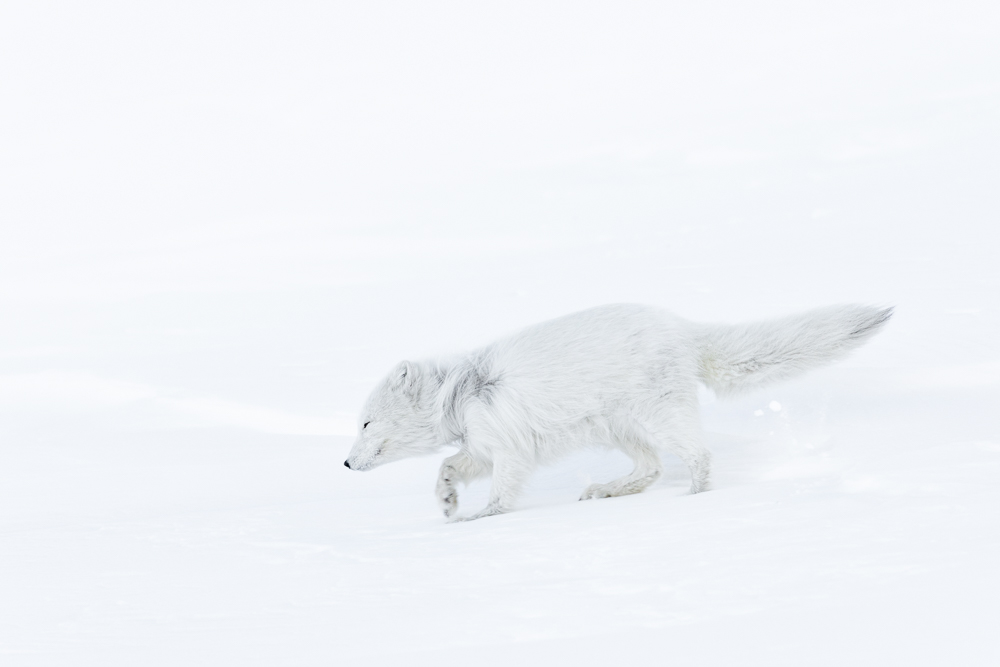
One of the primary goals of this expedition was to photograph Arctic foxes in their natural habitat. By the end of the trip, we had seen more than a dozen individuals—an incredible result in such a vast and challenging environment. These foxes, well-adapted to the cold and the shifting seasons, were in prime winter coat: a thick, snow-white camouflage against the terrain. This makes them hard to spot, but also incredibly photogenic in the snow covered environment.
One particularly encounter took place near a windswept ridge on the outskirts of Barentsburg, where we found a young white morph fox near the coastline. We set up low, using the terrain for cover, and waited. The fox came close—curious but cautious—offering a string of intimate moments that translated into some of the most compelling images of the trip. During this encounter we had to work quickly as there was a freezing wind that plummeted temperatures and numbed the fingers in moments. Despite the cold, some incredible images resulted from this encounter.
Another highlight came in the aftermath of a fresh snowfall. As we neared the town of Barentsburg, we spotted a fox high on a ridge line – watching from above. The soft light and pristine conditions gave the scene a dreamlike quality and a wonderful opportunity to show the fox in the landscape. It’s in moments like these that make wildlife photography in the Arctic such a joy.
While Arctic foxes were our primary focus, we were also treated to many memorable encounters with Svalbard reindeer in absolutely superb conditions. These smaller, stockier cousins of mainland reindeer are uniquely adapted to the harsh environment. We found several groups grazing through the snow-crusted tundra, their thick coats catching the snowfall.
Photographing them in the early hours and during the long twilight evenings, we were able to create evocative portraits against the vast, open white landscape amidst swirling snowfall.
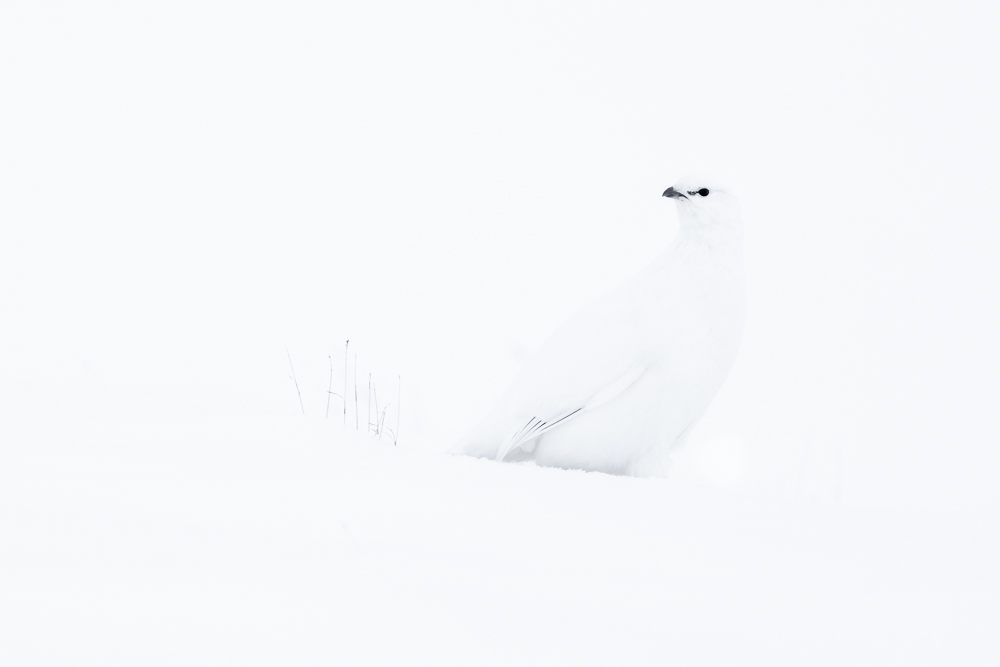
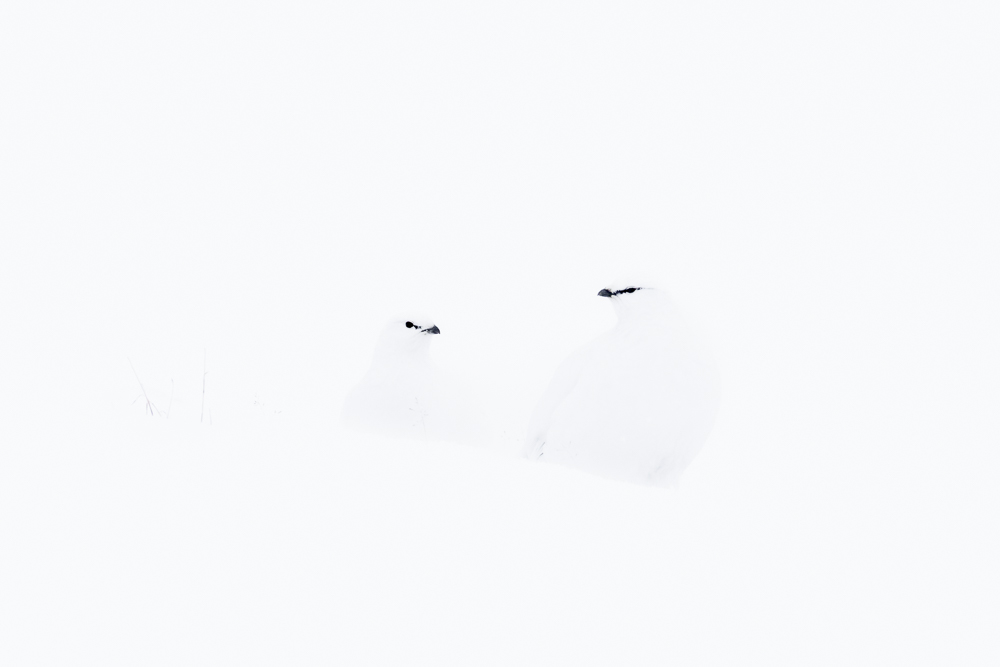
Ptarmigan, often overlooked, became another fascinating subject. With their feathered feet and perfectly camouflaged plumage, these Arctic birds offered opportunities for intimate ground-level compositions. Catching one mid-fluff or just as it shook free a dusting of snow made for dynamic, storytelling frames that added variety to the trip’s portfolio.
Of course, no Arctic expedition would be complete without a taste of the extreme. One full day of our trip was lost to a powerful whiteout winter storm that swept through the region. Winds howled across the open landscape, visibility dropped to near zero, and temperatures plummeted well below -35°C with windchill. Of course, we ventured out to experience the storm, but photography was impossible and we returned to the safety of town after our winter storm experience.
We hunkered down in our base accommodation—frustrated by the lost shooting time, but deeply aware that this, too, was part of the Arctic’s story. When the storm finally passed, it left behind a transformed world. The landscape had been reset—smooth, sculpted by the wind, and freshly dusted with snow. This shift opened new possibilities for minimalistic compositions, and our fox sightings resumed with a renewed sense of wonder.
Our routine became a rhythm of extremes—early starts, long snowmobile journeys, and frequent stops to assess terrain, scout for wildlife, or simply pause and admire the view. The focus was always on maximizing opportunities while respecting the environment and the wildlife. This private snowmobile expedition was not just a photography tour—it was a true Arctic experience. From the exhilaration of racing across frozen fjords to the quiet joy of lying in wait as a fox crests a snowbank, it was a journey that tested us, thrilled us, and left us with a deepened connection to the polar world.
As the snowmobiles rolled back into Longyearbyen for the final time, we were exhausted but elated—changed in ways we hadn’t expected. That, more than anything, is the hallmark of a truly great expedition. We will be running another snow mobile expedition for Arctic wildlife in 2026 in Svalbard. The expedition will again see us based in Longyearbyen, making daily journeys out in the field in search of wildlife. The expedition will run from April 1st until April 5th, 2026 and is limited to just three participants. Full details are now available on the website HERE.
I have just published episode 121 of my Wild Nature Photography Podcast. In this episode, I recount the full event of the harassment and sedation of the Polar Bear by the Norwegian Polar Institute on my recent April Svalbard expedition (Full Trip Report Coming Soon). This is a true and accurate recounting of the events as they unfolded in front of my eyes and the eyes of twelve other photographers (plus the ships captain and first mate) from the bridge of the expedition ship M.S Freya. You can sign the petition HERE.










 www.WILDNATUREPHOTOTRAVEL.com