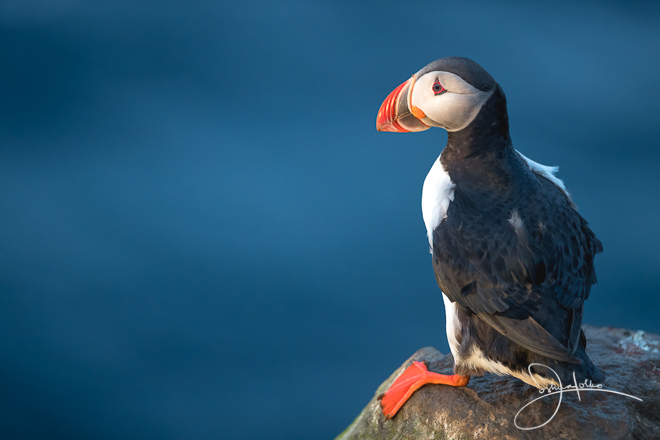
Recently, Daniel Bergmann and I completed a brand new workshop to photograph Atlantic Puffins and other Arctic birds at several different locations in Iceland that included the remote northern Grimsey Island, inside the Arctic circle. (Read the trip Report). The workshop was a great success and as such we have decided to offer a new workshop next year that will take us back to Grimsey Island to photograph both the wildlife and incredible landscape of this remote island. As well as Grimsey Island we will also spend time in Myvatn in the north of Iceland – One of the best places in the world to photograph Arctic birds. Grimsey Island in particular is one of the most spectacular locations I have visited in Iceland with towering cliffs that rise hundreds of feet out of the ocean and incredible basalt columns. It is a wild and primordial landscape that is rarely visited and even less rarely photographed. This photography workshop will last for eleven days (ten nights). We will be staying in good hotels and guest houses that are functional and clean. Breakfast, lunch and dinner are all included and will generally be held at the hotels where we are staying. However, this workshop is all about photography and we will be putting in long hours in the field in order to ensure we get the best possible light for photography. We may take food and drink with us into the field to ensure we are in the right locations get the best possible light.
 The cost for the workshop is $9,490 US Dollars. This is an all-inclusive price, but excluding your airfare to and from Akureyri, Iceland. From the moment the workshop begins until its end, 11 days later, all costs are included — transportation, food, drinks (excluding alcoholic beverages), and accommodation, which is based on a single room per person (shared rooms at Grimsey Island).
 Our workshop is strictly limited to a maximum of eight photographers with the first few places already spoken for and pre-sold. The last remaining places will be filled on a first come, first served basis. A complete itinerary and information PDF can be downloaded HERE. If you would like to join us and photograph both the landscape and wildlife of Grimsey Island please drop me an email to register or express your interest.
Category: Landscape Photographs
Landscape Photographs from around the World
The Toughest Print…
As many of my regular readers, friends and fellow photographers know, I love to print. For me, the photographic print is not only the final end result of the photographic process, but is importantly the ultimate expression of my work. The online jpeg is nothing more than a poor facsimile of the finished fine art print; where as the finished print is the medium in which I prefer to have my photography viewed. I really wish I could more easily share my printed photographs with a broader audience(Facebook needs a print sharing service!) and whilst it is possible to visit one of the galleries that represent my photography it is not always convenient or possible; especially for those that are not local.
I have in the past written about my need to print and spoken to the fact that I never really feel like I have finished with a photograph until I have made a print. The journey and process is extremely satisfying to me and the print is the final finish line for each photograph. Honestly, not every image makes it over the line, but those that do give me a great deal of satisfaction.
Over the last few days I have been working on a particular print that has proven to be the most difficult of my career thus far and I want to share how I finally achieved the perfect print of this photograph. It’s not a photograph that translates well in an online jpeg (unfortunately the jpeg compression destroys the tonalities), but it is simply wonderful in its final finished printed form. The photograph was taken last winter in Svalbard during my snow mobile expedition and is a layered white-on-white arctic landscape. The landscape was bathed in a very soft ethereal light when I made this photograph and contrast was extremely low. Super dense cold air hung low in the valleys and a subtle gentle fog softened the distant mountains. The darkest part of the scene was a distant rocky ridge-line, but even it was many shades above black. As a result the scene was high-key, yet it contained no harsh whites or blown out areas. Honestly, outside of getting to this remote location and the freezing temperature (around -30º Celsius) it was not a difficult photograph to make. It has however been a complete bear to process and print. There are literally hundreds of shades of different white in the photograph with extremely delicate tonalities that require just the right amount of finesse to print. Anything less than perfect results in flat areas that lack depth. The heart of the problem is that inkjet printers are not equipped with white ink. So, the whitest white one can achieve in an inkjet print is the natural white of the paper you have chosen (and not all papers are created equal). Hence, paper choice is a critical factor in the fine art printing process. Whilst it is true that lustre and gloss papers have a better d-max (better, deeper blacks) than matt papers I vastly prefer matt papers for their art feel, surface texture and softer finish. I personally find lustre and gloss papers (even the expensive Baryta papers) take away from the evocative feelings I want to portray in my work. As a result virtually all of my printing is on matt paper – specifically Moab Somerset Museum Rag. Somerset Museum Rag is a 300 gsm fine art paper with a subtle surface texture and a wonderfully high white point (with a good solid black point for an art paper). I have been printing with Museum Rag for many years and I have a very good understanding of the capabilities and limitations of this paper. It is absolutely ideal for printing snow and ice images in my experience.
Before I describe the process by which I achieved what I feel is the perfect print of this photograph I want take a few steps backward and start at the beginning of the process. The real key to making a fine art print is to start with a great capture. Anything less than a great capture will never be a great print – period. By a great capture, I mean an image that has been well exposed with its histogram biased towards the right hand side (without clipped highlights) , sharp where it needs to be and free from excessive noise. Once you have a great capture you need to carefully process the RAW file to bring out the best in the photograph (a totally seperate skill to the capture process). In the case of this photograph I took extreme care with contrast and highlights to gently pull out all of the subtle tonalities in the highlights in the file. There would be a strong temptation amongst many to bring down the blacks in this file until the rocky ridge-line had a hard deep solid black; but thats not how the scene was in reality and such artificial contrast would look extremely unnatural. As subjects get further away from our eyes they naturally loose contrast and bleed off into the distance. Artificially adding too much contrast will add impact, but it does so at the expense of image depth so you have to tread very carefully. This is of course an artistic decision, but in my case I wanted to print the scene as I remembered it and not create something that did not exist in Nature. All up, I probably spent an hour or so processing and re-processing this file until I was happy with the end result. Only then can you consider making a fine art print of the photograph.
At this point the first thing you need (other than an actual printer) is the best profile for your printer, paper and ink that you can lay your hands on. On no account should you compromise on the quality of the profile and on no account should you even consider using a canned generic profile. You absolutely must have a custom made high quality profile that you either made yourself, or had someone (who knows intimately what they are doing) make for you. I make own own profiles with an X-Rite ISIS2 and with a friend using his Barbieri Spectrophotometer. There are key differences between these units so I use both depending on what paper I am profiling.
Assuming you have ticked all the above boxes how do you then print a photograph that is basically a thousand shades of white on a piece of white paper with a printer that doesn’t use white ink?
The answer is you have to understand what the white point of your chosen paper is and what is the brightest white you can print on that particular paper. Without this information you have little chance of actually rendering all those subtle white tonalities and shades in the print. In my case, I started by actually measuring the white point (and black point) of Somerset Museum Rag which turned out to be 90.3 with a Dmax of 3.2. I then used this information to modify my custom profile to ensue my whites would not be blown out during printing.
I then created a test chart as below that has shades of white and black from 0 (black) to 255 (pure white). I then printed this test chart with my custom modified profile for Somerset Museum Rag, allowed it to dry and then critically examined it in my Graphiclite print booth to see how much highlight and shadow gradation I was actually achieving. In my case (and with my eyes) I can see highlight detail in my test print all the way up to 253 and shadow detail all the way down 5. Anything below 5 is the same shade of black to my eyes as the 5 shade. In the highlights anything above 253 (254 and 255) appear as paper white to me. This is an exceptional result on a matt paper and is testament to the quality of the profile used to make the print. Armed with this information I now knew that anything in my file that was above 253 would render purely as paper white and anything below 5 would render as a solid black. In this photograph the blacks are actually all but irrelevant since the darkest shades in the photograph are well above this (but it is an interesting exercise to understand for prints with dark tonalities). I then soft-proofed the image in photoshop with my custom profile and the Relative Colorimetric rendering intent and used a levels adjustment to tweak the highlights. In essence I manipulated the brightest tones in the photograph to bring them down to a point where I could see tonal gradation on the paper. I then used several curve layers to increase highlight contrast in certain tones to compensate for the fact that the front lit paper has a lot less contrast than the back-lit LCD screen. Great care had to be taken with these curves to ensure I kept my highlights under the paper white level. I then made a number of test prints of the photograph making small subtle adjustments to the curve layers to better render the tonalities in the extreme highlights. This was an iterative process that took quite a few prints to get just right.
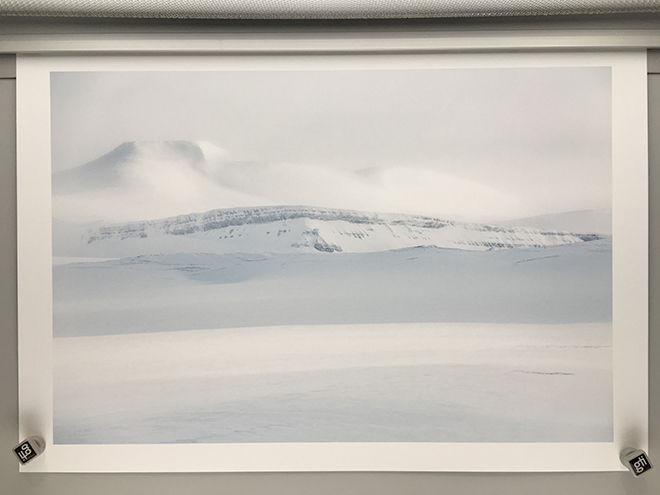 The end result is to my eyes absolutely perfect in terms of its rendition of tone in the highlights. The soft ethereal mountains are perfectly rendered with all of the mystical feeling I remember when I took the photograph. The rocky ridge-line and gentle snow slopes blend their shades of white perfectly; with the foreground having just the right amount of texture and tone. Although I would never enter this print into a competition (most judges would fail to grasp the difficulty of the print) it was one of the most rewarding I have made in recent times.
If you are not printing your work I urge you to make a start and get those 1’s and 0’s off your hard drive and onto paper where they can fully be appreciated. It is absolutely one of the greatest joys of photography.
Ultimate Puffins of Iceland 2017 Workshop Report
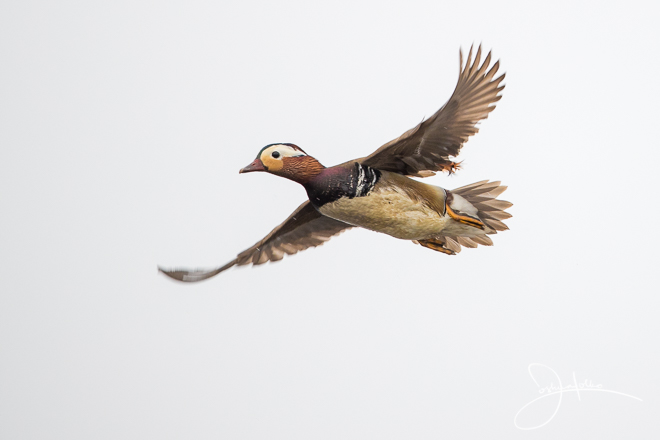
In May of 2017 Daniel Bergmann and l lead a new workshop to the north of Iceland specifically to photograph the Atlantic Puffin and other Arctic bird species. Iceland is one of the best places in the world to photograph Puffins and other Arctic birds in their natural environment and late May is the ideal time to ensure plenty of action in the colonies. Our plan was to focus the majority of our attention on Puffins; although we also planned to visit several different locations around Iceland to photograph different species. We had outstanding access to the Puffins living in burrows on the edge of sea cliffs during this workshop and we had timed our trip to ensure we were in the best locations at the best times to photograph these wonderful birds. There is a lot activity in the bird colonies in late May and early June and we were not disappointed with the sightings and displays.Our workshop took us to a number of different locations around Iceland including the bird cliffs at Latrabjarg in the West fjords as well as the rarely visited northernmost part of Iceland – Grimsey Island. We also photographed at the Snaefellsness peninsula as well as several other lesser known wetland areas (for Red Throated Divers, Phalaropes and more). Our first stop after Snaefellsness was Flatey Island. Flatey Island is a great location to photograph Black Guillemots, Snow Buntings, Puffins, Arctic Terns and other common Icelandic breeding birds. We spent one evening at the island and photographed at both sunrise and sunset. At this time of year we were blessed with midnight sun and as such we were able to spend a great deal of time in the field (although we had to dodge the odd rain shower at Flatey island). I was fortunate to see and photograph the very beautiful Mandarin duck whilst at Flatey; which was definitely a highlight of this stop for me.
 From Flatey Island and the ferry port at the northern side of Breidafjordur bay we journeyed north to Breidavik, where we were based for the next three nights. From there we had superb access out to the magnificent seabird cliff Latrabjarg. This westernmost point of Europe is the home of millions of seabirds and is very well known for its Puffin colony. The cliffs are a spectacular location and rise 440m out of the sea and are approximately 14km long. We photographed many different bird species in this area and were also fortunate to encounter and photograph an Arctic fox on his evening patrol along the cliff edge.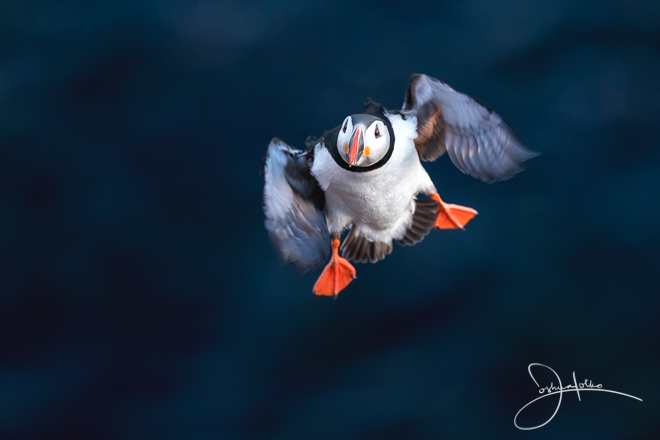
 From Breidavik we travelled to Dalvik to take the car-ferry out to Grimsey Island. This was my first time to Grimsey Island and I can say with a great degree of enthusiasm it was an incredible experience (I am itching to go back!) Grimsey Island is located just inside the Arctic circle and is approximately three and a half hours by car ferry from the northern most part of the mainland. This small island is home to literally thousands of Puffins, Razor bills, Black Guillemots and more. It offers an amazing array of sea cliffs with access from sea level to giant cliffs that soar more than 400 feet high. At this time of year the towering bird cliffs are perfectly aligned with the midnight sun and as such there are simply magnificent opportunities for both wildlife and landscape photography in golden light.
 In order to easily access the entire island we took our super jeep on the car ferry which enabled us access to all of the cliffs and landscape of this incredible island. Accomodation on Grimsey Island for our workshop was a small comfortable and clean guest house that was perfectly situated for our needs. Although accomodation options on the island are extremely limited the guest house is extremely well equipped and was ideal for our workshop.
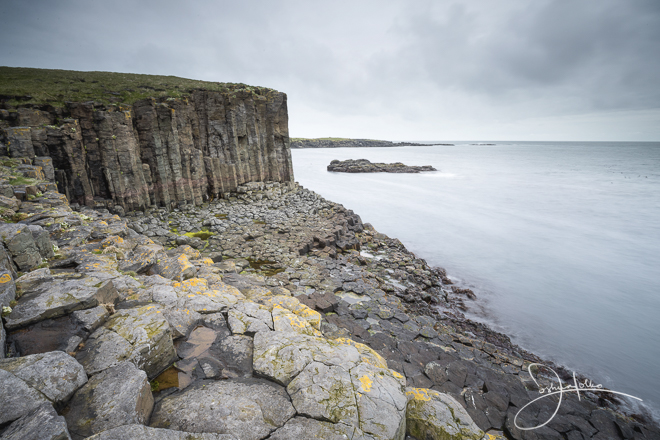
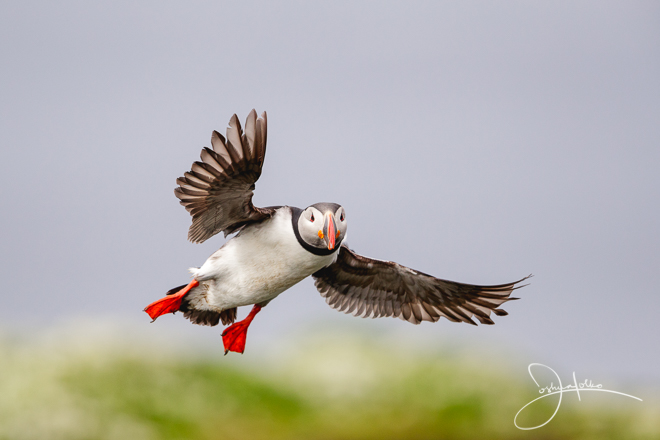 Grimsey Island is perhaps best known for its gigantic Puffin colonies; but there is also a fantastic landscape to photograph in just about every direction. Plunging sea cliffs, dramatic Arctic skies, spectacular basalt columns are all found in abundance. I was personally in awe of the landscape at Grimsey Island and found it thoroughly refreshing to be making photographs in an area so infrequently visited and photographed by tourists. In an era where Iceland is heavily touristed on the South coast it was blissful to be in the far north with a spectacular Island to ourselves for hours and hours of wildlife and landscape photography. During this workshop we saw and and photographed nearly fifty different species of birds. Our rarest sighting for the trip was the Sabines gull which we saw only briefly at Grimsey Island amongst a flock of black-legged Kitiwakes resting on the ocean (unfortunately none of us was quick enough to get a photograph). It was also fantastic to briefly encounter the Short-eared owl as well as the colourful Mandarin duck. Landscape opportunities were in abundance during our time at Grimsey Island and it was definitely an unexpected bonus to have such a fantastic landscape available.
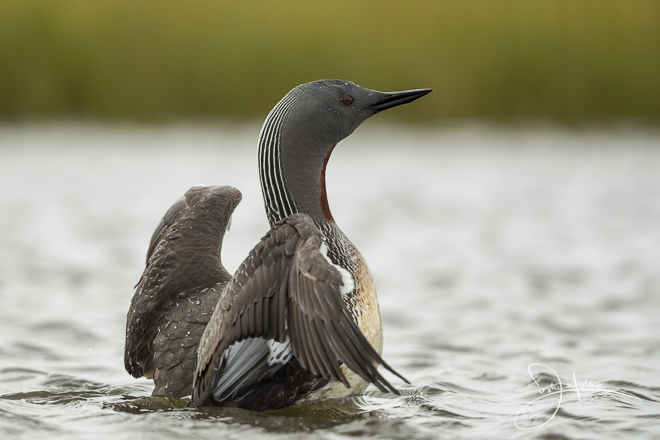
 On our last day during our return to Reykjavik we visited some wetland areas to photograph nesting red-throated divers.
 This was a remarkable workshop that offered up some fabulous wildlife and landscape opportunities. As such, Daniel and I have decided to return to Grimsey Island next year for a second workshop that focuses on both the birds of Iceland as well as the landscapes of this remarkable Island. We are currently finalising details, but if you would like to amongst the first to be notified once bookings are open you can register your interest now by dropping me an email at info@jholko.com
Lofoten Winter Workshop 2018 – SOLD OUT
My winter workshop to the Lofoten Islands next February is now sold out – thank you to all those who are joining Martyn and I on this workshop – we are really looking forward to it! The landscapes of Lofoten are really quite something to behold and with a dusting of fresh snow and arctic winter light the entire area is akin to a fairy tail location and subsequently the photographic opportunities can be truly superb. This will be second workshop I am leading to Lofoten (Read the 2016 Workshop Trip Report) and I am really looking forward to returning next year to this magical group of Islands.
Photo of the Month June 2017 – Ice Ahead
It is timely to have a landscape photograph from Antarctica as my photograph of the month for June both because I am currently reviewing my entire Antarctic Portfolio for a new large format fine art book to be released late next year and because I am starting to think about what equipment and lenses I am planning to take with me to Antarctica this November (this year I will also take with me an underwater housing which somewhat complicates the packing arrangements). This particular photograph was made last year on my Antarctica / South Georgia expedition from zodiac during overcast conditions and heavy snowfall on what was I felt our best day for photography. I used the Canon 11-24mm wide angle lens with the Canon EOS 1DX MKII camera held down low over the side of the zodiac just above the water line. I absolutely love the heavy brash ice in the foreground, the deep overcast sky and the beautiful shape and texture of the iceberg in the distance. I also prefer this sort of limited colour palette as I find it representative of the very best Antarctica has to offer (blue skies make nothing more than postcards). For me, these are the most evocative images of Antarctica that truly speak to me about the sublime beauty and ethereal tranquility of this stunning and most precious white continent.

 www.WILDNATUREPHOTOTRAVEL.com