The Spirit of Antarctica 2014 Expedition Report

In early December 2014 I led an expedition to Antarctica ‘The Spirit of Antarctica‘ with my good friend and fellow Nature photographer Antony Watson. This expedition departed from Ushuaia and saw us sail across the Drake Passage to the Antarctic Peninsula. We spent the next ten days exploring the incredible landscapes and wildlife of Antarctica before our return back across the Drake to Puerto Williams in Chile. We were quite fortunate with both crossings of the Drake and unlike my previous South Georgia Island expedition we really did not experience the ferocity that the Drake is so renowned for. Our crossings by comparison were quite mild which was manna from heaven for those of us who succumb to the occasional bout of sea sickness.

This expedition was a mixed group of photographers, climbers and kayakers which provided us with some unique opportunities to include the human element in our photographs. It also meant that we had quite a lot of room in our zodiacs for gear and equipment.

During this expedition we visited several new areas I had not been to before in Antarctica including Enterprise Island, Elephant Point and Useful Island. Enterprise Island turned out to be a really fantastic location where we encountered two humpback whales which played for a short time before they decided to head south. We also stopped to photograph the wrecked remains of ‘The Governor’ whaling ship. This abandoned hulk rests in the shallows of the island and provided wonderful subject material for our cameras. I normally choose not to photograph on blue sky days in Antarctica and instead soak up the beauty of the location but in this instance there was just enough interesting cloud to make a strong photograph. The key to this image was to ensure just the right angle on the ship and not to clip the reflection in the water. One of the wonderful things about zodiac photography is if you miss the shot on the first pass you can always have the driver turn the zodiac around for another go. If memory serves, we probably spent the better part of an hour photographing around the wreck remains. The wildlife photographers amongst us were thrilled with the nesting Antarctic terns and we also encountered a Crab Eater Seal on a nearby ice-flow. Enterprise Island is a location I am now looking forward to returning on future expeditions.

The GovernerElephant Point turned out to be another wonderful new location that reminded me very much of South Georgia Island. The beach was bedecked with Elephant Seals, Fur Seals and Gentoo Penguins when our zodiacs landed and there were outstanding opportunities for really intimate wildlife images with recently hatched penguin chicks. We even came across a vagrant King Penguin as we explored the area. Elephant Point is also a wonderful location to photograph Giant Petrels, Kelp Gulls and many other bird species. Personally, I spent quite a bit of time photographing the Giant Petrels during light snowfall. By far the majority of the photographers on this expedition had never visited South Georgia Island and this stop at Elephant Island really gave them a taste of the incredible Bio-mass one finds in South Georgia. I am leading a dedicated expedition to South Georgia Island this November and can’t wait to return. There are only two places remaining before this expedition will be sold out. You can read more about that expedition HERE.
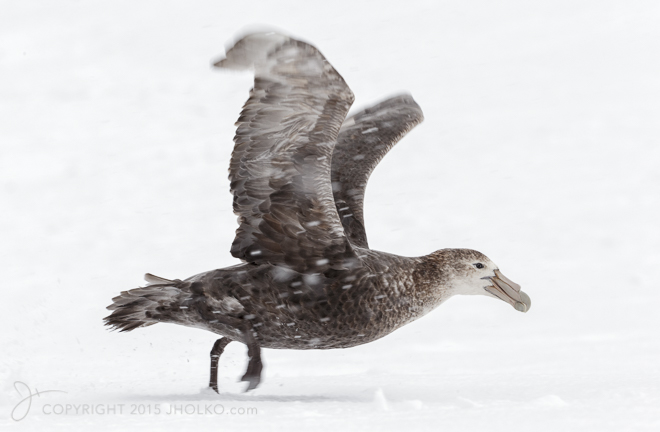
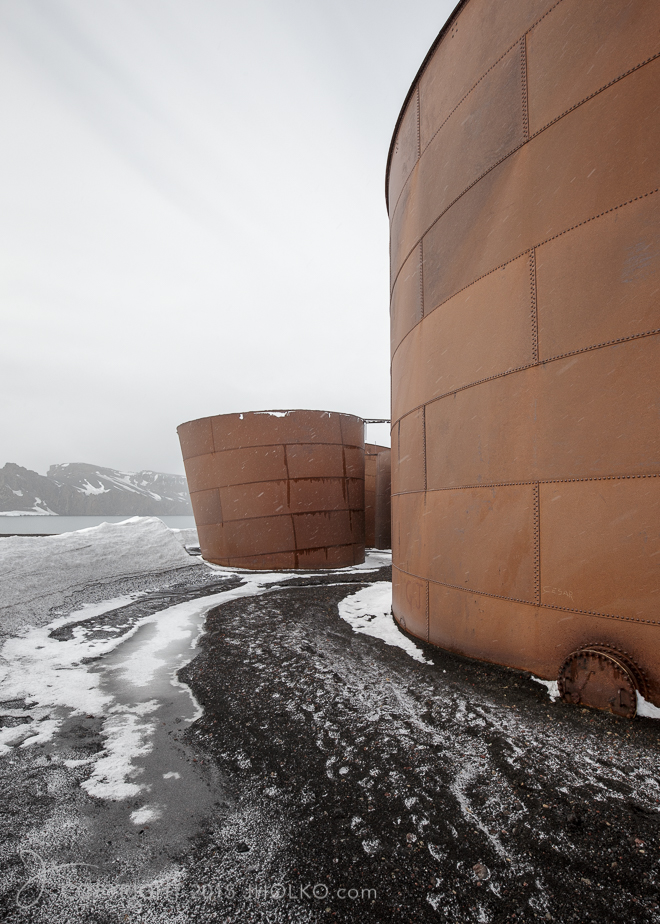
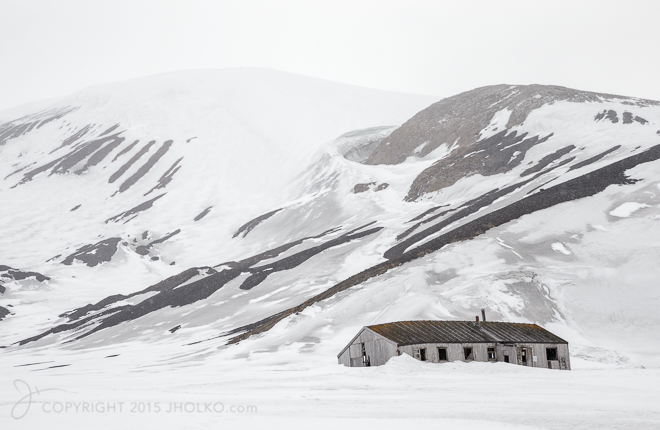
Giant PetrelWe also visited the geothermal caldera and remains of the whaling station at Deception Island during this expedition and were fortunate to have some overcast skies and light snowfall; which really added to the mystery and drama of this location. Deception Island is one of my personal favourite locations for photography in Antarctica. I actually wrote a short op ed. piece on this location earlier last month. This wonderfully surreal location offers virtually limitless opportunities for photography and its a great place to wander and explore. It has been interesting to watch the decay of the whalers remnants from visit to visit and year to year at Deception Island. My feeling is there is probably only a decade or two remaining before all that will be left is a few scraps of iron. Deception Island
One of the regular stops for Antarctica expeditions and one of my favourites for photographing penguins is Cuverville Island. Surrounded on just about all sides by towering mountains and hanging glaciers Cuverville Island is home to well over a thousand Gentoo Penguins and offers fantastic opportunities for photography amongst the many rookeries. We were fortunate to experience heavy snowfall during our stay here and some really fabulous photographs came out of this day. This photograph (my favourite from this Antarctica expedition) really captures the feeling of solitude one feels in Antarctica. I actually used this image recently in an article here on my blog ‘How to get Emotion and Mystery into your Landscape Photography‘ as an example of how to create evocative photographs.Antarctica-4470-Edit12014We even had an opportunity during this expedition to spend a night ashore camping at Useful Island for those who wished to partake in an overnight polar camping experience. From a photographic perspective this opportunity provided a great chance to work with the landscape and wildlife under the soft light of the moon and there is something quite surreal about falling asleep to the trumpeting sounds of Gentoo and Chinstrap Penguins.

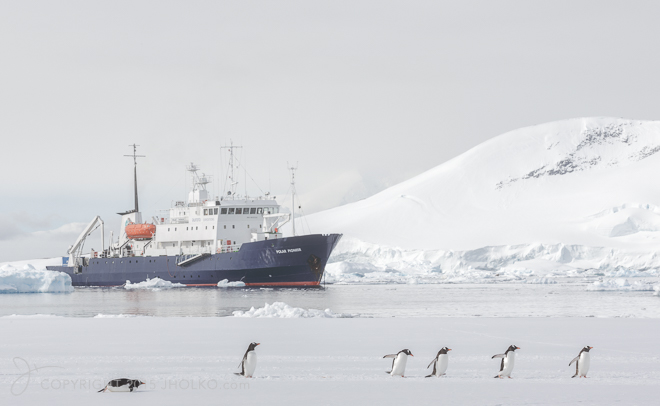
We also passed through the Lemaire channel during this expedition in wonderful conditions that even enabled us to have a BBQ on the back deck of the ship for dinner! This photograph of Gentoo penguins on the sea in front of our expedition ship was taken near the exit to the Lemaire channel in Pleneau Bay. This is an area I have visited on several other occasions, but this was the first time I have seen Penguins on the sea ice at this location.PolarPioneer and PenguinsAntarctic expeditions are always a unique experience. With the variation in weather comes a different expedition plan. These expeditions are fluid and its not uncommon for us to move from Plan A to B and C as the weather dictates. In this instance I think we got very close to sticking with Plan A for the duration of the expedition.
If you are interested in travelling and photographing in Antarctica, I will be leading a brand new expedition in February 2016 to the Weddell Sea – Antarctica The Wild Side. There are now only very limited places remaining before this expedition will be sold out. If you would like to know about this opportunity you can download a complete PDF itinerary and information flyer from my website HERE.

Just by way of a teaser and an easter egg for those of you who have read the trip review in its entirety: I am almost ready to announce a very special and totally unique opportunity for just four photographers to join me on a November 2016 expedition deep into Antarctica to photograph the mighty Emperor Penguins. This expedition will utilise a privately chartered transport jet to fly us deep into Antarctica where we are going to land on a pre-prepared ice-runway. At this point we will have left South America more than 3000 kilometres behind us and already be only 600 miles from the South Pole! We will then take a smaller privately chartered twin-otter ski aircraft to the remote Emperor Penguin colony where we will establish a field camp and spend our days living with and photographing the Emperors against a backdrop of spectacular mountains, icebergs and pressure ridges under soft evening  and early morning light. This is an expedition I have been working on for more than two years now and I am really excited to offer this very exclusive and unique opportunity to just four people very soon.

Landscape Photography with Emotion and Mystery Part Three

I thought I might have been finished yesterday when I hit the publish button on Part Two of my Landscape Photography with Emotion and Mystery article. However, I realised this morning that the flood gates were open and that there was more I wanted to share on this topic. I was quite direct in part two of this series on the problem with ‘Wow’ photography (See my post from yesterday for the definition of a ‘Wow’ photograph) and I want to instead focus on more positive aspects on the creation of evocative photography.  Training ourselves to see with better eyes and freeing ourselves up to be creative is going to be the subject of this third article. The hope is that we can create images that rise above ‘Fast Food Photography’ ‘(See my post from yesterday for the definition of Fast Food Photography).

One of the things I have noticed that happens in my own image making is that it takes me time to get into the rhythm of the location I am photographing. I rarely turn up at a new location on day one and make a photograph I consider to be anything more than a snapshot. If I get lucky and get some good light I might create a ‘Wow’ photograph, but thats not really any better than the snapshot. This is a phenomena I have long pondered and I have come to the realisation that it is actually very difficult to arrive in a new location and take a great photograph on day one.  Part of the reason for this is it takes time to settle in and get into the natural rhythm of the landscape and see better photographs. I need time to let the creative side of my brain attune itself to its surroundings. I need time to let my creative juices flow and I need time start to see strong compositions. The more time I spend at a location the more likely I am to produce an interesting evocative photograph. And that is an aspect to the creation of evocative photographs that has continually frustrated me.Well of LifeWhat I have also come to realise is that the more time I take off from actually being in the field and making photographs the more my ability to see strong and evocative images diminishes. When I spend a week or more in the field making photographs I become attuned to the landscape and the images start to flow freely. As the days progress I usually find the quality of the output improves. I am not necessarily taking more photographs, but I am taking better photographs. I can see this by looking at the images I made on a day-by-day basis after the fact in Lightroom.

When I subsequently leave the field and return to my studio for a period of time and then head back out into the field I feel like I am starting at square one again. Time has passed, my creative image making brain has been idle, and I have to attune myself all over again. Its a conundrum that has continually frustrated me. It really would be nice to pick right up where I left off with my creative brain in top gear and with strong and evocative imagery flowing freely. But how can that be done?

I have considered this problem for some time and have come to the conclusion that my creative ‘image-making’ brain is not being exercised sufficiently when I am not out in the field. Or perhaps more accurately, I am not spending the time learning to see with better eyes that I am doing when I am in the field. By the way, ‘seeing with better eyes’ is a subconscious process – its not something I am consciously considering when I am in the field. As a result my skill to see creatively is lying dormant and like any skill you don’t practice you start to loose your edge. The best analogy that comes to mind is cardio fitness. If you exercise daily your cardio fitness improves. If you stop and sit idle for a period of time your cardio fitness starts to deteriorate. Our ability to see creative images in the field works the same way – at least it does for me.

I have long considered the first few hours or days in the field to be ‘ramp-up’ time. That is time I need to spend attuning myself to see creatively. Or to use the cardio analogy, I need to ‘get fit’ again. The problem with ‘ramp-up’ time is that opportunities get missed. You may not realise it at the time, but you will no doubt, on reflection think back and consider the opportunities you missed during the first hours or days of a field session.

The key to minimising ‘ramp-up’ time for me has been to make a concerted effort to look at other photographers work in book and print as often as I can. This not only gives me insight into the work of other photographers and educates me on how they see the world, but it also keeps my creative brain ticking over. When I make the effort (and it isn’t an effort at all – its actually something I really enjoy) to sit and read or study a book of photographs it lights a creative spark in my brain. That spark gets me thinking about not only the photography I am absorbing, but also my own image making and how I can improve my next photograph when I next lift the camera to my eye. Looking at the work of other photographers gets me thinking about their interpretation of a scene, their vision and their way of seeing. It makes me consider how I look at the world, what stories I want to tell with my photographs and how I might consider an alternative approach to a scene or situation. It helps keep my ‘eye-in’ as it were and keeps things ticking over at a regular consistent pace.

One of the best things I believe you can do to improve your photography before you head out on your next field session is to spend some time looking at other photographers work. Not on social media, not on the web, but in books, prints and galleries where you are free from the distractions that plague the internet and social media platform. Take some time out of your day when the house is quiet and study a photography book from someone you admire or whose photography you enjoy. Go to the nearest gallery during your lunch break and spend some time studying the art work. Get to know the contemporary photographers out there who are masters of their craft and who are creating strong, evocative photographs with their own distinctive style. It never ceases to amaze me how many photographers I speak with can’t list more than ten well known photographers whose work they admire. Think about that for just a moment…. And what you will realise is that photographers are going out into the field uneducated and uninformed.

If you are planning a photographic trip somewhere make the effort to keep your creative brain stimulated with quality imagery before you get there. The more we train our brain to see the elements that make up a powerful evocative photograph the more likely we are to be able to create our own when we are next in the field. Just as an aside, I am not necessarily advocating you spend your time looking at photographs of African wildlife if Africa is your next travel destination. I am in two minds about wether this is a good idea. A part of me likes to approach a new location with fresh eyes and a clean slate without the influence of having seen location specific photography. Instead I would advocate you look at wildlife imagery in general and don’t necessarily limit yourself to African wildlife as in this example.

There is another thing you can do to improve your photography. I believe this is a really important aspect to the creation of evocative photographs and at the risk of being controversial, that just about all of us would be far better to invest the money allocated to our next camera or lens purchase to books on photography, prints, and museum and gallery entrance fees instead.

The marketing departments of the camera manufacturers has done a superb job over the last decade or so of convincing us that we ‘need’ the new model. That those extra pixels or extra stop of dynamic range are paramount in our photography. And that our current camera is now sub-optimal because the new version is now available for pre-order. This conditioning has been incredibly successful. Just scan the pages of any photography forum and you will find thread after thread talking about the next camera to come down the pipeline. Almost all of the ‘chatter’ is about equipment and very little is about about the creation of photographs. Now, I grant you the camera is an integral part of the process, but it is also just a tool.

The problem with that tool is that far too many photographers are constantly upgrading to the new version in the belief that it will improve their photography. The truth of the matter is that it usually has the opposite effect. The reason for this is that until control of the the camera you already own has become second nature and the movement of its controls nothing more than muscle memory you can never be truly be freed up to be creative. The brain is too focused on being a technician as it grapples with knobs and dials. We need to free ourselves up to be creative and the best way to do that is to properly learn to use the tool we already own. The best musical instrument players are intimately familiar with their instrument of choice. Yes, they can pick up another guitar, or another violin and play it very well. But they will play their own instrument at a higher level because they are intimately familiar with it. They understand its idiosyncracies and its limitations. They also understand how to get the best from it. And lastly, they don’t have to think consciously about it so they are freed up to play at their very best.

This is actually something I have witnessed countless times on my workshops and expeditions. Photographers fumble with their camera trying to find a button or setting. The focus and attention is on the equipment and not the photograph. Their brain is busy being a technician and is not focused on being creative. This is perfectly fine if the workshop is about teaching the technical aspects of photography and you are there to learn how to operate your camera. Typically however, this is not the case and the photographer is there to make images. Not only that, but they frequently have an expectation of wanting to create a strong photograph, yet they hamstring themselves through being unfamiliar with their equipment.

The take away from this is that you need to give yourself the best possible chance to be creative in the field and to do that you need to be intimately familiar with your equipment. Learn the camera you own back-to-front and inside-out and I promise your image making will improve considerably. Soldiers are trained to field strip a rifle blindfolded. They sleep with their rifle and they make sure they are intimately familiar with every aspect of their weapon. I am not advocating we all start sleeping with our cameras, but that perhaps if we just spent a bit more time committing the controls to muscle memory that we would give ourselves a far better chance to create a strong photograph when we are next in the field. This is unfortunately not the advice a lot of people want to hear. They prefer to believe that the new model camera that will be out soon, will improve their photography and that there is always some piece of gear or equipment that is holding back their image making. As you can see, the marketing departments of the camera companies have been extraordinarily successful.

If you choose to take this advice to heart you will find several things happen. Firstly, your wallet (and probably your significant other) will thank you as you will avoid what is in all likely hood an unnecessary camera upgrade or spurious lens purchase. As a side benefit you will also now have money for photography books, prints and gallery / museum entrance fees. Secondly, as you continue to learn the camera you already own your photography will improve as your brain shifts from being a technician who used to struggle with knobs and dials to a photographer who is freed up to create. Thirdly, your knowledge of photography will improve because you will own, appreciate and be familiar with the work of more photographers in book and print form. And finally, your own creative vision will improve because you have made the effort to focus your attention on the vision and not the tool. You will have armed yourself with the knowledge of the work of other photographers so that when you next go out into the field you are seeing with better eyes.

Landscape Photography with Emotion and Mystery Part Two

Yesterday I wrote a post (Creating Landscape Photographs with Emption and Mystery) in response to a question I received from Scott via Social Media that really got me thinking about creating evocative photographs. In fact, it got me thinking about a whole lot more than just making emotional images and I realised this morning I only just touched on what I was feeling when I drafted yesterdays post.

I want to pick up where I left off yesterday by first talking a bit more about what I have come to term ‘Wow’ images. A ‘Wow’ image is my term for the sort of photography referenced in the ‘Will the Real Landscape Photography Please Stand Up‘ article by Ugo Cei. These are photographs that make us go ‘Wow!’ on first glance but that lack any real substance once you strip back the colourful facade and frankly cliché composition. Incidently, these photographs are almost always also devoid of any discernible style as Ugo notes in his article.

The immediate impression on viewing such a photograph is usually ‘Wow!’ as our senses are overwhelmed with a beautiful scene full of vibrant saturated colour; hence my terminology. However, ‘Wow’ quickly turns to ‘Whats Next?’ because there just isn’t any real substance, emotion or intrigue there to hold the viewers attention once they have absorbed the scene and colour. There is no question posed, no mystery, or intrigue and usually no emotion or story. Its a fleeting experience perfectly suited to the nano-second attention span that is the social media experience. We look at these photographs, we ‘Wow!’, we ‘Like’ and we move on (Yes, I do it as well). We move on because we have already absorbed everything the photograph has to offer. We have been wowed by its vibrant colour and the experience is complete. The problem is, a few seconds later the experience is not only complete, but its completely forgotten. Our brain has moved onto the next thing that has drawn our attention (often another Wow image). This is something I have come to term ‘Fast Food Photography’.  Its cheap, easy and devoid of nutrition.

If you read my post from yesterday you already know that I have a strong personal preference for images that contain mystery, intrigue, drama and emotion. Suffice to say that photographs that contain these elements are not only more interesting than Wow images (at least to me) but they tend to grab and hold the viewers attention much longer. Straight up, these photographs will not get as many ‘Likes’ and as many comments as ‘Wow’ images on social media. But that has nothing to do with the power of the photograph and everything to do with the fact that these photographs require the viewer to actually pause and use their brain – something that many on social media seem unwilling to do. However, those viewers who do stop to look at the photograph will spend more time with it and it will likely make far more of a lasting impression than the next ‘Wow’ photograph that will come and go a few million times more that day.

Making ‘Wow’ photographs requires little in the way of artistic skill (Sorry if that offends anyone, but its true). Turn up to a beautiful location, setup your tripod and camera, wait for good light and practice being a technician. The net result will be a Wow photograph. It isn’t hard. In fact, its downright easy once you posses the technical skills. Probably the easiest and best example I can think of is the long exposure pier photograph that must run the social media channel highway a few million times a day in various iterations. We have all done it. Many of us continue to do it and those new to photography will do it in the future. In fact, its almost a right of passage or could perhaps more kindly be considered part of the photographer’s growth curve. Yet there is absolutely nothing of substance to the image once you strip back the sunset colour and the pier’s leading line. Its a standard cliché composition executed by millions of people that really only differs in the quality of light on offer. And here is the rub; I can guarantee someone has been there before you in better light. There are many more examples I could use to illustrate this point (Mesa Arch at sunrise springs to mind). If all you want to do is make these sort of photographs then all you need do is practice being a technician. But what if you want to create more than that?

Lets look at a couple of photographs of mine that I will use to illustrate a point. These two photographs were taken within seconds of each other near the Weddell Sea in Antarctica in November last year during gale force catabatic winds. The first photograph is a pretty standard composition. Yes, there is drama in this photograph courtesy of the weather conditions, but the composition doesn’t really hold the viewers attention. Is it a Wow image? Possibly.. although I would like to think it has enough drama and emotion to hold the viewers attention a little longer. In fact, I liked it enough to make it my photograph of the month for January this year. I still like it, but I also think I took a better photograph a few seconds later.Antarctic StormThis second photograph was taken just a few seconds later when I realised that this photograph should not be about the iceberg. Nor should it be about the ocean or the distant mountain partially obscured in cloud and fog. What this photograph was about was the jet trail like plume of snow being whipped off the top of the iceberg. This is where the real drama and emotion was to be found in this scene. The ocean is the stage, the distant mountain is the backdrop and the iceberg is merely a supporting actor. It is the vapour trail of snow that is the star of the show.Snow VapourAt the time I made these two photographs the decision to shoot the second image was a subconscious one. I knew I had captured the easy photograph – the entire scene; so I was now free to move on and ascertain what it was about the scene that was drawing me to photograph it. My subconscious took over and the result is the second photograph; which I personally feel, upon some reflection is a much more interesting image than the first.

It is the job of the photographer to dissect the scene through the viewfinder at the time of capture and to understand what should be excluded (See my post from yesterday about photography being a subtractive process). By cropping this image in camera I could much better focus the viewers attention on the real star, but still leave enough of the iceberg in frame to give context and create intrigue. We no longer know if this is a complete iceberg, or if its the edge of an ice shelf. We have left that decision to the viewer who will fill in the blank with their imagination. By comparison, the first image leaves nothing to the imagination and completes the story for the viewer – as a result its a ‘scene’. A dramatic scene, but just a scene nonetheless. In the second photograph we have still told the story, but we have excluded part of the iceberg to help fire the viewers imagination. We have given enough clues to help the viewer complete the scene in their mind without giving them just a pretty picture. In short, we have made them stop and think. Ultimately, it may well be a stronger photograph than the complete iceberg because it delivers a stronger message with deeper meaning.

I want to give one final example of how to achieve emotion in a photograph and it is one that comes courtesy of my six year old daughter. Last week she wandered into my studio as she is prone to do and asked me what I was doing whilst I was looking over a print I had just made. I told her I was looking at a print and she asked if she could see the photograph. Sure I said and turned the print to show her. This was the photograph in question.Antarctica-4470-Edit12014The first thing out of my daughters mouth after she spent a moment taking in the photograph was, and I quote: ‘The penguin looks sad Daddy“.

I smiled and asked her why she felt the penguin looked sad. She said, “Because he is all alone“.

As Yoda said – “Truly wonderful is the mind of a child“. My daughter nailed it.  And in one sentence understood exactly what this photograph was about – Solitude and loneliness.

I did not tell my daughter than just out of frame on the left hand side of the photograph there was an entire colony of over a hundred Gentoo Penguins going about their daily lives. It was not relevant to what I was trying to say with this photograph; so I excluded it from the frame. I wanted to give a sense of scale to this photograph and I chose to do so by framing just the one penguin in the corner with the huge mountains in the background. The heavy snowfall adds the magic element of drama and just a hint of mystery to this photograph, but it is the lone penguin set against the gigantic stage that carries the emotion.

In summary, I think it is worth thinking about what we are trying to say in our photography when we click the shutter and make a photograph. There is nothing wrong with wanting to create the Wow image (we all do it) and the world does need them for next years calendars and postcards. I challenge us all though, that we can do better and create more evocative photographs with deeper meaning if we just paused a little and thought about what we are trying to say with our photographs.

Iceland Winter 2016 – The Frozen North Expedition Open for Bookings

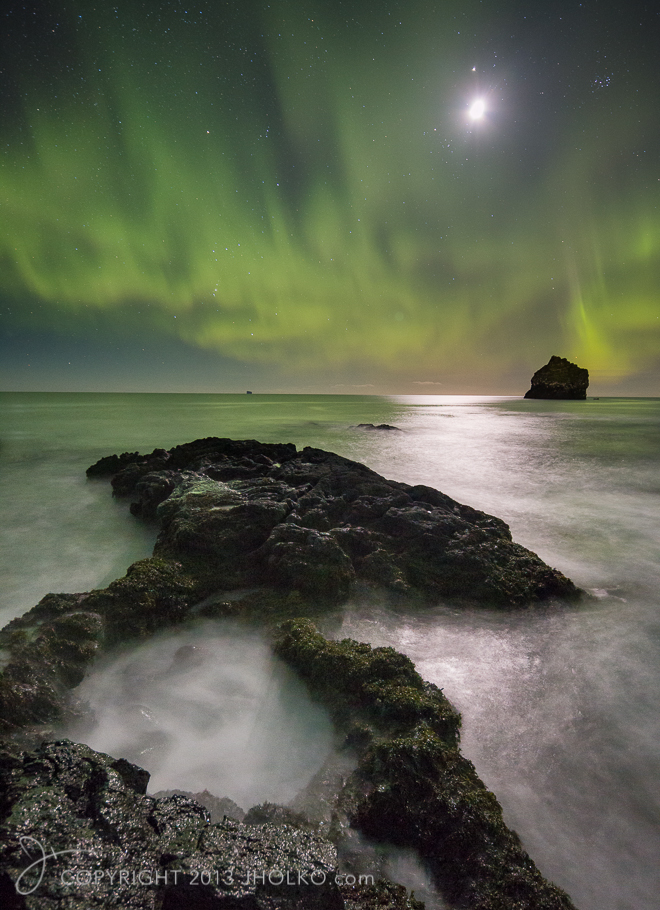
Daniel Bergmann and I are pleased to have now finalised our Winter Workshop itinerary for 2016 to Iceland. The workshop will run from the 4th of March 2016 until the 13th of March 2016 and will focus on the incredible northern landscapes of Iceland as well as the Aurora Borealis. We will be travelling in two Icelandic Super Jeeps (modified 4-wheel drives) so that we can get off the main bitumen road and into the more interesting areas for photography and experience the true splendour of Iceland in Winter. We will be focusing our efforts in the Northern part of Iceland in some of the less visited and more spectacular winter locations. In winter the northern landscapes are covered in snow and the light is often soft and ethereal. There are fantastic opportunities to create wonderful images of the winter landscape.Godafoss in Winter from the top of the fallsAt the beginning of March the darkness of the Icelandic winter is starting to lift and the days are becoming longer. We will have up to ten hours of good light during the day and with a little bit of luck the spectacular Northern Lights will increase our photographic opportunities well into the night. Winter conditions in Iceland can be stunningly beautiful: the glacial lagoons freeze, some of the waterfalls are partially frozen, the glaciers appear more blue with fresh snow on top, the landscape of the north is covered in fresh snow and with fewer visitors. With true darkness in winter comes the possibility of seeing the awe inspiring Northern Lights (Aurora Borealis). We plan to make photographs of them whenever there are clear skies and intense Aurora activity.Aurora over ReykjanestáYou can download a complete itinerary and information PDF HERE. The workshop is fully inclusive of all meals, accommodation and ground transportation as well as all tuition and image reviews. Our 2014 and 2015 workshop sold out in just a few days so if you would like to join us you can register your interest by dropping me an email or by filling in the registration form on my website at www.jholko.com. Due to initial expressions of interest and registrations the workshop is already 50% sold out. The last places are filled on a first come, first served basis and once they are spoken for thats it. Please be sure to read the testimonials page to see what others are saying about our workshops and expeditions. You can also visit the Iceland Portfolio on my website at www.jholko.com for more images of Iceland in Winter.Shaes of White
Deception Island Antarctica – The Hand of Man

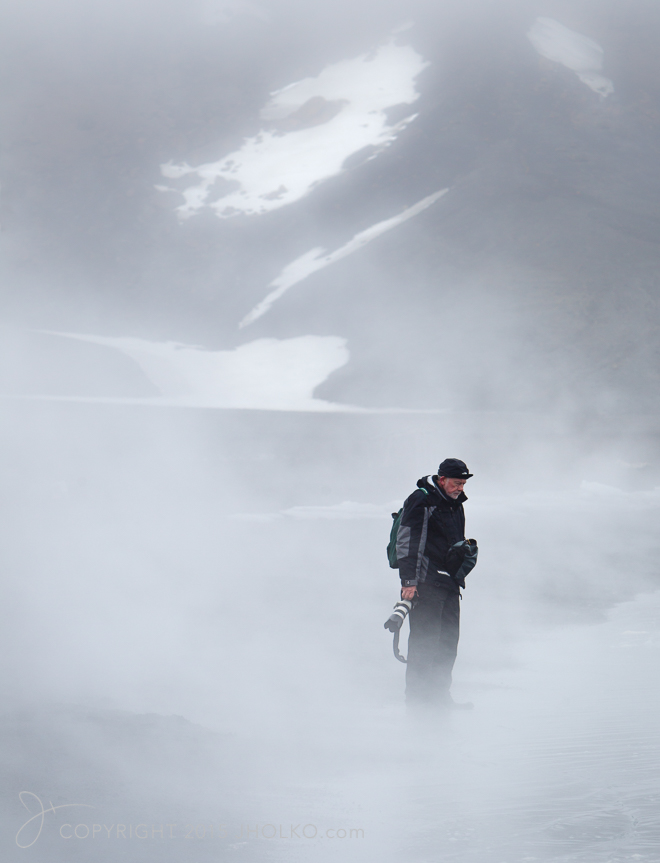
Deception Island is an island in the South Shetland Island archipelago off the Antarctic Peninsula. It is renowned as one of the safest harbours in Antarctica and has been for me a regular stopping point during Antarctic expeditions. The island itself is actually the caldera of an active volcano and geothermal sulphur still rises along the waterline. Photographer pauses to admire the beauty, partially hidden by riThe volcano caused serious damage to local scientific stations in 1967 and 1969. The island is perhaps best known historically for its whaling station; although it is now regarded as a tourist destination with a scientific outpost. Interestingly there are various countries that havee claimed sovereignty over the Island but it is thankfully administered under the Antarctic treaty system.Deception IslandI have been fortunate to visit Deception Island and Whaler’s Bay now on several different occasions. In fact, I actually posted a series of images here on my blog I titled ‘Made of Steel‘ from my first visit back in 2011. There is a palpable sense of grim history to this location and I have heard many first time visitors remark on the impact this location has had on them. Having visited this location many times now it remains for me one of the most sombre locations I have ever photographed with its dark whaling history. I feel a strong sense of foreboding at Whalers Bay, although I have enjoyed the photographic opportunities at this location very much. Whaler’s Bay is in many ways a a stark reminder of the way we were. Its rusting whaling remnants are a poignant reminder of humanities injustices on Nature. It is said, that at the height of the whaling in this area there were so many whales slaughtered that the bay turned red with blood. Now, many decades on from the injustices of human action the rusting remains of the whalers activities serve as some very interesting photographic subjects. Deception IslandThese three photographs were made during my recent expedition to Antarctica at the end of 2014 (the first photograph of the photographer on the beach was taken in 2011). They summarise for me the feeling of this abandoned location and capture something of the haunting atmosphere that seems to hang so low over the land. Interestingly all of these photographs were made during heavy snowfall. I have visited Deception Island in a range of different weather, but it is the images captured in the driving snow that best convey the feeling of this location for me.Deception Island