Why use an f2.8 (or other super fast) telephoto lens for your wildlife work when modern cameras are so good at high ISO?
It’s a good question; and one I get asked on a frequent basis on the workshops and expeditions I run in the world’s polar regions. The truth is, super fast telephoto lenses do weigh more than their f4 or slower equivalents and that can be an issue schlepping them through airports; especially if you are unfortunate enough to run into any airport staff having a particularly bad day. Just as an aside, the latest generation MK3 super-telephoto lenses from Canon are now much lighter than their predecessors, so the issue of weight is starting to disappear. Super fast telephoto lenses also cost more than their slower, smaller and lighter brethren; but there are some BIG advantages that far outweigh the extra weight (and cost) if capturing something special and unique is your goal. The most obvious advantage a super fast telephoto lens brings to the party is the shallow depth of field obtainable with a wide open aperture; which for wildlife can be a real boon in isolating the subject from its background. In addition, a wide aperture gives you a faster shutter speed; which in low light can make the difference between a sharp shot and a blurry one. A very good friend of mine recently waxed-lyrical, ‘Which would you rather? A sharp grainy image, or a soft blurry one? Well, truth be known I want to eat my cake and as such I want a sharp shot with a soft background free from excessive grain! And thankfully you and I can have it with a super fast telephoto lens strapped to a modern digital camera.

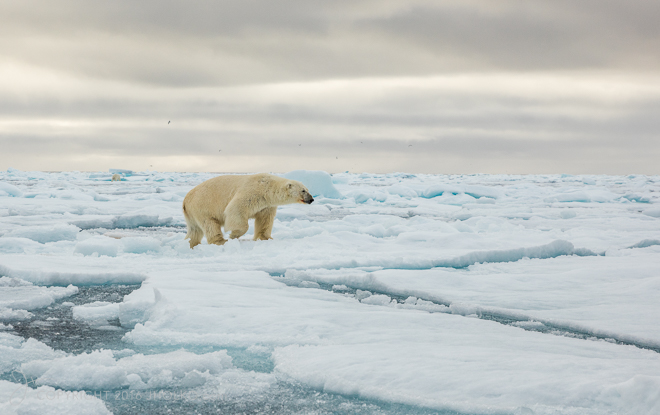
The third and probably the most useful (although vastly underrated) feature of a fast super telephoto lens (after creative DOF control) is you gain access to a lot more cross-type auto focus points and thus significantly faster and more accurate auto focus. The benefit of cross type points is more than considerable with moving wildlife and is in my experience often the difference between a sharp capture and one that doesn’t quite make it. The photograph above of a polar bear on the sea ice in Svalbard was shot with the Canon 400mm f2.8L IS MKII wide open at f2.8 in low light (I recently updated to the MKIII version of this lens, but have not yet had a chance to use it in the field). You just cant replicate this creamy bokeh and ‘look’ with a significantly slower lens. Nor could I have achieved the shutter speed I wanted and needed in the light conditions I was shooting in with a slower lens. If you are not familiar with cross-type auto focus points then its well worth your time to either break out your manual (that paper book thing that used to ship with a new camera) or read up online about the differences. Cross types are one of the best ‘guns’ in any wildlife photographers arsenal.


 Our intention is to sail directly north from the small town of Longyearbyen in Svalbard to approximately 80o degrees north, to the very edge of the permanent pack ice. At our northerly most point we will likely be less than 600 miles from the North Pole and depending on the sea ice we may get even closer. We will be using the ice hardened expedition ship M.S Freya that will enable us to skirt the edge of the pack ice searching for and photographing Polar Bears. M.S Freya is widely regarded as the best ship in the Arctic for Polar Bear Photography. With low-lying decks and operable portholes a mere 60cm above the water line we can photograph at eye level with wild Polar Bears. Our expedition ship is also equipped with sufficient zodiacs (2 x Zodiac MKV models) and crew for all photographers to be shooting simultaneously with plenty of room to spare for camera equipment – So bring what you need!
 Watch the expedition video ‘Kingdom of the Ice Bear’ to get an idea of what this expedition entails.

 www.WILDNATUREPHOTOTRAVEL.com