The photograph of the month for September 2016 is of a blue morph Arctic Fox on the prowl for something to eat during high winds and blowing snow on a remote Iceland peninsula in winter. Taken during my three year project on the Arctic Fox this is one of my favourite images in my new book ‘Melrakki’ on the Arctic Fox. The photograph itself was taken with a Canon EOS 1DX and a Canon 600mm F4L IS MKII lens from a snow hole . The snow hole allowed me to get down to eye level with the fox to create a more intimate image than would otherwise have been possible. I have particularly vivid memories of this day because of the cold and because of the constant need to shovel the snow out of my snow hole as built up around me. The light and blowing snow created fabulous atmosphere though and it was worth the effort for the resulting photograph.
Melrakki is available now for pre-order on my website as a limited edition hardcover fine-art book. The culmination of three years of winter photography in the extreme north-west of Iceland, Melrakki is limited to just 100 copies, each edition is hand numbered and signed and includes an original 11″ x 09″ inch fine-art pigment on paper print.
With foreword by pre-eminent scientist and Arctic fox expert Dr. Ester Rut Unnsteinsdóttir, Melrakki includes over fifty photographs and field notes from the three years spent photographing this remarkable predator in the extreme north-west of Iceland.
Melrakki Limited Edition is printed using the highest possible quality Canon Dreamlabo inkjet printer system and is printed on beautiful 250gsm High Definition Lustre paper that fully captures all of the incredible colour and tones of the original photographs. The Canon Dreamlabo represents the current state of the art in book printing and was chosen for this project after extensive testing and proofing as it yielded the highest quality that most closely resembles the original fine-art pigment on paper prints. I am extremely proud to stand behind the print quality in this Limited Edition book.
The included fine-art pigment-on-paper print is printed on Moab Somerset Museum Rag 300gsm paper and is hand signed.
Melrakki Limited Edition is $245 AUD plus shipping and can be ordered online exclusively through my website HERE.
I hope that you enjoy the photographs, insights and field notes from this project into the frozen world of Melrakki – the Arctic fox.
Photographs and Text by Joshua Holko
Approximate Dimensions: 22cm x 30 cm
96 pages (over 50 photographs + field notes)
The photo book & the print are together in a protective cloth sleeve
ISBN: 978-0-646-95781-4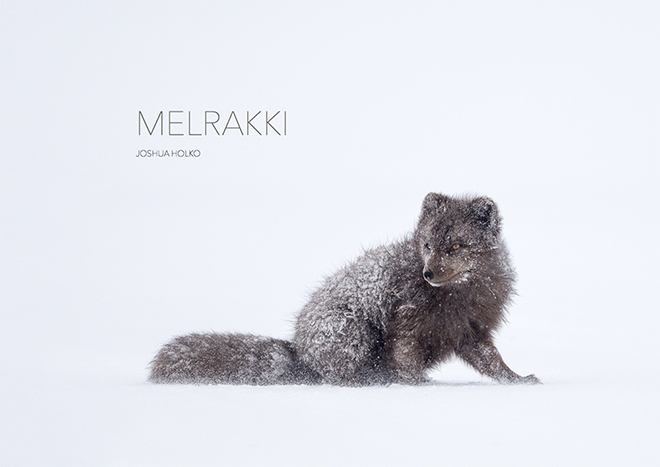


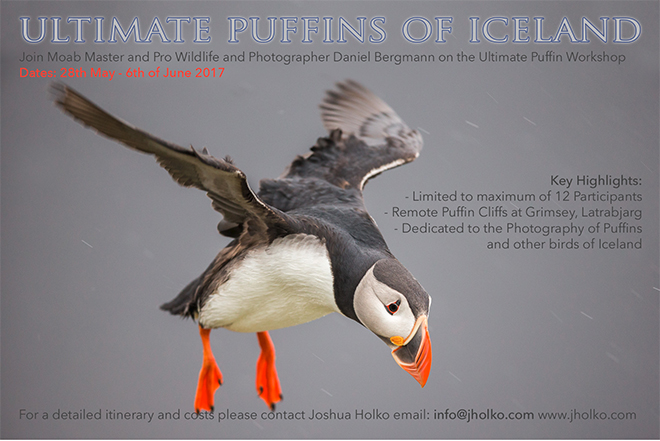 This photography workshop will last for 11 days (11 nights). We will be staying in good hotels and guest houses that are functional and clean. Breakfast, lunch and dinner are all included and will generally be held at the hotels where we are staying. However, this workshop is all about photography and we will be putting in long hours in the field in order to ensure we get the best possible light for photography. We may take food and drink with us into the field to ensure we are in the right locations get the best possible light.
  Itinerary: We start in the morning of May 27th in Reykjavik City and drive out to the Snaefellsnes peninsula. We’ll photograph birds and landscapes out at the edge of Snaefellsnes at Hellnar and Arnarstapi and will visit the iconic Mt. Kirkjufell. We’ll then overnight in the town of Stykkisholmur.
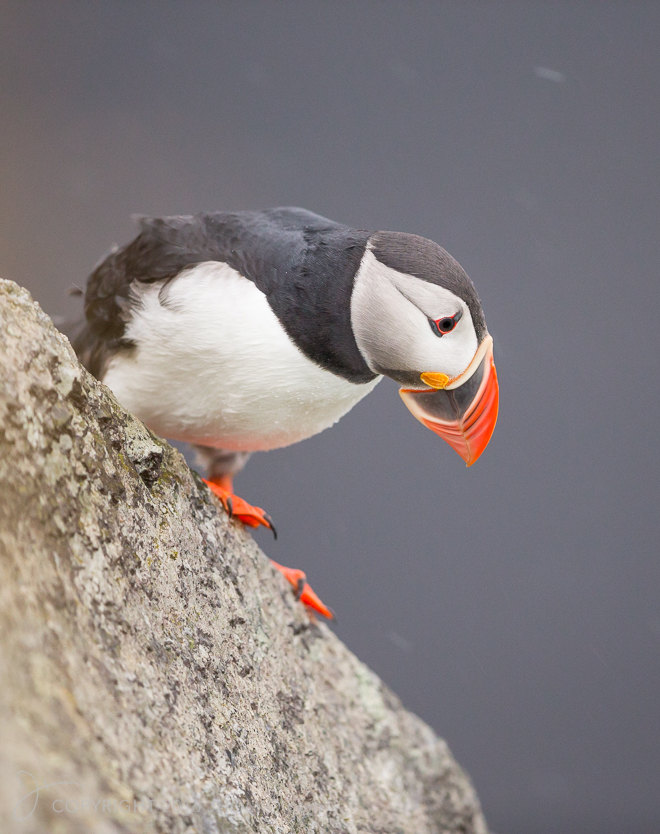
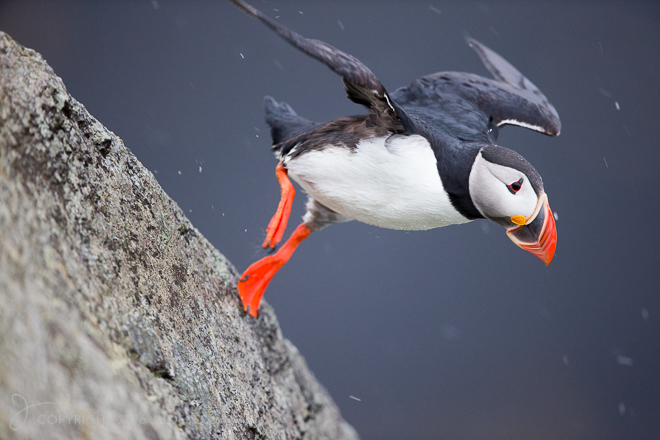 In the morning of May 29th we’ll get back on the ferry and finish the crossing. From the ferry port at the northern side of Breidafjordur bay we have couple of hours journey to Breidavik, where we’ll be based for the next three nights. From there it’s a 12km drive out to the magnificent seabird cliff Latrabjarg. This westernmost point of Europe is the home of millions of seabirds. It rises 440m out of the sea and is 14km long. The best locations for photography are within walking distance from the car park and we’ll have Fulmars and Kittiwakes soaring through the air, Guillemots (Murres) and Razorbills sitting on the cliff but it’s for the Puffins that we have come to Latrabjarg. Nowhere else are Puffins as tame. They can be photographed at close range, even with a wide-angle lens, and the cliff faces in a perfect direction for the setting sun. The Puffins can therefore be photographed in beautiful golden light or against the setting sun, creating wonderful silhouettes. As we are fast approaching the longest day of the year we have many hours of low light in the evening and early morning.
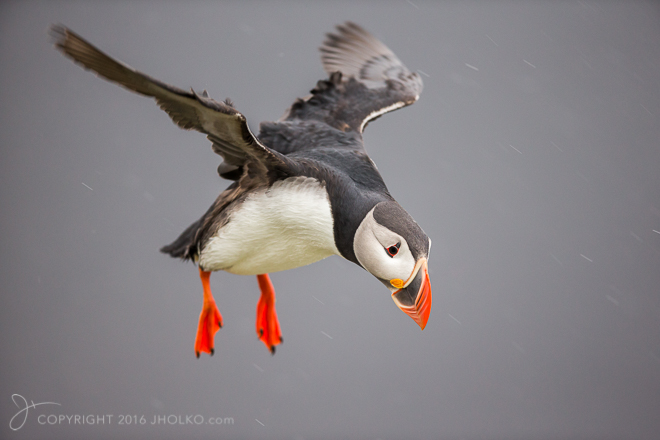 Closer to our accommodation in Breidavik we can venture out and photograph the birds in the area, such as Common Eider, Ringed Plover and possibly Ptarmigan. Arctic Foxes are frequently also seen in this part of the country and with luck we might find some arctic foxes to photograph during our time in this area.
 After our stay in the West Fjords we prepare for a long journey along the northern coast to the town of Dalvik. We’ll make a number of stops for photography on the way and will stay in Dalvik the night of June 1st so that we’ll be ready for the morning ferry to Grimsey Island on June 2nd. Grimsey is the northernmost inhabited Icelandic territory and the Arctic Circle runs through the island. The small island has about 85 inhabitants, is 5.3 square kilometres in size and has steep cliffs on almost every side, which makes it an ideal habitat for seabirds. During our three-day stay on the island we’ll continue to expand on our Puffin photography, now in a completely different environment that has a much larger population of Puffins than at Latrabjarg. Due to the remoteness of the island the accommodation is quite basic. The guesthouse offers comfortable full-board lodging but bathrooms are shared. Visiting Grimsey is a once in a lifetime adventure and its rich birdlife will keep us busy throughout the day and night.
 On June 5th we’ll depart Grimsey for the main land and drive back west along the scenic northern coast. We’ll overnight in Skagafjordur in the north, where we’ll have good opportunities for coastal landscapes and more of Iceland’s common birds, such as Whooper Swans. The Skagafjordur area is also known for its horse breeding and there are Icelandic horses almost everywhere.

 www.WILDNATUREPHOTOTRAVEL.com