Convincing yourself that an $11,000 USD camera lens is a worthy investment sometimes requires more than just a list of specifications. So Canon created a short stop-motion video of its EF 200-400mm f/4L IS USM lens disassembling itself and revealing all of its wonderfully complicated internal components. If you already own this fabulous lens, then this is your chance to peer inside at all of the electronics, motors, gears, and lenses that make it tick. The last thing you want to do is crack it open yourself. Taking it apart might be easy, but putting it all back together? Not so much….Time to get your geek on and enjoy.
Canons Auto Lighting Optimiser Demystified
One of the more obscure camera questions I occasionally field on my workshops from participants who shoot Canon is ‘what is Canons Auto Lighting Optimiser and should I be using it?’ I received this exact question this morning via email from a Canon user who just received their new camera and wanted to understand how this feature works.
First, some history on the Auto Lighting Optimiser (ALO). ALO was originally introduced as a feature on the EOS 450D DSLR in 2008. It has since found its way onto all current Canon EOS DSLR cameras, from Canon’s most basic entry-level DSLR to the professional EOS-1D X MKII (it was never included in the 1DS MKIII).
ALO is designed to even out contrast by selectively adjusting areas of the image. It is by definition most useful when using flash or with backlit subjects as it can detect faces in the frame and brighten those areas to achieve a better result. In a nutshell, the aim of ALO is to provide in-camera processing that will improve the look of your images. Those of you paying attention will have already figured out that it applies to jpeg files because it is working on in camera processing.
ALO analyses contrast in captured images and modifies both shadows and highlights via tone curve adjustments to minimise loss of detail in high contrast light conditions. There are three levels of setting strength in the current EOS 1DX MKII (low, medium and high) as well as the ability to turn the setting off. The levels can be used at any ISO speed setting.
The first thing you should know about ALO is where it is located in your cameras menu. ALO is found in the jpeg quality menu. This tells us that this setting applies to jpegs (not RAW files). If you shoot RAW then you can pretty much ignore ALO; with the caveat that it can be applied in post-production if you implement Canon’s Digital Photo Professional Software. If you are using Canon’s Digital Photo Professional workflow software (I honestly don’t know anyone who does), ALO can be applied to RAW images taken on compatible cameras during the post-processing workflow. This cannot be accomplished in Adobe Lightroom. Is this worth doing? Personally, I don’t think the benefit is worth the extra step (I would rather use a filter to tame the scene contrast in camera), but your mileage might vary.
When you select a Quality setting that results in a JPEG image file (have I mentioned you really should be shooting RAW?), ALO tries to enhance your photo while it’s processing the picture in camera. Unlike Highlight Tone Priority, which concentrates on preserving highlight detail only, Auto Lighting Optimizer adjusts both shadows and highlights to try and improve the final image tonality. This ‘could’ be useful if you are shooting jpegs in high contrast lighting and have no intention of doing post production work at a later date.
To sum up: If you shoot RAW (as I do) then you can ignore the ALO setting and just leave it off. If you insist on shooting jpeg then you should experiment with ALO to see what benefit it can yield to your jpeg files in certain high contrast lighting situations.
Photo of the Month June 2016 – Lemaire on Fire
The photograph of the month for June 2016 was taken this February during my Antarctica expedition to the Peninsula. We planned our arrival at the entrance to the Lemaire Channel for very first light and were fortunate to experience one of Nature’s truly great light shows. Over the course of about an hour and a half we cruised and drifted slowly though the brash ice of the Lemaire Channel as the sky exploded in a fireball of orange, red and magenta all around us. I have been fortunate to travel through the Lemaire channel many times over the last few years and these conditions were without doubt the best I have ever experienced.
If you hare interested in travelling and photographing in Antarctica be sure to check out the next expedition ‘Antarctica White Nature‘ that I announced a few days ago with good friend Ole Jorgen. This dedicated charter expedition is the ultimate way to see, experience and photograph this magical continent.

Antarctica : White Nature 2017 Expedition Announcement
Today I am very excited to announce a brand new and unique expedition to the Great White continent in November 2017 next year – Antarctica: White Nature. This new and very special expedition is a co-operative effort between myself and Norwegian photographer and friend Ole Jorgen Liodden.

Antarctica is miraculous; a remote, white continent of stark and beautiful desolation. For Nature photographers, Antarctica is without doubt the gold standard against which all other photography destinations are measured. Nowhere else on earth offers such incredible landscape and wildlife in such a pristine and remote environment. Best of all, we have timed our expedition as the first of the season in order to provide the best possible chance for fantastic icebergs and great light. Our expedition is a full charter which means we are 100% dedicated to providing the best possible experience and opportunities for photography. Unlike most trips to our Antarctica you wont have to share with tourists or regular travellers. You will be sharing with people who are just as dedicated and passionate as you are about capturing the best possible photographs.
The expedition is for a strictly limited number of 54 participants plus photography guides and expedition leader. We have chartered the ice hardened expedition ship M/S Polar Pioneer with a highly experienced crew so that we can get as close as possible to giant icebergs for the best photographs. Our expedition ship the ‘Polar Pioneer’ is equipped with sufficient zodiacs and crew for all photographers to be shooting simultaneously with plenty of room to spare for camera equipment. So bring what you need!

The main focus of this expedition will be Antarctic wildlife including penguins, seabirds, seals, and possibly even whales. We also plan to photograph snow and ice covered landscapes and icebergs. Our expedition has been timed as the first of the season so we expect fantastic icebergs and a breathtaking winter landscape. Very few photographers have visited Antarctica in early November, and experience has shown us that this will give you the best possible photo opportunities.
Antarctica is one of the hot-spots for photographing penguins, seals and icebergs in a great landscape. We will be landing early in the morning and late in the evening to get the best possible light conditions, which you will miss out on an ordinary tourist trip.
We will schedule much longer stops than usual when going ashore in order to provide participants with enough time to get excellent pictures. We will be using MKV zodiac boats to get ashore or when searching for the wildlife at sea. With 9-10 full days near the Antarctic Peninsula, this expedition is for nature photographers who want more quality time with the Antarctic wildlife and landscape. To get an idea of the sort gf photographs you will be able to make on this expedition please visit the Antarctica Portfolio on my website.
WHY TRAVEL TO ANTARCTICA WITH US?
• Unlike most tourist cruises to Antarctica, where you are sharing space with regular travelers, our expedition is a full charter dedicated to providing the best possible photographic experience for all aboard. You will be sharing the expedition only with dedicated and passionate photographers.
• Our expedition uses an ice hardened ship that is limited to the small group size of just 54 photographers. IATTO restrictions enforce the number of visitors to Antarctica rigorously. With only 54 photographers you will not miss any opportunity or suffer any landing restrictions due to large passenger numbers.
• Our expedition has been timed as the rst in the season in order to provide the very best opportunities for great light and fantastic icebergs. Very few photographers have traveled to Antarctica in November.
• Photography on our expedition is our primary focus and concern (after safety). Our catering staff understand our requirement to be working when the light is at its best. As such our meal times are exible and not regimented to ensure we maximize all opportunities.
• Our program is 100% tailored towards photography.
• The photography guide leaders: Joshua Holko and Ole Jorgen Liodden are both full time professional Nature photographers who specialize in Polar Photography and who have a combined total of twelve seasons of experience and more than twenty four expeditions to Antarctica.
• Our Expedition Leader Martin Enckell has spent more than ten summers in Antarctica and is widely regarded as one of the most experienced expedition leaders in Antarctica.
• Our Naturalist Eirik Grønningsæter is also a professional Nature photographer with more than eight years experience in Antarctica.
• Our expanded photographic guide team is quite simply the best in the business. With a combined total of well over sixty expeditions to Antarctica our guides know and understand what you are looking for in your photography and are dedicated to ensuring you capture the best possible images during the expedition.
• Check out some of our previous Expedition Videos
WHAT PREVIOUS PARTICIPANTS SAY ABOUT OUR EXPEDITIONS:
“After traveling with Joshua Holko and Wild Nature Photo Travel I simply can’t imagine going with anyone else. These guys are the real deal.” – Robyn Mills – Photographer
“If you want to experience and photograph the real Antarctica, look no further than Joshua Holko and Wild Nature Photo Travel” – Martyn Lucas – Photographer
We invite you to join us on a 14 days (13 nights) photography expedition to the Antarctic Peninsula in November 2017. due to our initial expressions of interest and bookings places are already very limited. If you would like more information or would like to register your booking please contact me via email. You can download a detailed PDF booking form HERE. Get ready for the ultimate Antarctica White Nature Expedition!
Lumo Nature Magazine Features Global Arctic Awards
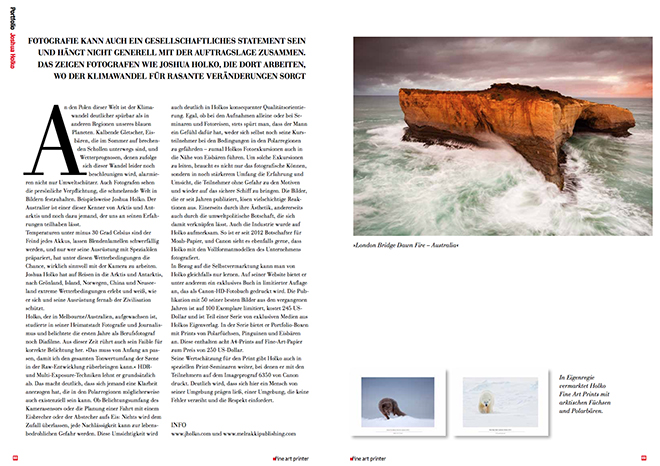
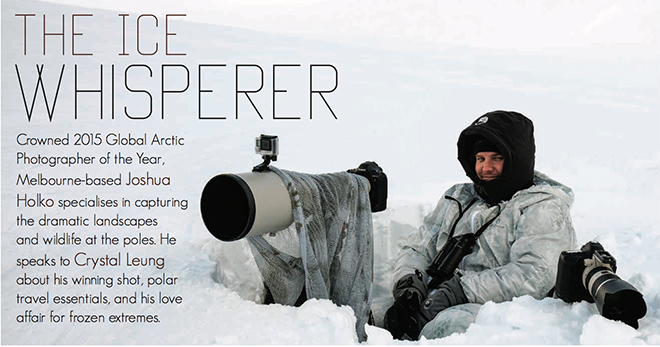
Finnish Nature photography magazine Lumo has just run a feature on the 2015 Global Arctic Awards. You can download a PDF of the Feature HERE or just click on the image below. You might need to brush up on your Finnish :-)