Antarctic Photographic Exhibition Showcases Icy Wilderness

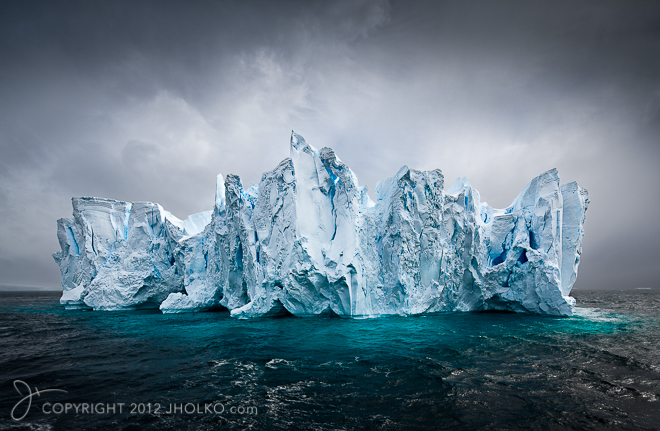
The Antarctic Photography Exhibition has opened at the Tasmanian Museum and Art Gallery as part of the Australian Antarctic Festival. All photographs were taken in recent years in Antarctica and the sub-Antarctic and were submitted by professional and amateur photographers from Greenland, Italy, New Zealand, Australia and Antarctica. Australian Antarctic Festival director Paul Cullen said the competition was narrowed down to 24 images to make up the exhibition. I am pleased to say the exhibition includes two of my personal favourite images from Antarctica (that have also been named as finalists).Ice Fortress HMAS Penguin Pool
The finalists selected for exhibition are:

  1. Nicole Anderson – Port Lockroy, Antarctica
  2. Nicole Anderson – Ice Cave Antarctica
  3. Helen Baird – Catch of the Day
  4. Barend Becker – King Penguins Leaving The Station At MacquarieIsland
  5. Karl Betteridge – Dive Comp
  6. Thomas Burns – The Sea Lion and the Skua
  7. Chad Carey – Orca Antarctica
  8. Tony Flemming – Aurora Basin Camp
  9. Brett Free – Angel Wings
  10. Jarrod Hodgson – Macquarie Island Sun – Australia’s sub-Antarctic From a Drone
  11. Joshua Holko – HMAS Iceberg
  12. Joshua Holko – The Fortress
  13. Kate Lawrence – Gadgets Gully, The Isthmus and North Head, Macquarie Island
  14. Sarah Lockyer – Adventures in Observation, Paradise Bay, Antarctic Peninsula
  15. David Lomas – Helicopter Resources AS350B3e helicopters loaded onto a RAAF C17
  16. Gianluca Lombardi – Reflections
  17. Rob Massom – Cold Hard Light of Day
  18. Shane Ness – Aurora Over Mawson Station
  19. Nick Roden – Defiant Legacy
  20. James Stone – King Penguin Collar Detail
  21. Doug Thost – Self Portrait with the Aurora
  22. Chris Wilson – Ice Berg With Penguins
  23. Eric Woehler – Rockhopper Penguin
  24. Jennifer Wressel – The Meeting

Natures Best Photography 2016 Highly Honoured Polar Passion

A few days ago I returned home to Australia from back-to-back expeditions and workshops to Svalbard and Iceland (trip reports coming soon). I was very pleasantly surprised to find on my return that one of my photographs that made the finals in the Polar Passion category of Natures Best Photography this year has subsequently been Highly Honoured and chosen for inclusion in the 2016 Natures Best Photography exhibition and book. See below for a complete list of the winners and highly honoured photographers.

The photograph was taken on my 2015 Summer Svalbard expedition (read the trip report). If you would like to travel to Svalbard and photograph Wild Polar Bears there are now only a couple of places remaining on my summer expedition next year 2017 before it will be sold out. To get an idea of what these expeditions are like be sure to watch the video Kingdom of the Ice Bear from our 2015 expedition.

The Nature’s Best Photography Windland Smith Rice International Awards staff is proud to announce the names of the photographers who will be displayed in our upcoming 2016 Nature’s Best Photography Windland Smith Rice International Awards Exhibition at the Smithsonian’s National Museum of Natural History in Washington, DC. The Windland Awards exhibition will open to the public on October 19, 2016 and run through 2017. 
Svalbard-1928-EditNaturesBest2016KingdomoftheiceBear

Svalbard in Winter Expedition SOLD OUT

I am excited to announce that as of last week my new expedition to Svalbard in Winter next March is already sold out. The result of several scouting and test trips this new and unique expedition offers a first time opportunity to photograph in Svalbard in winter from expedition ship. The Arctic in Winter is a place to inspire the imagination. It is a white landscape bathed in golden light. This brand new expedition is the first of its type to venture north of Longyearbyen by ship in winter.svalbard-9725-edit copyIf you missed out on this expedition and are interested in travelling and photographing in Svalbard in Winter I will be announcing new dates for 2018 soon. Like 2017, this expedition will be limited to just 12 participants and will take us into remote areas of the Arctic at a time when the polar light is at its absolute best. I am not quite ready to start taking bookings for 2018 yet, but if you would like to be amongst the first to reserve your place you can register your interest now by dropping me an email (no obligation at this point). More details to come soon.
Canon EOS 1DX MKII Firmware Update V.1.1.2

Canon has released the much rumoured firmware update for the EOS-1D X Mark II. Although I don’t often write about firmware and equipment updates I wanted to make an exception with this update as there are several new interesting features that might be appealing to some users. Of particular note is the function to set the GPS positional data retention period. I have found in my own experience that the GPS frequently looses connection when I am on ship moving in and out of my cabin; so this should resolve that issue. The addition of a function to append IPTC data is also appealing and could be useful in certain situations.

Firmware Version 1.1.2 incorporates the following improvements to enhance functions.

  1. The addition of a selectable color-tone option for the LCD monitor.
  2. The addition of a function to append IPTC data.
  3. The addition of a function to transfer only protected images.
  4. The addition of a function to set the GPS positional data retention period.
  5. An increase in the number of network connection settings that can be saved to a memory card from 20 to 40.
  6. When retrying FTP transfer, extension of the minimum auto power off time to 10 minutes.
  7. Improvement of wireless transmission when using Wireless File Transmitter WFT-E6.

In a nutshell: what’s new and different?

This new upgrade (version 1.1) addresses specific issues that professional news and photojournalism organizations have brought to Canon’s attention. Not all of these will be important in more ordinary, everyday use to individual photographers (including myself). That said, the changes and new features that this firmware adds to the EOS-1D X Mark II camera are the ability to:

  • Install up to 39 items of IPTC information into the camera, and to add data (or deliberately not apply it) to images you take
  • Add set-up information for up to 40 new Wi-Fi® networks to a memory card, and load that data as a full set of possible Wi-Fi networks to select from for connection
  • Transfer only “protected” images via Wi-Fi
  • Retain GPS position data:  Continue to apply last known GPS location information to images subsequently taken, even if GPS connection is lost (photographer went inside a building, etc.)
  • Change LCD color tone (four pre-defined settings), to either approximate display from other cameras you’re working with, or to shift color tone based on ambient lighting as the LCD monitor is being used

The aim of these changes is to enhance a professional photographer’s workflow; improve on-location network and Wi-Fi operations (especially for photographers working at large events, with many Wi-Fi networks in simultaneous operation); and to smooth the process of transferring images and managing them with new embedded metadata.

Keep in mind that the EOS-1D X Mark II differs from other Canon EOS models in that it not only permits network communication and transfer of images via Wi-Fi (using the optional WFT-E8A or WFT-E6A wireless file transmitters), but also via wired ethernet connection — there’s a dedicated ethernet port on the camera for this purpose.  This allows similar network connectivity, but without some of the variables users can encounter on-location with Wi-Fi transmission.

Read more at the Canon Digital Learning Center


Because I Compete with Myself at APPA

The Australian Professional Photography Awards recently wrapped up in Melbourne Australia and now is the time to consider any possible rule changes for the future. Should photographers and entrants have to retouch their own work, or should we properly credit the retoucher and printer with their work?

I recently wrote down my thoughts on this thorny topic and they were subsequently published in the latest edition of the AIPP Journal.

I read with interest the latest opinion pieces “Challenge, But Please Don’t Denigrate!” and “Low Scores = Inexperienced Judges?” by good friend Peter Eastway in the previous AIPP Journal. Peter and I do not always see eye-to-eye on how much post production is acceptable in a photograph, but we have the greatest respect for each other and our photography. We have discussed the issues of APPA at length and with APPA just past, I feel it’s time to share some of my thoughts with a broader audience.

Retouch and Print your own?

The issue of whether photographers should retouch and/or print their own work is a prickly one, but my preference is that it should be mandatory that all entrants retouch and print their own images. However, the reality is that it just isn’t practical to enforce a rule that entrants must print their own work, for all the reasons Peter outlined in his prior pieces. However, we can ensure photographers are behaving honestly and ethically with their entries and that we are rewarding the real talent behind an entry – and it’s on this issue which I wish to press.

In some ways it disappoints me that I need to raise the issue of ethics and honesty in relation to the APPA awards. In many ways, the question of ethics brings us back to why it is we enter APPA as professional photographers and what it is we hope to achieve with our entries.

If we are entering because we want to be recognised and rewarded by our professional peers, then it is paramount that the entrant’s work be entirely his or her own creation (or at the very least that any outsourced elements are fully disclosed so that our peers can acknowledge these contributions).

Or, If we are entering because we want to compete solely with ourselves (the best reason in my opinion), then it is equally important that we are honest with ourselves.

There is frankly little kudos in receiving a gold award for an image if you have outsourced the retouching and printing and provided little- to-no direction to the craftsmen who carried out these tasks. There is even less kudos if you fail to acknowledge the skills and contribution of the retoucher. The entrant might receive a pat on the back from friends and congratulations from their peers, but deep down, when the shine wears off , they will know it was not entirely their own work. And how much kudos is there in that?

I can tell you from personal experience, there is absolutely nothing sweeter than receiving gold and silver awards when you shot, retouched and printed the work yourself.

If we accept that it is not practical to enforce a rule whereby photographers must print their own work, then we are left with the significant issue of retouching.

I am of the belief that all entrants should retouch their own work and sign off on their entries as such. Retouching is simply a core skill in digital photography nowadays and a great many other photographers agree on this point. However, if we were to continue allowing external retouching, then shouldn’t we be awarding (or at least acknowledging) the skill of the retoucher as much as the photographer?

If we can agree we are awarding the print in front of us as judges, then surely we have to acknowledge that the retouching is a major component of the final print score?

There are countless examples I could cite where it was external third party retouching that elevated a capture to an award standard. Yet it was the photographer who was awarded, with little or no mention of the often very significant contribution of the retoucher.

Frankly, the current rules are just far to vague and open to abuse. Asking a retoucher to retouch a capture with a vignette and colour adjustments, drop in a new sky etc. can just as easily be followed up with, ‘And make it a gold award please’.

I propose that we consider an amendment to the APPA rules that requires all photographers to complete their own retouching and sign of on it as their own work. Practically, a short term solution might be to award half points to entries with third party retouching, thereby acknowledging the entry was not entirely the work of the photographer.

By way of example, if the image scores a 92 Gold Award with disclosed third party retouching, the entrant receives 1 point instead of 2. And if we took this approach, I wonder how many entrants would suddenly start retouching their own work?APPAAPPA2