During the first lecture I presented on Arctic Wildlife Photography at the AIPP Event in Perth Western Australia earlier this month I caught a number of people off guard in the audience when I explained my process for going out to photograph a particular species. It is an approach that will cost you much less than a new camera or lens and is guaranteed to help you get better photographs during your next wildlife outing. It is also an approach that requires a little investment in time, but its time well spent that will ensure you capture better images than you otherwise might have.
When I leave for a photographic expedition to photograph wildlife (it doesn’t matter what sort of wildlife) I don’t just pack my bags and head off into the wilderness to photograph a given animal with the latest and greatest gear. I do an extensive amount of research into the animal’s ecology so that I not only know where to find them, but also so that I am fully armed with knowledge of their behaviour. This knowledge is critical to capturing intimate images that would otherwise be impossible to realise. It enables me to read the many subtle signs an animal often displays and even predict their behaviour. Most of us know that a house cat is usually agitated or afraid when it flattens its ears. And we use this knowledge to deal with the cat accordingly. This same knowledge is a critical component to effective and successful wildlife imagery. It is far more important than a faster focusing lens or a camera with one stop more dynamic range. Those technical aspects of equipment are irrelivent if you have not equipped yourself with the right knowledge of your subject.
To cite an actual recent example of this in practice – When I set out on my Arctic Fox project (now coming into its third year) I went out and purchased every book I could on the ecology of Arctic Foxes so that I could learn as much as possible about their behaviour long before I ever pressed the shutter on my camera (I own not less than half a dozen different books on Arctic foxes). I wanted to arm myself with knowledge of the foxes behaviour so that I could recognise subtle signs and cues in their behaviour as I worked with the animals in the field. Wildlife give a great many clues about what they are going to do next through their behaviour and if you know and can recognise these clues you can predict the animals behaviour and greatly increase your ratio of quality keepers.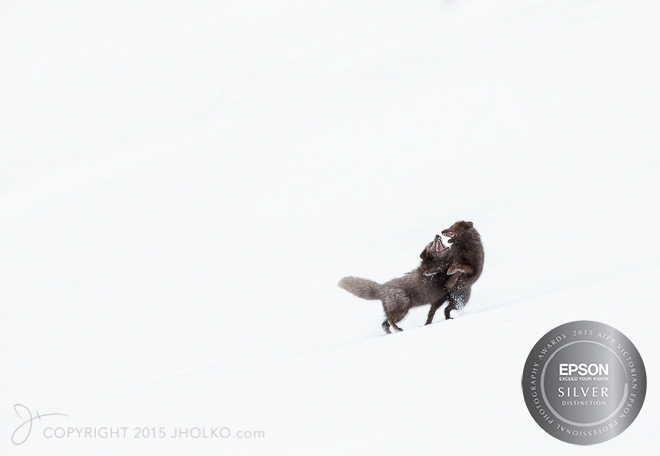 The other thing you can do in addition to researching and reading about your subject is to enlist the help of someone studying the animal you want to photograph. A scientist or even a PHD student working with a particular species is likely to posses a lot more knowledge on your subject than you can probably otherwise acquire in a short period of time. Their assistance can be invaluable in the field in locating hard to find wildlife and in understanding wildlife behaviour.
Now I grant you, spending time purchasing books, researching and reading about your photographic subject is not nearly as glamorous as a purchasing a shiny new lens or camera and running straight out into the field, but it does cost a lot less money and provides a far great return on investment in photographic terms. The next time you plan to go out and photograph wildlife it is well worth taking some time out and doing some research and reading on your chosen subject. You will almost certainly learn something about your subject and you will capture better photographs as a result. I will be leaving for the Arctic in a couple of days to lead two photographic expeditions for Polar Bears and I will certainly be brushing up on my reading with a couple of new Polar Bear books on the long flights from Australia. Happy Reading…
 What was really fascinating for me (and it has taken me a few days to come to this realisation) is that during the course of the two one and half hour seminars I presented there were almost no questions about which cameras I had used to make the photographs. This was an incredibly refreshing revelation and has in many ways re-envigorated my enthusiasm for sharing my photography. Instead, questions ranged from how to expose in these extreme environments to what sort of clothing I wear and how to prepare for this sort of photography as well as what I look for when I press the shutter. In this era of gear fascination that dominates all things photography (particularly in social media and forum circles) this was quite honestly an incredibly refreshing revelation. I feel as photographers (be it professional or amateur) we tend to get far to focused on equipment in the pursuit of better photographs. We constantly chase the next new thing in the belief it will improve our photography when the reality is it likely will do little for our photography other than drain our wallets.
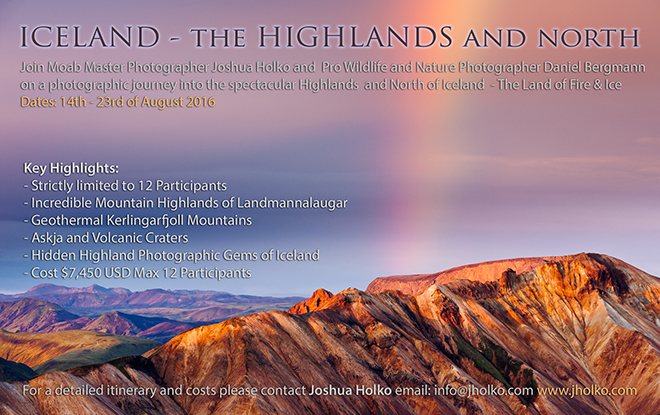 The first workshop will run from August 14th until August 23rd 2016 and will focus on the Highlands and Northern area of Iceland. We will also visit the precipitous basalt cliffs and rock formations of the Snaefellsness Peninusla, amongst many other areas. You can download a detailed itinerary and information PDF form for the first workshop
 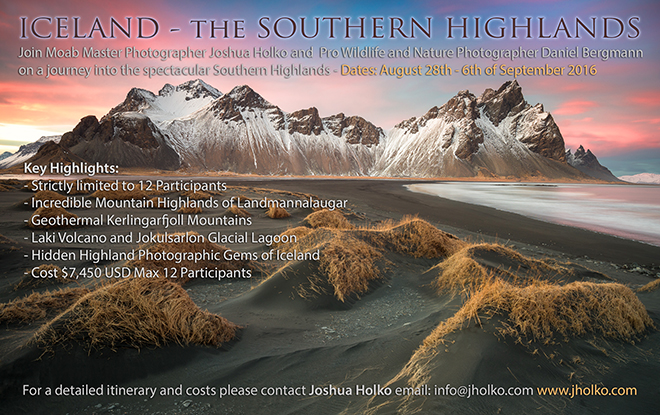 The second workshop will run from the 28th of August until the 6th of September 2016 and will focus on the Southern Highlands and eastern coastal regions of Iceland. Our intention on this workshop is to focus on some of the lesser known highland areas in the southern part of Iceland. We will also visit the precipitous ocean lined mountains at Stokksnes as well as vising the spectacular Laki Volcano and the world famous Jokulsarlon glacial lagoon. You can download a detailed itinerary and information PDF form for the second workshop
 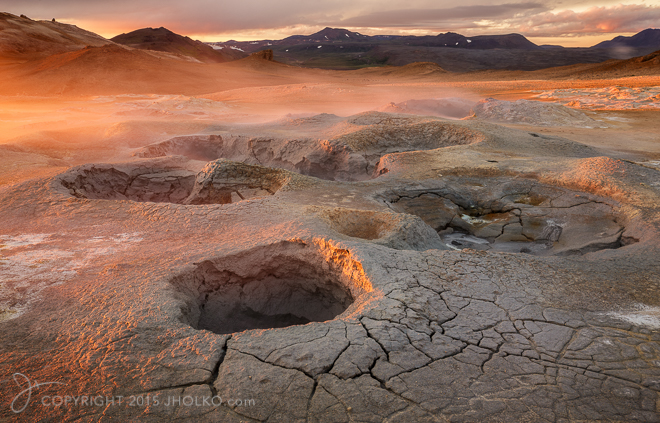 We have chosen August and early September for these workshops as this is an ideal time to visit Iceland for photography. The days are still long with Sunrise around 5 a.m. and sunset just before 10 p.m. The best light for landscape photography is therefore during the evening and early morning. This means that we may have an early dinner and then head out to photograph and sometimes be out before breakfast for a morning shoot. On cloudy days we’ll have a more normal routine. What we’ll do exactly on any given day will be decided around the weather and other conditions and there will be small changes to our original plan to make the most of our time in each area.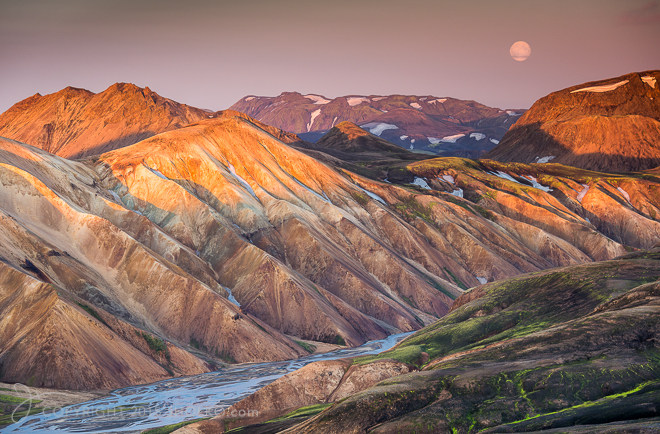
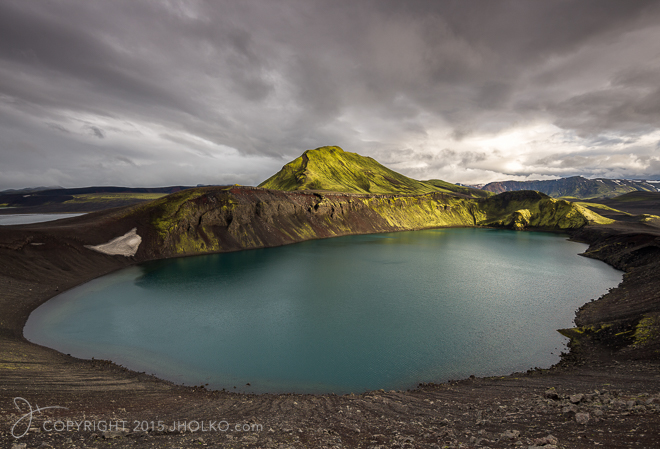 Cost: The cost for each workshop is $7,450 USD. There is no single supplement and single rooms will be provided wherever possible.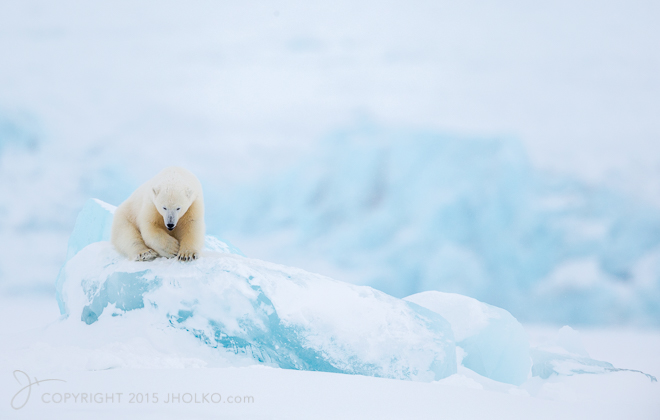

 www.WILDNATUREPHOTOTRAVEL.com