Book Review: Antarctica – The Global Warning by Sebastian Copeland

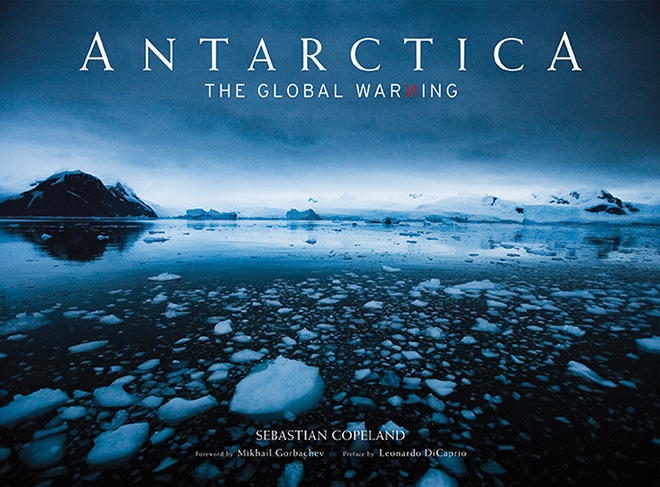
Antarctica – The Global Warning was released in back in 2006. The photographs are by Sebastian Copeland and there is a forward by Mikhail Gorbachev and a Preface by Leonardo DiCaprio. At the time of release it retailed for approximately $70.00 AUD here in Australia. It can now be found for significantly less than that if you shop around. You might want to read this review in full however before you part with your hard earned dollars on this book. I have actually been meaning to review this book for some time now, but before I begin I just want to say a few words about what Antarctica is actually like for those of you who have never been there.

Antarctica is miraculous. It is a continent of stark and beautiful desolation and I feel very privileged to have now visited and led expeditions to this incredible continent numerous times over the last few years. No where else on earth have I experienced such a sense of wonder as what I have felt in Antarctica and no where else is the landscape so other worldly. There is a variation to the weather, light and landscape in Antarctica that is in my experience completely unique. Mother Nature is a mad scientist and Antarctica is surely her greatest creation.

I have seen and experienced Antarctica at it’s most sunlit, brilliant and dazzling. I have also experienced violent storms, catabatic winds, snowstorms and some of mother Nature’s wildest weather. I have experienced dark, moody and overcast skies, racing clouds, sunlit mountains and glistening blue glaciers, the gentlest of snowfall and the strongest of blizzards. The weather and conditions in Antarctica are as varied as anywhere on earth and every visit offers a new experience in this regard.

It is this varied weather and Antarctica’s ability to both dazzle with brilliance and glow with purity that I found so obviously missing in Sebastian Copeland’s – ‘Antarctica The Global Warning’ photography book. This omission might not have bothered me so much (if at all) if it were not for the title of this book; the connotation of which is undeniable. This is, in its most basic form, a book intended to fuel the global warming debate. I do not wish to enter into this debate in this review; suffice to say that in my experience global warming is undeniable (I have witnessed its effects every year in both Antarctica and the Arctic). The problem I have with Antarctica The Global Warning book is that it it only shows one face of Antarctica in an attempt to skew the viewers impression of what Antarctica actually looks like and that makes it only a half truth.AntarcticaglobalwarningI feel there was an opportunity (and even a responsibility) in this book that has been missed by Sebastian Copeland. The opportunity existed to show Antarctica not only at its most mysterious, dark and ominous, but also in its brilliance and purity. Sebastian could have shown the ‘real’ Antarctica and the global warming message would have been even stronger. Yes, Antarctica can look like the dark images portrayed in this book. But it can also look brilliantly dazzling and incredibly pristine and pure. Indeed, it is often the most brilliant weather that truly portrays the rate of melt underway. I feel somewhat at odds saying this as a photographer who seeks out dark, moody and evocative landscapes in my own photography. Ultimately however, Sebastian’s book is not intended as a book of fine art photographs; it is intended to deliver a message and the images it uses to do so are only partially representative of the true Antarctica.
By far the majority of people who will read this book will have never visited Antarctica and will never do so in their lifetime. There is therfore an obligation in my view to present a more balanced viewpoint on what Antarctica is truly like when the intended purpose of the book is to highlight global warming.

It is hard to get past the message Antarctica The Global Warning is intended to deliver and I feel that is largely due to my own significant experiences in Antarctica. Had I never visited the continent I may well feel differently about the photographs in this book and their intended message. This leads me to believe that I and others who have visited Antarctica are not the intended audience for this book.

Print Quality: From the dust jacket I was disappointed with the print quality in Antarctica The Gobal Warning. There is clear evidence of banding, crushed and muddy blacks, blown highlights and poor tonal gradation. The photographs themselves are highly stylised with what I feel has been overly heavy-handed post production treatment (particularly in the 3/4 tones) and heavy vignetting. Many of the photographs are quite soft and exhibit excessive grain and noise; which, would appear to be a combination of over processing and poor quality offset printing. I am giving Sebastian the benefit of the doubt that these were not technical errors during capture. Overall, I was bitterly disappointed with the print quality in this book.

I personally have a strong preference for images that are printed with a white border around them to help contain and frame the photograph. Many of the images in Antarctica The Global Warning are full page, full bleed and appear awkwardly cropped to fit the page size.  I find this approach detracts significantly from the photographs and the photographers vision. This approach leaves me feeling short changed as if the photographer or publisher decided it was more important to have a full bleed photograph than it was to respect the images naturally preferred crop. There are examples to numerous to document where important elements in images are arbitrarily cropped at the edge of the page which leaves the image experience incomplete.

I have attempted over numerous sittings with this book to come to a different conclusion; but ultimately I feel Antarctica the Global Warning is a propaganda piece likely intended for those who will never visit or experience the true nature of this miraculous continent. I do not believe photographers are the intended audience for this book or more care and attention would have been paid to the print quality, layout, cropping and selection of photographs. I feel this book is a missed opportunity and that to me is the most disappointing aspect to this book.

Overall Review – * Give it a miss. There are better books on this subject you should consider adding to your library first

World Photography Cup 2015 Finalist

Every now and again a really pleasant surprise crosses our path and this morning I was very fortunate to meet that surprise. Recently the AIPP Australian Institute of Professional Photography selected one of my photographs from the 2014 APPA Awards to be part of the Australian Team entry at the 2015 World Photography Cup (WPC). Twenty eight different countries entered this year from across 4 continents and the finalists have just been announced at Imaging USA. I was thrilled to learn this morning that my photograph was selected as a finalist in the Reportage category.  Medalists will be announced at the end of February 2015 and the overall Winners will be announced in Montpellier, France, on April 12th, 2015. Included below is the full finalist list.WPCFinalists2015

February Photo of the Month Winner: Chris Roberts

Congratulations to the second print winner ‘Chris Roberts’, for the photograph of the month for February 2015: ‘Arctic Fox Freeze’

What Chris said: The fox is beautifully isolated, in pristine snow, and I feel very cold just looking at him. He is clearly very much in his environment, and I’d love to know what he is looking at, and what he’s about to do.

Even at this distance on my computer, I can see that there is fine detail in his tail with the light dusting of snow on his body. I’d love to have the opportunity to see this beautiful and rare animal in the wild, but in the interim would be happy to view him in my home instead! A gorgeous capture, in what would have been very challenging conditions.Arctic Fox

Congratulations Chris, you were the first, and your print will be sent to you this week.

Keep an eye out on my blog for the next print giveaway with the March photograph of the month. Remember the best way to get instant updates is to subscribe via email.

2015 February Photograph of the Month: Arctic Fox Freeze – Win a Fine Art Print!

It feels appropriate that an Arctic fox photograph is the February photograph of the month given I will soon be headed back to Winter in Iceland to photograph one of my favourite Polar mammals – Perhaps Nature’s greatest survivor. This photograph, taken in the extreme northeast of Iceland last year during freezing sub zero temperatures was taken during a seven day expedition to the Hornstrandir Nature Reserve. This is an area of Iceland very rarely visited during the winter months. It is extremely remote, and only accessible via chartered boat ride (approximately fours north of Isafjord). It is logistically difficult to get there and special permission is required from the park ranger to undertake a winter expedition into the area. On top of that there is no infrastructure once you arrive and everything from food to satellite communication and survival gear must be carried in for the duration of the expedition. I love this photograph for both the pose of the fox, but also for the dusting of snow clinging to its coat and tail. There was a low fog when I took this image and in print you can actually see the exhale of breath from the fox.Arctic FoxDon’t forget! You can win a free 13″ x 19″ Win a Fine art Print of this photograph including shipping anywhere in the world. All you need do is to be the first to comment on this post on the home page with your thoughts on why you like this photograph or why you would like to own a print of the image and then share the post with your preferred social media outlet. Just keep in mind that due to my hectic travel schedule it may take me some time to make and post out each print so if you are the lucky winner for a given month I ask that you jut exercise a little patience and as soon as I am back in my studio in Australia and as soon as practical I will make the print and send it to you – free of charge. Each print will be made and personally signed by me with the same care and attention to detail I exercise on my large gallery prints. There will be a total of twelve prints to win throughout the calendar year. The first print was won by Fred Jennings and his print should be with him in the next few days – congratulations Fred!

Good luck and don’t forget in order to win the print you need to be the first to comment here on the home page on the February photograph of the Month for the 2015 calendar year with your thoughts on why you like the photograph or why you would like to own a print and to then share the post with your social media outlet of choice.

Landscape Photography with Emotion and Mystery Part Three

I thought I might have been finished yesterday when I hit the publish button on Part Two of my Landscape Photography with Emotion and Mystery article. However, I realised this morning that the flood gates were open and that there was more I wanted to share on this topic. I was quite direct in part two of this series on the problem with ‘Wow’ photography (See my post from yesterday for the definition of a ‘Wow’ photograph) and I want to instead focus on more positive aspects on the creation of evocative photography.  Training ourselves to see with better eyes and freeing ourselves up to be creative is going to be the subject of this third article. The hope is that we can create images that rise above ‘Fast Food Photography’ ‘(See my post from yesterday for the definition of Fast Food Photography).

One of the things I have noticed that happens in my own image making is that it takes me time to get into the rhythm of the location I am photographing. I rarely turn up at a new location on day one and make a photograph I consider to be anything more than a snapshot. If I get lucky and get some good light I might create a ‘Wow’ photograph, but thats not really any better than the snapshot. This is a phenomena I have long pondered and I have come to the realisation that it is actually very difficult to arrive in a new location and take a great photograph on day one.  Part of the reason for this is it takes time to settle in and get into the natural rhythm of the landscape and see better photographs. I need time to let the creative side of my brain attune itself to its surroundings. I need time to let my creative juices flow and I need time start to see strong compositions. The more time I spend at a location the more likely I am to produce an interesting evocative photograph. And that is an aspect to the creation of evocative photographs that has continually frustrated me.Well of LifeWhat I have also come to realise is that the more time I take off from actually being in the field and making photographs the more my ability to see strong and evocative images diminishes. When I spend a week or more in the field making photographs I become attuned to the landscape and the images start to flow freely. As the days progress I usually find the quality of the output improves. I am not necessarily taking more photographs, but I am taking better photographs. I can see this by looking at the images I made on a day-by-day basis after the fact in Lightroom.

When I subsequently leave the field and return to my studio for a period of time and then head back out into the field I feel like I am starting at square one again. Time has passed, my creative image making brain has been idle, and I have to attune myself all over again. Its a conundrum that has continually frustrated me. It really would be nice to pick right up where I left off with my creative brain in top gear and with strong and evocative imagery flowing freely. But how can that be done?

I have considered this problem for some time and have come to the conclusion that my creative ‘image-making’ brain is not being exercised sufficiently when I am not out in the field. Or perhaps more accurately, I am not spending the time learning to see with better eyes that I am doing when I am in the field. By the way, ‘seeing with better eyes’ is a subconscious process – its not something I am consciously considering when I am in the field. As a result my skill to see creatively is lying dormant and like any skill you don’t practice you start to loose your edge. The best analogy that comes to mind is cardio fitness. If you exercise daily your cardio fitness improves. If you stop and sit idle for a period of time your cardio fitness starts to deteriorate. Our ability to see creative images in the field works the same way – at least it does for me.

I have long considered the first few hours or days in the field to be ‘ramp-up’ time. That is time I need to spend attuning myself to see creatively. Or to use the cardio analogy, I need to ‘get fit’ again. The problem with ‘ramp-up’ time is that opportunities get missed. You may not realise it at the time, but you will no doubt, on reflection think back and consider the opportunities you missed during the first hours or days of a field session.

The key to minimising ‘ramp-up’ time for me has been to make a concerted effort to look at other photographers work in book and print as often as I can. This not only gives me insight into the work of other photographers and educates me on how they see the world, but it also keeps my creative brain ticking over. When I make the effort (and it isn’t an effort at all – its actually something I really enjoy) to sit and read or study a book of photographs it lights a creative spark in my brain. That spark gets me thinking about not only the photography I am absorbing, but also my own image making and how I can improve my next photograph when I next lift the camera to my eye. Looking at the work of other photographers gets me thinking about their interpretation of a scene, their vision and their way of seeing. It makes me consider how I look at the world, what stories I want to tell with my photographs and how I might consider an alternative approach to a scene or situation. It helps keep my ‘eye-in’ as it were and keeps things ticking over at a regular consistent pace.

One of the best things I believe you can do to improve your photography before you head out on your next field session is to spend some time looking at other photographers work. Not on social media, not on the web, but in books, prints and galleries where you are free from the distractions that plague the internet and social media platform. Take some time out of your day when the house is quiet and study a photography book from someone you admire or whose photography you enjoy. Go to the nearest gallery during your lunch break and spend some time studying the art work. Get to know the contemporary photographers out there who are masters of their craft and who are creating strong, evocative photographs with their own distinctive style. It never ceases to amaze me how many photographers I speak with can’t list more than ten well known photographers whose work they admire. Think about that for just a moment…. And what you will realise is that photographers are going out into the field uneducated and uninformed.

If you are planning a photographic trip somewhere make the effort to keep your creative brain stimulated with quality imagery before you get there. The more we train our brain to see the elements that make up a powerful evocative photograph the more likely we are to be able to create our own when we are next in the field. Just as an aside, I am not necessarily advocating you spend your time looking at photographs of African wildlife if Africa is your next travel destination. I am in two minds about wether this is a good idea. A part of me likes to approach a new location with fresh eyes and a clean slate without the influence of having seen location specific photography. Instead I would advocate you look at wildlife imagery in general and don’t necessarily limit yourself to African wildlife as in this example.

There is another thing you can do to improve your photography. I believe this is a really important aspect to the creation of evocative photographs and at the risk of being controversial, that just about all of us would be far better to invest the money allocated to our next camera or lens purchase to books on photography, prints, and museum and gallery entrance fees instead.

The marketing departments of the camera manufacturers has done a superb job over the last decade or so of convincing us that we ‘need’ the new model. That those extra pixels or extra stop of dynamic range are paramount in our photography. And that our current camera is now sub-optimal because the new version is now available for pre-order. This conditioning has been incredibly successful. Just scan the pages of any photography forum and you will find thread after thread talking about the next camera to come down the pipeline. Almost all of the ‘chatter’ is about equipment and very little is about about the creation of photographs. Now, I grant you the camera is an integral part of the process, but it is also just a tool.

The problem with that tool is that far too many photographers are constantly upgrading to the new version in the belief that it will improve their photography. The truth of the matter is that it usually has the opposite effect. The reason for this is that until control of the the camera you already own has become second nature and the movement of its controls nothing more than muscle memory you can never be truly be freed up to be creative. The brain is too focused on being a technician as it grapples with knobs and dials. We need to free ourselves up to be creative and the best way to do that is to properly learn to use the tool we already own. The best musical instrument players are intimately familiar with their instrument of choice. Yes, they can pick up another guitar, or another violin and play it very well. But they will play their own instrument at a higher level because they are intimately familiar with it. They understand its idiosyncracies and its limitations. They also understand how to get the best from it. And lastly, they don’t have to think consciously about it so they are freed up to play at their very best.

This is actually something I have witnessed countless times on my workshops and expeditions. Photographers fumble with their camera trying to find a button or setting. The focus and attention is on the equipment and not the photograph. Their brain is busy being a technician and is not focused on being creative. This is perfectly fine if the workshop is about teaching the technical aspects of photography and you are there to learn how to operate your camera. Typically however, this is not the case and the photographer is there to make images. Not only that, but they frequently have an expectation of wanting to create a strong photograph, yet they hamstring themselves through being unfamiliar with their equipment.

The take away from this is that you need to give yourself the best possible chance to be creative in the field and to do that you need to be intimately familiar with your equipment. Learn the camera you own back-to-front and inside-out and I promise your image making will improve considerably. Soldiers are trained to field strip a rifle blindfolded. They sleep with their rifle and they make sure they are intimately familiar with every aspect of their weapon. I am not advocating we all start sleeping with our cameras, but that perhaps if we just spent a bit more time committing the controls to muscle memory that we would give ourselves a far better chance to create a strong photograph when we are next in the field. This is unfortunately not the advice a lot of people want to hear. They prefer to believe that the new model camera that will be out soon, will improve their photography and that there is always some piece of gear or equipment that is holding back their image making. As you can see, the marketing departments of the camera companies have been extraordinarily successful.

If you choose to take this advice to heart you will find several things happen. Firstly, your wallet (and probably your significant other) will thank you as you will avoid what is in all likely hood an unnecessary camera upgrade or spurious lens purchase. As a side benefit you will also now have money for photography books, prints and gallery / museum entrance fees. Secondly, as you continue to learn the camera you already own your photography will improve as your brain shifts from being a technician who used to struggle with knobs and dials to a photographer who is freed up to create. Thirdly, your knowledge of photography will improve because you will own, appreciate and be familiar with the work of more photographers in book and print form. And finally, your own creative vision will improve because you have made the effort to focus your attention on the vision and not the tool. You will have armed yourself with the knowledge of the work of other photographers so that when you next go out into the field you are seeing with better eyes.