My time in Australia has already come to an end, and as soon as I finish this post, I am leaving for Melbourne airport, where I will make my way to Mongolia for both my Pallas Cat and Snow Leopard expeditions. The last two and a half months have gone by in a blur (Christmas makes this whole period crazy), and it is now time to hit the road again. I am very excited to return to Mongolia in Winter to photograph these two amazing wild cats: the Pallas Cat and the Snow Leopard. For the Pallas cat, we will be based in the far eastern steppe region of Mongolia. For the Snow Leopard, we will be based in the northwestern region. For these two workshops, I will spend the better part of a month (January) in Mongolia.
I had full intentions of doing a detailed packing list and a podcast on this departure, but time has gotten away from me, so in lieu of that, I am squeezing in this quick packing post. For these two trips I am packing 2 x Canon EOS R1’s with two spare batteries. I am taking a selection of lenses, including the 20mm f1.4, 14-35mm F4L IS, 100-300mm F2.8L IS, 600mm F4L IS and an RF 1.4 Teleconverter. Although this leaves a gap from 35mm to 100mm, I find I use this focal range very little when working with wildlife and tend to be either at the longer or wider ends. All of this will fit in my SKB Roller case and Gura Gear Chobe. In the field, I will use my Lowe Pro 600mm Trekker for hiking with the Snow Leopard. For the Pallas cat, we tend to shoot very near the 4-wheel drives, so equipment doesn’t need to be carried very far. I am also packing my DJI mini-drone, binoculars, and, of course, plenty of cold-weather clothing. See you in Mongolia for New Year’s! And P.S: The 2025 retrospective podcast I will be recording and releasing from Mongolia.
In early January 2025, I ran my annual Winter workshop to the far Eastern Steppe region of Mongolia in search of the world’s grumpiest cat – the Pallas cat. A significant point of difference from others on this workshop is that we (my company – Wild Nature Photo Travel) will only take a maximum of six people to ensure we have a small intimate group to make minimal impact on each others photography in the field. With just a small group we can work together as a team and not be in each other’s way out in the field. I have watched other groups of up to ten or even more attempt this sort of trip as a group and it just doesn’t work effectively.
We began our workshop with a drive from the capital of Mongolia, Ulanbataar to our private camp in the Eastern Steppe region. Most of the drive is on regular paved roads with only the last couple of hours off-road through the Steppe. This year, conditions made for easy driving with little to no snow that saw us arrive at our camp in the early evening. We had time to settle in before dinner with high expectations for finding and photographing Pallas cat the following morning. It was a very interesting counterpoint this year as 2024 had been an extremely high snow year which made for really difficult driving conditions, but also exceptional photographic opportunities.
Our accomodation for this workshop was in both private and shared Gyrs (depending on preference). Each Gyr is equipped with a coal stove for heating, bed, wash basin and has plenty of space for equipment and luggage. The video below is a quick tour of one of the shared Gyrs.
We rose early on our first full day in the field and took breakfast before sunrise. This time of the year the sun doesn’t actually crest the Steppe before approximately 8am. With the sun just creeping over the horizon we set off from camp in our 4-wheel drives into the Steppe in search of the Pallas Cat. Despite the low snow conditions it didn’t take too long before we found our first cat and we captured the first images of this amazing animal.
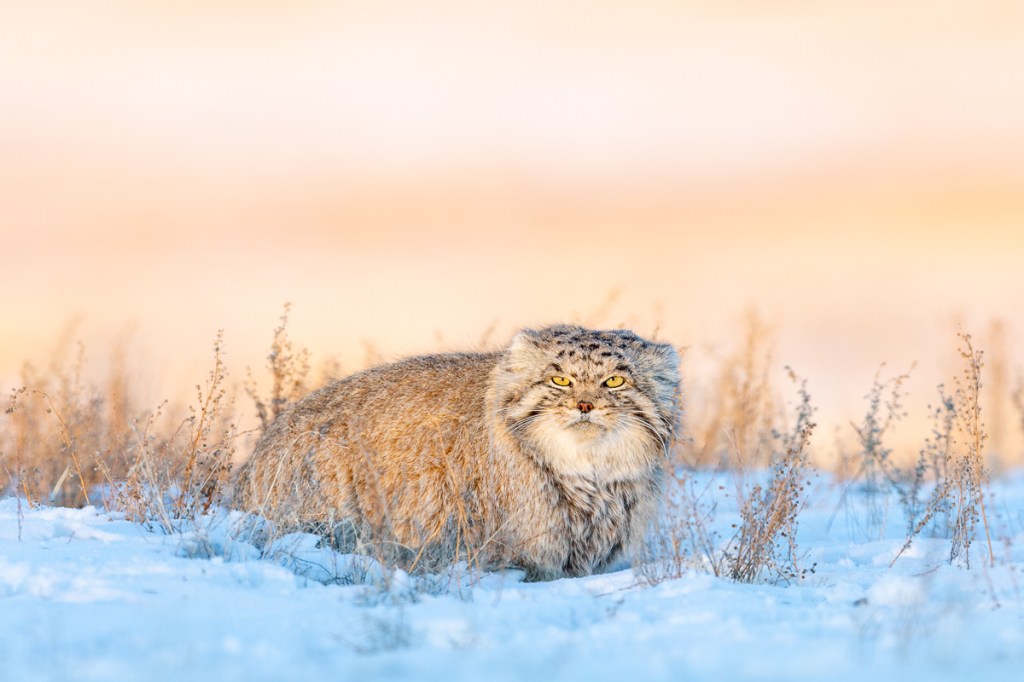
The main photographic challenge this year was the lack of snow, which meant dealing with tall grass as an obstacle between the lens and the cat. This made the photography a little more difficult, but also more rewarding. With longer grass the best approach in my experience is to try and frame the cat amongst the grasses.
Over the course of the next week we photographed half a dozen different cats in various lighting conditions. Being a low snow year in the eastern region there was minimal opportunity for shooting the cat against an all white background. Instead the grasses of the Steppe served as the perfect addition to add environmental context.
Over the course of the week long workshop we also saw (but did not photograph) several Corsak Fox as well as a great many Upland Buzzards. We also sighted both Steppe and Golden Eagle as well as Saker Falcon and Mongolian Gazelle. The wildlife in this region of Mongolia never fails to disappoint and it remains one of the best untapped gems for wildlife photographers the world over.
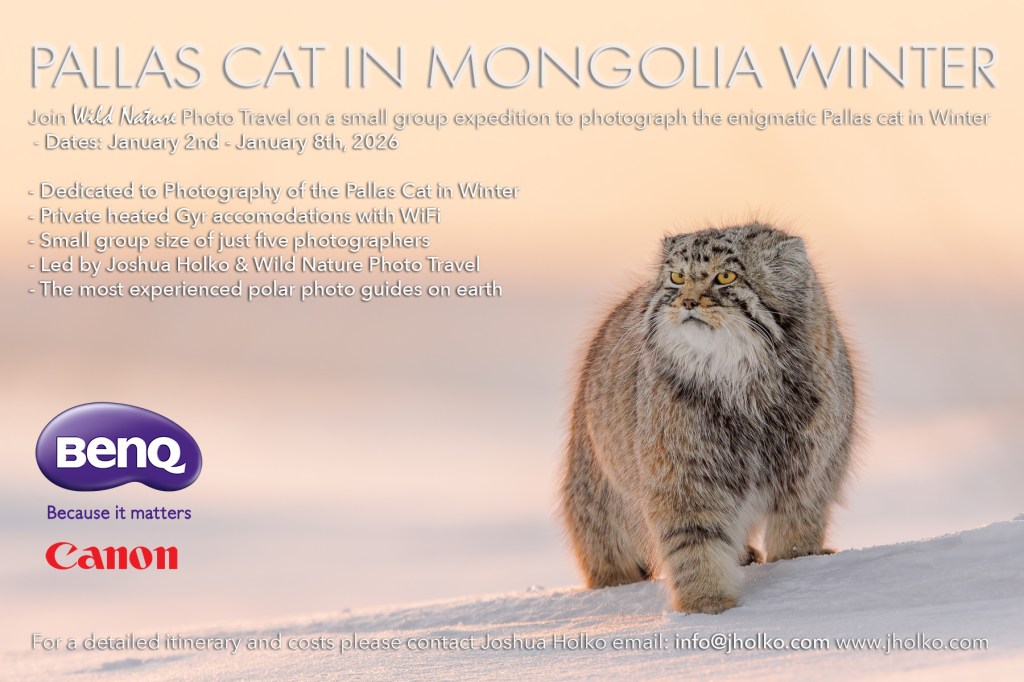
I will return to the Steppe region of Mongolia again early next year in January 2026 in search of this wonderful wild cat. If you would like to join myself and Wild Nature Photo Travel on this unique experience in Mongolia please get in touch to register your interest. Places are filled on a first come first served basis. The 2026 workshop will run from the 2nd of January until the 9th of January which is the perfect time for winter conditions to photograph this beautiful (but grumpy) cat.
In January of 2024, I ran an expedition to Mongolia’s far eastern Steppe region to find and photograph the stunningly beautiful, rare and enigmatic Pallas Cat. This was my third expedition to this remote region of Mongolia, and it proved no less productive than the previous two (Read the 2023 Trip Report).
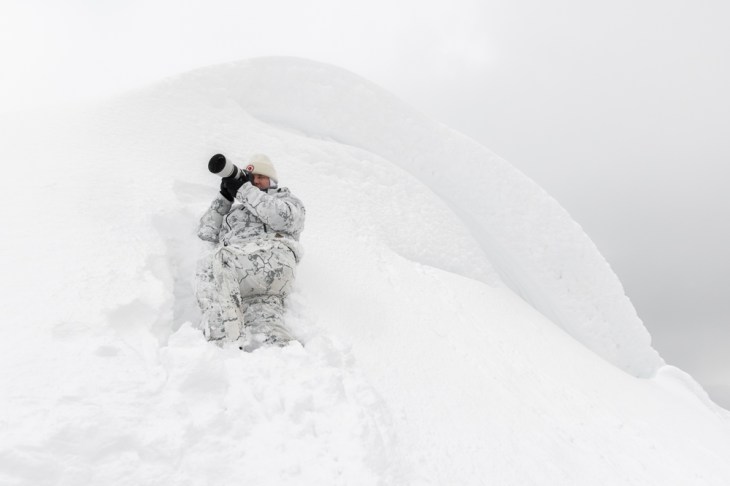
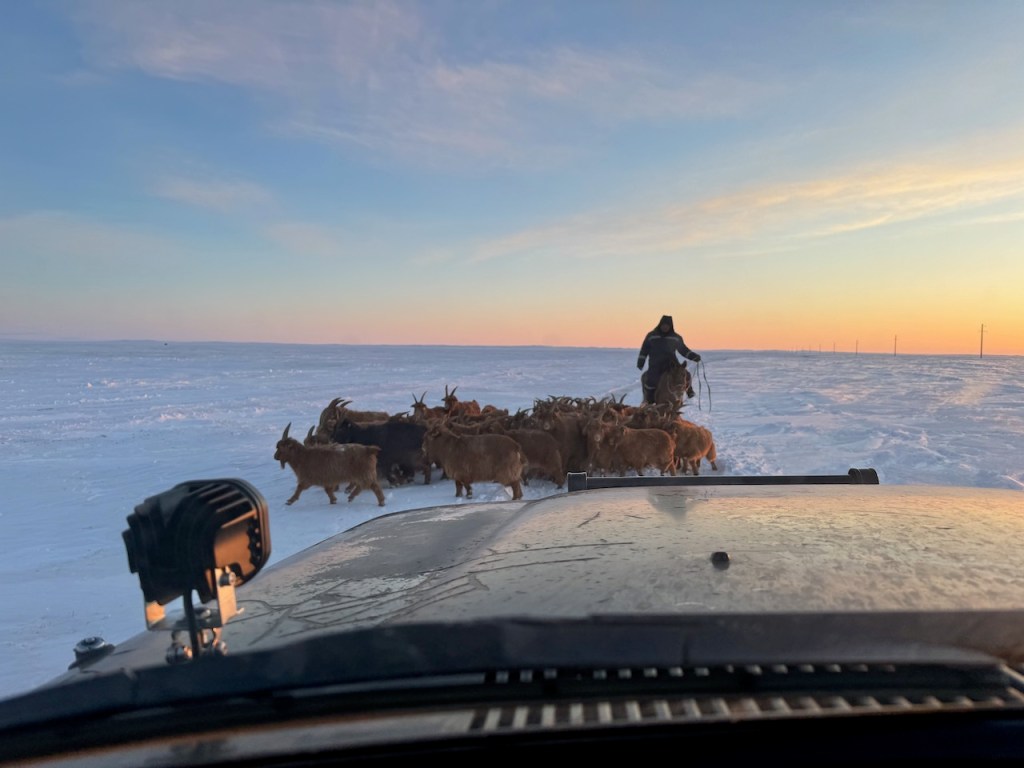
The camp where we based ourselves to find and photograph Pallas Cats resides in Mongolia’s far eastern Steppe region, nearly 700 kilometres from the capital, Ulaanbaatar. We used three large 4-wheel drive vehicles to reach the camp and to search for cats in the field. In good conditions, the drive is around 8-10 hours. The drive took us nearly twelve hours this year due to heavy snowfall. This year, I am including more behind-the-scenes photographs in the trip report to help paint a better picture of the overall experience of visiting and living in this remote region.
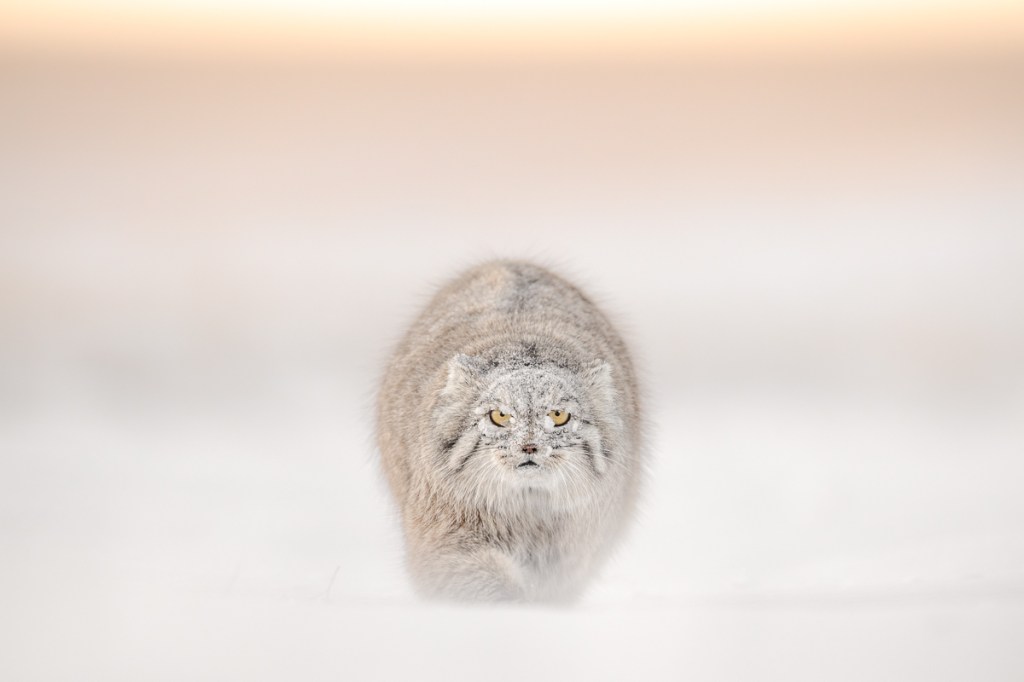
Widely unknown by many, the Pallas cat is a small wildcat roughly the size of a domestic house cat that is found in Mongolia, parts of China, Russia and Tibet. Typically, it is an ambush hunter living off small rodents such as vols. Unlike most cats that have an elliptical pupil, what makes the Pallas cat unique and special is its round pupils. Affectionately known as the ‘Grumpy cat’ by many, Pallas cats always tend to have an annoyed look that is undoubtedly part of their charm and appeal.
For 2024, Mongolia’s far east Steppe region has been buried under heavy snow, making for absolutely ideal conditions for finding and photographing Pallas Cat. Most years, the snow coverage is sparse in this region, and it is not uncommon for there to be little or even no snow. The lack of snow makes for easy driving conditions but can be problematic for photography. This year, the reverse proved true, with outstanding conditions for winter photography and adverse driving conditions that slowed us down on more than one occasion.
Over the week-long expedition, we photographed approximately six different Pallas Cats and sighted another half dozen or so as we traversed the landscape in our 4-wheel drives. Pallas cats can be challenging to distinguish, so it is impossible to be sure of the exact number of individual cats we sighted. Our local guides again showed their eagle-vision superpower of spotting the small cats at huge distances across the landscape. Finding Pallas cats in the vast, seemingly endless Steppe region would be impossible without their skilled eyes.
During this expedition, we also had a fantastic photographic encounter with a Corsak fox. This encounter was the first time in my visits that I could get close enough to Corsak Fox to photograph them. Completely relaxed, the fox allowed us to get close enough to fill the frame with a 600mm lens and a 1.4 teleconverter. Typically, the foxes in this region of Mongolia run away before you can get out of the car. This particular fox was found quite close to a nearby small village, and I suspect it was somewhat habituated to human activity. Nevertheless, it proved an incredible encounter.
During the trip, we also saw many raptors, including the Upland Buzzard (a fantastic black morph was also sighted), Golden Eagle, Saker Falcon, and the Cinereous Vulture.
Our final encounter for the expedition provided terrific images of a Pallas cat in backlight just as the winter sun was setting. This encounter was to be our last shoot for the trip, with the following day being lost to a snowstorm with poor visibility and high winds. In these sorts of conditions, Pallas cats prefer to hunker down in the rocks or fox and marmot burrows to seek shelter from the winds.
The following day, Our return to Ulaanbaatar took far longer than usual due to the heavy snow, which slowed us down considerably. The first part of the return journey (a distance of approximately 70 kilometres) is all off-road driving through the steppe region, and thanks to heavy snow, high winds and a snowstorm, this drive took us five and a half hours instead of the usual hour and a half. We left camp at 6am, anticipating the drive would be slow in the prevailing conditions. Indeed, the deep snow drifts saw us bogged down or stuck eleven times in our 4-wheel drives. Even once we made the main road, we were frequently slowed down by road closures and snow and ice conditions. Thanks to the tireless work of our local guides and drivers, we got moving each time and finally made it safely back to the capital an epic sixteen hours after our departure. Although this proved a very long travel day, the resulting photographs from the expedition were superb and totally worth the long hours in the car to and from the capital.
I will return to Mongolia this July for an expedition to photograph Pallas Cat and Pallas Cat kittens in the warm summer sun. This workshop is now sold out, but I am taking bookings for January and winter 2025. If you are interested in photographing this beautiful wildcat in winter snow conditions, drop me an email for more information or to register your interest.





 www.WILDNATUREPHOTOTRAVEL.com