
The Emperor penguin is considered by many photographers to be the Holy Grail of wildlife photography. No other animal live so far south in Antarctica and is so difficult to visit. Photographers travelling to Antarctica live in the hope of catching even a glimpse of the world’s largest penguin during their adventure. The reality is though, that very few people ever get to see and photograph this majestic penguin on their Antarctic expedition. The Emperors live on the sea ice deep in Antarctica and short of stumbling across a vagrant there is little to no chance of even sighting (let-alone photographing) this bird on an Antarctic expedition. Even those ship based expeditions that set off with the intention of finding and photographing Emperors fail many more times than they succeed because of sea ice conditions and difficulties in reaching the colonies. There is a way to visit and photograph the Emperors that all but ensures success and I am really excited and thrilled to now be offering this opportunity for a very select few photographers.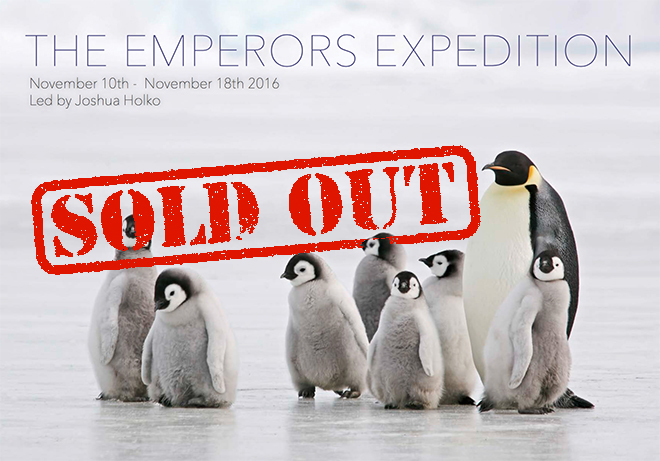 With the Emperor Penguins living so far south on the sea ice this expedition will be utilizing a privately chartered transport jet to access our first base camp at Union Glacier deep in Antarctica. We will then utilize a privately chartered Twin-Otter aircraft to take us to the remote Emperor Penguin colony where we will establish a field camp for the duration of our expedition.
  This expedition has been more than two years in the planning and has been designed to provide the very best possible opportunities to Photograph Emperor Penguins in their natural environment. By using chartered planes we can avoid the problems and uncertainty associated with ship based expeditions not being able to reach the colony due to sea ice conditions. Establishing a field camp means we can also photograph during the polar night when the light is soft and ethereal. Our time with the Emperors will be an extended one and provide us ample opportunities to photograph these majestic birds amidst a backdrop of spectacular glaciers and pressure ridges.
 During the expedition we will be 1,870 miles (over 3000km) from the southern tip of Chile and only a stone’s throw away from Mount Vinson, the highest peak in Antarctica. The South Pole will be just over 600 miles (1000km) away. Our geographic location will be 79°46’S 82°52’W. And our elevation 2, 297ft (700m) above sea level. This will be further south than I have previously ever ventured and is an area very rarely visited by humans.
 Given the logistics, and cost involved this expedition is certainly not for everyone. To my knowledge this is the first time this expedition has been offered as a workshop for dedicated wildlife photographers and I am really excited about this new photographic expedition and very much looking forward to the experience. Due to the initial expressions of interest and subsequent bookings the expedition is already completely sold out, but if you would like to be put on the waiting list you can still register your interest by emailing me at info@jholk.com. You can download a complete PDF itinerary and information flyer from my website at www.jholko.com in the Workshops tab.
 Please note that due to the nature of this expedition and the logistic difficulty of reaching and camping with the Emperor Penguins that this unique opportunity is unlikely to be repeated in subsequent years.
About Emperor Penguins
The emperor penguin (Aptenodytes forsteri) is the tallest and heaviest of all living penguin species and is endemic to Antarctica. The male and female are similar in plumage and size, reaching 122 cm (48 in) in height and weighing anywhere from 22 to 45 kg (49 to 99 lb). The dorsal side and head are black and sharply delineated from the white belly, pale-yellow breast and bright-yellow ear patches. Like all penguins it is flightless, with a streamlined body, and wings stiffened and flattened into flippers for a marine habitat. Its diet consists primarily of fish, but can also include crustaceans, such as krill, and cephalopods, such as squid. In hunting, the species can remain submerged up to 18 minutes, diving to a depth of 535 m (1,755 ft). It has several adaptations to facilitate this, including an unusually structured hemoglobin to allow it to function at low oxygen levels, solid bones to reduce barotrauma, and the ability to reduce its metabolism and shut down non-essential organ functions.
The only penguin species that breeds during the Antarctic winter, emperor penguins trek 50–120 km (31–75 mi) over the ice to breeding colonies which may include thousands of individuals. The female lays a single egg, which is incubated by the male while the female returns to the sea to feed; parents subsequently take turns foraging at sea and caring for their chick in the colony. The lifespan is typically 20 years in the wild, although observations suggest that some individuals may live to 50 years of age.
The emperor penguin has a circumpolar distribution in the Antarctic almost exclusively between the 66° and 77° south latitudes. It almost always breeds on stable pack ice near the coast and up to 18 km (11 mi) offshore.
The emperor penguin is a social animal in its nesting and its foraging behaviour; birds hunting together may coordinate their diving and surfacing.Individuals may be active day or night.
In 2012 the emperor penguin was uplisted from a species of least concern to near threatened by the IUCN. Along with nine other species of penguin, it is currently under consideration for inclusion under the US Endangered Species Act.
 Day Three: Twizel: Another early start as we set up to photograph first light and sunrise on the mountains. After breakfast we travelled off-road in our 4-wheel drives deep into the heart of the MacKenzie wilderness to photograph where few others venture. This part of New Zealand’s South Island offered us incredibly unique photographic opportunities in a very remote wilderness setting. We returned for lunch and a break before we headed out again for our last light evening shoot in the mountains.
 Day Five: North Otago – Te Anau: Sunrise on day five found us on the beach shooting the other-worldly and alien Moeraki Boulders, unusual spherical rock formations embedded in the sand that make for wonderful photography. This peculiar natural phenomenon is contrasted beautifully by the wide-open expanse of the Pacific Ocean. We then left the coast and made our way west to the lakeside town of Te Anau, located on the fringe of the Fiordland National Park. We arrived late in the afternoon and photographed by the lake shore late into the evening.
 Day Seven: Te Anau: We spent a full day in the Milford Sound area of the Fiordland National Park. We photographed dramatic mountains carved out by glaciers, lush rainforest draped in mosses and lichens, and crystal-clear rivers. We then returned to Te Anau, arriving in the late evening. We also took a cruise up the Sound to photograph the cascading waterfalls and precipitous mountains that plunge hundreds of metres into the ocean.
 Day Eight: Te Anau – Wanaka: We began with a sunrise shoot on the shores on Lake Te Anau. After breakfast we travelled north through Central Otago as we made for another lake town: Wanaka. We arrived in the early afternoon and left soon afterwards for our shoot location, overlooking Lake Wanaka and the mountains.

 Day Twelve: Greymouth – Christchurch: We departed Greymouth well before dawn and made for a quiet out of the way, and little known location where we could photograph some wonderful trees in a serene and peaceful lake. We had torrential rain on our last day of photography that really worked to our advantage – creating a lovely soft ethereal contrast in the trees. We concluded our workshop back in Christchurch with flights out in the late afternoon.

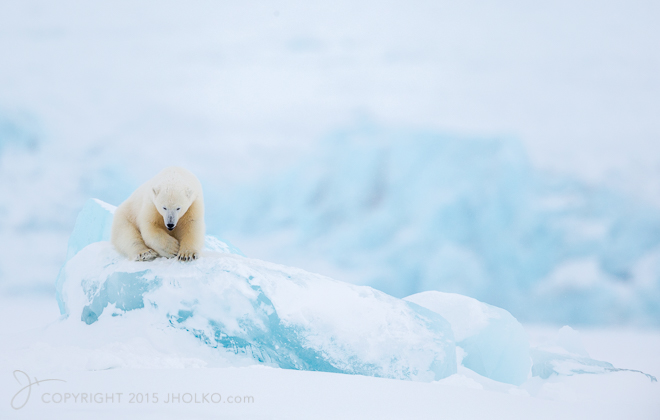
 South Georgia’s remote, untamed landscape is simply stunning. Scattered across the mighty Southern Ocean, the tiny arc of windswept islands and harbours are some of the world’s greatest wildlife sanctuaries set against world class landscapes. Famed for its abandoned whaling stations and Shackleton’s heroic journey, South Georgia is home to literally millions of fur seals and penguins, wallows of elephant seals, and nesting albatross. After we finish photographing in this breathtaking area we will sail back to the Falkland Islands where we will dock on the 21st of November and conclude this photographic expedition.
 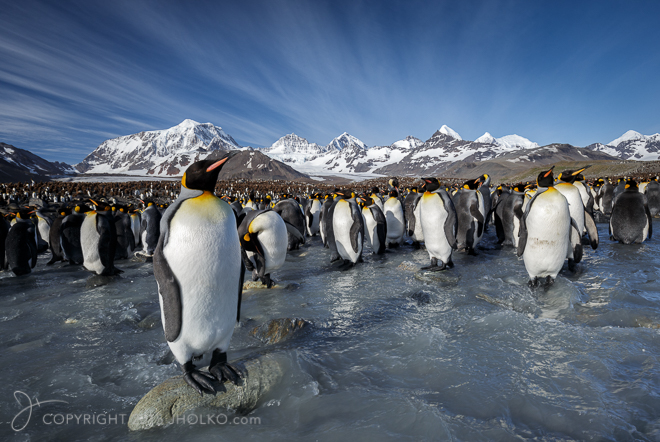 We will be using an ice hardened expedition ship that will enable us to get into the best possible locations. Our expedition ship the ‘Polar Pioneer’ is equipped with sufficient zodiacs and crew for all photographers to be shooting simultaneously with plenty of room to spare for camera equipment. If you would like to reserve one of the two available places or would like further information you can download a detailed itinerary and PDF flyer
