I thought I might have been finished yesterday when I hit the publish button on Part Two of my Landscape Photography with Emotion and Mystery article. However, I realised this morning that the flood gates were open and that there was more I wanted to share on this topic. I was quite direct in part two of this series on the problem with ‘Wow’ photography (See my post from yesterday for the definition of a ‘Wow’ photograph) and I want to instead focus on more positive aspects on the creation of evocative photography. Training ourselves to see with better eyes and freeing ourselves up to be creative is going to be the subject of this third article. The hope is that we can create images that rise above ‘Fast Food Photography’ ‘(See my post from yesterday for the definition of Fast Food Photography).
One of the things I have noticed that happens in my own image making is that it takes me time to get into the rhythm of the location I am photographing. I rarely turn up at a new location on day one and make a photograph I consider to be anything more than a snapshot. If I get lucky and get some good light I might create a ‘Wow’ photograph, but thats not really any better than the snapshot. This is a phenomena I have long pondered and I have come to the realisation that it is actually very difficult to arrive in a new location and take a great photograph on day one. Part of the reason for this is it takes time to settle in and get into the natural rhythm of the landscape and see better photographs. I need time to let the creative side of my brain attune itself to its surroundings. I need time to let my creative juices flow and I need time start to see strong compositions. The more time I spend at a location the more likely I am to produce an interesting evocative photograph. And that is an aspect to the creation of evocative photographs that has continually frustrated me. What I have also come to realise is that the more time I take off from actually being in the field and making photographs the more my ability to see strong and evocative images diminishes. When I spend a week or more in the field making photographs I become attuned to the landscape and the images start to flow freely. As the days progress I usually find the quality of the output improves. I am not necessarily taking more photographs, but I am taking better photographs. I can see this by looking at the images I made on a day-by-day basis after the fact in Lightroom.
When I subsequently leave the field and return to my studio for a period of time and then head back out into the field I feel like I am starting at square one again. Time has passed, my creative image making brain has been idle, and I have to attune myself all over again. Its a conundrum that has continually frustrated me. It really would be nice to pick right up where I left off with my creative brain in top gear and with strong and evocative imagery flowing freely. But how can that be done?
I have considered this problem for some time and have come to the conclusion that my creative ‘image-making’ brain is not being exercised sufficiently when I am not out in the field. Or perhaps more accurately, I am not spending the time learning to see with better eyes that I am doing when I am in the field. By the way, ‘seeing with better eyes’ is a subconscious process – its not something I am consciously considering when I am in the field. As a result my skill to see creatively is lying dormant and like any skill you don’t practice you start to loose your edge. The best analogy that comes to mind is cardio fitness. If you exercise daily your cardio fitness improves. If you stop and sit idle for a period of time your cardio fitness starts to deteriorate. Our ability to see creative images in the field works the same way – at least it does for me.
I have long considered the first few hours or days in the field to be ‘ramp-up’ time. That is time I need to spend attuning myself to see creatively. Or to use the cardio analogy, I need to ‘get fit’ again. The problem with ‘ramp-up’ time is that opportunities get missed. You may not realise it at the time, but you will no doubt, on reflection think back and consider the opportunities you missed during the first hours or days of a field session.
The key to minimising ‘ramp-up’ time for me has been to make a concerted effort to look at other photographers work in book and print as often as I can. This not only gives me insight into the work of other photographers and educates me on how they see the world, but it also keeps my creative brain ticking over. When I make the effort (and it isn’t an effort at all – its actually something I really enjoy) to sit and read or study a book of photographs it lights a creative spark in my brain. That spark gets me thinking about not only the photography I am absorbing, but also my own image making and how I can improve my next photograph when I next lift the camera to my eye. Looking at the work of other photographers gets me thinking about their interpretation of a scene, their vision and their way of seeing. It makes me consider how I look at the world, what stories I want to tell with my photographs and how I might consider an alternative approach to a scene or situation. It helps keep my ‘eye-in’ as it were and keeps things ticking over at a regular consistent pace.
One of the best things I believe you can do to improve your photography before you head out on your next field session is to spend some time looking at other photographers work. Not on social media, not on the web, but in books, prints and galleries where you are free from the distractions that plague the internet and social media platform. Take some time out of your day when the house is quiet and study a photography book from someone you admire or whose photography you enjoy. Go to the nearest gallery during your lunch break and spend some time studying the art work. Get to know the contemporary photographers out there who are masters of their craft and who are creating strong, evocative photographs with their own distinctive style. It never ceases to amaze me how many photographers I speak with can’t list more than ten well known photographers whose work they admire. Think about that for just a moment…. And what you will realise is that photographers are going out into the field uneducated and uninformed.
If you are planning a photographic trip somewhere make the effort to keep your creative brain stimulated with quality imagery before you get there. The more we train our brain to see the elements that make up a powerful evocative photograph the more likely we are to be able to create our own when we are next in the field. Just as an aside, I am not necessarily advocating you spend your time looking at photographs of African wildlife if Africa is your next travel destination. I am in two minds about wether this is a good idea. A part of me likes to approach a new location with fresh eyes and a clean slate without the influence of having seen location specific photography. Instead I would advocate you look at wildlife imagery in general and don’t necessarily limit yourself to African wildlife as in this example.
There is another thing you can do to improve your photography. I believe this is a really important aspect to the creation of evocative photographs and at the risk of being controversial, that just about all of us would be far better to invest the money allocated to our next camera or lens purchase to books on photography, prints, and museum and gallery entrance fees instead.
The marketing departments of the camera manufacturers has done a superb job over the last decade or so of convincing us that we ‘need’ the new model. That those extra pixels or extra stop of dynamic range are paramount in our photography. And that our current camera is now sub-optimal because the new version is now available for pre-order. This conditioning has been incredibly successful. Just scan the pages of any photography forum and you will find thread after thread talking about the next camera to come down the pipeline. Almost all of the ‘chatter’ is about equipment and very little is about about the creation of photographs. Now, I grant you the camera is an integral part of the process, but it is also just a tool.
The problem with that tool is that far too many photographers are constantly upgrading to the new version in the belief that it will improve their photography. The truth of the matter is that it usually has the opposite effect. The reason for this is that until control of the the camera you already own has become second nature and the movement of its controls nothing more than muscle memory you can never be truly be freed up to be creative. The brain is too focused on being a technician as it grapples with knobs and dials. We need to free ourselves up to be creative and the best way to do that is to properly learn to use the tool we already own. The best musical instrument players are intimately familiar with their instrument of choice. Yes, they can pick up another guitar, or another violin and play it very well. But they will play their own instrument at a higher level because they are intimately familiar with it. They understand its idiosyncracies and its limitations. They also understand how to get the best from it. And lastly, they don’t have to think consciously about it so they are freed up to play at their very best.
This is actually something I have witnessed countless times on my workshops and expeditions. Photographers fumble with their camera trying to find a button or setting. The focus and attention is on the equipment and not the photograph. Their brain is busy being a technician and is not focused on being creative. This is perfectly fine if the workshop is about teaching the technical aspects of photography and you are there to learn how to operate your camera. Typically however, this is not the case and the photographer is there to make images. Not only that, but they frequently have an expectation of wanting to create a strong photograph, yet they hamstring themselves through being unfamiliar with their equipment.
The take away from this is that you need to give yourself the best possible chance to be creative in the field and to do that you need to be intimately familiar with your equipment. Learn the camera you own back-to-front and inside-out and I promise your image making will improve considerably. Soldiers are trained to field strip a rifle blindfolded. They sleep with their rifle and they make sure they are intimately familiar with every aspect of their weapon. I am not advocating we all start sleeping with our cameras, but that perhaps if we just spent a bit more time committing the controls to muscle memory that we would give ourselves a far better chance to create a strong photograph when we are next in the field. This is unfortunately not the advice a lot of people want to hear. They prefer to believe that the new model camera that will be out soon, will improve their photography and that there is always some piece of gear or equipment that is holding back their image making. As you can see, the marketing departments of the camera companies have been extraordinarily successful.
If you choose to take this advice to heart you will find several things happen. Firstly, your wallet (and probably your significant other) will thank you as you will avoid what is in all likely hood an unnecessary camera upgrade or spurious lens purchase. As a side benefit you will also now have money for photography books, prints and gallery / museum entrance fees. Secondly, as you continue to learn the camera you already own your photography will improve as your brain shifts from being a technician who used to struggle with knobs and dials to a photographer who is freed up to create. Thirdly, your knowledge of photography will improve because you will own, appreciate and be familiar with the work of more photographers in book and print form. And finally, your own creative vision will improve because you have made the effort to focus your attention on the vision and not the tool. You will have armed yourself with the knowledge of the work of other photographers so that when you next go out into the field you are seeing with better eyes.
 Don’t forget! You can win a free 13″ x 19″ Win a Fine art Print of this photograph including shipping anywhere in the world. All you need do is to be the first to comment on this post on the home page with your thoughts on why you like this photograph or why you would like to own a print of the image and then share the post with your preferred social media outlet. Just keep in mind that due to my hectic travel schedule it may take me some time to make and post out each print so if you are the lucky winner for a given month I ask that you jut exercise a little patience and as soon as I am back in my studio in Australia and as soon as practical I will make the print and send it to you – free of charge. Each print will be made and personally signed by me with the same care and attention to detail I exercise on my large gallery prints. There will be a total of twelve prints to win throughout the calendar year. The first print was won by Fred Jennings and his print should be with him in the next few days – congratulations Fred!
 This second photograph was taken just a few seconds later when I realised that this photograph should not be about the iceberg. Nor should it be about the ocean or the distant mountain partially obscured in cloud and fog. What this photograph was about was the jet trail like plume of snow being whipped off the top of the iceberg. This is where the real drama and emotion was to be found in this scene. The ocean is the stage, the distant mountain is the backdrop and the iceberg is merely a supporting actor. It is the vapour trail of snow that is the star of the show.
 At the time I made these two photographs the decision to shoot the second image was a subconscious one. I knew I had captured the easy photograph – the entire scene; so I was now free to move on and ascertain what it was about the scene that was drawing me to photograph it. My subconscious took over and the result is the second photograph; which I personally feel, upon some reflection is a much more interesting image than the first.
 The first thing out of my daughters mouth after she spent a moment taking in the photograph was, and I quote: ‘The penguin looks sad Daddy“.
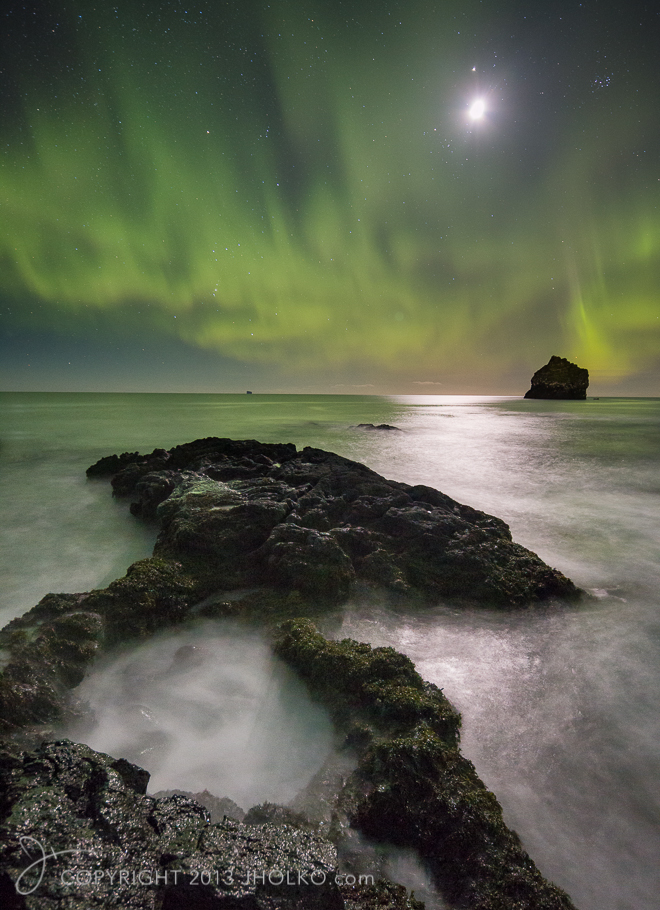
 At the beginning of March the darkness of the Icelandic winter is starting to lift and the days are becoming longer. We will have up to ten hours of good light during the day and with a little bit of luck the spectacular Northern Lights will increase our photographic opportunities well into the night. Winter conditions in Iceland can be stunningly beautiful: the glacial lagoons freeze, some of the waterfalls are partially frozen, the glaciers appear more blue with fresh snow on top, the landscape of the north is covered in fresh snow and with fewer visitors. With true darkness in winter comes the possibility of seeing the awe inspiring Northern Lights (Aurora Borealis). We plan to make photographs of them whenever there are clear skies and intense Aurora activity.
 You can download a complete itinerary and information PDF

