Photographers – Do you Collect Music?

Over the last twelve to eighteen months I have made a concerted effort when speaking with other photographers to ask them the seemingly obvious question: “Do you collect other photographer’s work?”

The responses have been very interesting to say the least, with the vast majority saying, “Yes. I have quite a lot of photography books.”  To this end, I don’t think I know a photographer worth his or her salt who does not own even a modest collection of books on photography.

At this point I have to clarify myself by adding: “What I mean is, do you collect or own any Fine Art Prints from other photographers?”

I am often greeted with either a blank stare or a confused look, sometimes with a “No” and only occasionally with a “Yes”.

When I ask them why they do not own any other photographer’s work, on the whole they can’t give me a reasonable response. Many of them clumsily stumble over their words before regrettably admitting they have no good reason for not owning any other photographer’s work. This response has been almost universal.

As a result, it seems to me there is somewhat of a strange “disconnect” between photographers who produce fine art prints and those who actually collect or own any outside of their own work. I want to use an analogy to try and put this into perspective.

Musicians are also by definition artists. And yet, all musicians collect the music of other musicians without exception. They collect what they appreciate and enjoy. They also want to see what their peers are producing.dazed_confused_musicWhy should it be any different for photographers?

I would certainly be keen to hear from other photographers who have had a different experience. It seems reasonable to me that if you produce art, you should share in the ownership of the art of others. It is one thing to peruse it in a book, quite another to live with it in your home. I would argue it is when we live with a piece of art that we truly learn to, not only appreciate it, but also potentially fully understand it. Viewing a print in a gallery is also a very different experience to passing that print in your home a dozen or more times a day.

I do not believe for a second that any of the photographers I have spoken with appreciate only their own art. If this was the case they would not own or purchase so many photography books or they would not enjoy viewing the work of other photographers at galleries, or online.

No; there is something else at work here that is responsible for the “disconnect”. Before I try and dissect what is going on I just want to make a quick comment on photography books at this point.  I love and own many books by many different photographers. I regularly enjoy perusing them and enjoy the photographs immensely. However, they are all, without exception poor facsimiles of the original fine art prints. Offset printing cannot yet match the colors, tonalities and subtleties of an original fine art print. Offset printing is getting better all the time, but realistically it still has a long way to go before it can encapsulate the fine art print.

You are probably thinking to yourself at this point, Do I own any fine art prints from other photographers?

The answer is yes; I do, though my collection still excludes many photographers whose work I greatly admire. However, I am proud to count several well known photographers amongst my art collection and quite a few others whose names are far less well known. These are actual hand signed (sometimes limited edition) fine art photographic prints. My collection also includes fine art prints from photographers I have swapped work with over the years, either through mutual respect and admiration for our work, or because we have visited the same locations and wanted to see each other’s interpretations in a finished print. Indeed, this is one of the great pleasures of making prints for me.

There is no better yardstick to gauge the quality and standard of your own prints than to be able to compare your work with that of other photographers whose work you respect and admire.

So I encourage you – if you like art, and in particular photographic art, then do yourself and the art world a favor – buy a fine art print from a photographer whose work you admire and respect. It doesn’t have to be one of mine and this piece is not in any way intended to promote my own fine art prints. Just find a piece of photographic art you like and start your own collection. Your life will be far richer for the experience.

Addendum:

I have subsequently shown this piece to a good photographer friend of mine whose opinion in these matters I highly value. He has made the following comments which I feel are worthy of inclusion as both a potential explanation and as one experienced individual’s conclusions.

I, too, am “guilty” of not collecting the prints of other photographers. In fact, the ONLY print I have EVER purchased made by another photographer was the one by Brooks Jensen, and I have never hung it on a wall. The truth is I believe it is beautiful art, but the real reason I bought it was that it was inexpensive. And yet, around the same time, I purchased a print (reproduction) of one of  Vettriano’s paintings for around $250, which was proudly hung on the wall in a central position where nobody entering my lounge could miss it. I once said to you that I wished I could take photographs the way he paints. It is the people in his paintings and their actions that holds one’s eye.

So, your article  has forced me to ask myself the same question you have raised. I think it has something to do with the fact that there can be only one painting, but there can be many photographic prints. And yet, that also isn’t quite right, because Vettriamo’s painting in my lounge is just a print, the original having been sold at auction for around $500,0000! You will recall that I also have around 8 of my own photographs on the walls, framed and proudly presented. I know this is also true of you.

I think there are a couple of things happening here:

Firstly, I doubt there are many painters who collect the paintings of other painters, so I don’t believe photographers are unique in this regard. Frankly, I believe all artists, whether they be photographers, painters, or sculptors want to surround themselves with their own work, because it’s their “stuff” and that’s what they want to display to others.


I find your analogy of musicians may not be an accurate one. Of course, musicians collect the works of others  – this is so they can exercise their art by playing the music of others, either to go on exercising their playing skills on their various instruments or simply to listen to music they like and learn from it. This is an auditory thing, involving literally thousands of tunes, whilst our problem is optical, and there is only so much wall space available..At the same time, I bet that if you asked a musician to play you a tune on, say, his piano, he would either play one that he had composed himself (presuming he was a composer and not just a player, a distinction you may want too make in your article). This raises an interesting question in itself –  is a musician an artist who can play well on,say, a piano, or does he have to be a composer? In my humble opinion both are artists, but the composer is the supremo/maestro.

So, when you get behind the lens you are definitely playing at being the maestro – or are you? Because the composition is already there before you and when does the transition take place from your just being a good player to being an actual composer?

The REAL question that has haunted me since I began serious photography in 1984 is why, especially in Australia, photography prints do not seem to be considered as high-end art? I think it has a lot to do with how simply I can go out and buy an excellent print of a  $500,000 painting very well framed for only $250. Given this situation, why should anybody buy a photograph whose value is unknown at, say $600 or a more reasonable $6000, even if they are originals?

In my modest opinion, the real market is the general public (1% are photographers, 99% want something nice to hang on the wall). I just haven’t been able to find a way to convince Australians to consider photographic images as serious, high-end art that they should buy to decorate their walls….

What do you think?

BenQ SW2700PT 27 inch Adobe RGB Monitor Review

In the later half of last year I reviewed Eizo’s brand new, superb CG-318 4k Resolution Graphics Display for Photographers and Graphic Design Professionals and gave it my highest recommendation. The Eizo represents the state of the art in graphics display for working professionals but comes with a fairly significant price barrier to entry. So what are your options if you are in the market for a high quality Adobe RGB monitor on a more family friendly budget?BenQ2Enter, BenQ who now have a solution for photographers on more modest budgets in the form of the SW2700PT 27″ Adobe RGB Monitor. The monitor has an MSRP of just $690 USD (about $900 AUD in Australia if you shop around) which for the sake of a price only comparison is close to ten times cheaper than the Eizo CG-318. Realistically however, there is no direct comparison between these two displays – the Eizo is a bespoke Ferrari and by comparison the BenQ a modest family car. Any direct comparisons are therefore irrelevant outside of the exceptional performance of the Eizo and the exceptional value for money of the BenQ. I will  however make a number of references to the differences throughout this review. Be aware however, that these are vastly different monitors at very different price points. I suspect the decision of which one to choose may well be heavily dependant on your budget and needs (probably in that order).

The BenQ SW2700PT is a 27″ monitor with a QHD native resolution of 2560 x 1440 pixels (that resolution in a 27″ monitor equates to 109 pixels per inch). It is a true 10 bit display producing more than one billion colors, with a 16:9 aspect ratio and covers an impressive 99% of the Adobe RGB Color Space. The benefits of a 10 bit display are often misunderstood, but in short a 10 bit display enables smooth shading and color transitions and very smooth tonal gradations. photographer page 2Key Features

  • 27”W 2560×1440 QHD Resolution
  • 99% Adobe RGB with IPS technology
  • Hardware Calibration with accuracy color
  • Palette Master Element color calibration software
  • Black-and-White photo mode
  • Shading Hood / OSD controller

I have been working with the new BenQ SW2700PT over the last couple of weeks as the primary Graphics display for processing and printing my photographs. The BenQ monitor is supplied well packed and out of the box requires some assembly of the stand and connection of the display to the stand. Assembly is easy and only takes a few minutes (no tools required). The instructions are clear and easy to follow, although I do recommend you assemble the display on a flat clean table using a blanket or something soft to prevent any scratches. The back of the monitor also has a VESA standard mount with 100mm pattern, allowing the installation of a wall mount bracket if required. I was also pleased to see the addition of a carry handle for moving the monitor around. There is also some minimal cable management in the form of a hole to thread cable through the stand.

As well as the monitor and stand BenQ also provide an individual calibration certificate that shows how the display tested before it left the factory. This certificate is not as detailed as that supplied with the more expensive Eizo CG-318 (nor is it hand signed), but it has all of the information one is likely to want or need. Personally, I like to receive a certificate like this that my monitor has been personally checked by a real person and not just a machine. I was pleased to see the BenQ also includes a hood shade in the box. The hood shade requires assembly and is simply clipped together in a few moments. A nice addition is a small hatch in the hood to enable the calibration device cable to be fed through for easy calibration of the screen without having to remove the hood. The supplied display hood is a nice addition that helps keep stray light from falling on the screen. Whilst the screen itself exhibits quite low reflectance. Once assembled, the monitor is plug and play and requires no software for immediate use (you do need software to access the hardware calibration features). I plugged it into my 2013 MacBook Pro via the display port and was up and running in just a few minutes. A DVI-DL/miniDP to DP/USB 3.0(1.8m) cable is also included in the box.

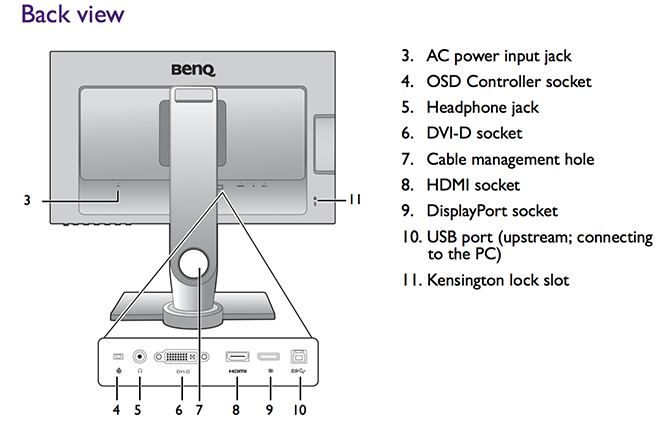
The BenQ has a good range of connectivity options that should fit most users requirements. It is nice to see that USB3 is supported as well as HDMI. There is also an inbuilt SD Card reader. I personally don’t find much use for an inbuilt SD card reader, but your mileage may vary depending on your workflow. Likewise, the headphone jack seems a bit superfluous to me on a monitor designed for graphics professionals, but it could serve a purpose in open plan work areas.BenQBackLike the Eizo, the BenQ SW2700PT is a hardware calibration equiped monitor. Hardware calibration allows you to adjust the monitor’s image processing chip without changing graphics card output data. Calibration keeps images consistent with originals without being affected by graphic card settings. Two monitor preset modes allow calibration results to be saved directly into the monitor. As discussed in the review on the Eizo CG-318, this is a significant advantage over software only calibration solutions and should be one of the primary considerations when purchasing a display for high end graphics applications.
Wide gamut displays such as the BenQ SW2700PT have the capability of displaying a much wider range of colour than the vast majority of computer displays. Most consumer displays will display colours close to that approximating the SRGB colour space. SRGB is a very small colour space and the default colour space of the internet. It is for all intent and purpose the lowest common denominator in the colour space world. Wide Gamut monitors have the capability of displaying a much wider range of colour (more saturated colours) and typically come close to approximating the Adobe RGB colour space. What this all means in real world terms is the reproduction of much deeper more saturated colours. This enables better rendition of colour tones and better gradation in colour. For image processing and printing this is a key advantage and for photographers is critical to achieving the best possible results. Here in my own studio my wide format Canon printers are capable of producing colours that greatly exceed the SRGB Colour Space (and in some areas even the Adobe RGB Colour Space). The BenQ is capable of rendering these colours on screen and thus I can ensure my images are optimally processed for final print without guess work or test prints.

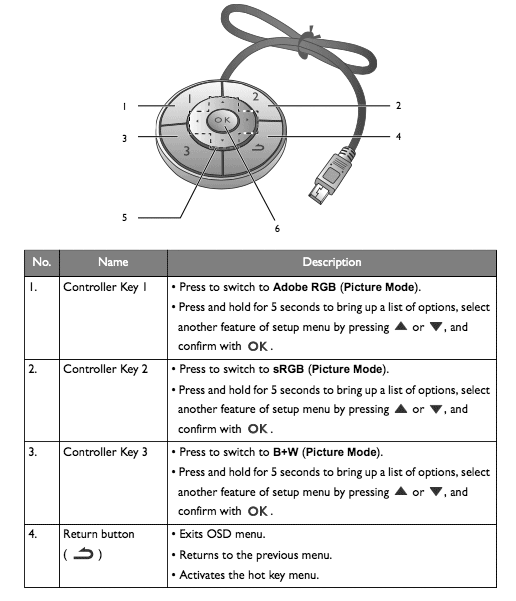
The BenQ is equiped with a 14-bit 3D Look Up Table (LUT) which improves RGB color blending accuracy for color reproduction. It is also equiped with an “OSD Controller”. The OSD controller is a remote controller that comes with three preset buttons each set up with a customized display setting such as Adobe RGB, sRGB and Black and White mode. This enables easy switching between presets without going through complicated settings. The OSD Controller also comes with a button for quick OSD navigation and settings. My initial impressions of this OSD controller were a bit gimmicky. However, in practical use I actually found this quite useful for soft proofing images for the web in SRGB. Black and white photographers will likely also love this capability with the dedicated Black and White mode. With a simple click of a button, you can preview color photos in black-and-white before adding effects or having to do any post production work.osd-infoIn terms of both sheer colour range and accuracy of colour reproduction, the BenQ’s performance is excellent. Testing shows superb SRGB performance and approximately 99% of the Adobe RGB gamut range is successfully displayed. The much larger Adobe RGB space is much harder to reproduce and most monitors don’t reach even 80% of it. At this price point the BenQ sets a new standard in my experience.
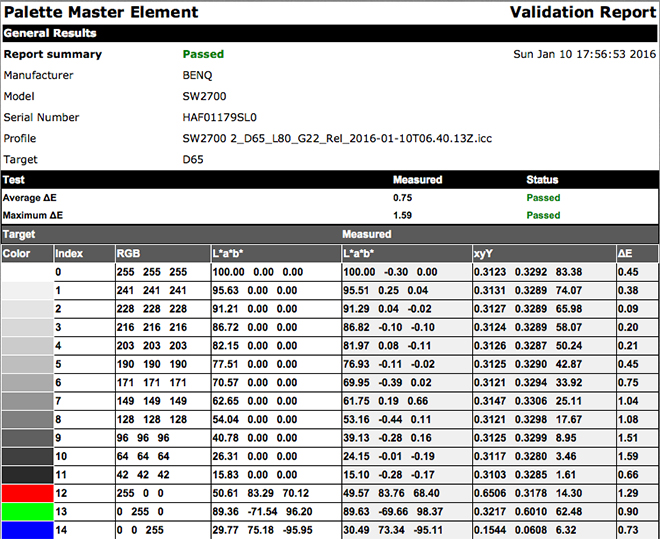
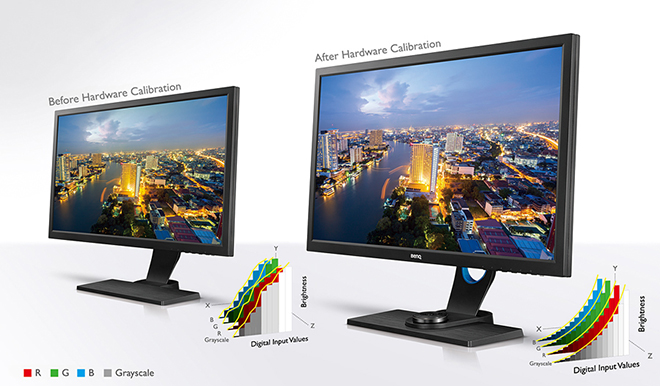
Being able to produce all of those colours is not very useful unless a monitor can do it accurately – and here the BenQ also offers very good performance. The measurement of accuracy is referred to as the ‘Delta-E’. In short, the bigger the number, the more inaccurate the monitor is. My own testing shows the BenQ’s average Delta-E to be a very respectable 0.75  and the maximum was 1.59. Whilst not as incredible as the Eizo CG-318 this is nonetheless excellent performance in a display at this price point and considerably better than many other consumer displays (including Apple’s iMacs).

The colour gamut advantage of displays such as the BenQ are the most commonly known advantage over more typical computer displays for graphics professionals. However, there is another key advantage worth mentioning; which is uniformity. Uniformity refers to the displays ability to maintain even brightness and contrast from one side of the panel to another. The more uniform the brightness the more ‘paper-like’ the appearance of the screen, the easier it is on the eyes and from a photography perspective the easier it is to judge tone and contrast in a given area of an image. Uniformity is extremely important in the reproduction of fine art prints since it ensures an even contrast ratio across the monitor.

Even uniformity is difficult to achieve in back-lit monitors and is often one of the first things you notice in a poor quality display. Monitors that are brightest in the middle and fall off in the corners are common place and are a very poor choice for creative professionals working with digital images. Uniformity can easily be measured and in my own tests I find just under a stop of difference across the face of the display from corner to corner when calibrated to 80 Candelas in my studio. Again, this is excellent performance in a monitor at this price point. It is worth noting that out of the box the default settings for the monitor are set to ‘retina burn-in mode’. I suggest calibrating the brightness setting to something more realistic for your environment.

PALETTE MASTER ELEMENT SOFTWARE

To really get the best from this monitor you need to take some time to properly calibrate and profile the display. The best way to do this is to use the supplied Palette Master Element software which can be download directly from BenQ’s website. A clear how to users guide is also available for download.

The supplied software offers options for both a basic and advanced calibration depending on your needs. Either option is quite intuitive and users should have no problem successfully calibrating their display by following the on screen prompts. Once calibrated and validated the software presents the user with a validation report on the calibration.PaletteMasterReport

Unlike the Eizo CG318 the BenQ SW2700PT does not include an inbuilt calibration device and requires an external instrument to calibrate the display. For the purpose of this review I used the X-Rite i1 Display colorimeter to calibrate the display (although the Spyder model 5 colorimeters are also supported). A colorimeter is an additional piece of equipment at additional cost, but really is necessary if you are going to get this display to perform at its best. To be honest, I am somewhat spoilt these days with the inbuilt calibration of the Eizo and I find it a bit of a hassle to dig out the colorimeter on a regular basis.photographer page 2REAL WORLD USE

In my review of the Eizo I wrote about the incredible resolution of a true 4K DCI compliant display and those conclusions still hold for me in my studio. Whilst the BenQ SW2700PT cannot compete in the resolution stakes with the CG-318 it does offer text of a more legible size which will I feel appeal to a great many photographers who will likely also use this monitor for email and web browsing as well as image processing. The BenQ also looks a little soft by comparison to the Eizo in side by side comparisons and clearly suffers from its lower resolution in this regard. A fairer comparison would be to compare the BenQ to my previous NEC monitor of the same resolution and in this instance the BenQ offers superb performance.

My daily use for a monitor such as the BenQ involves the editing, post production and printing of digital files in Adobe Lightroom and Adobe Photoshop Creative Cloud. I also use applications such as in-Design, Premiere Pro and other image related programs and plug ins. On the whole most of my time is in the majority spent in Lightroom and Photoshop and thus this is the area that my comments are most related.

Images in Lightroom (and Photoshop) are well rendered on the BenQ. Clarity and resolution are truly excellent in a monitor of this price point.  The colour rendition is excellent and when combined with the very good uniformity the BenQ offers it is extremely easy to judge tone and contrast when processing RAW files.  For soft proofing images for print the BenQ again offers excellent performance at this price point.

BenQ’s Palette Master Element Software is easy to set up, install and use and is strongly recommended to get the very best from this display.

CONCLUSION

The BenQ is a well built, high quality display that is easy to assemble, install and use via its display connectivity options. The quality of the image is excellent with very good uniformity and color accuracy that falls short of the much more expensive Eizo CG318; but far exceeds the average display. It needs to be said that the performance offered by the BenQ at this price point is nothing short of exceptional and that you are unlikely to notice the color accuracy and uniformity differences between these displays in all but the most demanding of workflows. Like the Eizo, I would have preferred the HDMI connection on the BenQ to be V.2 rather than 1.4 for future connectivity, but I suspect most users will opt for the display port in any case so this is a minor nit pick.

At an MSRP of $690 USD the BenQ should be number one on your list if you are after a high quality AdobeRGB monitor on a budget. The monitor offers exceptional performance for its price and all will likely meet your needs for a high resolution Adobe RGB display. The monitor comes with a limited three year warranty. Highly Recommended.


2015 A Retrospective and 2016 Whats in Store?

As is tradition on my blog, I like to do a “What’s in Store” post for the coming year as well as reflect back, and wrap up the year that was. In terms of stats over the course of the 2015 year this blog was viewed over 620,000 times across 159 countries. Which means if it were a concert at Madison Square Garden it would take more than 30 sold out performances for that many people to see it. Thats a huge increase over the previous year and quite a humbling feeling. The busiest day of the year was August 2nd with 11,459 views. The most popular post that day was How to Improve your Wildlife Photography without Spending a Lot of Money. Interestingly, one of the most popular posts remains one I made back in 2012 on Big Stopper Filters. I don’t often write about equipment and gear, but there is no denying that posts on equipment are extremely popular. Over the course of the 2015 year I made 110 new posts, growing the total archive of this blog to 596 posts.

In equipment or ‘gear’ terms 2015 was an interesting year with the introduction of the Canon EOS 5DS and 5DSR 50+ mega pixel cameras (long overdue some would argue) as well as the surprise new Canon 11-24mm F4L super wide angle zoom lens. Both of these have found a home in my equipment cupboard and I have utilised both extensively during workshops and expeditions in the later half of 2015. Although I still prefer the Canon EOS 1DX camera for the majority of my photography, there is no denying the huge resolution advantage of the 5DS/R when making giant prints. The 11-24mm F4L has proved a superb optic and although the use of such a wide angle lens is limited it has nevertheless proved a very useful tool thus far. 2015 also marked the year I ditched gimbal heads for long lens work and moved to a Sachtler FSB-6 Fluid head. There is simply no comparison between working with a fluid head vs. a gimbal and outside of the weight and cost difference the fluid head offers significant benefits that has resulted in a far higher ratio of ‘keepers’. This move represents what was probably the best equipment investment I made in 2015 in terms of improving my photography. My gear pick of the year for 2015 however goes to the Eizo CG-318 4K Wide Gamut monitor that I reviewed a couple of months ago here on my blog. Whilst its far from inexpensive, the Eizo CG-318 is a superb monitor that makes working with high resolution images, soft proofing and making prints an absolute pleasure. As I said in my review: If you have the means I highly recommend picking one up.

2016 will be a very interesting year in equipment terms as it is both an Olympic and Photokina year. As such, I expect to see the introduction of the Canon EOS 1DX MKII by no later than the end of April as well as several new L series lenses. However, the jury is still out on what lenses Canon will actually deliver. Expect the 1DX MKII to have an all new focus system, 4k video capability, and to set a new standard for high ISO images. I expect resolution to be around 22 mega pixels which is more than enough for 90%+ of my photography. Rumours persist of a new 600mm F4 DO lens (a patent has been filed by Canon) as well as a new 800mm F5.6 lens. A new 800mm lens will have to offer something really extraordinary as the current 600mm F4L IS MKII with a MKIII 1.4 TC is as good as the current 800mm F5.6 with greater reach and greater flexibility. I would not be surprised if we see a new 800mm F5.6 lens with an inbuilt 1.4 Teleconverter; although such a lens would be highly specialised and very expensive.

Book pick for the year for me was a close call between Ragnar Axelssons’s magnificent Last Days of the Arctic (Review coming Soon) and Vincent Munier’s opus Arctique (Read the Review). Both were stand out books for me packed with some of the best photography I have seen from the Arctic. Ultimately, I am giving the nod to Vincent Munier’s Arctique –  an absolutely superb presentation that deserves a place in any photographic library.

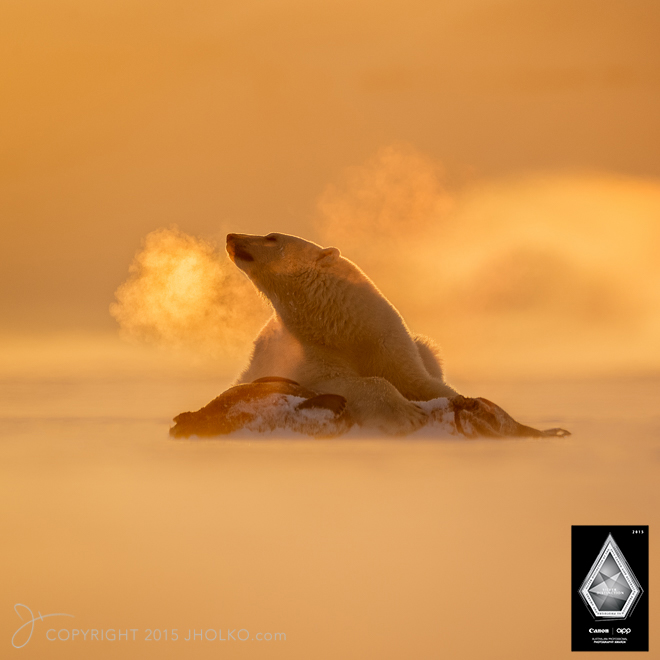
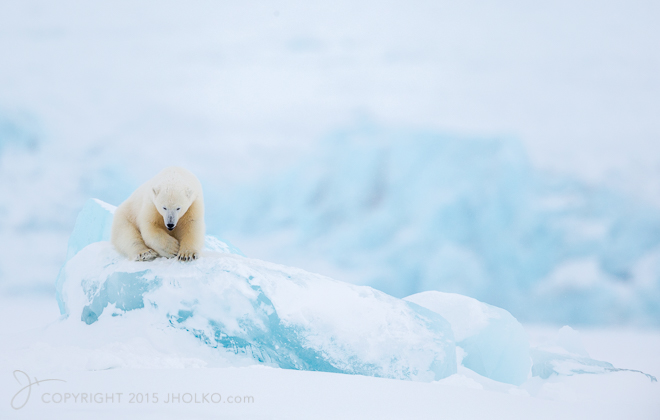
Over the course of this year I published my own favourite twelve photographs here on my blog. Please be sure to check them out and let me know what you thought. I don’t usually have an overall favourite from a given year, although I definitely have a soft spot for this photograph of the back lit Polar Bear with is breath steaming in the Arctic winter light. Svalbard-9725-Edit copyI also gave away more than a dozen fine art prints over the course of the year that have gone around the world and that have found their way onto the walls of homes and offices. The chance to give something back in 2015 has been something I have very much enjoyed and the feedback I have received from those who have won a print throughout the year has been incredibly fulfilling. I would very much like to continue this series going forward, but due to a very heavy travel schedule next year I will just not have time to regularly make and send out the prints. I will return to this print giveaway at a future date however.
In competition terms, 2015 was a solid year for me with finalist positions in the  2015 Canon APPA Professional Science, Wildlife and Wild Places Photographer of the Year as well as finalist in the  Epson 2015 Professional Science, Wildlife and Wild Places Photographer of the Year. I was also a finalist in the 2015 Outdoor Photographer of the Year and 2015 Travel Photographer of the Year competitions as well being short listed in BBC Wildlife Photographer of the Year and Natures Best Photography. It was a great year and I have been thrilled with the results. Three of my photographs (including the polar bear above) will be published in the 2015 Outdoor Photographer of the Year competition book that is now available for pre-order.

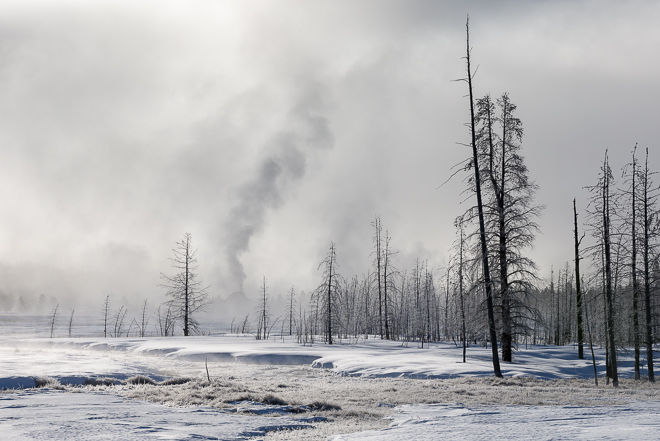
2015 was also the biggest year yet for me both with destinations visited and sheer number of international miles travelled. 2015 also marked the year I finally returned to the United States and photographed in Yellowstone in Winter (something I have long wanted to do and am planning to do again in early 2017). I have no idea how many actual miles I covered in 2015 in total, how many aeroplanes I boarded, how many times I went through airport security or how many tens of hours I spent waiting around in airports for connecting flights, but it was an awful lot. 2016 will certainly have its fair share of flights and layovers and I am trying to work through as much office work as possible in the next few weeks before I board the next plane in February.

2015 kicked off with a brand new Yellowstone in Winter workshop followed by a four day extension to the spectacular Grand Tetons (Read the Trip Report). Although we did not have great snow at this time we were fortunate to see and photograph the Lemaire Valley wolf pack as well as the Canyon and Yellowstone packs. Seeing wolves in the wild is an amazing experience and the chance to photograph them was fantastic. They are a haunting animal and it is no wonder they are still shrouded in so much mystery. We also had some superb conditions for landscape photography inside the park. Although the majority of photographers travel to Yellowstone for the wildlife, the landscape is in many ways the real gem of the area. The combination of geothermal activity with snow and ice can make for some very evocative imagery. I am planning a future workshop to Yellowstone in Winter in early 2017 that will focus on both landscape and wildlife. Details will come early in the new year.Yellowstone-7096-Edit12015After Yellowstone Daniel Bergmann and I ran our annual Winter Iceland workshop (Read the Trip Report) that included destinations in both the north and south of the Island. Iceland in winter is an incredible experience and this workshop provided us with wonderful opportunities in a snow covered landscape. This year saw a return to cooler temperatures during winter in Iceland than recent years as well as greater snowfall; both of which made for some fabulous photography.Iceland-7851-Edit12015After Iceland I travelled to Svalbard where I participated in a small group snow mobile expedition for Polar bears and other wildlife in the winter landscape of Svalbard. This exploratory expedition resulted in some remarkable photographs and is something I hope to repeat early in 2017. I will also have a new offering in 2017 to photograph from small ship in the middle of winter – Details to come soon.Polar Bear BluesAfter Svalbard I returned to Iceland and continued work on my Arctic Fox Project. I am getting close to completing the project now and hope to finish the project in 2016.Hornvik-9988-Edit42015After Iceland, I ran my annual two week New Zealand South Island workshop which saw us circumnavigate the South Island via private 4-wheel drives and that included significant helicopter time over the spectacular southern Alps as well as the Teanu region. We visited Milford Sound, Queenstown, Fox Glacier, Mount Cook and a great many other off the beaten track locations during the workshop. We also visited the now very popular Moraki boulders area where I was able to make this image that for me really captures the essence of these amazing rocks. (Read the Trip Report) I also spent an extra two weeks photographing in New Zealand with my good friend Martyn before we returned to Australia for some Great Ocean Road photography.NewZealand-2355-Edit12015After a short break, I then travelled back to Svalbard for my Wild Polar Bears expedition (Read the Trip Report). This was a fabulous expedition that saw us circumnavigate Spitsbergen (something I had not done before) during the ten day trip. We had numerous close encounters with Polar Bears, Arctic Fox and Walrus and some fabulous images resulted.
I then returned to Iceland for the Summer season and lead my annual summer trip with Daniel Bergmann (Read the Trip Report). I never tire of returning to Iceland and eagerly look forward to each return visit. The 2016 Winter workshop is long sold out, but there are still a few places remaining on the 2016 summer workshops if you would like to join us. Just drop me an email to register your interest.

After Iceland Daniel Bergmann and I travelled back to Svalbard for our Kingdom of the Ice Bear expedition. This year I teamed up again with the crew from Untitled Film works to produce a short movie on what it was like to travel on a dedicated photography expedition to the Arctic for Polar Bears. The short film we released a few months ago has been a huge hit and we have received some truly wonderful feedback. If you haven’t yet seen the movie yet you can click on the image below. Be sure to watch it full screen, dim the lights and crank the music. Enjoy.KingdomoftheiceBearIn November I travelled to South Georgia Island for a fifteen day expedition that saw us photographing in some of the world’s best locations for wildlife (full trip report coming soon). I have really been enjoying seeing the fantastic photographs being shared on social media taken by all who participated on this expedition. Just as an interesting aside, I noticed a significant increase in the number of small birds in South Georgia this year which is a testament to the effectiveness of the rat eradication program that has been running for the last few years. It was wonderful to see so many South Georgia Pipits this year after seeing none the previous year.

At the conclusion of this expedition I lead a small group workshop to the Falkland Islands. During our time in the Falklands we flew from Stanley to both Saunders and Sea Lion Islands where we photographed many of the fabulous bird species found in these world class locations (full trip report coming soon). The highlight for me was finding and photographing the magnificent Short-eared owl on Sea Lion Island.FalklandIslands2015-4675After the Falklands I travelled to Punta Arenas in Chile where I boarded a Soviet Ilyushin jet (The Russian equivalent of an American Hercules) and flew down to Union Glacier in Antarctica where we landed on a naturally occurring blue ice runway just 500 nautical miles from the South Pole. The purpose of this scouting trip was in preparation for the Emperor Penguin expedition next year. This was a truly remarkable experience and I will have a lot more to say about this experience in future posts.AntarcticaUnionGlacier2015-2155-EditI then lead one final expedition to the Antarctic peninsula to finish up the 2015 year before arriving home two days before Christmas. All up I led a total of ten separate international workshops and expeditions in 2015 spread across the globe (not including some local private workshops to the Great Ocean Road as well as one-on-one Print workshops). A brief count tallies up more than thirty five international plane rides and well over thirty thousand exposures (wish they were all keepers!) and a lot more than thirty hours of lost sleep. It was a fantastic year and I just want to thank all of you who I was fortunate to meet, travel and photograph with throughout the year. It was real privilege to share in such remarkable destinations with so many fantastic photographers – thank you.

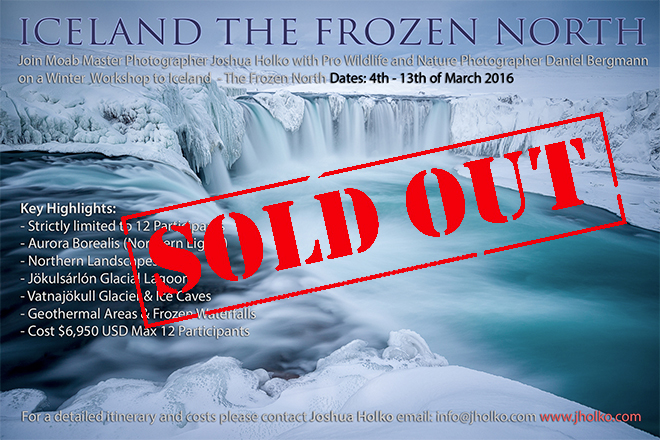
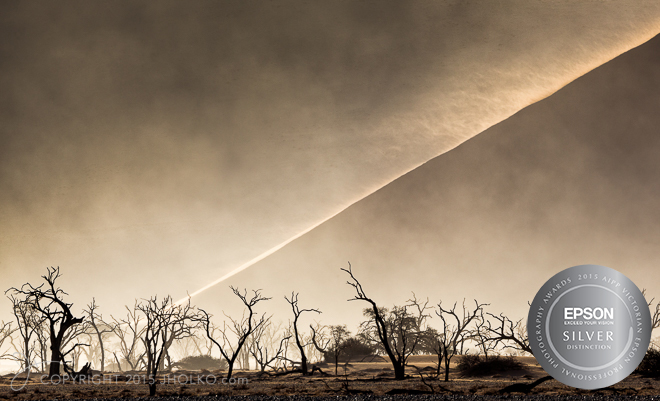
2016 is shaping up to be an even bigger year than 2015 in terms of both miles and locations and I am really excited about whats in store. In February I will lead a sold out expedition to the Weddell Sea in Antarctica. The Weddell Sea is a very different experience to the more often visited eastern side of the Antarctic Peninsula and is home to some really huge Adelie Penguin colonies as well as giant tabular icebergs. There has been a huge amount of ice this year coming out of the Weddell Sea (more than I have ever seen before) and I expect we will encounter some truly gigantic icebergs during this expedition. Pool and Penguin at Sea in SnowstormAfter the Weddell Sea I will travel directly to Iceland where I will spend ten days in the remote north working on my project on the Arctic Fox. This will be my third year working on this project and I hope to gather the final images from this trip and complete the project in 2016. A portfolio of prints celebrating this remarkable animal will be available early in the new year, followed up by a book in the later part of 2016.Hornvik-9491-Edit-Print-MoabSMR-RelCol32015After I finish in the north of Iceland I will lead my annual Winter Aurora workshop to Iceland (Sold Out) with my good friend Daniel Bergmann. We have a  slightly different itinerary in store to last year and will spend the majority of our time this year in the frozen north. We are looking forward to frozen waterfalls, ice caves and with a little luck some spectacular northern lights. IcelandWinter2016soldoutAfter Iceland I will travel to Lofoten in Norway where I will lead a brand new workshop for winter landscapes in this spectacular part of Norway. The Lofoten Islands have long been on my wish list to visit and photograph and I am very excited to be travelling to these spectacular islands in winter with a small group of photographers.LofotenAfter Lofoten I am heading straight to Namibia in Africa for a private small group overland safari. We are planning to visit a number of different areas for landscape photography including the ghost town of Kolmonskop as well as the incredible sand dunes of Sossusvlei and the salt pan of Dead Vlei. This safari has long been sold out, but due to a recent cancellation there is now one single place available. Please drop me an email if you would like further details._MG_0383-Edit12014In May I am going to make the short hop across to the South Island of New Zealand to co-lead a Masterclass workshop with friend Phillip Bartlett (Sold Out). We have some really exciting locations lined up for this trip that include helicopter access into the remote back country and an extension to the coastal town of Kaikoura. I always look forward to any chance to photograph in this spectacular country.
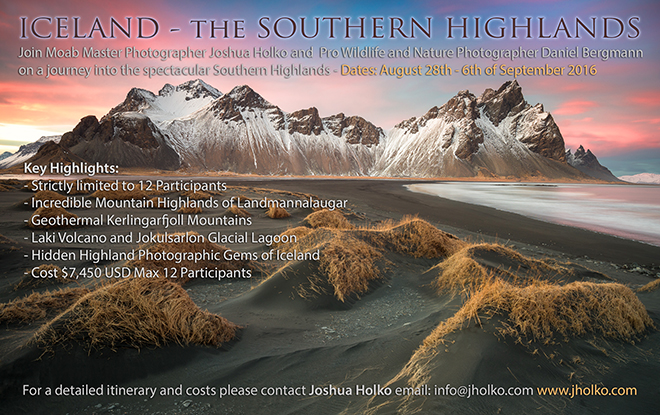
In July I will head back to Svalbard to lead my Wild Polar Bears expedition. We will depart from the small town of Longyearbyen and sail up to the edge of the permanent pack ice where we will spend out time searching for and photographing the king of the Arctic.

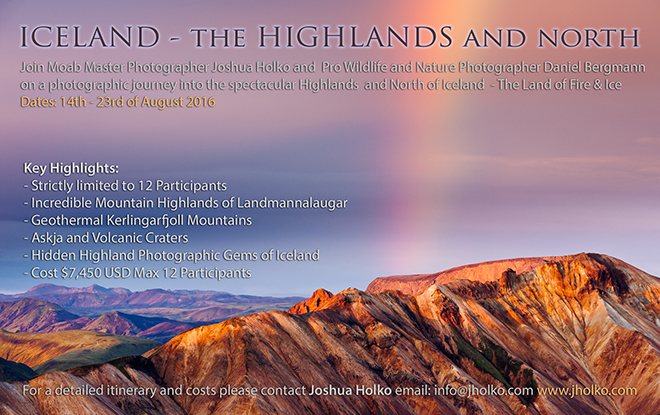
At the conclusion of this trip I am flying to Iceland where Daniel and I will lead our Iceland Highland Expeditions (still a few places available). Please drop me an email if you would like further details. In November 2016 I will travel deep into the interior of Antarctica where I will lead a small group on a dedicated expedition for  photography of Emperor Penguins (Sold Out). This expedition has been several years in the planning and I am extremely excited to be taking a small group of passionate and dedicated photographers on this trip. The opportunities for photography in this incredibly remote part of Antarctica are nothing short of breath taking. Emperors-7In late November I will travel to the Falkland Islands (our departure point) for a  photographic expedition to South Georgia Island and Antarctica. Unlike the expedition I led in 2015; which visited only South Georgia, this expedition will also take us down to Antarctica. Its going to be a very busy and hectic year and I am keen to make a start in Antarctica in the Weddell Sea in just a few weeks time.
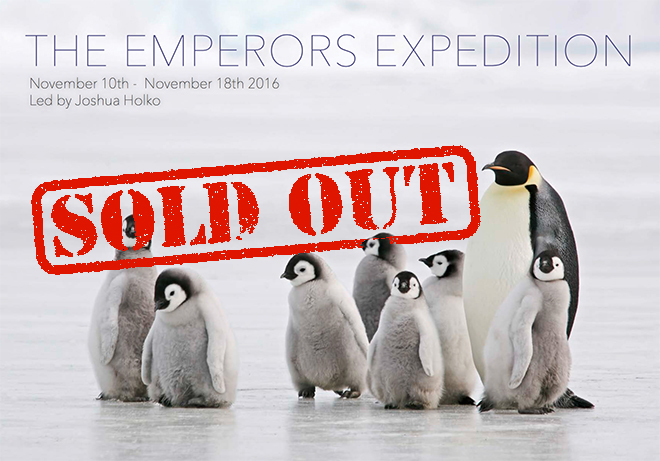
In other projects, I had planned to finalise and publish my book ‘Extreme Latitude’ in 2015 (this long overdue project has been sitting ‘mostly’ finished on my hard drive for the last couple of years) but travel commitments got in the way and the project has languished unfinished. I now plan to split this project into several books – the first of which I hope will be available by the end of 2016.

A final sneak peak into 2017 for those of you who have managed to read this far: I will be announcing at some stage next year another winter Yellowstone workshop for a small group of photographers. This workshop will be via private snow coach and will include an extension to the spectacular Grand Tetons. I will also be announcing a completely new trip to Svalbard in winter and I will have more to say about this opportunity next year.

Lastly, I want to wish all of you a very safe and happy New Year and may 2016 be one of amazing light and experiences for all of you.

Photo of the Month December – Fox Huddle – Win a Fine Art Print!

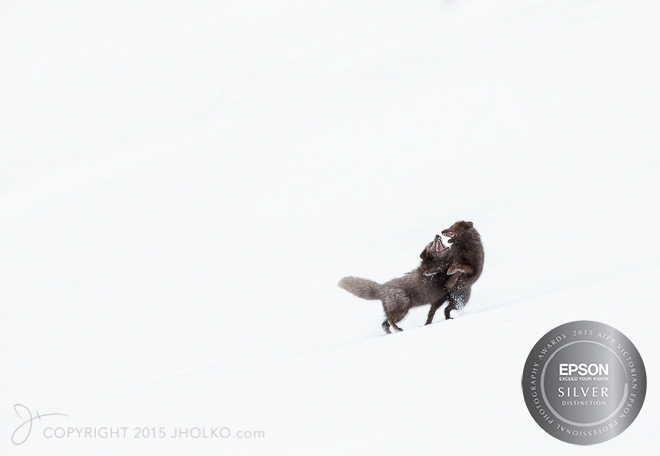
The final photograph of the month for 2015 is part of the Arctic Fox project I have been working on for the last few years in a remote part of Iceland during the winter months. This male and female fox were huddled together near my snow blind for about an hour during some pretty serious weather last winter. The wind was howling and the snow was flying – the ideal conditions I look for when photographing Arctic and Antarctic wildlife. Photographing in these conditions is challenging, but the results are incredibly rewarding.

I will be returning to Iceland to finish this project early in the new year and will subsequently be releasing a small portfolio of prints and a limited edition book later next year to celebrate the completion of the project on what is one of Nature’s greatest survivors. The portfolio will be available early in the New Year with the book to follow around the middle of 2016.Hornvik-9854-EditDon’t forget! You can win a free 13″ x 19″ Fine Art Print of this photograph including shipping anywhere in the world. All you need do is to be the first to comment on this post on the home page with your thoughts on why you like this photograph or why you would like to own a print of the image and then share the post with your preferred social media outlet.

This will be the final print giveaway for 2015. Over the course of the year I have given away more than a dozen prints (some months I sent out several prints) that have gone around the world and that have found their way onto the walls of homes and offices. The chance to give something back in 2015 has been something I have very much enjoyed and the feedback I have received from those who have won a print throughout the year has been incredibly fulfilling. I would very much to continue this series going forward, but due to a very heavy travel schedule next year I will just not have time to regularly make and send out the prints. As such, this will be final print give away for the foreseeable future – so don’t miss your last chance to own a fine art print from this contest.

Weddell Sea Expedition February 2016 – SOLD OUT

I am excited to announce that my new expedition to the Weddell Sea, Antarctica  in February next year is now sold out. Renowned as the wild side of Antarctica,  the Weddell sea is famous for its gigantic tabular sized icebergs and incredibly rugged landscape. The Weddell sea is an area of Antarctica rarely accessible due to sea ice conditions and our intention is to explore and photograph this rarely visited wild side of Antarctica. We will be using an ice-hardened expedition class ship ‘Polar Pioneer’ so we can push quite a lot of ice safely; which will enable us to get much further south than most vessels.

We will sail across the Bransfield Strait to Antarctic Sound on our journey toward the Weddell Sea. Antarctic Sound is home to literally monolothic tabular icebergs that break off the Antarctic ice shelf and float up out of the Weddell Sea. There are incredible photographic opportunities in this area and we will stop to take advantage of spectacular tabular icebergs as we encounter them. We then plan to travel down the east side of the peninsula as deeply as we can penetrate into the sea ice.Pool and Penguin at Sea in SnowstormIf you missed out on this expedition and are interested in travelling and photographing in Antarctica I will soon be announcing a new seventeen day expedition to the great white continent slated for November 2016. This new expedition will be limited to just 48 participants and will include a new itinerary. I am not quite ready to start taking bookings yet, but if you would like to be amongst the first to reserve your place you can register your interest now by dropping me an email (no obligation at this point). More details to come soon.