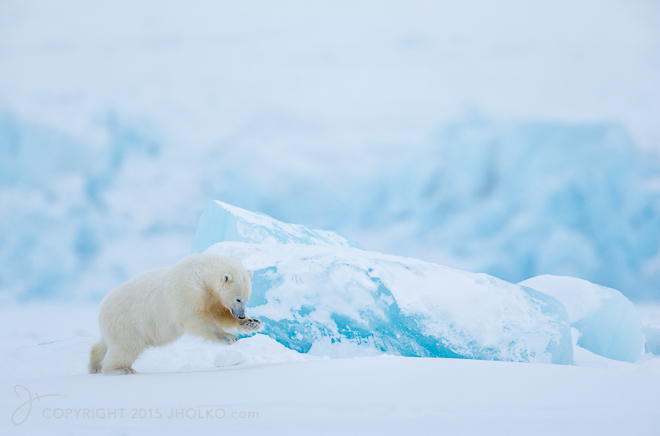
Congratulations to the seventh print winner ‘Peta Horsten’ for the photograph of the month for July 2015: ‘Polar Bear Pounce’.
What Peta said: Absolutely exquisite image capturing the frivolity of animals in the wild. It is a dream of mine to photograph Polar Bears – would love to have a print of yours on my wall to remind me of that dream!.
There were several other comments that came in within seconds of each other and I have therefore decided to give away two additional prints to the two runners up, Frede Lamo and Hulia Boz. What Frede and Hulia said:
Frede: I would really would like a fine art print of this photo Joshua. I think this picture has a very special and sad story. I observed and photographed this polar bear a couple of times before it was killed, but they did not turn out this great.
Hulia: Its poetry… it’s magic and it’s taken in a special location with a special animal by a special photographer! why would I not want to win an amazing print!
 Congratulations Peta, Frede and Hulia, your prints will be sent to you in the next few days. Keep an eye out on my blog for the next print giveaway with the August photograph of the month. Remember the best way to get instant updates is to subscribe via email.


 FootNote: Wild magazine was founded and originally owned by Chris Baxter – a well respected climber and outdoorsman in his own right who was largely responsible for a significant portion of the early rock climbing scene in Australia. I had the privilege of knowing Chris and climbing with him briefly during my youth at both Mount Arapiles and The Grampians. Chris forged many new climbs at both of these world famous locations as well as Mount Buffalo and was a full time character in the Australian climbing scene. Chris subsequently sold Wild due to health issues after building up a very successful publishing company that became the outlet for all things bush walking and climbing related in Australia. Unfortunately Chris passed away in 2010 after a long fight with cancer but ‘Wild’ and ‘Rock’ continue to be published under new new ownership.
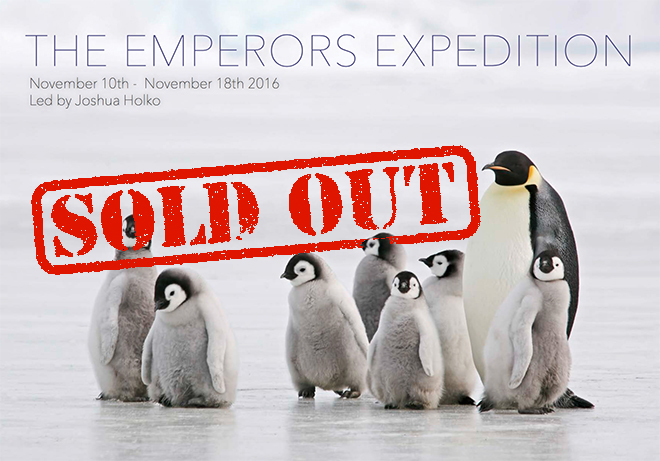 With the Emperor Penguins living so far south on the sea ice this expedition will be utilizing a privately chartered transport jet to access our first base camp at Union Glacier deep in Antarctica. We will then utilize a privately chartered Twin-Otter aircraft to take us to the remote Emperor Penguin colony where we will establish a field camp for the duration of our expedition.
  This expedition has been more than two years in the planning and has been designed to provide the very best possible opportunities to Photograph Emperor Penguins in their natural environment. By using chartered planes we can avoid the problems and uncertainty associated with ship based expeditions not being able to reach the colony due to sea ice conditions. Establishing a field camp means we can also photograph during the polar night when the light is soft and ethereal. Our time with the Emperors will be an extended one and provide us ample opportunities to photograph these majestic birds amidst a backdrop of spectacular glaciers and pressure ridges.
 During the expedition we will be 1,870 miles (over 3000km) from the southern tip of Chile and only a stone’s throw away from Mount Vinson, the highest peak in Antarctica. The South Pole will be just over 600 miles (1000km) away. Our geographic location will be 79°46’S 82°52’W. And our elevation 2, 297ft (700m) above sea level. This will be further south than I have previously ever ventured and is an area very rarely visited by humans.
 Given the logistics, and cost involved this expedition is certainly not for everyone. To my knowledge this is the first time this expedition has been offered as a workshop for dedicated wildlife photographers and I am really excited about this new photographic expedition and very much looking forward to the experience. Due to the initial expressions of interest and subsequent bookings the expedition is already completely sold out, but if you would like to be put on the waiting list you can still register your interest by emailing me at
  Please note that due to the nature of this expedition and the logistic difficulty of reaching and camping with the Emperor Penguins that this unique opportunity is unlikely to be repeated in subsequent years.
 Its diet consists primarily of fish, but can also include crustaceans, such as krill, and cephalopods, such as squid. In hunting, the species can remain submerged up to 18 minutes, diving to a depth of 535 m (1,755 ft). It has several adaptations to facilitate this, including an unusually structured hemoglobin to allow it to function at low oxygen levels, solid bones to reduce barotrauma, and the ability to reduce its metabolism and shut down non-essential organ functions.
 www.WILDNATUREPHOTOTRAVEL.com