
Since my podcast yesterday breaking the news that the Canon EOS R1 would be 24 Mega-pixels and feature Quad pixel Auto Focus and Canon Rumour’s subsequent post confirming the Canon EOS R1 specifications, YouTube has pretty much exploded with the specifications news. Comments on the videos the Ordinary Film Maker posted to date make for pretty hilarious reading (assuming you have nothing else to do). Judging by the comments. some of these people really need to get away from their keyboards and spend more time in Nature :-). The content is good, though, and worth your time if you are interested in the Canon EOS R1 or the Canon EOS R5. I expect a lot more news to drop in the next few weeks.
WNPP Episode 98 The Canon EOS R1 will be 24 Mega Pixels with QPAF
I have just published episode 89 of my Wild Nature Photography Podcast. In this episode, I briefly update my Namibia workshop, which I wrapped up a couple of days ago (an amazing group and a fantastic trip). I then dive into the Canon EOS R1 Development Announcement, the ‘incorrect’ Adorama specifications that were unfortunately published worldwide, and discuss the actual resolution and some of the specifications of the camera from an inside source.

Post Production Ethics and the Use of Generative Artificial Intelligence
AI-generated images are literally swamping social media platforms. Many of the Nature photography groups on Facebook I have historically been a part of are now drowning in A.I generated images as surrepticious users attempt to outdo each other in a seemingly never-ending quest for likes and views. Disclosure does not appear anywhere on most posters radar, and the intent is very clearly to deceive and fool the viewer. These posts are often immediately apparent to the trained eye; but even an untrained eye can quickly check the posters photo album to see that they have nothing else even close to what they are claiming is their photograph. It is a very sad run-away train of one-up manship that is significantly blurring the lines between Nature photography and “computer-generated art” (and I use the word ‘art’ loosely). Where will it end? I have no idea, but at least in the Nature space, the use of generative A.I tools appears to be highly destructive to accurate depictions and documentation of Nature. Or, at the very least, it causes significant confusion about what is real in the Nature space.
Since the rise of generative A.I tools, I have been receiving more correspondence asking if I use any A.I techniques to enhance my photographs. The answer is NO. A long time ago I published an ethics statement on my website HERE fully disclosing how I approach processing my photographs. I have now updated this to include the exclusion of A.I generative tools.
ETHICS AND POST-PRODUCTION
All of the photographs on this website are single-image captures without HDR (High Dynamic Range) or multi-image compositing techniques. No focus stacking or blending of multiple exposures has been used, and there are no overlayed textures or dropped-in skies or foregrounds. Panoramas do include stitched images.
I learned the craft of photography by shooting 35mm transparencies (primarily Fujichrome Provia 100 and Velvia 50). Transparencies had very little exposure latitude, and outside of a third of a stop on either side of a correct exposure, the slide was either over or under-exposed and destined for the trash. I learned the hard way that it was critical to get my exposures correct in camera and this is something I still try very hard to achieve today shooting digitally. I use graduated neutral density filters in the field extensively in my photography to help tame the dynamic range found in Nature. I bias my exposures to the right (ETTR) wherever possible to try and capture the most information possible in my RAW file. The RAW file on the right was overexposed by one stop (without clipping the highlights) in order to capture more data. The exposure was then corrected during post-production in Adobe Lightroom.
All of the photographs on this website were shot with Canon digital cameras in RAW and post-processed in Adobe Lightroom. Adjustments include White Balance, Color and Tone, Capture Sharpening, and equivalent techniques to darkroom dodging and burning.
Any excessive noise or grain from high ISO captures is treated in Lightroom or other noise reduction programs with subtle adjustments of the Noise Sliders. Any sensor dust spots are removed in post production – but that is the extent of any digital cloning or manipulation.
Post-processing is utilised to faithfully reproduce the natural colours and light captured in the field. Never to create something that wasn’t there. Additionally, no artificial intelligence (AI) generative technologies or tools have been used to create or enhance these photographs. My work remains true to the traditional craft of photography, ensuring authenticity and integrity in every image. I want the viewer to enjoy the majesty and beauty of Nature as it appears on our mother Earth.

Canon EOS R1 Leaked Specifications Adorama Apology
Adorama has issued a statement about their ‘mistake’ of leaking the Canon EOS R1 specifications. Was it an honest mistake? Or genius marketing? Even if it was the former, it pushed a lot of traffic their way. What does this mean for the real EOS R1 specifications? Until Canon lifts its skirt, we can only speculate. From my two cents, Adorama ‘might’ have been pretty close – but mum’s the word.

Canon EOS R1 Development Announcement and Leaked Specifications
Yesterday, Canon made a development announcement for the much anticipated EOS R1 camera. The announcement was thin on material specifications and heavy on marketing hype and jargon. You can read the full announcement HERE. While we wait for Canon to officially announce further details Adorama have slipped up and published the main camera specifications (no doubt an ‘unfortunate’ mistake). A screenshot of which Peta-pixel grabbed before they quickly took it down (see bottom of this post). The main points to note are 30 mega pixels, no mechanical shutter, incredibly fast electronic readout, up to a crazy 240 fps and a one second pre-capture feature.


TOKYO, May 15, 2024—Canon Inc. announced today that it is currently developing the EOS R1, a full-frame mirrorless camera, as the first flagship model for the EOS R SYSTEM equipped with an RF mount and is aiming for a 2024 release.
The EOS R1 is a mirrorless camera geared toward professionals that brings together Canon’s cutting-edge technology and combines top-class performance with the strong durability and high reliability sought in a flagship model. This camera will dramatically improve* the performance of both still images and video and meet the high requirements of professionals on the frontlines of a wide range of fields including sports, news reporting, and video production.
This camera employs the newly developed image processor DIGIC Accelerator in addition to the pre-existing processor DIGIC X. The new image processing system, composed of these processors and a new CMOS sensor, enables large volume of data to be processed at high speeds and delivers never-before-seen advancements in Auto Focus (AF) and other functions.
By combining the new image processing system and deep learning technology to an advanced degree, Canon has achieved high-speed and high-accuracy subject recognition. For example, subject tracking accuracy has been improved so that in team sporting events where multiple subjects intersect, the target subject can continually be tracked even if another player passes directly in front of them. In addition, the AF “Action Priority” function recognizes subject movement by rapidly analyzing the subject’s status. In moments during a sports game when it is difficult to predict what will happen next, this function automatically determines the player performing a certain action, such as shooting a ball, as the main subject and instantly shifts the AF frame, thereby helping to capture decisive moments of gameplay.
The combination of the new image processing system and deep learning technology will help to improve image quality. Canon implements the image noise reduction function, which has been previously developed and improved as part of the software for PCs, as a camera function to further improve image quality and contribute to user creativity.
Canon is working on field tests for this camera, and will support capturing definitive and impactful moments at international sporting events to be held in the future.Going forward, Canon will continue to expand the EOS R SYSTEM lineup of fascinating cameras and RF lenses, thereby continuing to meet the demands of a wide range of users and contribute to the development of photography and video culture.
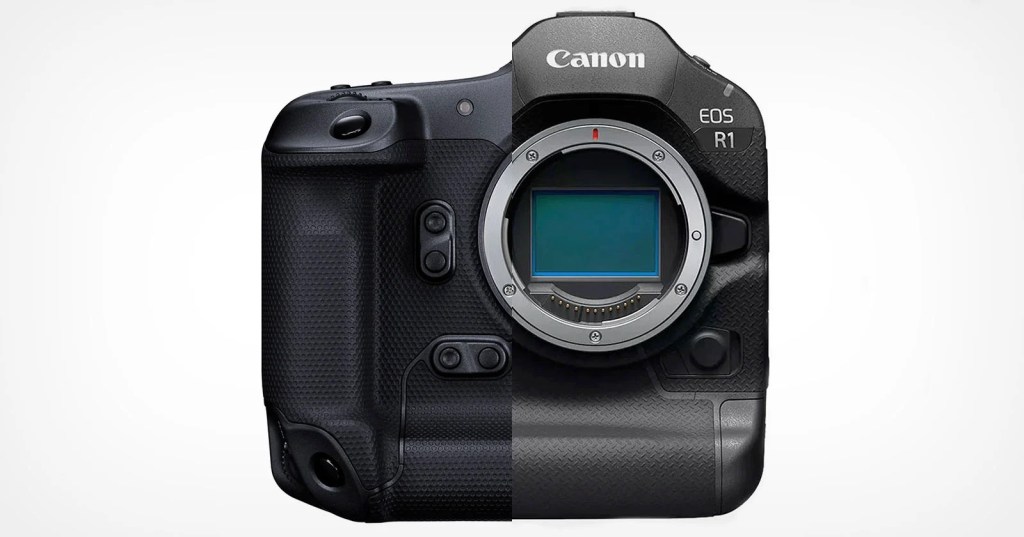
Petapixel have also published a very interesting comparison between the ergonomics of the EOS R3 and the EOS R1.

 www.WILDNATUREPHOTOTRAVEL.com