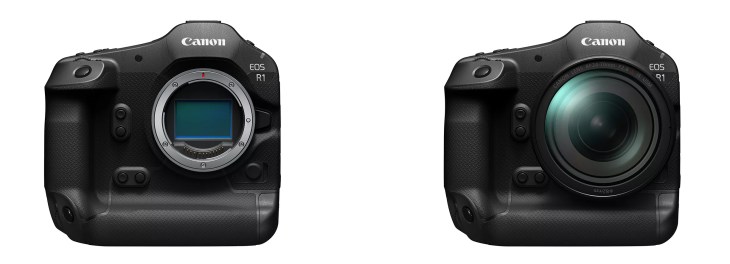
Canon has updated the firmware for the Canon EOS R1 today. The big news is that this update lets you bind pre-capture to a custom button! Thank you, Canon! The equally big news is that Canon has expanded on its Action Priority capability. This is huge news for the future of this incredible feature. This firmware update includes the following:
Firmware Ver1.3.0 incorporates the following fixes and enhancements:
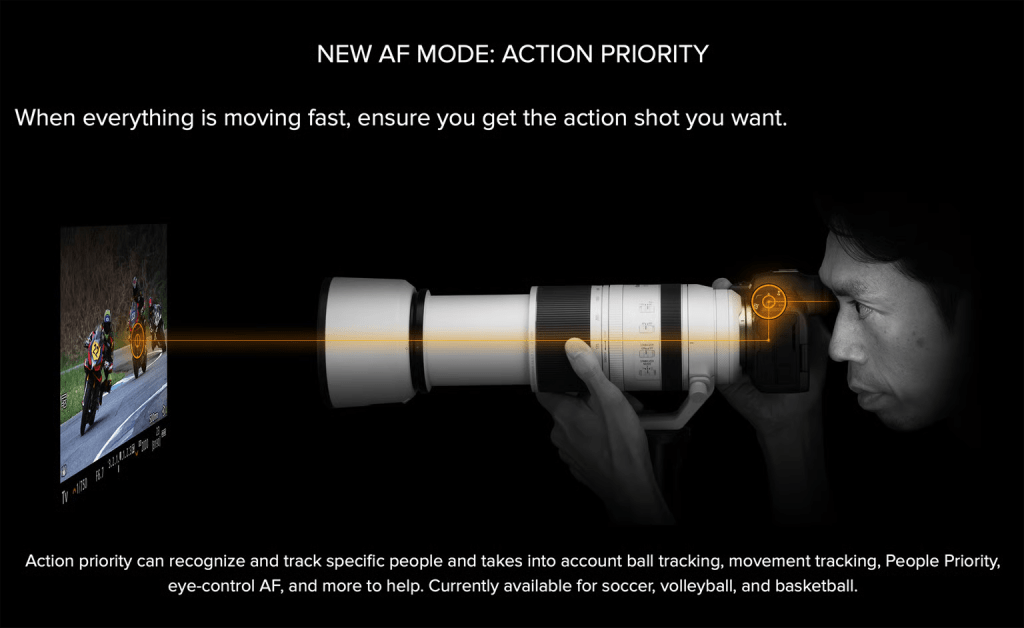
1. Adds [American Football] in [Action Priority] to optimise human subject detection for individuals wearing helmets and shoulder pads. *For an overview and instructions on using [Action Priority], please refer to the Instruction Manual or the AF Settings Guide.
2. Improves tracking and detection performance for [Register people priority] in challenging conditions—including profile views, blurred or partially obscured faces, small subjects in the frame, and children—even when the feature is set to [Off]. *Performing a firmware update will delete registered data stored in the camera. If necessary, save the data in advance using [Save/load registered data on card], and reload it after the firmware update. For details, please refer to the Instruction Manual.
3. Adds [Wi‑Fi freq. band] to [Communication Settings], allowing the user to select the 5 GHz or 2.4 G Hz band when transferring from Bluetooth to Wi-Fi.
4. Adds [No. of connections] to [FTP transfer settings], allowing the user to select the number of transfer threads for [FTP transfer].
5. Adds the ability to store up to four [Color temp] values in [White balance setting] and to assign [Switch color temperature] to [Customize buttons for shooting].
6. Adds the ability to set [False Color Settings] to [On] when [HDR/C.Log View Assist] is selected.
7. Adds the ability to assign [Pre‑continuous Shooting] to [Customize buttons for shooting].
8. Adds the ability to transfer AF-related settings between cameras of the same model by adding [Save to card] and [Load from card] to [Register/recall AF‑related settings].
9. Adds the ability to display the electronic level during movie recording.
10. Adds the option for grid display during movie recording.
11. Adds the ability to display playback screens and menu screens when outputting to two screens via [HDMI Display During Connection].
12. Adds the ability to switch the group settings of a receiver camera from the sender camera when using the EOS Multi-Remote app.
13. Adds the [Night Display Mode] menu option
14. Fixes an issue that may cause Err70 to be displayed in live view when the user captured a multiple-exposure shot in a dark environment.
15. Fixes an issue that may cause Err49 to be displayed repeatedly during communication with an SFTP server.
16. Fixes an issue that may impact the camera’s shooting ability if the auto power-off function is activated during interval timer shooting.
17. Fixes an issue that may cause the camera to restart when the shutter button is pressed while deleting images.
18. Fixes an issue that may cause the camera to not be recognised when connected to a smartphone via USB.
19. Improves other system stability.
If the camera’s firmware is already Ver1.3.0, it is not necessary to update the firmware.
The User Manual on the website has been updated accordingly.
Q&A Section: Preparations for the firmware update: In the folder you downloaded are the firmware (EOSR1130.FIR / file size: 270942208 bytes) and instructions on the firmware update procedures (a PDF file in five languages: Japanese, English, French, Spanish, and Simplified Chinese). Before starting the firmware update operations, please be sure to carefully review the instructions to confirm your understanding of the firmware update procedures.
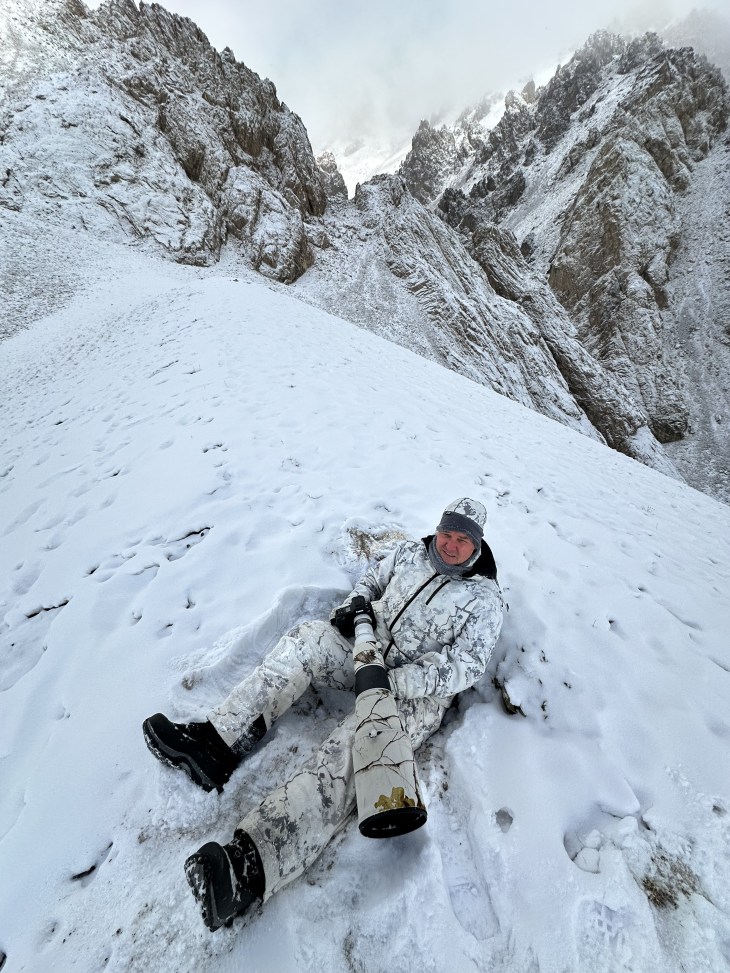
We are well into the first quarter of 2026, and to date I have been in Australia, Mongolia (for Pallas Cat and Snow Leopard), the UAE (United Arab Emirates for the incredible Xposure festival), Colombia (for Birds), and Iceland (for two Arctic Fox trips and a private landscape trip) and in a couple of weeks I will be in Svalbard, north of Norway for both a private Snow Scooter trip and a 10-day boat charter. That’s six countries in just three months, more than 60,000 RAW captures with my two Canon EOS R1s, and a lot of time in airports in transit around the world. And that got me thinking… With all the photography I have already done this year, what do I want to see next from Canon?
Pre-Capture: First and foremost, I want a firmware update to bind pre-capture to a single custom button on the EOSR1. I wrote extensively about this feature request recently HERE, so I won’t belabour the point further. I have subsequently written to Canon Australia and am hopeful we will see this feature via firmware soon. I feel somewhat blessed that we at least have RAW pre-capture, and are not limited to jpeg, as is currently the case with Nikon. As an aside, Sony already allows pre-capture binding (as does the Canon EOS R6 MK3).
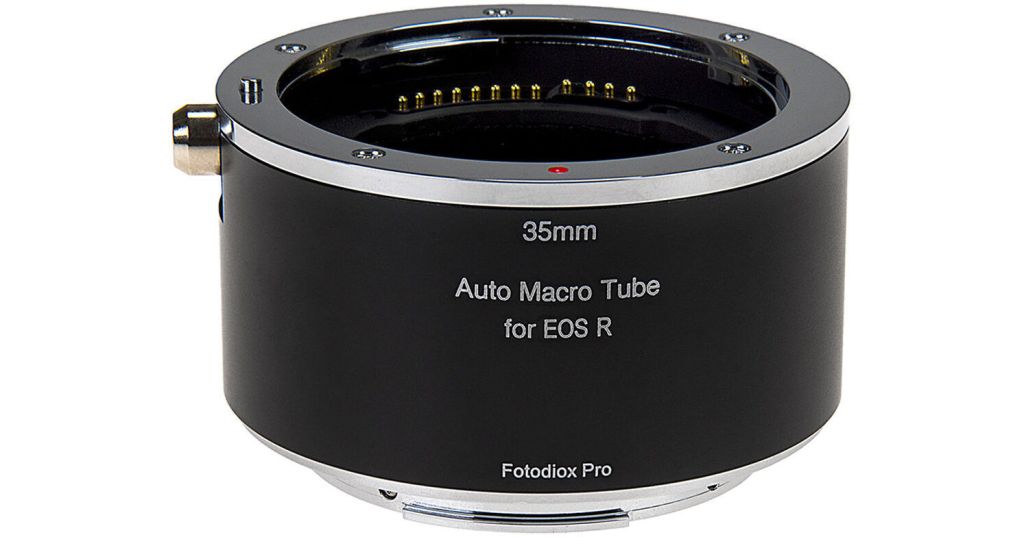
RF Extension Tubes: Currently, the RF lens lineup has some gaps that I would very much like to see Canon fill. These include an RF extension tube or a series of tubes. Canon used to make EF extension tubes, and these are extremely useful for closing the close focus distance on subjects in the field. I still own an EF extension tube, but unfortunately, these cannot be adapted to RF glass. There are a number of aftermarket options available, with mixed reviews, but nothing from Canon currently. Extension tubes are most commonly used for Macro work, but they are also a really useful tool for wildlife photographers who want to capture tight headshots of small subjects or small details.
Mega Pixels: 24 is enough for what I do and provides incredible high-ISO performance to boot in the EOS R1. I have no hesitation in shooting the EOS R1 at ISO 12,800 or even ISO 25,600. That said, I would gladly trade more pixels (anything over 24) for even better ISO performance, but I fear we are reaching the limit of physics at this point, and further improvements in ISO performance in the future are likely to be mostly computational. I know others want more pixels for cropping power – I am just not amongst them. If you need more than 24 megapixels, buy an EOS R5 MK2.
Canon Camera Connect App: I would like to see significant improvements in this App that make it more reliable and stable in connection and much faster to use in the field. Currently, connecting to the camera is too slow to be a viable method of camera control for wildlife (most of the time). The app also frustratingly drops its connection on occasion and can be problematic with reconnection. If the application were faster to connect and more reliable, it would turn any smartphone into a fantastic control screen for any Polecam or camera trap system.
Auto Focus: The autofocus in the EOS R1 is the best I have ever used and the camera tracks subjects better than all previous Canon cameras. Its ability to track and stay on the subject’s eye is phenomenal. However, it cannot ‘stay on target’ as well as the EOS 1DX MK2 or MK3 could in heavy snowfall, and has a nasty, annoying habit of grabbing snowflakes in front of the subject. Even tweaking the AF sensitivity settings in the AF menu cannot overcome this issue. This is an issue I have seen repeated on the Nikon Z9 and Sony A1 and A1 MK2 cameras. In general, the AF on these cameras is so ‘tweaked’ and sensitive that falling snow causes continual interference. On my previous 1DX MK3, I could not track the subject’s eye (the camera did not have eye tracking), but I could keep the focus points on the subject, and the camera would successfully ignore falling snow. This could be addressed in firmware with a ‘snow setting’. If we can have a special ‘net’ setting to avoid the net in soccer goals (for photographers shooting from behind the net), we can have a snowfall setting, please, Canon.
Action Priority: Canon has teased us with the initial offering of ‘Action Priority’ for select sports. Further down the line, special focus cases for different wildlife could be a real boon with this technology.
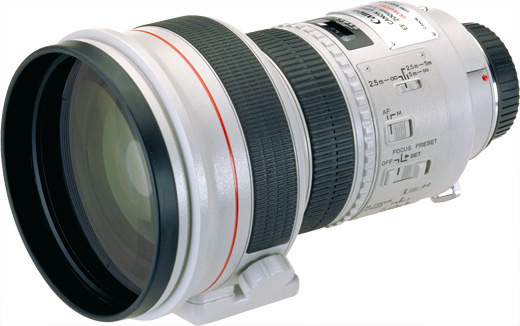
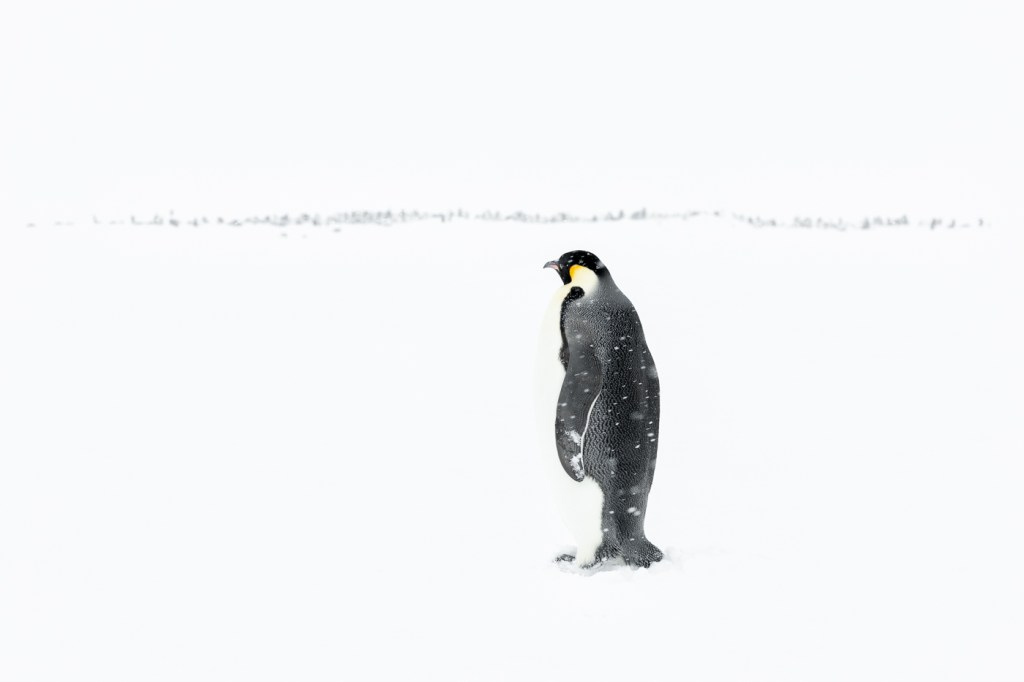
Telephoto Lenses: Over the years, Canon has made both f1.8 and f2.0 EF 200mm lenses. With the RF system, it should be possible (in theory) to make a 200mm lens even faster than f1.8 (or another at f1.8). Such a lens would be the background ‘obliterator’ and an awesome tool in the arsenal of any wildlife photographer whose subject distance can be controlled relatively easily. Penguins, for example, would be the ideal subject for such a lens. Portrait and Wedding photographers would also have strong arguement to employ such a lens. Lenses such as this are highly specialised, but offer creative options not otherwise available. Lenses such as this also tend to be showpieces of what is possible by a manufacturer, but do serve a real functional purpose for creatives.
Super Telephoto Lenses: The much-rumoured 300-600mm RF lens is certainly on my wish list and would complement Canon’s excellent RF 100-300mm F2.8L IS USM lens. I would also love an RF 600mm f4 with a built-in 1.4 or 1.7 teleconverter. The addition of a built-in teleconverter makes a huge difference in the field when you have a subject like a Polar Bear slowly approaching from a distance. Those few seconds saved by flicking in a built-in teleconverter vs having to unscrew the lens and screw in a converter can often mean the difference between getting the shot and missing the best moment. I would also appreciate an 800mm f6.3 DO lens that is small and lightweight for hiking (like Nikon offers), yet still offers incredible reach with a reasonably fast aperture. Such a lens would be fantastic for hard-to-reach targets, such as Snow Leopards or small birds.
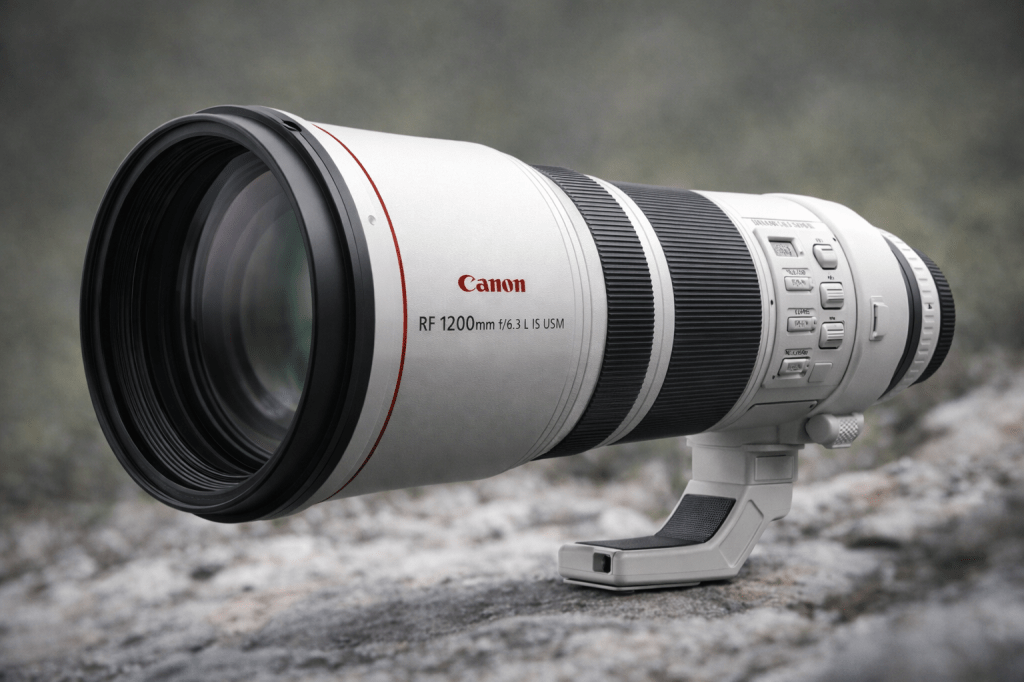
Ridiculous Super Telephoto Lenses: Ok, it’s a long shot Hail Mary, but an RF 1200mm f6.3 or f7.1 (Canon used to make an EF 1200mm f5.6) would be wonderful for bragging rights and really small birds. At this focal length, heat haze and air pollution are a real and present danger, so such a lens would be most useful for small birds and other similarly small critters. I can definitely see a use for this lens from the floating hide. The likelihood of such a lens is extremely low, as it would be very expensive to produce and very few would be sold. But Canon would sell at least one!
Tilt Shift Lenses: Canon has made really excellent EF TSE lenses over the years. The 17mm, 24mm, 50mm, and 90mm are all outstanding. I have owned the 17mm, 24mm and 90mm in recent times. All can be adapted to RF mount with the Canon adapter. RF versions have long been rumoured with talk of auto-focus capability. I am not sure I need an AF TSE lens, but I would really like a 20mm TSE in the RF mount. 20mm is my favourite focal length for wide-angle landscape work, and the addition of tilt and shift adds a lot of creative control.
It is still early in 2026 and Canon has not as yet made all its announcements for the year. With luck, we may see some of the above later this year. Let me know what you would like to see from Canon next?
I need to get something off my chest about the Canon EOS R1 that’s been at the front of my mind over the last two weeks during my Birds of Colombia workshop. Before I do, I want to clarify that the EOS R1 is the best camera (mirrorless, DSLR or otherwise) that I have ever had the privilege to use. It is an incredible camera across the board, from its industry-leading autofocus to its phenomenally clean high-ISO images. It is a masterpiece and a tool that any photographer worldwide should be happy to use. But! It has an Achilles heel that Canon could fix in a single firmware update. Allow me to explain.
The Canon EOS R1 is Canon’s flagship. The pinnacle. The no-compromise, built-for-professionals, wildlife-and-sports-dominating machine. And yet (inexplicably) the user cannot bind pre-capture to a custom button. Let that sink in for a moment. One of the most powerful features for wildlife and sports photographers, the ability to buffer frames before you fully depress the shutter, cannot be assigned in a way that makes it instantly accessible in the field. For a camera aimed squarely at action professionals, that’s not just an oversight. It’s baffling and makes me seriously question Canon’s ability to listen to the needs of its working pro photographers.
Now here’s the part that irks me and really twists the knife. This ‘binding’ functionality can now be found on the Canon EOS R6 Mark III. A significantly lower-tier body. Not the flagship. Not the no-holds-barred professional tool. Somehow, the R6 Mark III gets the flexibility, while the R1, the supposed apex predator, does not. I genuinely struggle to understand the product logic and thought process here.
For wildlife photographers working in unpredictable environments such as snow leopards cresting a ridge, hummingbirds buzzing past feeders, Pallas’s cats darting between rocks, pre-capture isn’t a gimmick. It’s the difference between getting the shot and going home empty. And the same applies to sports photographers looking to capture the decisive moment. Pre-capture needs to be instantly deployable. It needs to be muscle memory. I don’t want to dig through menus or compromise another critical control to access it. I want it bound to a custom button so I can toggle it seamlessly as conditions change. And yes, I know I can assign it to a custom shooting mode (which is my current workaround), but that isn’t a perfect solution suitable for a flagship product.
In high-end fieldwork, ergonomics and customisation aren’t luxuries; they are essential workflow elements. When you’re wearing gloves in sub-zero conditions or reacting to split-second behaviour, you don’t have time for pause or friction. The whole point of a flagship body is to remove friction. To anticipate professional needs. To give us more control, not less.
What makes this especially frustrating is that the hardware is clearly capable. This is not a limitation of processing power or buffer depth. It’s firmware. It’s menu logic and its exclusion is a design decision. And when a mid-tier body receives that flexibility while the flagship does not, it raises uncomfortable questions about segmentation strategy versus user experience. It raises eyebrows that Canon might be deliberately holding this capability back to sell us a MK2 camera in the near future.
Canon builds incredible cameras. I’ve trusted them for decades in some of the harshest environments on Earth. The R1 is, without any doubt, a phenomenal tool. But choices like this undermine confidence. Professionals, like myself, invest heavily, not just financially, but in muscle memory, system familiarity, and long-term ecosystem loyalty. When basic functional customisation is arbitrarily limited, it feels like we’re being managed instead of supported.
This isn’t about spec sheets or marketing hype. It’s about real-world use. It’s about being on a windswept ridge with a once-in-a-lifetime moment unfolding and knowing your camera is working with you and not against you. In the final home stretch of two weeks of intense bird photography here in Colombia, this issue has come to the front of my mind consistently during the days in the field.
Canon, if you’re listening: This is a firmware fix. Give R1 users the ability to bind pre-capture to a custom button. The capability clearly exists within the system. Professionals shouldn’t have fewer ergonomic options than mid-tier bodies. Flagship should mean freedom.
For the past eight months, I’ve been working extensively with two of Canon’s EOS R1’s—Canon’s long-awaited flagship mirrorless body—in some of the harshest and most remote environments on the planet. From the snow-blasted cliffs of Hornstrandir to the sea ice of Svalbard, the windswept Arctic Circle island of Grimsey, to the frozen sea ice deep in the Weddel sea region of Antarctica, the R1 has been at my side through thick and thin, shooting everything from high-speed Arctic foxes to cliff-dancing puffins, charging walrus bulls, stoic polar bears in whiteout conditions and majestic Emperor Penguins.
This isn’t a review based on lab tests or YouTube comparisons. This is the perspective of a full-time working wildlife and nature photographer who relies on his gear not only to create imagery but to function flawlessly in environments where failure is not an option.
Initial Expectations – When Canon announced the EOS R1, the bar and expectations were set sky-high. The promise was of a no-compromise, professional mirrorless body designed to finally go toe-to-toe with the competition in the high-speed, high-performance segment, but with Canon’s colour science, ergonomics, and reliability.
After moving to the EOS R5 MKII for lighter-weight expeditions, I found myself constantly pushing against its limitations—buffer depth, tracking inconsistencies, and durability being the most significant. The EOS R3 helped bridge that gap, but I still longed for a body that felt as bulletproof as the 1DX Mark III, with the speed and accuracy needed for unpredictable Arctic wildlife and landscapes. The EOS R1 promised that convergence. It was a long wait – And, in short, it was worth it.
In the Hand – From the first time I picked it up, the R1 felt like an old friend. The ergonomics are classic Canon—refined, intuitive, and completely muscle-memory driven for anyone coming from the 1D or R-series. The integrated vertical grip is beautifully balanced. The magnesium alloy body is solid but not excessively heavy, and most importantly, every button is exactly where it should be—even when wearing thick gloves in -40°C temperatures.
The R1 has survived rain, snow, salt spray, sub-zero wind chill, and even a minor fall onto sea ice without missing a beat. It’s weather-sealed to a degree that gave me absolute confidence in the field—something I can’t say for all mirrorless systems.
Autofocus – A New Benchmark – If there’s one area where the R1 has fundamentally changed how I work in the field, it’s autofocus. Simply put, the AF system in this camera is astonishing. I can lock onto an Arctic fox sprinting across a windswept snowfield at 40km/h and trust the R1 to not only find the eye, but to maintain critical focus through erratic movements—even when the subject disappears briefly behind foreground grasses or snowdrifts.
The deep-learning-based subject recognition has expanded dramatically. Eye tracking works almost flawlessly on mammals and birds, even in backlit or low-contrast conditions. The system now recognises a broader set of body shapes and head angles. In real-world terms, this means fewer missed frames, more keepers, and less need to second-guess the AF system. I’ve used the R1 to track puffins flying straight at me in gusting winds, razorbills launching from cliff edges, and polar bears moving through layers of blowing snow. In all these scenarios, the camera performed like a seasoned field partner—silent, responsive, and ruthlessly efficient.
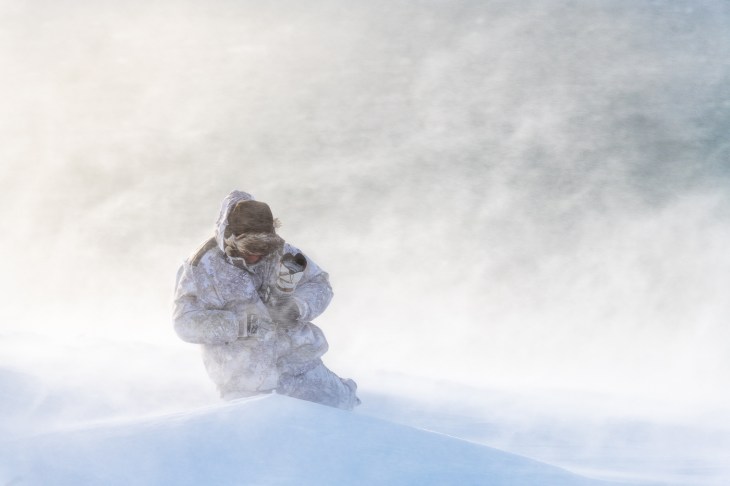
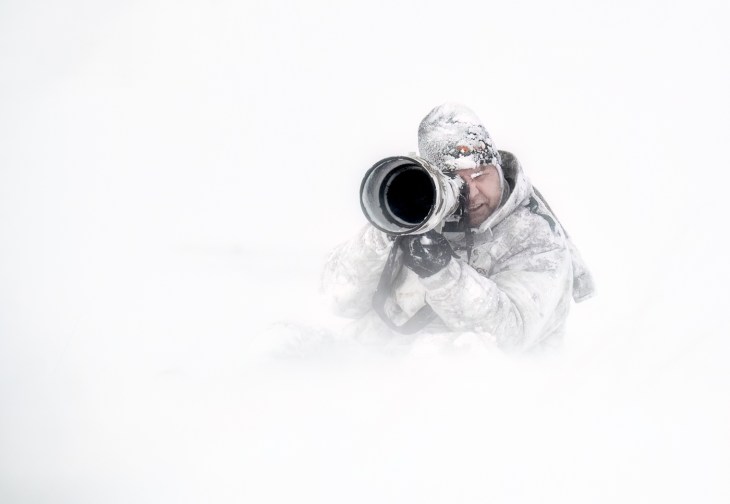
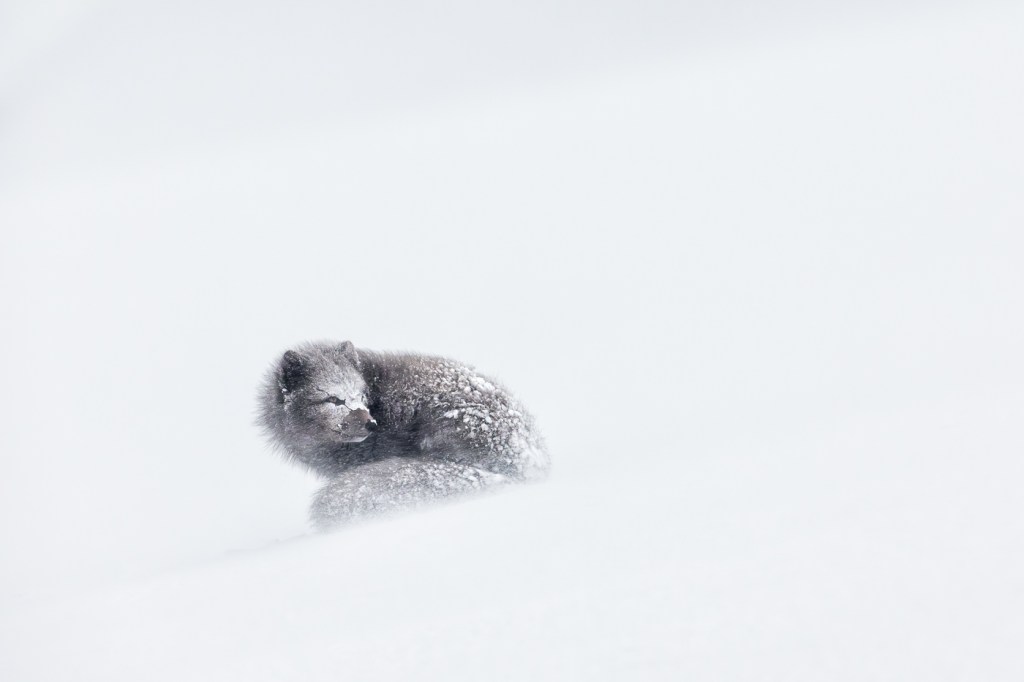
There is still room for improvement, though. When shooting wildlife in falling snow with the Canon EOS R1, one of the more frustrating quirks that has emerged is the camera’s occasional difficulty in ignoring snowflakes (big or small) that pass between the subject and the lens. While the R1’s autofocus system is astonishingly fast and sticky in many conditions, its subject detection algorithms can sometimes momentarily latch onto a bright, high-contrast snowflake, especially in backlit or low-contrast scenes where the subject blends into the background (regardless of case setting). This can cause brief focus hunting or a shift away from the intended target—particularly problematic when photographing fast-moving animals like Arctic foxes or polar bears in a blizzard, where every fraction of a second counts. In heavy snowfall, the effect can compound, forcing the photographer to adjust AF case sensitivity, reduce tracking responsiveness, or switch to a smaller AF zone to help the camera “tunnel vision” on the subject. It’s not an insurmountable flaw, but in the right (or wrong) conditions, it’s enough to cost you the critical sharp frame.
The R1, as incredible as it is, cannot, as yet, ignore falling snow with the same ruthless efficiency that the 1DXMK2 and 3 could. The R1 will stubbornly grab falling snow in lieu of the wildlife to the point that it has, on occasion, forced me to switch to manual focus as in the video above. Falling snow is quite honestly the current Achilles heel of the EOS R1.
Frame Rate, Buffer, and Workflow – The EOS R1’s blackout-free electronic shutter and lightning-fast readout speed make it a dream for tracking fast action. I often shoot at 40fps in full RAW, which feels like wielding a high-speed cinema camera with stills precision. 40fps might seem excessive to some, but when you are searching for that perfect wing or paw position it is frequently the difference between getting the shot or missing it.
Critically, the buffer performance has improved dramatically over previous models. Even at full 40fps in RAW, I can shoot long sequences without any slowdown. This has been essential for capturing behaviour sequences—foxes leaping, puffins mid-flight, walruses rearing up from the surf—where timing and rhythm are everything.
Canon’s RAW format has continually proven to be the perfect balance between file size and post-processing flexibility. I’ve had no issues pushing shadows, recovering highlights, or making large exhibition prints from these files. My Lightroom workflow has remained fluid even when dealing with thousands of frames per day.
Image Quality – Resolution-wise, the R1 hits a sweet spot. At 24 megapixels, it provides the detail and dynamic range necessary for large-format fine art prints without ballooning file sizes. Colour rendering is signature Canon—neutral, nuanced, and skin tones (or fur tones, in my case) are beautifully rendered. The sensor’s performance in low light is game-changing. I’ve comfortably shot Arctic foxes in fading twilight and seabirds at ISO 25,600 with minimal noise and excellent detail retention.
I frequently shoot in high-contrast snow conditions, and the R1 allows me to retain texture in both highlights and shadows, giving more flexibility in post and fewer blown exposures in the field.
Electronic Viewfinder and LCD – One of the biggest shifts from DSLRs to mirrorless was learning to trust the EVF. On the R1, Canon has finally nailed it. The EVF is large, crisp, and incredibly responsive, with no perceptible lag even at high frame rates. Exposure and colour previews are accurate enough that I’ve stopped chimping almost entirely—I can make confident exposure decisions without pulling my eye from the viewfinder.
The rear LCD is sharp and usable even in bright daylight. I especially appreciate the ability to zoom quickly for focus checking, something essential when reviewing sharpness on Arctic fox whiskers or avian feathers in the field. I admit though, with my vision not what it used to be close up (I am 51) I almost never use the LCD screen anymore and prefer the EVF.
Silent Shooting and Minimal Disturbance – For wildlife photography—especially with sensitive species—the ability to shoot silently and discreetly is priceless. The R1’s electronic shutter is truly silent, allowing me to photograph close-range birds and mammals without introducing sound that might alter their behaviour.
Battery Life and Power Management – Battery life is excellent (although not as good as the Nikon Z9). Using the LP-E19 battery, I routinely get 4000+ frames per charge, even in cold conditions. With power-saving settings enabled and the EVF auto-switching intelligently, I rarely have to change batteries during a full shooting session. I carry three batteries for redundancy, but rarely needed more than one and a half per day—even when shooting thousands of images in a 14-hour Arctic summer day.
Lenses and Native Support – The R1’s performance is complemented by Canon’s growing lineup of RF glass. The RF 400mm f2.8 has been a mainstay for my Grimsey Island bird photography, while the RF 600mm f/4 remains my go-to lens for polar bear and fox work. I always keep an RF 70-200 or 100-500 handy on a second body for those close encounters.
The IBIS (in-body image stabilization) combined with RF lens IS gives handheld stability that’s frankly absurd. I’ve made sharp images at 1/20th of a second with the 600mm handheld—something that would have been impossible just a few years ago.
Lens performance is consistent across the board, and the EOS R1 brings out the best in these optics. I’ve seen a noticeable improvement in AF speed and accuracy compared to using these same lenses on the R5 or R3.
Video Capabilities – While I am a stills photographer first, the R1’s video features have not gone unnoticed. I’ve used the R1 to capture atmospheric B-roll—snow swirling across fox tracks, slow-motion footage of terns hovering in a gale—which has integrated beautifully into my expedition film work.
Durability and Trust – Ultimately, the most important quality in a camera for me is trust. I need to know that it will work in blowing snow, freezing wind, salt spray, and rough handling. The EOS R1 has proven itself beyond doubt. During one Svalbard expedition, I shot for more than six hours in -30°C with intermittent snow squalls and howling wind. The camera remained responsive, the battery held strong, and the sensor never failed to deliver. Another day, I took a spill on sea ice with the R1 slung at my side. It came away with a cosmetic scuff—and nothing more. That kind of reliability builds confidence. And confidence allows creativity.
What Could Be Improved – No camera is perfect. Here are a few areas where I think Canon could continue to evolve:
• Custom Mode Settings: More flexibility in assigning custom button layouts per mode would be helpful. Specifically, the ability to assign pre-capture to a multi-function button.
• Pricing: The R1 is a serious investment. While justified for professionals, it’s less accessible for serious enthusiasts.
•The Auto Focus algorithms need to do better with falling snow.
But these are quibbles, not deal-breakers. Canon has clearly built this camera with professionals in mind, and it shows.
Conclusion – After eight months of intense field use, I can say with complete confidence that the Canon EOS R1 is the most capable and reliable camera I’ve ever used. It is also the most complicated in terms of customising the set-up. Whilst not necessarily a bad thing (as it allows you to set up the camera to your personal preferences and shooting style), it does mean a step learning curve.
Arctic Fox 2020
The camera allows me to focus on my craft rather than my gear. It adapts to the unpredictable rhythm of wildlife. It empowers me to create in silence and solitude. It endures what I endure—and then some. Whether lying prone on frozen tundra waiting for a fox to approach, hanging off a cliff edge as puffins rocket past in golden light, or tracking a walrus bull charging through ice-laden surf, the R1 has delivered—frame after frame, moment after moment. It doesn’t get in the way. It just works. And when you’re working on the edge of the world, that’s everything.
Canon Australia has this afternoon reposted the new firmware update for the Canon EOS R1.
This firmware (Version 1.1.2) includes fixes for the following issues identified in Version 1.1.0: 1. Fixes an issue where video could not be recorded correctly when using a memory card larger than 2TB with the [Pre-recording] setting enabled. 2. Fixes an issue where the camera failed to operate properly after updating to Firmware Version 1.1.0 if the still photo shooting/movie recording switch function was set to [Silent shutter function switching] or [Disable].
This firmware also incorporates the following changes introduced in Firmware Version 1.1.0: 1. Improves security features. A password must be set initially. •Adds the ability to review the history of any changes made to the password, network information, or other settings. *For more information, please refer to the ‘Setting a Password’ section in the Advanced User Guide on cam.start.canon. 2. Enables firmware updates to be performed when the camera is connected to the internet and new firmware is made available on Canon servers. 3. Adds [Viewfinder Priority] mode, which activates the viewfinder when a user is detected by the rear sensor. 4. Adds the ability to automatically detect Flicker at 100 or 120 Hz during Live View display. 5. Adds the ability to register focus position as a presets on the CR-A100 Camera Remote Application. This ability makes it easier to focus on subjects at the intended distance when the application is used with Robotic Camera System CR-S700R. 6. Adds the ability to select [Panning Assist]. When users pan with compatible lenses, image stabilization and subject blur correction are applied during exposure. 7. Adds the ability to select [Case Special] to expand Servo AF characteristics which is effective for subjects located behind a net in sporting events, such as badminton or volleyball. 8. Adds support for the Software Development Assistance Kit (EDSDK/CCAPI). 9. Adds a function that simultaneously protects images when they are rated. 10. Adds the ability to use up to 8TB of CFexpress cards. Note – Cards larger than 8TB require low-level formatting by the camera. – Cards larger than 8TB are treated as 8TB cards. – Cards larger than 2TB cannot be used for firmware updating. 11. Adds to lower the image capture frame rate to help prevent overheating when connected to CR-A100 in extended remote shooting. 12. When transferring images with voice memos via FTP, the transfer order priority has now changed with voice memo (Wav) file being sent first followed by image file. If a voice memo is added to an image queued for transfer, the image and voice memo are now sent last. 13. Adds the ability to set the number of shots captured in pre-continuous shooting mode. 14. Adds the ability to set [Airplane mode] to shooting button customization. 15. Adds the ability to enable [Exposure Simulation] when a flash unit is attached. 16. Improved AF tracking during video capture for subjects that are difficult to focus on. 17. Fixes an issue in which Err70 may occur when enlarging an image after shooting with [Blackout-Free Display] set to “On” and [Servo 1st image priority/One-Shot AF release priority] set to “Release priority”. 18. Fixes an issue in which Err70 may occur during Bluetooth communication due to interference from other Bluetooth devices. 19. Fixes an issue in which Err70 may occur when repeatedly shooting in the “High-speed continuous shooting +” mode. 20. Fixes an issue in which Err70 may occur immediately after startup when shooting with the electronic shutter. 21. Fixes an issue in which Err70 may occur during video recording in “FHD239.8P/200.0P”. 22. Fixes an issue in which Error 70 may occur while filming in video mode with frame rate set to “50.00P” and [Movie Digital IS] set to “On” or “Enhanced”. 23. Fixes an issue in which Err70 may occur during shooting when both [Pre-recording] and [Auto send] to image.canon are set to “Enable”. 24. Fixes an issue in which the camera may stop functioning properly when [Image Review] is set to “Off” and the monitor entered low brightness mode after pre-continuous shooting. 25. Fixes an issue in which video recording may not be possible when using Remote Live View shooting in EOS Utility while outputting via HDMI. 26. Fixes an issue in which large RAW image files may not be transferred via Camera Connect. 27. Fixes an issue in which the camera may not connect to Wi-Fi 7-compatible routers.
If you are considering updating to the latest firmware, I recommend waiting at least two weeks in case any further issues are detected. Unless you have an urgent need for password protection, its always prudent to wait a bit on firmware updates.