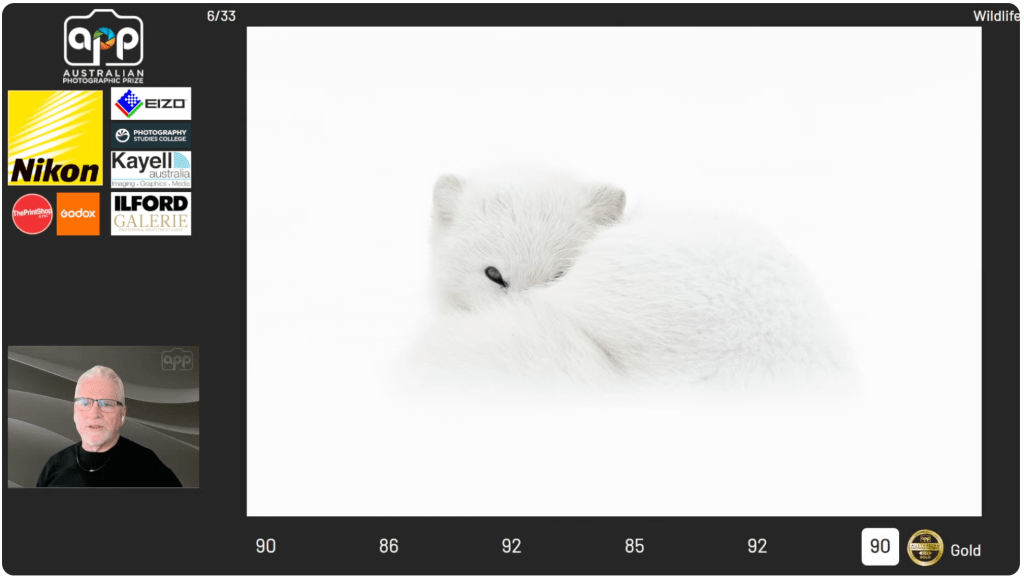
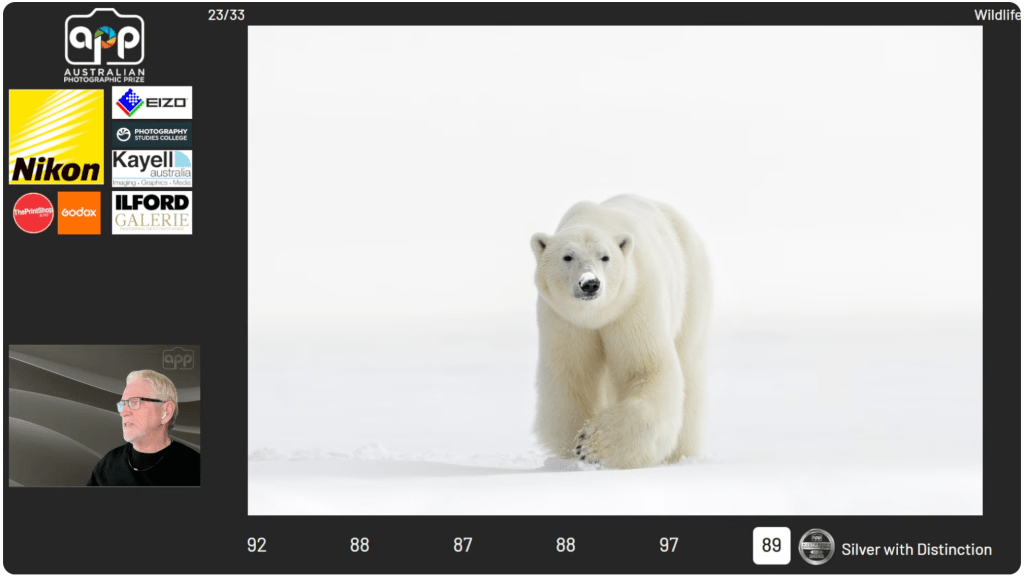
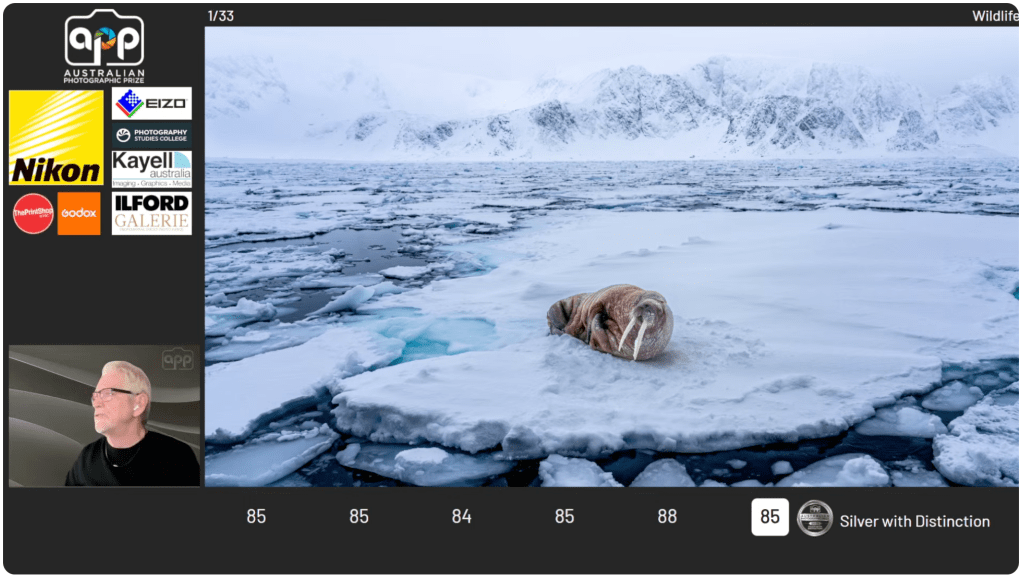
The Australian Photographic Prize Wildlife category was judged on Saturday, 19 July. This year, I decided to enter the single-image Wildlife category of the Australian Photographic Prize at the last minutedue to my hectic travel schedule. I just caught up on the results on You-Tube this morning during some downtime here in Melbourne. Of the four photographs I chose to enter this year, all four made the final round of judging (top 35 entered images in the category). Two of the four received highly coveted Gold Awards, and the remaining two images both earned Silver with Distinction awards, with the Polar Bear being only 1 point shy of a third Gold award. I am not sure what held back the Polar Bear from Gold, as the average scores from the judges is 90.4, which should be a Gold Award? Screenshots of the judge’s scores and images are included below. The overall winner of the category will be announced in the next few days.
Only two places remain on our 2025 Zululand, South Africa ground-level Wildlife masterclass this May before it will be sold out. This exclusive workshop will run from May 7th – May 16th, 2025 and is fully inclusive of luxurious accomodation, private game drives, private hides and all photographic tuition. This is a full camp takeover, meaning it will be just us in the entire reserve – no one else. This maximises the time we have available for game drives and hide sessions giving you the best possible opportunities. You will not be limited to the usual one hide session, but will have many opportunities over the course of the workshop. During this workshop you can also expect to get out of the safari vehicles and walk with Cheetahs (an incredible photographic experience). You can get an idea of what to expect from this workshop by reading the 2024 trip report HERE and by checking out the portfolio on my website HERE. This is the workshop for you if you have ever wanted to photograph African wildlife at ground and eye level and create truly incredible wildlife images. For more information, please drop me an email. First in best dressed.
Those who know me know I always advocate for the highest quality photographic display you can afford. It should be the first purchase you make after a digital camera. A wide-gamut, high-quality, calibrated photographic monitor is the difference between optimally processing your RAW files and standing blindfolded, throwing darts at a board. But what do you do while in the field on a laptop? Or, how do you otherwise make do if you have an Apple Liquid Retina XDR display and have neither the budget nor space for an external display? I should footnote this: If you can afford an Apple Liquid Retina XDR display, you have no excuse not to own a significantly better photographic display such as those from BenQ (Read our Recent review on the new BenQ 4K display).
Jeremy Daalder over at Image Science recently published the best piece I have read to date on optimally calibrating an Apple Liquid Retina XDR Display. If you own an Apple laptop with a Liquid Retina XDR display or one of Apple’s hugely over-priced external displays then you owe it to yourself to take five minutes out of your day, and read his article. This is the first piece I have read on the internet that accurately documents the process for a successful calibration of these displays.
INTRODUCTION
Apple’s newest XDR Liquid Retina displays, such as is seen inside the new 14” and 16” MacBook Pro (and the XDR Pro Display) are a completely different ball game when it comes to calibration. The new XDR Liquid Retina displays (hereafter referred to as XDR displays) are different than their predecessors in that they employ a full array local dimming miniLED backlight. The issues at play here are essentially two-fold. Because of Apple’s decision to implement:
A miniLED backlight (which older calibrators just weren’t designed to calibrate), and
the forced usage of Reference Modes (both their clunky implementation of them and specifically the inability to NOT use them)…
…both the required calibration technologies and the process for calibrating them is completely different to ALL older Apple displays (including all older external displays, any iMacs, any Intel-based Laptops, any Macbook Air’s, and even the newer Apple Silicon based 13” and 15” MacBook Pros).
During my last few days in Greenland (I am currently in Iceland wrapping up the extension trip), Canon updated firmware for the EOS R3, EOS R5MK2 and many other cameras in the line-up. Most of the updates are bug fixes, although some cameras got support for the new LP-E6P. You can download firmware updates through the Camera Connect app or directly from a Canon website. Personally, I find the Canon Camera Connect app to be the easiest and fastest. I updated my R3 in the field in less than ten minutes with my iPhone while waiting for the clouds to gather after the morning shoot here in Iceland.
In July of 2024, I ran my first workshop for Pallas cat kittens in the far east of Mongolia. I am no stranger to travel and photography in Mongolia, having led multiple winter workshops to this fantastic country (for both Pallas cat and Snow Leopard) over the last 7+ years, but this was the first time I have run a summer workshop that was dedicated to the photography of Pallas cat kittens. It was a fantastic experience with many sightings of Pallas cats and their kittens! There is also something to be said for the packing requirements for a summer workshop that dictates shorts and a T-shirt!
During our nine-day workshop, we were fortunate to have numerous captivating encounters with Pallas cat kittens and their mothers. The absolute highlight was the rare chance to conduct multiple photographic sessions with a Pallas cat and her extraordinary litter of six kittens. Such a large litter is a rare occurrence, only happening in years with abundant prey. This year, the area was teeming with voles, ensuring a plentiful food supply. We also had the privilege of encountering another litter of five kittens and several smaller litters.
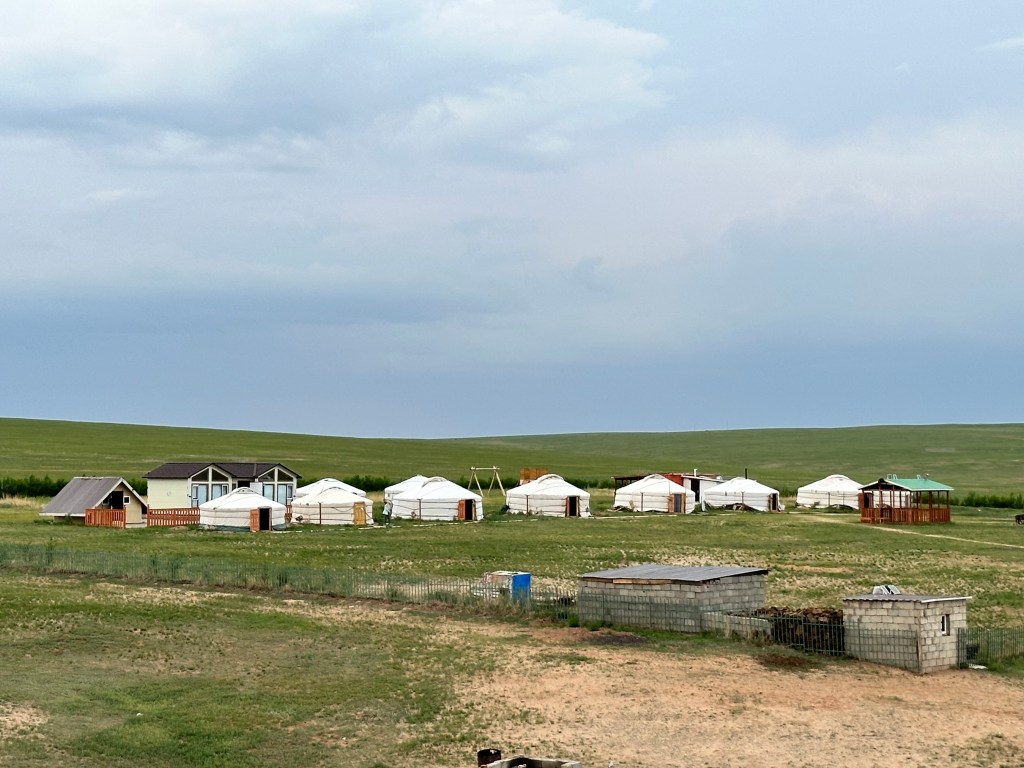
For the duration of this workshop, we are based in a permanent wildlife camp set up specifically to study and photograph Pallas cats. The camp is approximately eight hours’ drive east from the capital of Ulanbataar and is located in a region known as the Steppe. This area boasts the highest density of Pallas cats to be found anywhere on earth. It is a stunning location that comprises endless grass-covered rolling hills that stretch to the horizon in all directions.
For the duration of the workshop, we stay in traditional Mongolian Gyrs. Each Gyr is equipped with a comfortable bed, a small basin with clean, fresh water for washing, and power for charging via a generator. With average daily temperatures ranging from 25 to 35º Celsius and cooling down in the evenings, there’s no need for heating in the summer. The facilities include western-style pit toilets, a dedicated living and dining Gyr, and 4-wheel drives for exploring the Steppe region.
The photography of the Pallas cat kittens is done from portable blinds that we set up at a location out in the field. These blinds, which are quickly assembled on site, and allow us to photograph the cats and kittens without disturbing their natural play and hunting behaviour. As the blinds are portable, we can position them for the best possible backgrounds, light angle and to ensure the best opportunities. Telephoto zoom lenses are ideal for this workshop with focal lengths between 100 and 600mm.
The days are long this time of year in Mongolia, with sunrise around 5:00 a.m. and sunset around 8:30 p.m. As the cats are most active first thing in the morning and just prior to sunset, this means we are out in the field from 4:30 a.m. until 7:30 a.m. and then again from 4 p.m. until sunset. Time in between is lunch and downtime to download images and review the day’s shooting.
Toward the end of our workshop, we experienced two days of stormy weather and some heavy rain, which made locating the cats more difficult as they tended to relocate to higher ground at this time. Nevertheless, we managed some interesting opportunities of the kittens playing high in rocky areas.
On our final day, we were treated to an unforgettable morning and evening session with a different Pallas cat and her litter of five kittens. During the sunset shoot, the cats disappeared for a while, only to re-emerge during the best light of the day. It was a valuable lesson in the importance of patience and perseverance in wildlife photography. We also had several opportunities to capture the mother hunting voles near her den.
I will return to Mongolia in July of 2026 to lead another workshop for Pallas cat kittens in the Far East of this fantastic country. The workshop will be strictly limited to a maximum of five. Please drop me an email if you would like to register for this opportunity.







 www.WILDNATUREPHOTOTRAVEL.com