Emperor Penguins of Antarctica Expedition Report December 2024

In late November / early December 2024, I ran my semi-annual wildlife expedition to the world’s most southerly Emperor Penguin colony at Gould Bay, deep in the Weddell Sea region of Antarctica. For this expedition, we flew from Punta Arenas at the bottom of Chile on a privately chartered Iceland Air 757 to the naturally occurring blue ice runway at Union Glacier in Antarctica. From this point, we overnighted at Union Glacier Basecamp before we took a 2nd smaller Basler aircraft another three hours out to the remote sea ice at Gould Bay, where we landed on the sea ice and established camp with the Emperor Penguins.

This year, for the trip report, I decided to utilise the video I recorded during each stage of the expedition to better illustrate the travel process to the Emperor Penguins and what it is like to camp, live with and photograph the emperor penguins. This year, we were fortunate to spend a full seven days (six nights) camped out at the colony. This provided us phenomenal opportunities and the chance to photograph in various weather conditions. Personally, my favourite day was heavily overcast with light snow. I have yet to encounter a full-on blizzard out at the colony, but I am hopeful for future years!

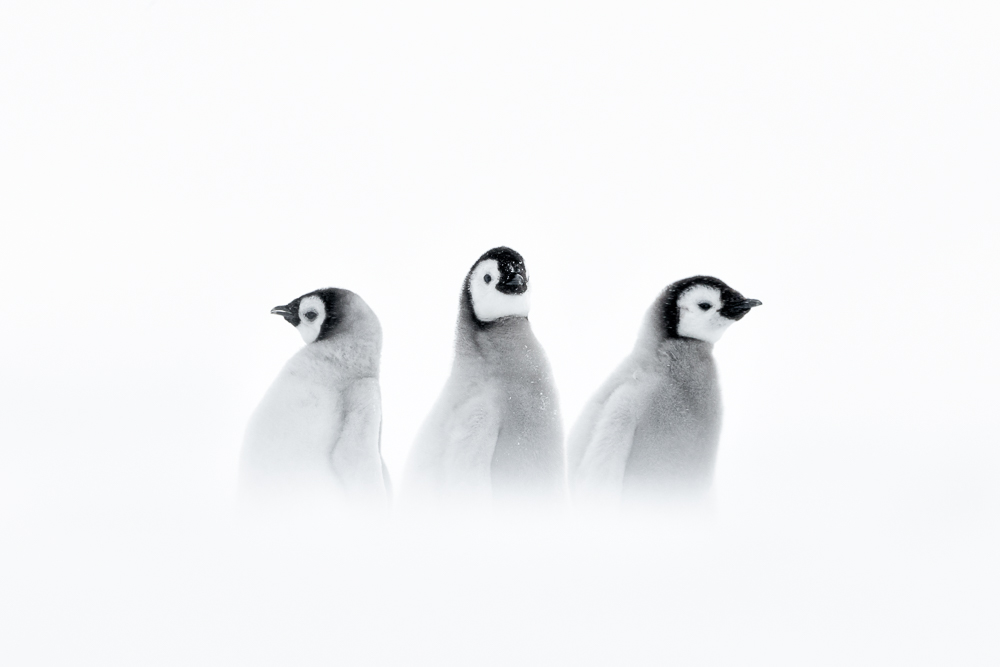
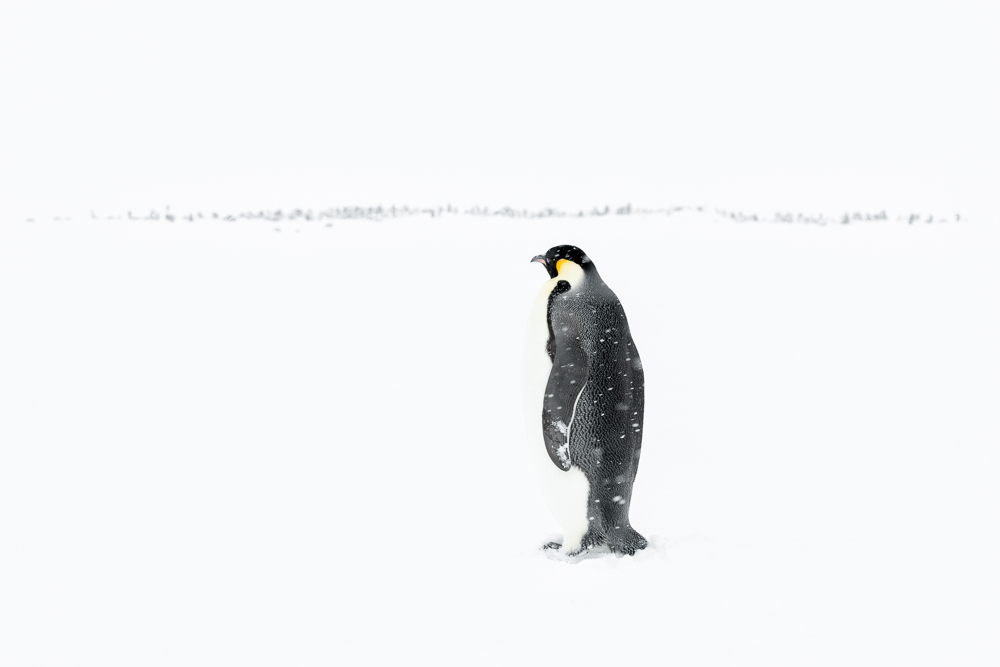
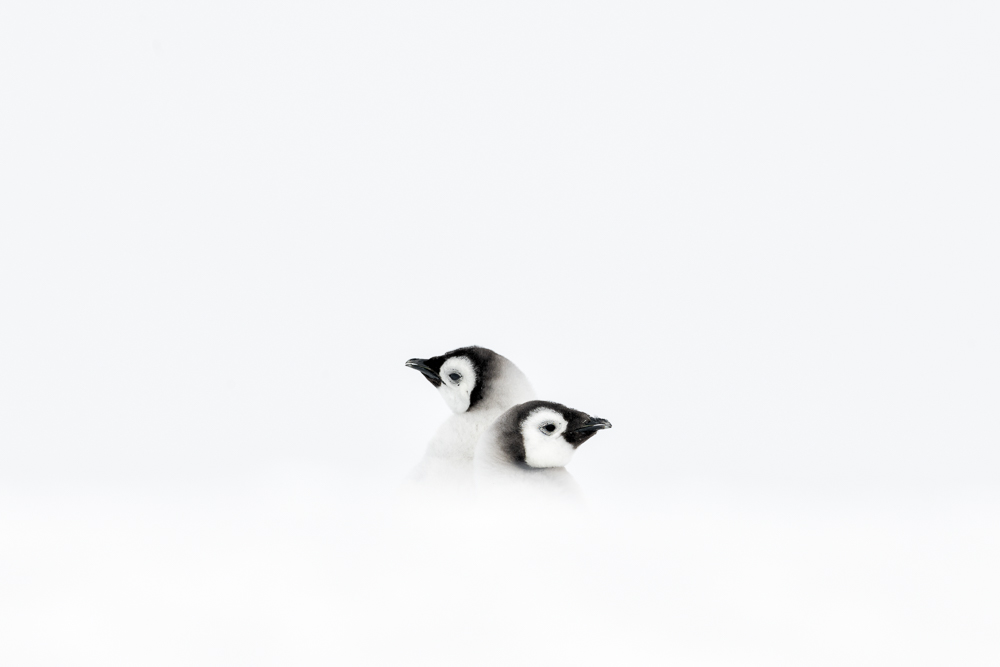
I am still working through the more than five thousand images I made during the course of the week spent out on the sea ice with the penguins, but I have included a few favourites already processed below from what I felt was our best few days – heavily overcast conditions and light snowfall.

The above montage footage was all shot with the new Canon EOS R1 at 4K 120 fps with the Canon RF 600mm F4L IS handheld. This was the first outing with the new Canon EOS R1, and I am blown away by both the ergonomics and performance of this camera. There is a purity and depth of colour to the 14-bit RAW files I have only seen before in much more expensive medium format cameras. The eye tracking focus (yes it can track the black eye of an Emperor Penguin against black feathers), the pre-capture, the build quality and overall performance all stack up to make this the best camera I have yet used. I will have more to say about this in a future podcast.

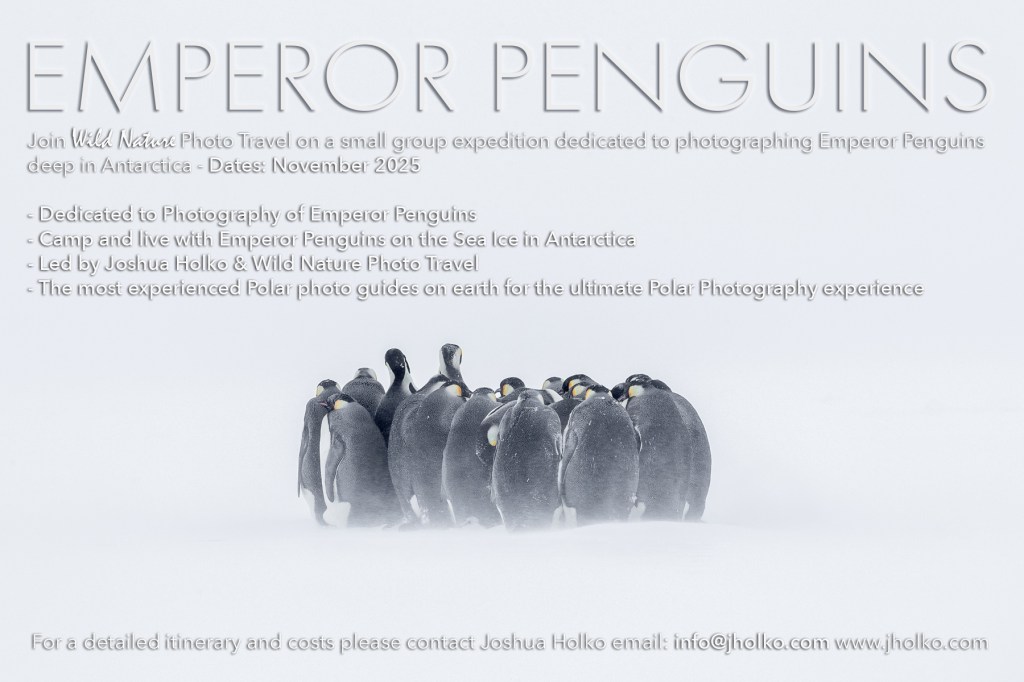
I will return to the world’s most southerly Emperor penguin colony in early November next year (2025) to lead another small group of photographers on this incredible expedition. If you have ever wanted to photograph the world’s largest and most elegant, photogenic penguin, this is the expedition for you. Limited places are still available on this extraordinary expedition. Please contact me for more details.
Optimally Calibaring Apple Liquid Retina XDR Displays for Photography

Those who know me know I always advocate for the highest quality photographic display you can afford. It should be the first purchase you make after a digital camera. A wide-gamut, high-quality, calibrated photographic monitor is the difference between optimally processing your RAW files and standing blindfolded, throwing darts at a board. But what do you do while in the field on a laptop? Or, how do you otherwise make do if you have an Apple Liquid Retina XDR display and have neither the budget nor space for an external display? I should footnote this: If you can afford an Apple Liquid Retina XDR display, you have no excuse not to own a significantly better photographic display such as those from BenQ (Read our Recent review on the new BenQ 4K display).

Jeremy Daalder over at Image Science recently published the best piece I have read to date on optimally calibrating an Apple Liquid Retina XDR Display. If you own an Apple laptop with a Liquid Retina XDR display or one of Apple’s hugely over-priced external displays then you owe it to yourself to take five minutes out of your day, and read his article. This is the first piece I have read on the internet that accurately documents the process for a successful calibration of these displays.

INTRODUCTION

Apple’s newest XDR Liquid Retina displays, such as is seen inside the new 14” and 16” MacBook Pro (and the XDR Pro Display) are a completely different ball game when it comes to calibration. The new XDR Liquid Retina displays (hereafter referred to as XDR displays) are different than their predecessors in that they employ a full array local dimming miniLED backlight. The issues at play here are essentially two-fold. Because of Apple’s decision to implement:

  1. A miniLED backlight (which older calibrators just weren’t designed to calibrate), and
  2. the forced usage of Reference Modes (both their clunky implementation of them and specifically the inability to NOT use them)…

…both the required calibration technologies and the process for calibrating them is completely different to ALL older Apple displays (including all older external displays, any iMacs, any Intel-based Laptops, any Macbook Air’s, and even the newer Apple Silicon based 13” and 15” MacBook Pros).

READ ON HERE

Photograph of the Month December 2024 – Emperor Penguins

The photograph of the month for December 2024 (and the last for the 2024 year!) comes from my recent expedition to the world’s most southerly Emperor Penguin colony at Gould Bay in the Weddell Sea region of Antarctica (Trip report coming soon). This was from what I felt was our best day on the sea ice with soft overcast light conditions and gently falling snow. In these conditions, it isn’t hard to make good photographs when you have such stunning subjects in front of you. In this instance, it was just about waiting for the tender moment when the adult bent down to better shelter its small chick; which was huddling close for warmth.

Canon EOS R1 Firmware 1.01 Update December 2024

Canon has released new firmware for the EOS R1. The firmware is primarily bug fixes. New features are not expected before Q1 2025 at the earliest. Personally, I want the ability to assign pre-capture to one of the multi-function buttons (hopefully early next year). Update includes:

  1. The Wi-Fi connection status is now identifiable by the colour of the [FTP Transfer Icon].
  2. Adds [Protect Images] and [Rating] during FTP Transfer.
  3. Adds the ability to change [Custom Shooting Mode] while writing images to the media (BUSY).
  4. Fixes an issue in which the camera may become inoperable if a lens that does not communicate with the camera is attached when repeatedly shooting while using HDMI output.
  5. Fixes an issue in which the camera may become inoperable if an image is cropped while other images are being transferred to an FTP server.
  6. Fixes an issue in which Err70 may occur when using an application software such as Camera Connect, and the load on the smartphone increases.
  7. Fixes an issue in which image stabilization may become unstable in movie mode when panning diagonally while using some stabilization rigs (such as monopod or handheld rigs).
  8. Fixes an issue in which all images may not be copied when copying multiple selected images in the camera.
  9. Fixes an issue in which another manufacturer devices (such as strobe or remote camera trigger) may work during pre-continuous shooting.
  10. Fixes an issue that may, immediately after shooting, cause the screen to take a long time to turn off when using a button that has been assigned the “Screen off” function.
  11. Fixes an issue in which Look File settings may apply to multiple custom picture files.
  12. Fixes an issue in which the AF frame movement may not be smooth when several shooting information items are displayed and the multi-controller is operated.
  13. Implements a fix to include custom pictures when saving camera settings.
  14. Improves operation stability during network communication.

Download Canon EOS R1 firmware v1.0.1 on the Camera Connect app or Canon HK