Professional Fine Art Landscape, Nature and Wilderness Photographer based in Melbourne Australia. I run international photography workshops to Antarctica, the Arctic, Iceland and other remote locations. www.jholko.com
I wanted to share a photograph that shows how a Polar Bear (or any wildlife for that matter) can be not only be safely photographed (this image shot before the new restrictions in Svalbard – more than a year ago), but also treated with the highest degree of respect and not interfered with, harassed or stressed in the slightest. We observed this magnificent bear, walking slowly across some fast ice near a glacier at a distance of more than three kilometres. We parked our small expedition ship (12 passengers aboard – all photographers) at the edge of the fast ice, shut off the engine and watched and observed through our binoculars for more than two hours – enjoying the moment with respect, awe and hopeful anticipation. Slowly, the bear approached of its own volition and curiosity, without need for us to do anything other than remain calm, quiet and patient. All on board remained quiet, observant and patient. Cameras at the ready, we began to photograph the bear from the safety of our ship as it walked slowly along the fast ice, still at distance from the boat. Of course, it noticed us, as it sniffed the air in passing in curiosity. But, it was never interfered with. It was never stressed and it was never chased. It was treated with the highest degree of respect it deserves. The Polar Bear is the king of the Arctic. It deserves nothing less than the highest degree of respect at all times. When the bear was ready, it continued its journey along the edge of the fast ice, disappearing into the distance. It was never chased or followed and there was never stress caused. There was never a question of danger from the safety of the expedition ship. When the bear had gone, we started our engine and continued our journey. This is how you photograph wildlife with respect. Perhaps scientists who chase bears with helicopters could learn a thing or two from wildlife photographers about how to approach and photograph wildlife with respect and patience. Even in this ‘cropped’ photograph, taken with a 600mm lens and a 1.4 TC (effective focal length 840mm) the bear was never closer than a couple of hundred metres. Wildlife photography of Polar Bears doesn’t need a wide angle lens to be powerful, emotive and dramatic. What is required is an understanding and respect for the wildlife. Wildlife FIRST. Photography second. This is not a comparison between Science and Tourism. That is not the intent. This is a comparison between methodologies. How Polar Bears can be engaged with, with respect, or as in the case of the recent helicopter incident by researchers, without respect that unduly stresses the animal. For the record, I am not against the Science of Polar Bears. I am against invasive, stressful methods for Polar Bear sedation and research such as chasing bears from helicopter.
Edit: Update: 24th April 2025 8.35pm AEST – Svalbard Posten has posted an article about the incident HERE. NRK Media in Norway has also posted a front page Article HERE.
Many wildlife photographers of are likely already aware of the increasingly absurd regulations being imposed on all visitors to Svalbard, particularly surrounding the ‘so-called’ protection of polar bears. One of the most contentious of these mandates is the requirement to maintain a minimum distance of 500 meters from a polar bear—no matter the circumstance. That includes viewing from the safety of an expedition vessel and even when a bear voluntarily approaches. Photographers, wildlife enthusiasts, and nature lovers are being pushed further and further away, forced to retreat at the exact moment nature becomes intimate and magical. These new regulations are not designed to protect Polar Bears – they are designed to stop Polar Bear watching in Svalbard.
The new law (Legislative Decree 65 2023–2024), passed in mid-2024, reads:
It is prohibited to unnecessarily disturb, lure, or pursue polar bears.No one may travel or stay closer than 300 meters to a polar bear. From March 1 to June 30, no one may travel or stay closer than 500 meters to a polar bear. Anyone who spots a polar bear closer than the distance limit must move away so that the legal distance is maintained.
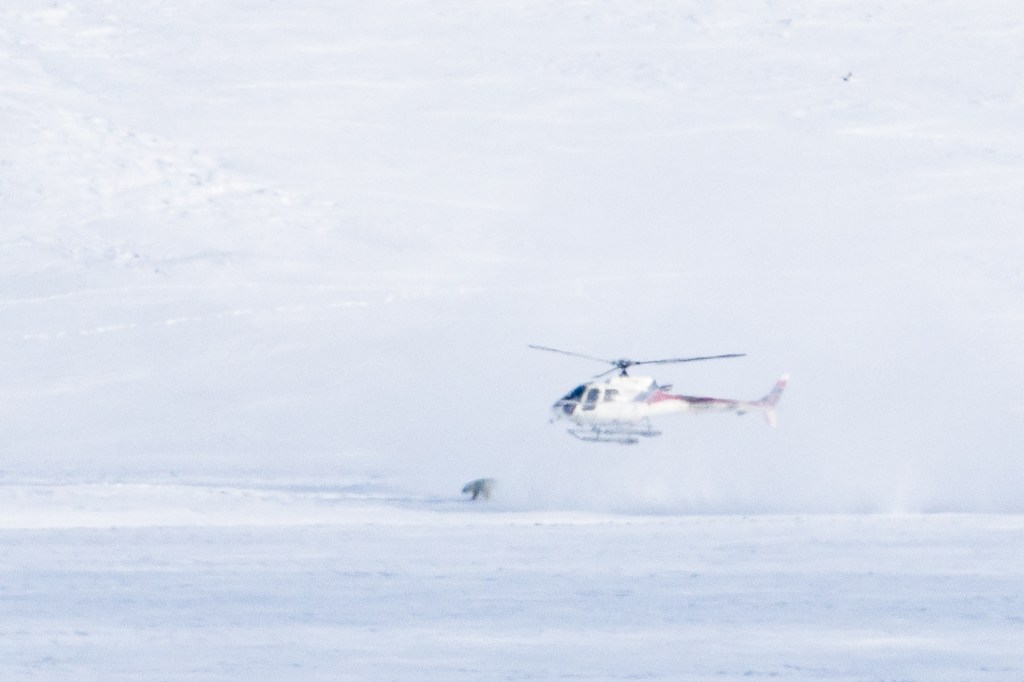
Yet on the 20th of April this year, 2025, I witnessed something that throws the entire justification for these restrictions into serious question. I documented an utterly disgraceful scene involving so-called “researchers / scientists” from the Norwegian Polar Institute, who, under the banner of science, mercilessly harassed and stressed a wild polar bear with their helicopter. This wasn’t a misunderstanding or a necessary intervention. This was a prolonged, high-speed chase that left a majestic animal panicked, exhausted, stressed and visibly terrified.
We had been observing this particular bear from a respectful distance aboard our expedition vessel—more than 3 kilometres away—as it rested peacefully on the ice and slowly ambled across the frozen landscape. It was calm, undisturbed, and behaving entirely naturally. We observed the bear for more than four hours, keeping our distance and respecting the environment and the bear. Then came the helicopter.
Flying in at a low altitude and high speed, the chopper panicked the bear almost immediately. It leapt up and began running at full speed, clearly terrified by the sudden roar and presence of the aircraft. What followed was not a quick dart-and-release operation. Instead, the helicopter pursued the bear relentlessly for more than thirty minutes, sweeping down to within mere metres of the fleeing and now highly stressed animal. This was not research—it was a chase. And it was heartbreaking to witness.
Eventually, after the bear was clearly exhausted and had no energy left to continue running, it was darted. Imagine that: terrorising an animal into a state of total exhaustion and stress before sedating it. All in the name of science.
Let’s be crystal clear here: this was harassment, pure and simple. No matter how it’s packaged, this kind of treatment of a wild animal is not only unethical, it is completely out of alignment with the strict rules imposed on everyone else in Svalbard. If a group of photographers or tourists had behaved this way—approaching a bear at such a close range, causing it to flee in fear, disturbing its natural behavior—we’d be vilified. Fined. Possibly even banned. And yet when it’s a helicopter marked with the insignia of a research organization, this behavior is suddenly justifiable?
I want to be clear at this point. I am not against the science of Polar Bears. I am against the invasive and highly stressful nature in which this science is currently being carried out by the Norwegian Polar Institute. They, and the governor of Svalbard are responsible.
We cannot stand by and allow this kind of hypocrisy to go unchecked. The rules in Svalbard must be applied consistently, regardless of whether the person breaking them wears a lab coat or carries a camera. If it’s unacceptable for an expedition ship to remain stationary while a curious bear approaches, how can it possibly be acceptable to chase that same bear with a helicopter until it collapses from fear, stress and exhaustion?
This is not an isolated incident. Reports from others who have spent time in the Arctic tell similar stories of “research” being used as a shield for disturbing and unnecessary interference with wildlife. It is high time we start questioning who is truly disturbing the natural order in Svalbard.
I’ve included above a photograph—a zoomed-in crop from a 600mm lens—that captures the moment this bear, utterly drained and frightened, tried to escape the mechanical predator circling above. It’s not easy to look at, but it is vital that this image be seen. I urge you to share it widely. Send it to the Governor of Svalbard. Send it to the Norwegian Environmental Agency and Norwegian Polar institute. Send it to every institution responsible for wildlife regulation and oversight in the Arctic – This needs to stop.
The polar bear is not just a symbol of the Arctic—it is an apex species already under tremendous pressure from a rapidly warming world. The very least we can do is treat it with the respect and dignity it deserves. And that means holding everyone—scientists, tourists, guides, and yes, photographers—to the same standard of ethical behavior.
The world is watching. Let’s make sure Svalbard does better.
Addendum: Through a mutual friend, Morten Jørgensen (author or Polar Bears on the Edge), Nikita Ovsyanikov, (Dr. of Bio. Sci., Polar bear specialist), has reached out with the following statement.
“This is a very powerful message in this record of the violence against the bear done by polar bear scientists in Svalbard. And this evidence should be published widely in all possible media, in all possible ways. Science is doing its cynical business, jeopardizing polar bears in this way to “answer the question of how global warming is affecting polar bears “. These scientists are driving polar bears to extinction. What they are doing is an ecological crime, nothing else!
Considering the legal aspects of this event, and of this invasive methodology in general, the following qualification should be applied:
Due to its de facto impact on animals, this application of such an invasive methodology, should be interpreted as a violation of the law. There are laws intended to protect animals from cruelty, and this is intentional cruel treatment of an animal. There are laws protecting endangered animals, and this intentional treatment has a strong negative impact on and endangered and protected animal.
This harassment of animals and violation of humanitarian and conservation principles must be stopped. Protection of animals from cruelty and protection of endangered species from negative impacts that reduce their survival capacity (evidence is numerous, but continuously denied by the scientists more interested in continuing their business) should be made real and effective.”
Nikita Ovsyanikov,Dr. of Bio. Sci., Polar bear specialist,Ethologist and conservationist.
Dr. Nikita Ovsyanikov is widely regarded as the most experienced Polar Bear scientist in the world with decades of experience.
Today we are starting our Wild Nature Photo Travel winter expedition on boat up here in Svalbard. This is an expedition I have been looking forward to since last year and I am really excited to be getting underway. Incredible snow covered landscapes, arctic wildlife, pack ice and stunning Winter light make this the ideal time of year to be in Svalbard.
Next year, April 2026, I will run a new Winter wildlife and landscape expedition to the archipelago of Svalbard. This expedition is for photographers who want to capture powerful and evocative photographs of Arctic wildlife, including polar bears, Arctic foxes, reindeer and walruses, as well as dramatic snow- and ice-covered landscapes in a winter setting. The expedition will run from April 7th until April 15th 2026, starting and finishing in Longyearbyen, Svalbard. The cusp of Winter is a beautiful time to visit and photograph in Svalbard. At this time of the year, the sun will be low in the sky, and the landscape will be wearing its winter armour. We will use the expedition class ship, M.S Freya, enabling us to push north into the permanent pack ice. Full details, are available on my website HERE. This expedition will be limited to a maximum of 12 participants – almost have the places already spoken for. If you would like to join the expedition or would like further information, please drop me an email. To get an idea of the style of photographs you can capture on this expedition please visit the Svalbard portfolio on my website.
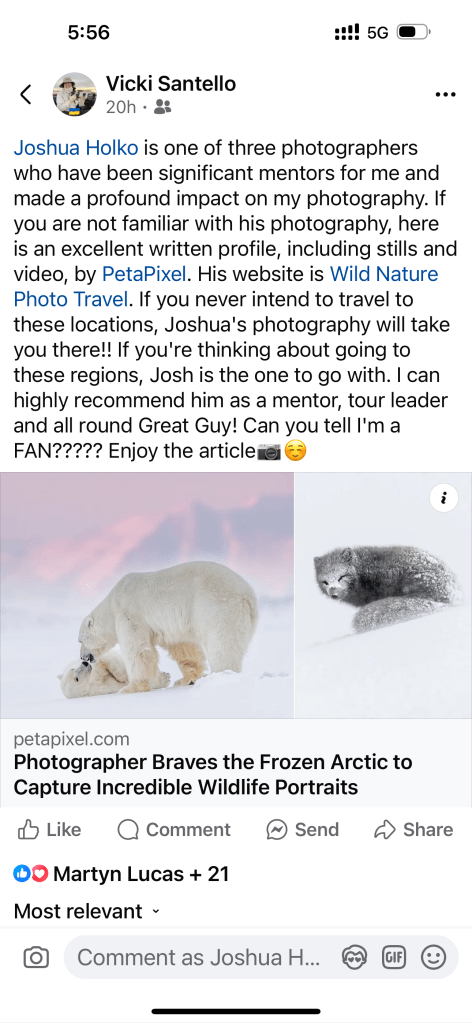
A few days ago I received an absolutely wonderful endorsement and testimonial from regular traveller and photographer, Vicki Santello, who I have had the good fortune to travel with on quite a few workshops and expeditions with now (including Antarctica). The endorsement came on the back of the recent PetaPixel article and interview. I just wanted to share this as its not often someone takes time out of their day to write something positive about anything these days and I very much appreciate the kind words and sentiment – thank you Vicki.
I have just published episode 120 of my Wild Nature Photography Podcast. In this episode, I discuss the latest article by Peta Pixel on my Polar photography, and wrap up the snow mobile expedition I just finished up here in Svalbard for Arctic Fox and Reindeer. The conversation also includes the destruction of the 200-800mm lens, also featured on Canon rumours and Peta-Pixel in the last few days.




 www.WILDNATUREPHOTOTRAVEL.com