March Photo of the Month Winner: Caroline Hind

Congratulations to the third print winner ‘Caroline Hind’, for the photograph of the month for March 2015: ‘Epic Sense of Scale’

What Caroline said: That is a truly spectacular image! I’ve been to Antarctica only once, but it’s captured my heart and I know I’ll be back.An Epic Sense of Scale

Congratulations Caroline, you were the first, and your print will be sent to you when I return to Australia in early April.

Keep an eye out on my blog for the next print giveaway with the April photograph of the month. Remember the best way to get instant updates is to subscribe via email.

2015 March Photograph of the Month: Epic Sense of Scale

The photograph of the month for March 2015 was shot during one of the last zodiac cruises on my 2013 Antarctica expedition. We were fortunate to come across an iceberg of truly monumental size near the entrance to Antarctic Sound. Whilst I have been fortunate to see and photograph icebergs even larger than this (and the biggest icebergs are measured in kilometres) this particular iceberg also had an incredible chasm, wonderful form and shape and beautifully chiselled features. Our expedition ship ‘Polar Pioneer’ pictured here is seventy two metres long and a full six decks high at the fly bridge.  This was actually one giant iceberg joined underneath the water.  Our ship could have easily fit through the chasm however such a venture would have been exceedingly dangerous. I admit though my mind was racing with the thought of a blast through this chasm in our zodiac! VPPY - Gold AwardDon’t forget! You can win a free 13″ x 19″ Win a Fine art Print of this photograph including shipping anywhere in the world. All you need do is to be the first to comment on this post on the home page with your thoughts on why you like this photograph or why you would like to own a print of the image and then share the post with your preferred social media outlet. Just keep in mind that due to my hectic travel schedule it may take me some time to make and post out each print so if you are the lucky winner for a given month I ask that you jut exercise a little patience and as soon as I am back in my studio in Australia and as soon as practical I will make the print and send it to you – free of charge. Each print will be made and personally signed by me with the same care and attention to detail I exercise on my large gallery prints. There will be a total of twelve prints to win throughout the calendar year. The first two prints of the year were won by Fred Jennings and Chris Roberts and their prints have now been delivered, framed by them and are hanging on their walls.

This particular print is one I hold quite close to my heart as it won a coveted Gold Award at both the 2014 VPPY Victorian Professional Photography Awards and also at the National APPA Australian Professional Photography Awards. It was one of my four portfolio photographs that won me the 2014 Australian Canon Science, Nature and Environment Photographer of the Year award.

Good luck and don’t forget in order to win the print you need to be the first to comment here on the home page on the March photograph of the Month for the 2015 calendar year with your thoughts on why you like the photograph or why you would like to own a print and to then share the post with your social media outlet of choice.

Iceland Winter Workshop 2015 Complete – Heading North in search of Polar Bears

Daniel Bergmann and I have just wrapped up an absolutely brilliant 2015 Winter workshop here in Iceland. We had some incredible light, Aurora and experiences during our time exploring the winter countryside with a fabulous group of passionate photographers. In brief, we photographed the spectacular snow covered landscapes of Southern Iceland, partially frozen waterfalls, and the magical Northern Lights over a period of ten days.Iceland-7629 A full trip report and photographs from the workshop will come later once I have a chance to sort through the images and fully digest our shared experiences. Just a reminder if you would like to join us on our 2016 Winter workshop to Iceland there are now only a few places remaining before it will be sold out. We will be exploring the northern landscapes of Iceland and visiting some of the spectacular northern features and landscapes whilst they are covered in fresh snow. You can register your interest by dropping me an email.GullFoss in WinterI am headed North tomorrow via Oslo to the small town of Longyearbyen in Svalbard on a scouting trip to photograph Polar Bears and Reindeer in the deep freeze of an Arctic Winter. Longyearbyen is the world’s most northerly permanent settlement at 78º North and has a population of around 2,500 people. In summer, it is the jumping off point for many Arctic adventures including my own Polar Bear Photography Expeditions. In winter, it is a sleepy frozen town held tightly in the clutches of the Arctic night. Longyearbyen is only my starting point for this scouting trip however, and I will be heading further north with a few friends via snowmobile (snowmobile and dog sleds are the only way to get further north in winter) to a very remote hut by the edge of one of Svalbard’s most spectacular glaciers. We intend to spend a week at this location photographing wildlife and landscapes in the Arctic winter light. At this time of year we are expecting temperatures to potentially dip as low as -30 Celsius and possibly even colder, but we are also expecting incredible winter light should the weather and conditions co-operate. Because of the extremes of temperature at this time of year as well as the danger of camping with Polar Bears we are utilising the small hut as our Basecamp and will explore the landscape daily on snowmobiles and then return to rest in the warmth of the hut. This is the first time a photographic expedition of this nature has been undertaken to my knowledge and it should be an incredible experience. It is our hope that we may be able to offer this remarkable opportunity as a workshop expedition in the near future if our scouting trip is successful. I am very excited about this new opportunity and will have more to report once I return. In the meantime it is time to catch a few hours sleep before I catch my flight to Oslo.

Top Ten Polar Photography Tips to Improve Your Photography

Recently I compiled a list of Top Ten things you can do to give yourself the best chance of taking great photographs when you visit the extreme latitudes of the globe. The Top Ten Tips were also recently featured on View-Bug.

Nature and landscape photographs really require three things in my mind to be successful. Great Subject, Great Composition and Great Light. You really need all three to create an exceptional photograph. 
 
Included below are my top ten in no particular order
  1.  Be patient whenever possible: Wait for good light. Wait for the wildlife to be active.
  2. Give yourself a chance to get in tune with the landscape. Its almost impossible to turn up to a new area you have never visited and make outstanding photographs. It takes time to get in the rhythm of the landscape and really ‘see’ powerful images. Spend some time just looking before you start taking pictures. (See my articles on Landscape Photography with Mystery and Emotion – Part One, Part Two and Part Three).
  3. Know your camera gear intimately. It needs to be muscle memory to change settings on your camera. If you are fumbling with buttons and unsure of how to makes changes to your cameras setting your’e photography is going to suffer (See my article on Landscape Photography with Mystery and Emotion Part Three).
  4. Use weather sealed cameras or use weather proof covers for your camera gear.
  5. Think about what it is you are trying to say with your photography. Try and look past the cliche postcard. The strongest images are often the simplest and are those that leave the viewer wanting more or that evoke an emotional response in the viewer.See my article on Landscape Photography with Mystery and Emotion Part Two).
  6.  Look for the edges of weather. The most dramatic light is often found at the edge of a rainstorm or snow storm. Avoid blue sky sunny days as they usually result in boring photographs. 
  7. Be prepared and dress for bad weather. You need to be able to stay out in the snow storm if the light is incredible and keep making photographs. Having the right equipment for yourself is as important as having the right camera equipment.
  8. Try different focal lengths and compositions. Don’t always go for the super wide angle because it looks more dramatic on the camera’s LCD.
  9. Remember that landscape and nature photography are more often about what we exclude from the frame rather than what we include. Consider simplifying the frame when you are composing the image. A photograph that leaves the viewer asking questions is far more interesting than just a pretty picture. (See my articles on Landscape Photography with Mystery and Emotion – Part OnePart Two and Part Three).
  10. Look for leading lines in the landscape. Photography is the reproduction of a 3-dimensional scene into a 2-dimensional image or print. Strong leading lines will help you convey a sense of depth and help bring the image to life. Also use slow shutter speeds for clouds and water to help create a sense of movement that can also help bring a photograph to life.HMAS Penguin Pool

Antarctica The Wild Side – Weddell Sea Expedition

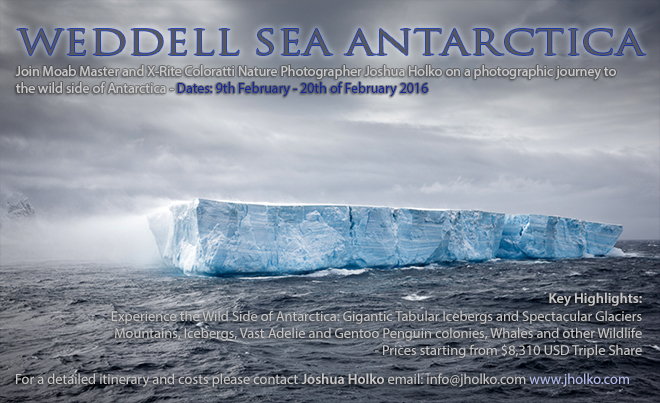
In February 2016 I will be leading a brand new expedition to Antarctica. Unlike previous years this new expedition to Antarctica will depart in February instead of early November and will take us deep into the Weddell Sea – the Wild Side of Antarctica. The expedition dates are February 9th – February 20th 2016. The Weddell sea is an area of Antarctica pretty much inaccessible earlier in the season due to sea ice conditions and our intention is to explore and photograph this rarely visited wild side of Antarctica. We will be using an ice-hardened expedition class ship ‘Polar Pioneer’ so we can push quite a lot of ice safely; which will enable us to get much further south than most vessels.Antarctica-Weddell2015We will sail across the Bransfield Strait to Antarctic Sound on our journey toward the Weddell Sea. Antarctic Sound is home to literally monolothic tabular icebergs that break off the Antarctic ice shelf and float up out of the Weddell Sea. There are incredible photographic opportunities in this area and we will stop to take advantage of spectacular tabular icebergs as we encounter them. We then plan to travel down the east side of the peninsula as deeply as we can penetrate into the sea ice.
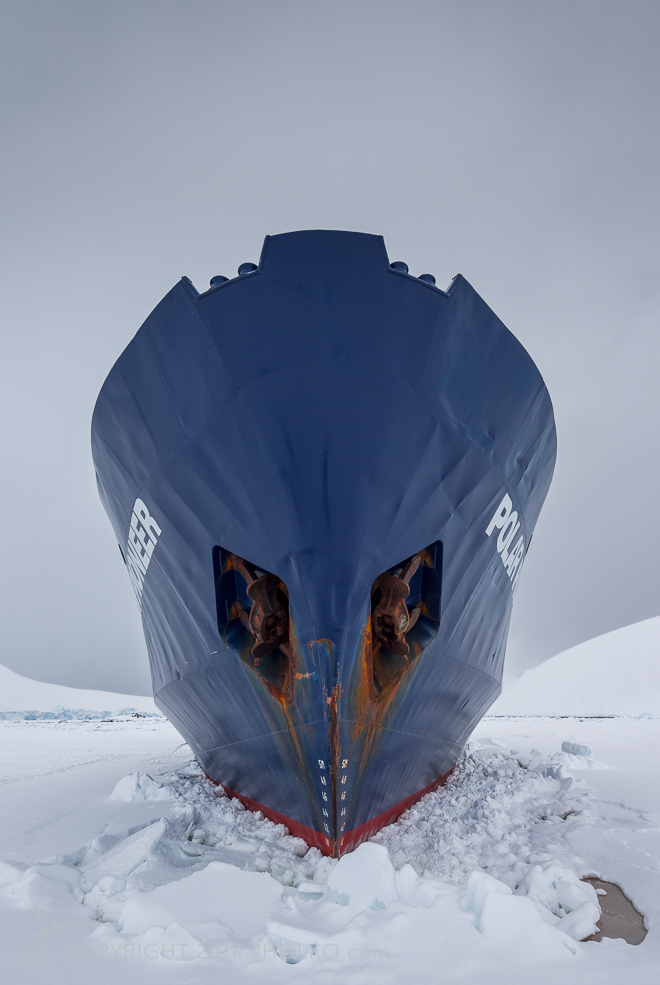
Polar Pioneer

The peninsula’s wild side will welcome us with huge icebergs and spectacular scenery. We will likely visit Paulet Island, a conical volcano with a huge Adelie penguin colony that rises several hundred feet from the islands periphery to its lower slopes. Penguin covered icebergs drift in the currents set against towering ice cliffs. We also hope to explore Prince Gustav Channel and Seymour Island. We will also explore the west coast of the peninsula which offers glaciated peaks rising from a maze of islands and waterways alive with seals, penguins and whales. At the conclusion of the expedition we will sail back across the Drake Passage to Ushuaia.An Epic Sense of Scale

This expedition is for a strictly limited number of just 54 photographers. With many of the expedition ships now taking well over 100 passengers this is a unique opportunity to take advantage of a small group on an ice hardened expedition ship in one of the most rarely visited areas in Antarctica. Due to preliminary expressions of interest and bookings there are now only a few places remaining before this expedition will be sold out. If you would like to confirm cabin availability or would like any additional information about this expedition please drop me an email to info@jholko.com. A detailed PDF information flyer and itinerary can be downloaded clicking on weddellsea2016.