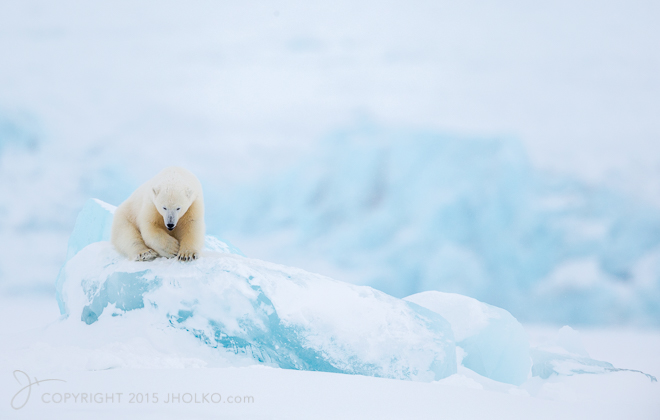
2015 April Photograph of the Month: Polar Bear Blues

The photograph of the month for April 2015 was taken during my recent expedition to photograph Polar Bears in Svalbard in the Arctic this winter. If you have been following my blog (or read the story in the news) you will know that this bear was unfortunately shot dead only a few days after this photograph was taken (You can read my thoughts on this tragedy that could have so easily been avoided). The investigation into the death of this bear and the circumstances that led up to the attack and shooting are currently under investigation. I hope to report the findings of the investigation when they are released later this month.

This particular photograph is a very emotional image for me because of the tragic set of circumstances that led up to the death of this magnificent animal and the time I had spent photographing it only days earlier. I debated with myself for quite some time about wether to make this the photograph of the month for April and ultimately decided I would like this print to go to someone who will not only appreciate the print, but also the story behind it. I watched and photographed this magnificent Polar Bear play around this piece of blue ice against the backdrop of the glacier in Tempelfjorden in Svalbard for well over an hour. It was one of the most playful Polar Bears I have ever encountered and watching it climb over and play around this piece of blue ice was a very unique and special experience. I also photographed the same bear two days before this image as it lay on a fresh seal kill under the polar winter sunset. Polar Bear BluesYou can Win a free Fine art Print  13″ x 19″ of this photograph including shipping anywhere in the world. All you need do is to be the first to comment on this post on the home page with your thoughts on why you like this photograph or why you would like to own a print of the image and then share the post with your preferred social media outlet. Just keep in mind that due to my hectic travel schedule it may take me some time to make and post out each print so if you are the lucky winner for a given month I ask that you jut exercise a little patience and as soon as I am back in my studio in Australia and as soon as practical I will make the print and send it to you – free of charge. Each print will be made and personally signed by me with the same care and attention to detail I exercise on my large gallery prints. There will be a total of twelve prints to win throughout the calendar year. The first three prints of the year were won by Fred JenningsChris Roberts and Caroline Hind and their prints have now been delivered, framed by them and are hanging on their walls (Caroline your print is shipping next week).
Good luck and don’t forget in order to win the print you need to be the first to comment here on the home page on the April photograph of the Month for the 2015 calendar year with your thoughts on why you like the photograph or why you would like to own a print and to then share the post with your social media outlet of choice.

Polar Bear Shot Dead in Svalbard because of the Ignorance of Tourists

Today I am sharing a photograph I took less than a week ago in Svalbard whilst I was on a scouting trip to photograph Polar Bears in winter from snow mobile. I watched and photographed this magnificent Polar Bear play around this piece of blue ice against the backdrop of the glacier in Tempelfjorden in Svalbard for several hours only days ago. The teenage bear had been in the fjord for days and had been hunting seals at breathing holes along the edge of the frozen ice. I photographed the same bear two days before this image as it lay on a fresh seal kill under the polar winter sunset.

I was deeply saddened and moved to tears today to learn that this Polar Bear is now Dead. Shot dead because of the ignorance and arrogance of tourists who travelled to Svalbard to witness the Solar Eclipse. From what I have been able to piece together from the various news reports now popping up online it seems a tourist suffered minor injuries when the polar bear attacked the tent where he was sleeping. An area where the bear was known to be hunting and where these tourists irresponsibly set up their camp. Svalbard-RIPPolice spokesman Vidar Arnesen said the man was among a group of six that was on a combined ski and snow scooter trip on the remote islands more than 800 kilometers (500 miles) north of the Norwegian mainland. The group was camping north of the main town of Longyearbyen.
The man, Jakub Moravec, told local media he hoped to be out of the hospital later Thursday.

“Now I am fine. I have some scratches in the face, on one arm and on the back. But I feel fine,” he told the Svalbardposten newspaper.

Jakub Moravec I am glad you feel fine. You don’t deserve to feel fine. It is because of you and your friends ignorance and stupidity that this beautiful Polar Bear had to be killed. Tent camping in an area a Polar Bear is known to be currently in is not only incredibly stupid, but its incredibly ignorant. Shame on you. I hope the life of this bear that you and your friends caused the death of haunts you for a very long time.

Svalbard Arctic Winter Scouting Trip Complete

Yesterday we arrived back in the small town of Longyearbyen via snow mobiles from our scouting trip to the wilderness in the north of Svalbard where we photographed Polar Bear, Reindeer and icy landscapes in the deep freeze of an Arctic Winter. This scouting trip ranks in the top five most amazing and extraodinary expeditions I have ever been fortunate to undertake – it was also the coldest. The mercury plummeted below -30º Celsius with wind chill on many occasions. Although it was cold (its the Arctic in Winter!) we had a mix of incredible light, landscape and wildlife in a deep winter scene that was a very special experience. Part of the problem in dealing with the cold during this test trip was that we were out in the elements for ten or more hours a day with no option to return to our hut to warm up. This meant donning lots of layers and being prepared to deal with really extreme temperatures for many hours. One of the few places you could actually get some warmth into your body when the cold seeped its way through the layers was from the heated handgrips on the snowmobiles and I was personally very pleased to have these available. Being able to operate the camera requires thin gloves and these offer little protection in this extreme environment. We were over two hundred kilometres from Longyearbyen in the remote northern part of Svalbard  which limited us to what we could take with us and the provisions already supplied at the hut. We travelled more than five hundred kilometres in total during the expedition.

During the expedition we encountered and photographed Polar Bears, Seals, Arctic Fox, as well as Reindeer and were able to make some very unique photographs of these animals in the Arctic Winter light. I will be sharing some of the photographs I made when I get a chance to process them on my return to Australia. As tempting as it is to process a few images on my macbook now, I really prefer to save this work for my studio editing machine where I have a much more tightly controlled colour managed environment.

I am going to stay in Longyearbyen for the next couple of days before I fly back to Iceland to continue my Arctic Fox project in the extreme north-east of Iceland. As it happens, there are several fox dens just outside of town in Longyearbyen and I want to check these out before I leave and potentially spend a day photographing the foxes if they are around. Once back in Iceland I am going to to drive up to Isafjord where I will take a charter boat up to the Hornstrandir Nature Reserve. This very remote part of Iceland is very rarely visited in winter and is only accessible by chartered boat (approximately four hours steam north of Isafjord) and there is no infrastructure (power, running water, roads etc.) in place in this wilderness so we have to take everything with us for the duration of the trip. It is a major undertaking to travel and photograph in Hornvik in winter requiring the co-ordination of not only a chartered boat, supplies, and emergency EPIRB, satellite communication equipment, but also special permission from the park ranger. I want to take a moment and thank my friends in Iceland who have helped make this all possible. Without their assistance in co-ordinating and arranging this expedition it simply would not have been possible. I spent a week or so last year in this area photographing Arctic Fox with their assistance from a snow blind and was able to get several images for my project that I was extremely happy with. I hope to get sufficient images from this expedition to complete the project. In the meantime I am going to enjoy a couple of days in Longyearbyen with hot water, electricity and a warm room. See you back in Iceland in a few days.

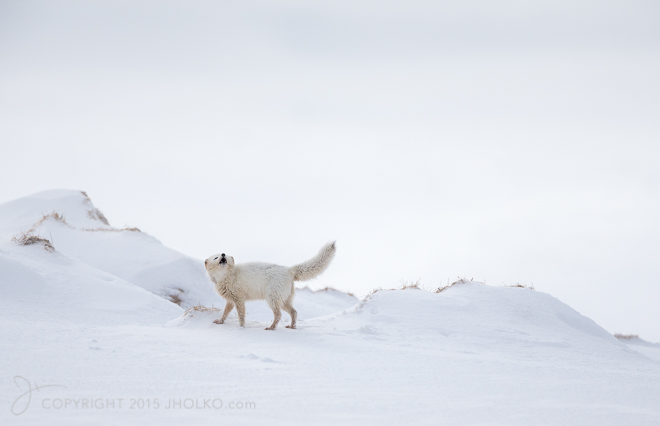
Arctic Fox Howl

Svalbard in Winter – The Deep Freeze of an Arctic Winter

I arrived in Longyearbyen a few hours ago where the temperature is currently -5º Celsius plus a little wind chill factor. Outside the frozen mountainous landscape is covered in fresh snow and is spectacular to behold – I am looking forward to heading outside shortly to grab a few snapshots of the town in winter. It is fantastic and very exciting to be here in winter and tomorrow I will be heading north with a few friends on snow mobiles to a remote hut by the side of one of Svalbard’s spectacular glaciers on our scouting trip to photograph Polar Bears, Reindeer and landscapes under winter arctic light. For now it is time to enjoy a few feature comforts and the warmth of Basecamp whilst making final gear preparations for our departure tomorrow morning. _H9P3362-Edit-MoabSMR-RelCol32013

Top Ten Polar Photography Tips to Improve Your Photography

Recently I compiled a list of Top Ten things you can do to give yourself the best chance of taking great photographs when you visit the extreme latitudes of the globe. The Top Ten Tips were also recently featured on View-Bug.

Nature and landscape photographs really require three things in my mind to be successful. Great Subject, Great Composition and Great Light. You really need all three to create an exceptional photograph. 
 
Included below are my top ten in no particular order
  1.  Be patient whenever possible: Wait for good light. Wait for the wildlife to be active.
  2. Give yourself a chance to get in tune with the landscape. Its almost impossible to turn up to a new area you have never visited and make outstanding photographs. It takes time to get in the rhythm of the landscape and really ‘see’ powerful images. Spend some time just looking before you start taking pictures. (See my articles on Landscape Photography with Mystery and Emotion – Part One, Part Two and Part Three).
  3. Know your camera gear intimately. It needs to be muscle memory to change settings on your camera. If you are fumbling with buttons and unsure of how to makes changes to your cameras setting your’e photography is going to suffer (See my article on Landscape Photography with Mystery and Emotion Part Three).
  4. Use weather sealed cameras or use weather proof covers for your camera gear.
  5. Think about what it is you are trying to say with your photography. Try and look past the cliche postcard. The strongest images are often the simplest and are those that leave the viewer wanting more or that evoke an emotional response in the viewer.See my article on Landscape Photography with Mystery and Emotion Part Two).
  6.  Look for the edges of weather. The most dramatic light is often found at the edge of a rainstorm or snow storm. Avoid blue sky sunny days as they usually result in boring photographs. 
  7. Be prepared and dress for bad weather. You need to be able to stay out in the snow storm if the light is incredible and keep making photographs. Having the right equipment for yourself is as important as having the right camera equipment.
  8. Try different focal lengths and compositions. Don’t always go for the super wide angle because it looks more dramatic on the camera’s LCD.
  9. Remember that landscape and nature photography are more often about what we exclude from the frame rather than what we include. Consider simplifying the frame when you are composing the image. A photograph that leaves the viewer asking questions is far more interesting than just a pretty picture. (See my articles on Landscape Photography with Mystery and Emotion – Part OnePart Two and Part Three).
  10. Look for leading lines in the landscape. Photography is the reproduction of a 3-dimensional scene into a 2-dimensional image or print. Strong leading lines will help you convey a sense of depth and help bring the image to life. Also use slow shutter speeds for clouds and water to help create a sense of movement that can also help bring a photograph to life.HMAS Penguin Pool