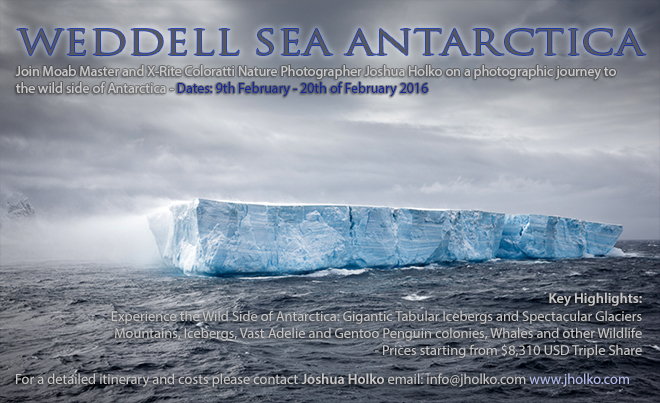
My good friend and fellow photographer Antony Watson has just finished a video of our experiences last year in the Falkland Islands, South Georgia Island and Antarctica and you can now watch the video online (Click to Read the Trip Report). Just click on the image below to watch the video – Enjoy.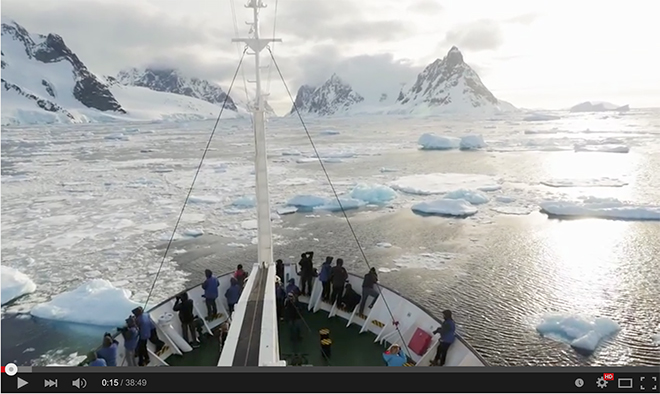 If you are interested in travelling to South Georgia Island and the Weddell Sea Antarctica I have an expedition this November to South Georgia Island and to Antarctica in February next year. Places are now extremely limited on both expeditions. There is now only one remaining place on South Georgia Island expedition before it will be sold out.
 I am heading out of Reykjavik later today up to the very north (and very wild and remote) western tip of Iceland on an expedition to Photograph Arctic Foxes for an ongoing project. See you back in Reykjavik in a week or so – weather permitting a timely return.
Category: South Georgia
Top Ten Polar Photography Tips to Improve Your Photography
Recently I compiled a list of Top Ten things you can do to give yourself the best chance of taking great photographs when you visit the extreme latitudes of the globe. The Top Ten Tips were also recently featured on View-Bug.
Nature and landscape photographs really require three things in my mind to be successful. Great Subject, Great Composition and Great Light. You really need all three to create an exceptional photograph.
Included below are my top ten in no particular order
- Be patient whenever possible: Wait for good light. Wait for the wildlife to be active.
- Give yourself a chance to get in tune with the landscape. Its almost impossible to turn up to a new area you have never visited and make outstanding photographs. It takes time to get in the rhythm of the landscape and really ‘see’ powerful images. Spend some time just looking before you start taking pictures. (See my articles on Landscape Photography with Mystery and Emotion – Part One, Part Two and Part Three).
- Know your camera gear intimately. It needs to be muscle memory to change settings on your camera. If you are fumbling with buttons and unsure of how to makes changes to your cameras setting your’e photography is going to suffer (See my article on Landscape Photography with Mystery and Emotion Part Three).
- Use weather sealed cameras or use weather proof covers for your camera gear.
- Think about what it is you are trying to say with your photography. Try and look past the cliche postcard. The strongest images are often the simplest and are those that leave the viewer wanting more or that evoke an emotional response in the viewer.See my article on Landscape Photography with Mystery and Emotion Part Two).
- Look for the edges of weather. The most dramatic light is often found at the edge of a rainstorm or snow storm. Avoid blue sky sunny days as they usually result in boring photographs.
- Be prepared and dress for bad weather. You need to be able to stay out in the snow storm if the light is incredible and keep making photographs. Having the right equipment for yourself is as important as having the right camera equipment.
- Try different focal lengths and compositions. Don’t always go for the super wide angle because it looks more dramatic on the camera’s LCD.
- Remember that landscape and nature photography are more often about what we exclude from the frame rather than what we include. Consider simplifying the frame when you are composing the image. A photograph that leaves the viewer asking questions is far more interesting than just a pretty picture. (See my articles on Landscape Photography with Mystery and Emotion – Part One, Part Two and Part Three).
- Look for leading lines in the landscape. Photography is the reproduction of a 3-dimensional scene into a 2-dimensional image or print. Strong leading lines will help you convey a sense of depth and help bring the image to life. Also use slow shutter speeds for clouds and water to help create a sense of movement that can also help bring a photograph to life.

Baby Elephant Seal Play Time in South Georgia
One of the most fantastic experiences you can have during a Nature photography expedition is getting close to wildlife. Close encounters with wild animals are always special and can yield wonderful photographs. During the recent twenty one day expedition I lead to South Georgia Island and Antarctica we were fortunate to have some wonderful close encounters with wildlife. One of the most memorable was with a baby Elephant Seal at Grytviken Harbour in South Georgia. This very curious and inquisitive baby seal decided it would be good fun to play in the shallows and kiss the underwater camera. Just click on the image below to play the video. It is important to note that this seal approached us on its own and was in no way stressed or harmed – it was merely curious. In fact, during our time in Antarctica we had several participants who even had curious baby seals approach them and try to climb up onto them whilst they were lying down and taking photographs. Baby seals are often very curious and its quite common for them to not only approach well within five metres but also to touch, push and play with people. We always respect wildlife and boundaries to the wildlife and enjoy these special moments when the wildlife decides to come to us and investigate.
The underwater housing featured in this short video and that was used to make this photograph is an Aquatech Delphin 1DX housing with underwater dome port.
South Georgia Island and Antarctica Expedition 2014 Report
In November 2014 I led an extensive twenty-one day landscape and wildlife photographic expedition with good friend Andy Biggs to the Falkland Islands, South Georgia Island and Antarctica. The purpose of this extended expedition was to provide the definitive Antarctic and sub-Antarctic experience. We planned to take in the best of the Falklands, South Georgia Island and Antarctica and experience not only the diverse landscape and wildlife, but also some of the historic relics and history of these amazing places.
Our expedition saw us cover more than 3400 nautical miles in a round trip from Ushuaia, to the Falkland Islands, South Georgia Island, The South Shetland Islands, Antarctica and finally return to Ushuaia. We experienced the full range of weather and conditions from brilliant sunshine to gale force winds on our approach to Antarctica. As a photographer who prefers the drama of overcast skies and storm conditions I relished the opportunities that we had to shoot in inclement weather. Those of us who preferred calmer conditions were likewise blessed with some wonderful weather during much of our time in the Falklands and South Georgia. Unfortunately for me, I did suffer (not alone ) a good dose of seasickness during this expedition that more or less confined me to cabin during our sea days on this expedition. This was the first time I have succumbed in such a manner to sea sickness and I can now completely sympathise with anyone has been unfortunate enough to suffer from this uncomfortable condition.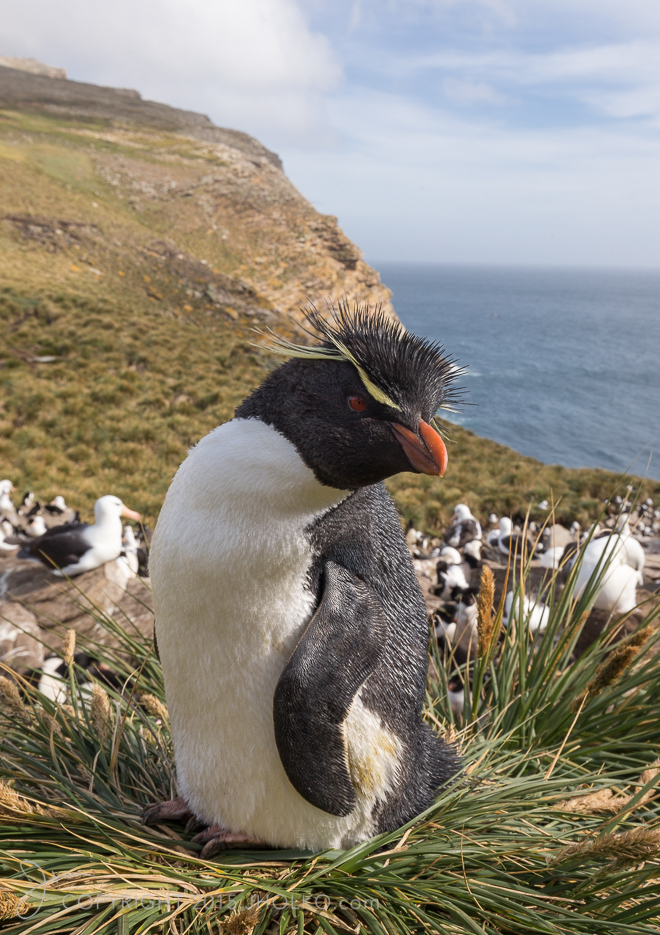 In the Falklands we visited West Point Island and New Island where we photographed majestic Black Browed Albatross and Rock Hopper Penguins. Rock Hopper Penguins are the rock stars of the penguin world and are extremely photogenic with their wild hair and cool looks. We were fortunate to have some fabulous light and incredible access in the Falklands and were able to photograph nesting Black Browed Albatross up close. Some of us were also fortunate to see and photograph the very rare Striated Kara Kara. Although I did manage to grab a couple of snaps of this rare raptor for documentary purposes the images themselves are more record photographs and not considered compositions. Nevertheless it was a real thrill to see and photograph this rare bird of prey.
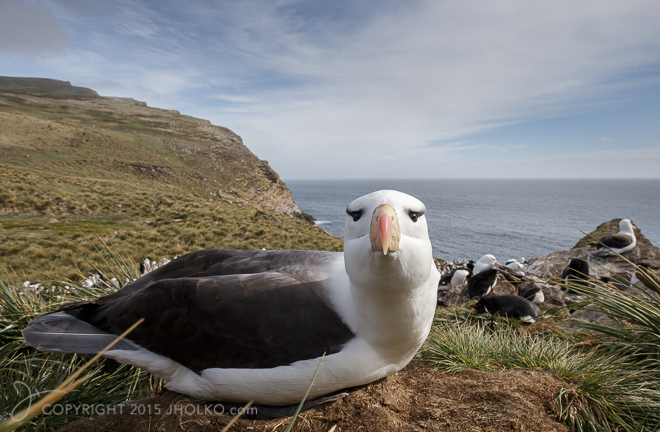 We also stopped in Stanley, the capital of the Falklands where we refuelled on coffee and took in some local sights. Keen to make our way to South Georgia our stay in the Falklands was brief and we were soon underway for three days sailing to South Georgia Island.
South Georgia is one of the most remote islands on the planet and is a full three days sail from the Falkland Islands. It is also host to an incredible biomass of wildlife that makes it not only unique but also incredibly special. The sheer mass of wildlife on tap in South Georgia is a wildlife photographers dream and the opportunities are infinite. South Georgia is nothing short of a complete sensory assault with tens of thousands of nesting King Penguins, penguin chicks, Fur Seals, Elephant seals and a virtual cornucopia of birdlife. At first blush South Georgia can be so overwhelming that simply making sense of it can be difficult and it pays to spend some time simply enjoying the experience as well as photographing.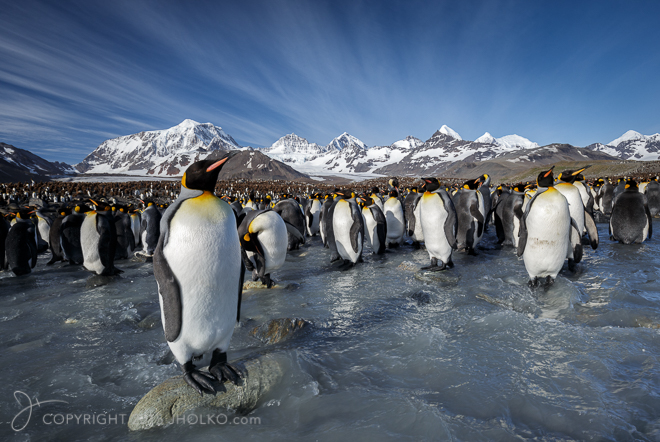 South Georgia island is strictly controlled in terms of number of visitors permitted on the island, where they are allowed to land and the hours they can be ashore. The purpose of these restrictions is to keep South Georgia as pristine as possible and to give wildlife a chance to rest away from the disturbance of human visitation. As such it is not permitted to land in South Georgia before 4am and you must depart by no later than 10pm. In order to take advantage of the best light possible we frequently commenced our zodiac operations at 4am so that we could not only maximise our time ashore but also ensure we experienced the best of the light available. These long hours usually enabled us three landings per day which meant we could squeeze in a great amount of photography during our time in this amazing location.
Our first stop in South Georgia was Grytviken where we explored the old whaling remnants that lie scattered amongst the small settlement. Fur seals and elephant seals greeted us as our zodiacs landed amongst the rusty whalers remnants. I chose to focus my efforts at this location on a very playful baby elephant seal wallowing in the shallows of the harbour. This photograph was taken with a Canon EOS1DX with a 16-35mm F4L IS lens in an Aquatech underwater sports housing with wide angle dome port. The seal seemed intent on kissing the camera and I had to wipe seal slobber off the dome port on several occasions. My sincere thanks to Aquatech for the loan of the underwater housing for the duration of this expedition. One of the greatest attractions in South Georgia are the majestic King Penguins. These elegant birds are the Kings of South Georgia and can be found by the tens of thousands at Salisbury Plain, Gold Harbor and Saint Andrews – all of which we visited during this expedition. Larger than the Gentoo, Chinstrap, Rockhopper and Macaroon they are also the most colourful and to my mind at least, the most elegant and photogenic.
 We also visited Little Moltke harbour, Hercules and the Drygalski fjord in South Georgia. All of these offered incredible landscapes and wildlife opportunities. I hope to share more photographs from these locations over the coming weeks and months.
As we sailed from South Georgia Island to Antarctica through the Scotia sea we passed gigantic tabular icebergs slowly drifting out of the Weddell Sea. The largest of which measured an enormous twelve kilometres on the ships radar. Icebergs of this size and magnitude generate their own local weather system and are always dramatic to photograph.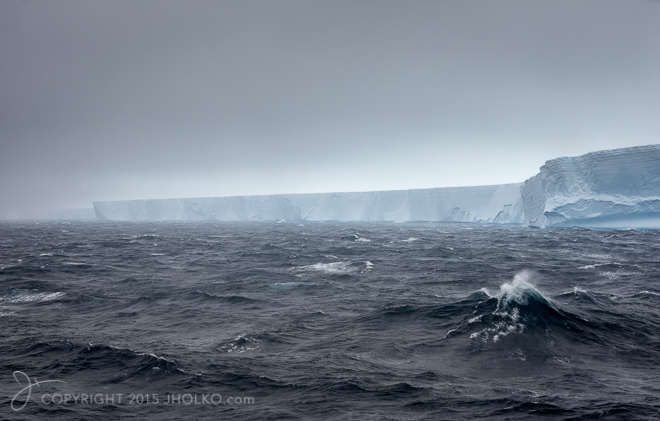 Our approach from South Georgia to Antarctica presented us with nearly 50 knots of howling wind which prevented us from landing at Deception Island. However, we were able to land briefly at the historic Point Wild in rising Catabolic winds. This is the first time I have been able to actually place a foot on rock at this location having been blown out on all other attempts. Point Wild is home to a colony of Chinstrap penguins and was the location where Antarctic explorers huddled for three months before rescue.
 During our time in Antarctica our most southerly point was the breathtaking Lemaire Channel which we cruised through during a magnificent polar sunset. The Lemaire channel is always a dicey bet this early in the season but with the experience of our Russian Captain we were able to navigate the ice strewn waters and experience one of the most amazing sunsets I have ever witnessed in polar waters.
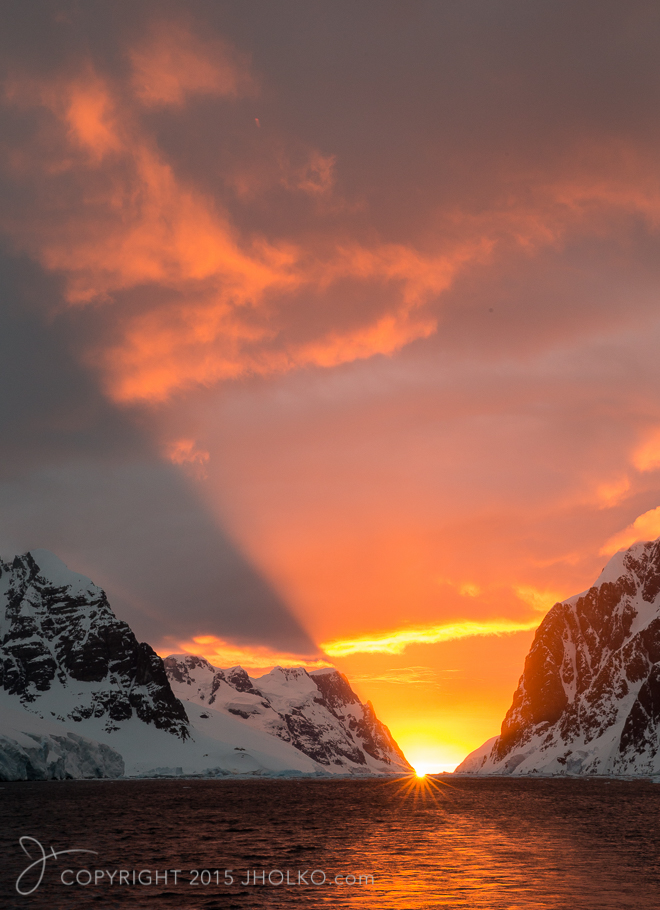 We also explored Neko Harbour, Paradise Bay, Cierva Cove and more. We cruised on zodiacs amongst spectacular icebergs as well as landing and exploring on foot. We were regularly greeted during our landings by our comedic friends the Gentoo penguins.
Our final landing in Antarctica was at the penguin festooned Cuverville Island. Cuverville has become one of my favourite landings in Antarctica with its stunning dramatic scenery, extensive Gentoo penguin colonies set against precipitous mountains and incredible glaciers hanging between mountains. It provides the perfect backdrop for Antarctic photography. Add a liberal dose of inclement weather and the island comes alive with drama. Cuverville was our coldest landing with 20-25knott winds and a significant wind chill. The resulting images bore out a taste of just what Antarctica can truly be like. It is hostile in its magnificence. There were some fantastic photographs that resulted from this expedition by many of the photographers who participated. Personally, I shot over 7,500 images during the course of the expedition and as is usual it will take me many months to mine the jewels from this expedition. For now the photographs in this report are just a few of my initial favourites. During the course of the expedition the ships crew prepare a report of the previous days activities as well as what to expect for the coming day. You can download the daily trip reports as a SouthGeorgiaReport PDF.
 We also had a videographer aboard to document our expedition and I hope to share the video from this expedition in a few months once all of the editing and post production work is complete.
If you are interested in travelling and photographing in South Georgia Island I will be leading a dedicated fifteen day expedition in November this year that departs from the Falkland Islands and that will spend more than eight days in this wondrous location. There are now only two places remaining before this expedition will be sold out. If you would like any additional information you can register your interest by dropping me an email at info@jholko.com
Spirit of Antarctica 2014 Complete – Heading Home
After nearly two months of solid photography in South Georgia Island, Antarctica and Patagonia I am finally headed home later today in time for Christmas with my family. The last two months has been nothing short of a phenomenal experience that was as always a sheer pleasure to share with so many like minded and passionate photographers.
I am currently in Puerto Williams in Chile having just docked a couple of hours ago after returning from my last Antarctica expedition of the year. We were fortunate to have a relatively mild Drake crossing on the return which was a pleasant and welcome surprise. Another pleasant surprise has been I just learnt that I have won the 2014 Travel Photographer of the Year Award for the Wild and Vibrant Category. The winning photograph was shot last year in Svalbard.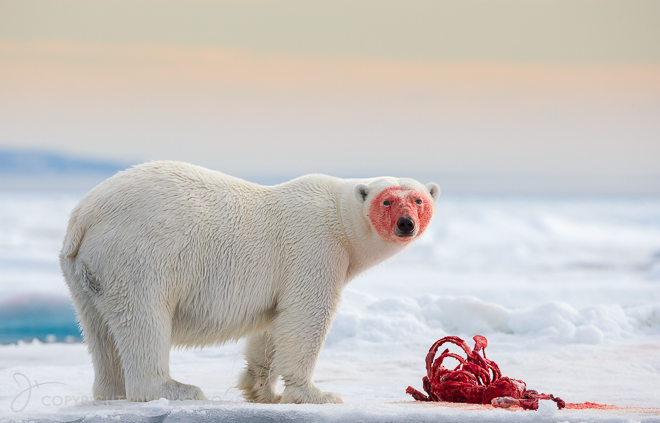
I admit to being pretty shattered at this point having existed on little sleep over this last two months. With so much exposure to the midnight sun so far south my body clock is a bit of a mess. The one benefit of this state of exhaustion is that I am likely to at least catch up on some sleep on the long haul flights home. I quite honestly have no idea when I will get a chance to process some of the photographs I have made during this time away as my time at home is very limited before I next head overseas. In the meantime, I am very much looking forward to walking in my front door, seeing my family and spending Christmas with my kids.
If you have been following along on my blog you will know that I will only be home for a two weeks before I will head back to South America and Antarctica for a scouting trip to photograph the mighty Emperor Penguins at the beginning of 2015. I am super excited about this new opportunity and am looking forward to heading deep into remote Antarctica where the Emperors make their home. The intention of this scouting trip is to spend a week camping and living on the sea ice with the Emperors in order to ensure everything is in place for a future small group photographic expedition in 2016. I will have more to say about this expedition soon. For now, if you are interested in a future expedition to visit, camp, photograph and live with Emperor Penguins you can drop me an email to express your interest – no obligation at this point.
Now, its time to head to the airport in Puerto Williams and start the long trek home. See you in Australia.
 www.WILDNATUREPHOTOTRAVEL.com