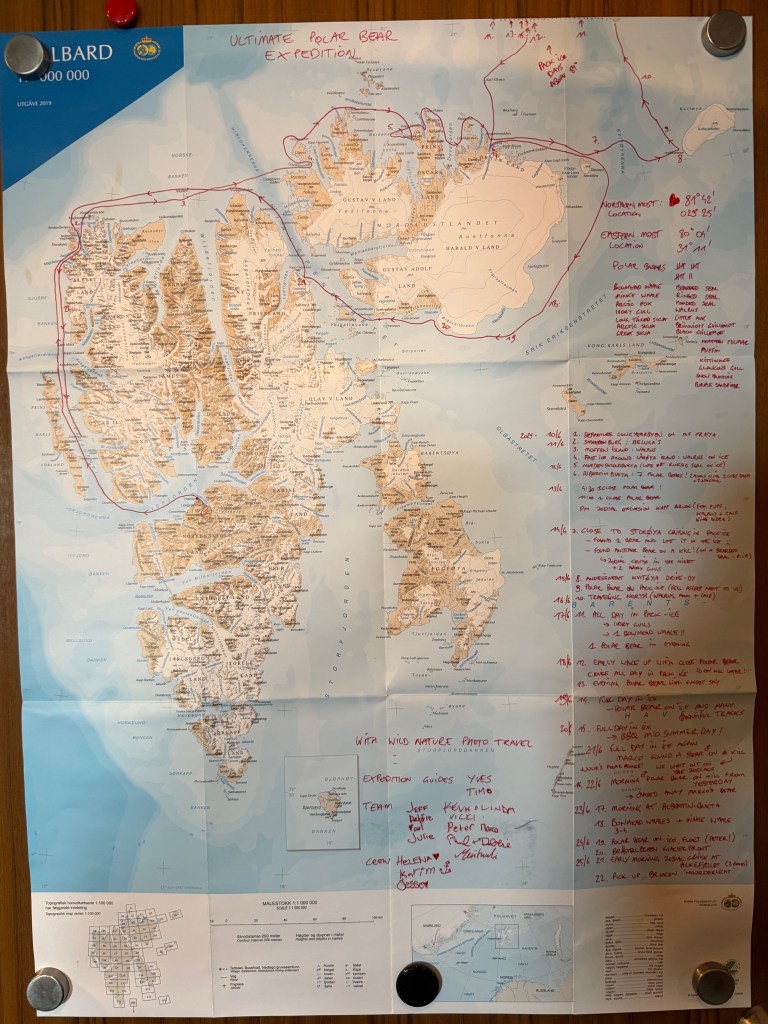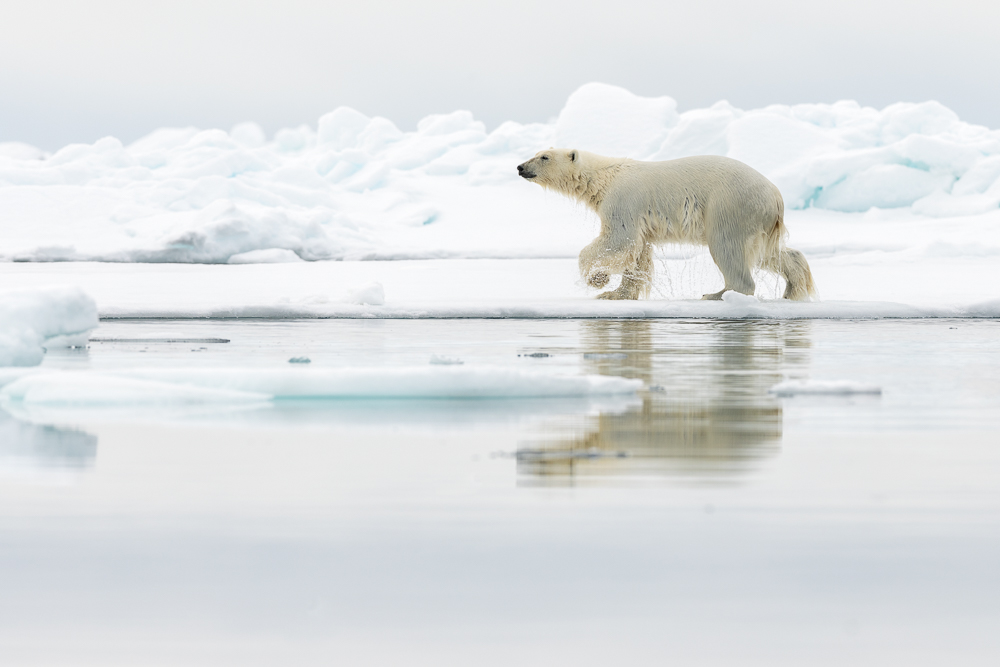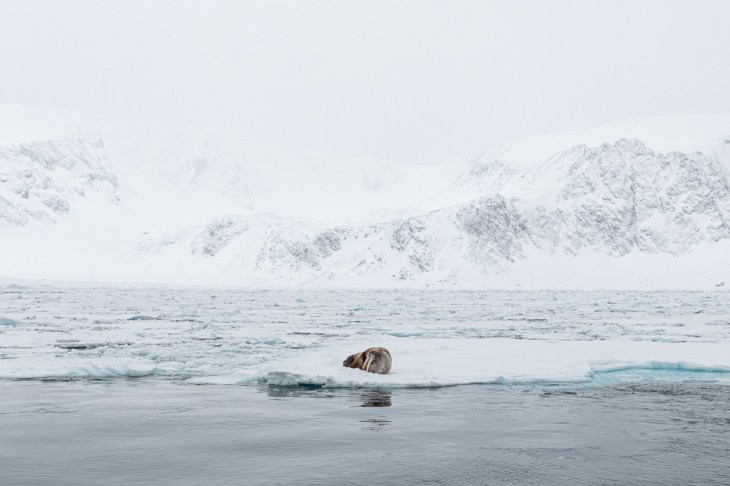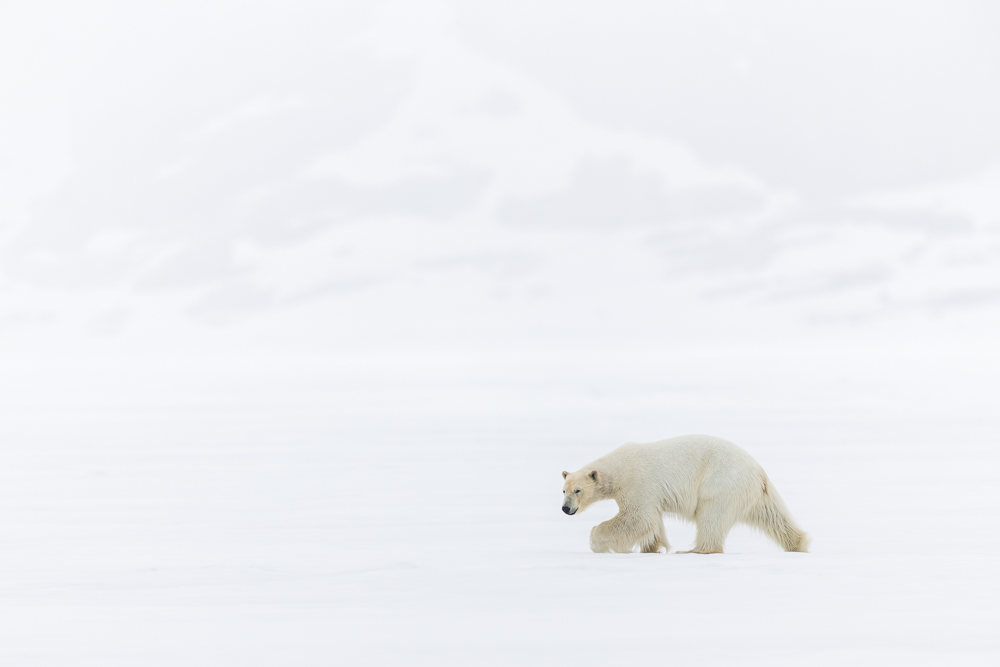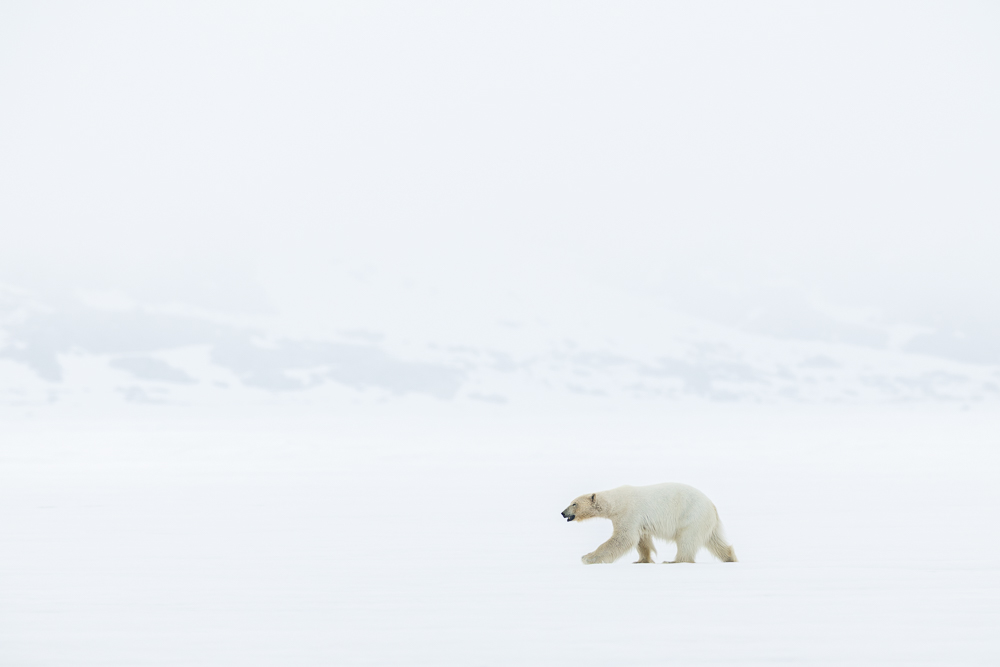
I wanted to share a photograph that shows how a Polar Bear (or any wildlife for that matter) can be not only be safely photographed (this image shot before the new restrictions in Svalbard – more than a year ago), but also treated with the highest degree of respect and not interfered with, harassed or stressed in the slightest. We observed this magnificent bear, walking slowly across some fast ice near a glacier at a distance of more than three kilometres. We parked our small expedition ship (12 passengers aboard – all photographers) at the edge of the fast ice, shut off the engine and watched and observed through our binoculars for more than two hours – enjoying the moment with respect, awe and hopeful anticipation. Slowly, the bear approached of its own volition and curiosity, without need for us to do anything other than remain calm, quiet and patient. All on board remained quiet, observant and patient. Cameras at the ready, we began to photograph the bear from the safety of our ship as it walked slowly along the fast ice, still at distance from the boat. Of course, it noticed us, as it sniffed the air in passing in curiosity. But, it was never interfered with. It was never stressed and it was never chased. It was treated with the highest degree of respect it deserves. The Polar Bear is the king of the Arctic. It deserves nothing less than the highest degree of respect at all times. When the bear was ready, it continued its journey along the edge of the fast ice, disappearing into the distance. It was never chased or followed and there was never stress caused. There was never a question of danger from the safety of the expedition ship. When the bear had gone, we started our engine and continued our journey. This is how you photograph wildlife with respect. Perhaps scientists who chase bears with helicopters could learn a thing or two from wildlife photographers about how to approach and photograph wildlife with respect and patience. Even in this ‘cropped’ photograph, taken with a 600mm lens and a 1.4 TC (effective focal length 840mm) the bear was never closer than a couple of hundred metres. Wildlife photography of Polar Bears doesn’t need a wide angle lens to be powerful, emotive and dramatic. What is required is an understanding and respect for the wildlife. Wildlife FIRST. Photography second. This is not a comparison between Science and Tourism. That is not the intent. This is a comparison between methodologies. How Polar Bears can be engaged with, with respect, or as in the case of the recent helicopter incident by researchers, without respect that unduly stresses the animal. For the record, I am not against the Science of Polar Bears. I am against invasive, stressful methods for Polar Bear sedation and research such as chasing bears from helicopter.
Edit: Update: 24th April 2025 8.35pm AEST – Svalbard Posten has posted an article about the incident HERE. NRK Media in Norway has also posted a front page Article HERE.
Many wildlife photographers of are likely already aware of the increasingly absurd regulations being imposed on all visitors to Svalbard, particularly surrounding the ‘so-called’ protection of polar bears. One of the most contentious of these mandates is the requirement to maintain a minimum distance of 500 meters from a polar bear—no matter the circumstance. That includes viewing from the safety of an expedition vessel and even when a bear voluntarily approaches. Photographers, wildlife enthusiasts, and nature lovers are being pushed further and further away, forced to retreat at the exact moment nature becomes intimate and magical. These new regulations are not designed to protect Polar Bears – they are designed to stop Polar Bear watching in Svalbard.
The new law (Legislative Decree 65 2023–2024), passed in mid-2024, reads:
It is prohibited to unnecessarily disturb, lure, or pursue polar bears.No one may travel or stay closer than 300 meters to a polar bear. From March 1 to June 30, no one may travel or stay closer than 500 meters to a polar bear. Anyone who spots a polar bear closer than the distance limit must move away so that the legal distance is maintained.
Yet on the 20th of April this year, 2025, I witnessed something that throws the entire justification for these restrictions into serious question. I documented an utterly disgraceful scene involving so-called “researchers / scientists” from the Norwegian Polar Institute, who, under the banner of science, mercilessly harassed and stressed a wild polar bear with their helicopter. This wasn’t a misunderstanding or a necessary intervention. This was a prolonged, high-speed chase that left a majestic animal panicked, exhausted, stressed and visibly terrified.
We had been observing this particular bear from a respectful distance aboard our expedition vessel—more than 3 kilometres away—as it rested peacefully on the ice and slowly ambled across the frozen landscape. It was calm, undisturbed, and behaving entirely naturally. We observed the bear for more than four hours, keeping our distance and respecting the environment and the bear. Then came the helicopter.
Flying in at a low altitude and high speed, the chopper panicked the bear almost immediately. It leapt up and began running at full speed, clearly terrified by the sudden roar and presence of the aircraft. What followed was not a quick dart-and-release operation. Instead, the helicopter pursued the bear relentlessly for more than thirty minutes, sweeping down to within mere metres of the fleeing and now highly stressed animal. This was not research—it was a chase. And it was heartbreaking to witness.
Eventually, after the bear was clearly exhausted and had no energy left to continue running, it was darted. Imagine that: terrorising an animal into a state of total exhaustion and stress before sedating it. All in the name of science.
Let’s be crystal clear here: this was harassment, pure and simple. No matter how it’s packaged, this kind of treatment of a wild animal is not only unethical, it is completely out of alignment with the strict rules imposed on everyone else in Svalbard. If a group of photographers or tourists had behaved this way—approaching a bear at such a close range, causing it to flee in fear, disturbing its natural behavior—we’d be vilified. Fined. Possibly even banned. And yet when it’s a helicopter marked with the insignia of a research organization, this behavior is suddenly justifiable?
I want to be clear at this point. I am not against the science of Polar Bears. I am against the invasive and highly stressful nature in which this science is currently being carried out by the Norwegian Polar Institute. They, and the governor of Svalbard are responsible.
We cannot stand by and allow this kind of hypocrisy to go unchecked. The rules in Svalbard must be applied consistently, regardless of whether the person breaking them wears a lab coat or carries a camera. If it’s unacceptable for an expedition ship to remain stationary while a curious bear approaches, how can it possibly be acceptable to chase that same bear with a helicopter until it collapses from fear, stress and exhaustion?
This is not an isolated incident. Reports from others who have spent time in the Arctic tell similar stories of “research” being used as a shield for disturbing and unnecessary interference with wildlife. It is high time we start questioning who is truly disturbing the natural order in Svalbard.
I’ve included above a photograph—a zoomed-in crop from a 600mm lens—that captures the moment this bear, utterly drained and frightened, tried to escape the mechanical predator circling above. It’s not easy to look at, but it is vital that this image be seen. I urge you to share it widely. Send it to the Governor of Svalbard. Send it to the Norwegian Environmental Agency and Norwegian Polar institute. Send it to every institution responsible for wildlife regulation and oversight in the Arctic – This needs to stop.
The polar bear is not just a symbol of the Arctic—it is an apex species already under tremendous pressure from a rapidly warming world. The very least we can do is treat it with the respect and dignity it deserves. And that means holding everyone—scientists, tourists, guides, and yes, photographers—to the same standard of ethical behavior.
The world is watching. Let’s make sure Svalbard does better.
Addendum: Through a mutual friend, Morten Jørgensen (author or Polar Bears on the Edge), Nikita Ovsyanikov, (Dr. of Bio. Sci., Polar bear specialist), has reached out with the following statement.
“This is a very powerful message in this record of the violence against the bear done by polar bear scientists in Svalbard. And this evidence should be published widely in all possible media, in all possible ways. Science is doing its cynical business, jeopardizing polar bears in this way to “answer the question of how global warming is affecting polar bears “. These scientists are driving polar bears to extinction. What they are doing is an ecological crime, nothing else!
Considering the legal aspects of this event, and of this invasive methodology in general, the following qualification should be applied:
Due to its de facto impact on animals, this application of such an invasive methodology, should be interpreted as a violation of the law. There are laws intended to protect animals from cruelty, and this is intentional cruel treatment of an animal. There are laws protecting endangered animals, and this intentional treatment has a strong negative impact on and endangered and protected animal.
This harassment of animals and violation of humanitarian and conservation principles must be stopped. Protection of animals from cruelty and protection of endangered species from negative impacts that reduce their survival capacity (evidence is numerous, but continuously denied by the scientists more interested in continuing their business) should be made real and effective.”
Nikita Ovsyanikov,Dr. of Bio. Sci., Polar bear specialist,Ethologist and conservationist.
Dr. Nikita Ovsyanikov is widely regarded as the most experienced Polar Bear scientist in the world with decades of experience.
In early February 2025, I led two back-to-back Arctic fox photography workshops in the remote and rugged Hornstrandir Nature Reserve in northwestern Iceland for two seperate groups of photographers. Hornstrandir is a true wilderness, offering some of the best opportunities anywhere in the Arctic to observe and photograph Arctic foxes in their natural habitat. Unlike much of Iceland, where foxes are still hunted, the nature reserve provides them with full protection. As a result, they are more approachable here than in other parts of the country, making it an exceptional destination for wildlife photography. Accessible in the winter, and only by boat, the Hornstrandir Nature Reserve also offers a wonderful getaway for photographers looking to get back to Nature and spend quality time with their subjects.
This year’s workshops presented a mix of conditions that kept us constantly adapting. We arrived to find a good covering of snow, which is always ideal for clean, wintery backdrops. However, strong southerly winds soon brought in sporadic rain, initiating a rapid thaw. Iceland’s freeze-thaw cycle is highly dynamic, and even in the depths of winter, conditions can change within hours. While this can be frustrating, it also presents opportunities—by working with the available weather and terrain, we were able to capture a diverse portfolio of Arctic fox images in just a short span of time.
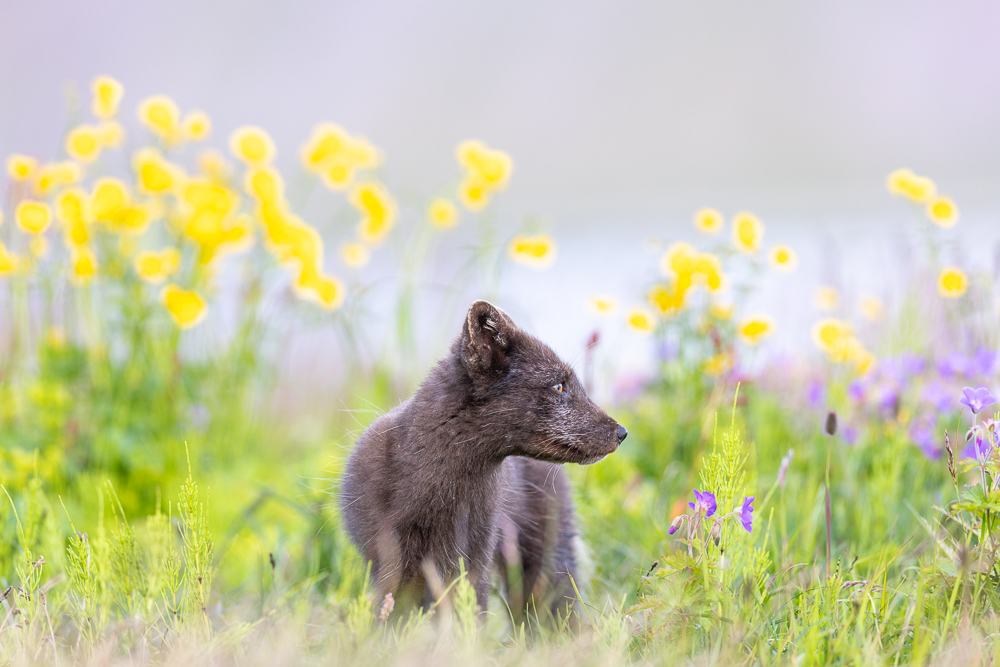
Over the course of the two workshops, we encountered a total of six different Arctic foxes, each with its own distinct personality and behaviour. The majority of them (five out of six) were blue morphs, which are much more common in coastal regions like Hornstrandir. Blue morph Arctic foxes retain a dark brown coat throughout winter, unlike their white morph counterparts that shift from brownish-grey in summer to pure white in winter. The contrast of the dark blue morph foxes against the snow-covered and rocky landscape provided excellent photographic opportunities. The sixth fox, a striking white morph, was a particular highlight—seeing a white fox in winter is always a special moment, as they blend seamlessly with their snowy surroundings. The opportunities for white-on-white minimalist photography are at their very best in winter with the White morph.
Among the foxes we observed was a dominant male, clearly in control of his territory. He was confident, bold, and regularly patrolled his area, occasionally chasing off younger or less dominant foxes. We also photographed several other males, females, and first-year cubs. The cubs, still relatively inexperienced, displayed playful and curious behaviour, which made for some fantastic interactions and storytelling images.
One of the most rewarding aspects of these workshops was the ability to spend extended time with individual foxes, allowing us to observe and document their behaviours in depth. Patience was key—by positioning ourselves carefully and waiting quietly, we were often rewarded with intimate moments of foxes resting, hunting, and interacting with each other.
Winter photography in Hornstrandir presents a unique set of challenges and rewards. The ever-changing conditions meant that we had to constantly adjust our approach. Some days were dominated by heavy cloud cover, creating soft, diffused light that was perfect for close-up portraits and details as well as wide vistas. Other times, brief windows of clear skies allowed us to work with directional light, emphasizing the texture of the foxes’ fur and the rugged landscape. We also took the opportunity to photograph some of the bird life in this area.
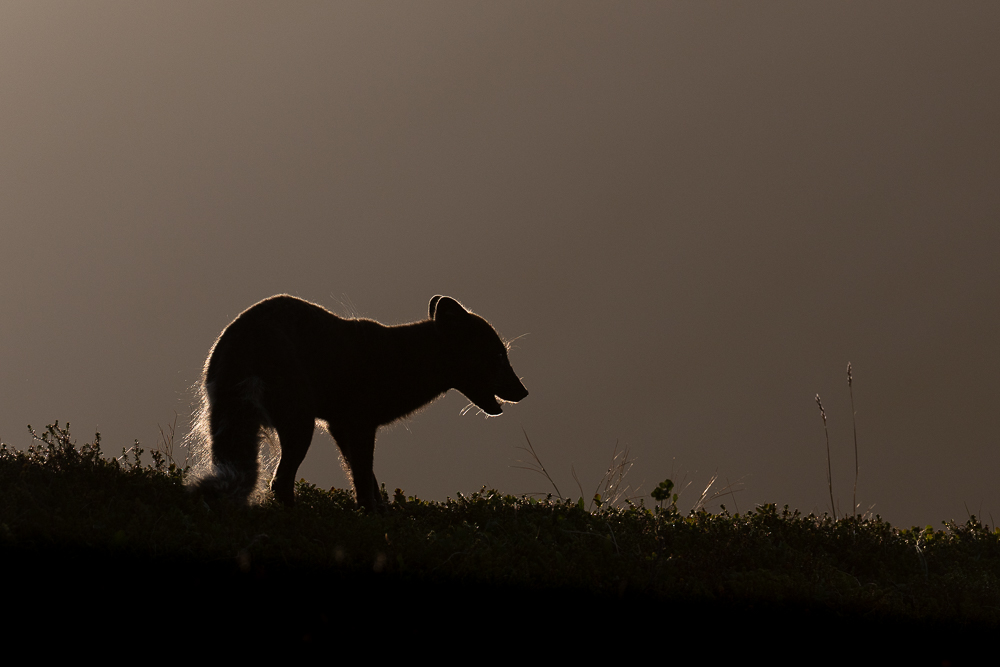
One particularly memorable session took place in the late afternoon as the low winter sun briefly broke through the clouds, casting a golden glow over the landscape. A blue morph Arctic fox paused on a rocky outcrop, bathed in the last light of the day, allowing us to capture a stunning series of backlit portraits. Moments like this are what make winter wildlife photography so rewarding—being in the right place at the right time, ready to seize an opportunity when the elements align.
The thawing snow added another dynamic element to the imagery. As the white landscape receded, patches of dark volcanic rock and golden-brown tundra began to emerge, creating a striking contrast with the foxes. This gave us a more varied and unique portfolio than a uniform blanket of snow might have allowed. Some images showcased the foxes navigating a pristine winter landscape, while others depicted them against a more transitional, raw, and textured background.
After the conclusion of the workshops, I traveled to a new, previously unexplored location in northwestern Iceland to scout for future Arctic fox photography opportunities. This region offers not only a dramatic coastal setting but also supports both blue morph and white morph Arctic foxes, making it a particularly exciting prospect for future trips.
The scouting trip was highly productive—I was able to locate multiple foxes and observe their behaviour in this environment. The landscape features towering cliffs, black sand beaches, and rugged fjords. The combination of these elements provides a striking backdrop for wildlife photography, adding another layer of visual interest to Arctic fox images.
I also took the time to assess the logistics of operating a workshop in this new location. Accessibility, accommodation options, and weather patterns all play a crucial role in determining the viability of a new workshop destination. From what I experienced, this area has tremendous potential, and I’m excited to return for more in-depth exploration.
Following the success of this year’s workshops, we will be returning to Iceland in February 2026 for another round of back-to-back Arctic fox photography expeditions. Hornstrandir remains one of the best locations in the Arctic for reliably finding and photographing these elusive animals, and with the addition of a new location in northwestern Iceland, we will have even more opportunities to create exceptional imagery.
Each workshop is limited to a maximum of five photographers, ensuring a highly personalized experience with ample one-on-one guidance. Whether you’re interested in capturing intimate portraits, dynamic action shots, or environmental compositions that showcase the foxes within their rugged habitat, these workshops are designed to maximize photographic opportunities in one of the most breathtaking winter landscapes on Earth.
If you’re interested in joining us for this incredible experience, feel free to reach out to register your interest. With small group sizes, spaces fill quickly, and this remains one of the most sought-after wildlife photography experiences in Iceland.
Photographing Arctic foxes in winter is both a challenge and a privilege. These animals are perfectly adapted to one of the harshest environments on the planet, and spending time with them in their natural habitat is an unforgettable experience. The combination of dramatic landscapes, rapidly changing weather, and the intimate encounters we had with the foxes made this year’s workshops a tremendous success. As always, adapting to the conditions was key. Iceland’s winter is unpredictable, and working with what nature provides—rather than against it—ensures the best photographic results. The freeze-thaw cycle, while sometimes frustrating, ultimately allowed us to create a diverse and compelling portfolio in just a short period.
With the addition of a new location for future expeditions, I’m looking forward to expanding the possibilities for Arctic fox photography in Iceland. These workshops remain a highlight of the year, and I can’t wait to return in February 2026 to once again immerse myself in this incredible environment. If Arctic fox photography in the wild is something you’ve dreamed of, now is the time to start planning. I hope to see you in Iceland next winter for another unforgettable experience!
Wildlife photography is one of the most challenging and rewarding genres of Nature photography. Creating powerful and emotive wildlife photographs demands a deep understanding of animal behaviour, patience, and the ability to adapt to unpredictable environments. But beyond all that, there is one factor that determines whether you capture the decisive moment or miss it completely—how well you know your camera.
Over the decades I have been working as a professional Nature photographer, I’ve had the privilege of photographing in some of the planet’s most remote and extreme environments, from the frozen landscapes of Antarctica to the rugged and unforgiving Arctic tundra of Svalbard and Greenland. In these places, conditions can be brutally harsh, wildlife is unpredictable, and opportunities are fleeting. In such environments, there is no time to fumble with settings or second-guess technical choices. Mastery of your camera is the foundation that allows you to focus on composition, storytelling, and, most importantly, the wildlife itself.
In this article, I’ll discuss why knowing your camera inside and out is critical in wildlife photography, the key settings and features you must master, and how this knowledge translates into better images in the field. Even if you don’t shoot wildlife, this article will help you become a better photographer. It may even save you from an expensive purchase and from the common misconception that a new camera is the vehicle to better photography. In point of fact, a new camera is often detrimental to your photography in the short term as you have to learn the new tool.
The Unforgiving Nature of Wildlife Photography – Seconds Make the Difference – Wildlife photography is about capturing fleeting, decisive moments. Whether it’s an Arctic fox pouncing on prey, a polar bear emerging from the ice and fog, or a sea eagle diving for fish, these moments are unpredictable and often last no more than a split second or two. If you’re not intimately familiar with your camera, you risk missing the shot altogether. In fact, unless you have complete technical mastery of your camera, including muscle memory for all of its controls, you will almost certainly miss it.
I’ve repeatedly seen photographers in the field hesitate because they needed to adjust their autofocus settings, change their exposure compensation or otherwise make a technical adjustment. By the time they’ve made the adjustment, the moment is gone and the photograph has been missed. Wildlife doesn’t wait for you to be ready—you must be ready at all times.
Harsh and Unpredictable Environments – In many of the locations I photograph, the environment itself is a formidable challenge. Freezing temperatures in the Arctic can drain batteries quickly, gloves make it difficult to adjust dials, and snow can easily confuse a camera’s metering system. In such conditions, knowing how to operate your camera by feel—without having to look at buttons or menus—is essential. Even if you take the harsh environment out of the equation knowing how to operate your camera intuitively with muscle memory will improve your photography; regardless of the environment.
When I’m photographing Arctic foxes in Iceland’s Hornstrandir Nature Reserve, for example, I might be kneeling or laying down in the snow with high winds and blowing ice, tracking a fast-moving subject. In such situations, I cannot afford to be distracted by my camera. Everything must be second nature. The second I have to look away or stop and think about what I am doing from a technical perspective is the moment I stop being an artist and start being a technician.
Essential Camera Skills Every Wildlife Photographer Must Master – Autofocus Mastery – Autofocus (AF) performance can make or break a wildlife image. Understanding how your camera’s AF system works—its various modes, tracking capabilities, and limitations—is critical.
For wildlife, I typically rely on continuous autofocus (AI Servo) and use a combination of single-point and zone AF modes depending on the subject. For fast-moving subjects, animal eye-tracking autofocus (available on newer mirrorless cameras) is a game-changer. However, not all cameras perform equally well in different settings, and understanding your camera’s strengths and weaknesses helps you choose the right settings in the moment. This can only come with experience.
When photographing Arctic foxes, I frequently switch between single-point AF for precise focus (when the fox is stationary or moving slowly) and zone AF for tracking eye and movement (when it’s running or otherwise active). Knowing when and how to make these adjustments without taking my eye off the viewfinder is a skill that comes with practice. Once you master this ability you can free your brain up to focus (pardon the pun) on composition.
Exposure Control in Extreme Conditions – Wildlife photography often involves high-contrast environments. In the Arctic, for example, bright snow can fool a camera’s metering system, leading to underexposed subjects. Conversely, dark fur on an Arctic fox or polar bear in shadowed ice can result in overexposure.
Mastering exposure compensation and understanding histograms is crucial. I always shoot in Manual mode, allowing me to control shutter speed and aperture with an appropriate ISO setting for the light. Since I shoot in Manual I don’t need to dial in exposure compensation to ensure my subject is properly exposed. I know from experience, that in a bright white snow environment I am going to have to overexpose approximately two stops to ensure my whites are white (and not grey) and that my histogram is is biased to the right (for optimal signal to noise). To accomplish this, I simply shoot a frame, check the histogram and make any required adjustments before the wildlife comes into play.
Shutter Speed and Motion – One of the most common mistakes I see in wildlife photography (after underexposure) is using an inadequate shutter speed. A slow shutter can result in motion blur, rendering an otherwise perfect moment unusable. Of course, there are times when we want to introduce motion blur into a photograph to convey a feeling of movement. Other times, we want to ensure a sharp subject. As a general rule: • Fast-moving subjects (birds in flight, running mammals): 1/1250s or faster • General wildlife (walking animals, standing birds): 1/500s • Slow or stationary subjects: 1/250s or lower, depending on focal length and speed of subject
Keep in mind the above are general guidelines only and you should choose an appropriate shutter speed to your subject. This is also where knowing your subject can greatly assist you.
One technique to try is using Auto ISO with a minimum shutter speed. This ensures you will maintain a sharp image while allowing flexibility in exposure settings. If you try this I recommend setting a ceiling for the ISO so that you control the final noise in your files.
Understanding Custom Buttons and Shortcuts – Modern cameras offer extensive customisation options. I encourage every wildlife photographer to set up their camera for quick access to critical settings. For example: • Back-button focus: Separates focusing from the shutter button for better control of auto focus and metering. • Custom buttons for AF mode switching: Quickly toggling between single-point and zone AF is essential. If you happen to also shoot a Canon EOS R1 then you can achieve this with just the one button on the back of the camera. • Custom mode settings: Saving different exposure settings (e.g., one for action, one for static subjects) allows rapid switching.
By configuring my camera to my workflow, I eliminate unnecessary adjustments and can react instantly in the field.
Translating Camera Knowledge into Better Wildlife Images – Confidence and Speed in the Field – When you know your camera inside and out, you develop the confidence to focus on composition and storytelling rather than technical details. You will free up your brain to become an artist in the field, instead of a technician.
For example, during my Arctic fox workshops, I often find myself tracking a fox as it moves across a snowy landscape. Because I don’t have to think about my settings, I can concentrate on anticipating the fox’s next move, positioning myself for the best angle, and ensuring a compelling background. I am also ready to capture the decisive moment if the fox does something unpredictable.
Better Use of Light and Composition – Technical mastery also allows for more creative freedom. Instead of struggling with settings, you can focus on utilising the best light, framing your subject effectively, and telling a more powerful visual story.
A well-executed image isn’t just about sharpness—it’s about emotion, behaviour, and the relationship between the subject and its environment. Knowing your camera allows you to capture these elements with precision. Remember, we are visual storytellers. We want to tell the story of the wildlife in the environment in which it lives. Keep this in the forefront of your thinking and I promise you your photography of wildlife will improve.
How to Improve Your Camera Mastery – Practice Before You Travel – Before heading into the field, spend time practicing with your camera in controlled conditions. Learn its menus, test autofocus performance, and memorize button placements so you can operate it without looking. Make sure you master the tool (the camera) so that you can take full advantage of all of its capabilities in the field without disengaging yourself from the subject in front of you.
Simulate Real-World Conditions – If you’re preparing for an Arctic or cold weather experience, practice shooting in the cold with gloves on. If you’ll be photographing birds in flight, visit a local park and test your tracking skills. The more you train in realistic conditions, the more prepared you’ll be. When I was teaching myself how to photograph birds in flight I would go down to my local beach on the weekend with my camera and photograph seagulls for practice.
Learn from Mistakes – Every missed shot is an opportunity to improve. Analyse your images to identify technical errors and refine your approach. Continuous learning is key to mastering wildlife photography. Remember to also learn about your subject. The more you know about the wildlife you are choosing to photograph the more you will be able to predict its behaviour and the more likely you are to capture decisive and powerful photographs that fully convey the emotion of being in the field.
Final Thoughts – In wildlife photography, knowing your camera is just as important as knowing your subject. The difference between a missed opportunity and a breathtaking image often comes down to how quickly and instinctively you can adjust your settings. Mastering your camera frees you to focus on the art of photography—the light, composition, and the incredible wildlife we are privileged to witness. So take the time to truly understand your gear, because when the moment comes, you won’t have time to think—you’ll need to react.
Tomorrow morning we are kicking off the second of our two back-to-back sold out workshops for the Arctic fox here in the far north west of Iceland. Iceland is never dull and you never know what the weather will do next with its wild freeze / thaw winter climate. Our first trip saw us start with a good cover of snow and end with a touch of Spring! With a little luck we will have some incredible conditions out in the Hornstrandir nature reserve over the coming week. Of course, we hope for lots of flying snow to capture incredible images of Nature’s greatest feat of engineering.
There are now just a few places remaining on next years 2026 workshop. If you have ever wanted to photograph Arctic Fox in winter then this is absolutely the workshop for you. We have a small group size, personal one-on-one tuition and private cabin for the duration of the trip. We pioneered this trip and have been successfully running workshops for Arctic Fox for more than ten years now to the remote north west of Iceland. What our clients say about this workshop:
“We just got home yesterday. I hope everyone had an easy journey! It was great being there and great having such a wonderful group of people. Josh, THANK YOU for all the hard work to make this trip a RESOUNDING SUCCESS (also thanks to the photo gods for great weather and our beautiful little melraaki). Thank you for your Post-processing help offer and the offer to print!!!! Will stay in touch Best to all”
“Hi Josh, you had a bunch of very kind and special people on this trip. Those stars have a tough time aligning, and your trip made that possible. Your arctic fox trip had way too many kind and special people. Not every tour leader can claim that. Looking forward to our next trip with you. You assemble and run the best tours!!!”
“Hi Josh!I just wanted to drop you a line, having taken a look at your selection of top images for 2024 – firstly, of course, they are all fantastic……but what really strikes me is that I have three almost identical ones – and that’s down to you. There is no doubt that you are taking us, your clients, to the absolute top spots, in the right conditions with the top in-field guides, then pushing to make the most of what we find. And on top of that, you are always up for last minutes in-field shooting questions and post-processing recommendations.Can’t thank you enough!”