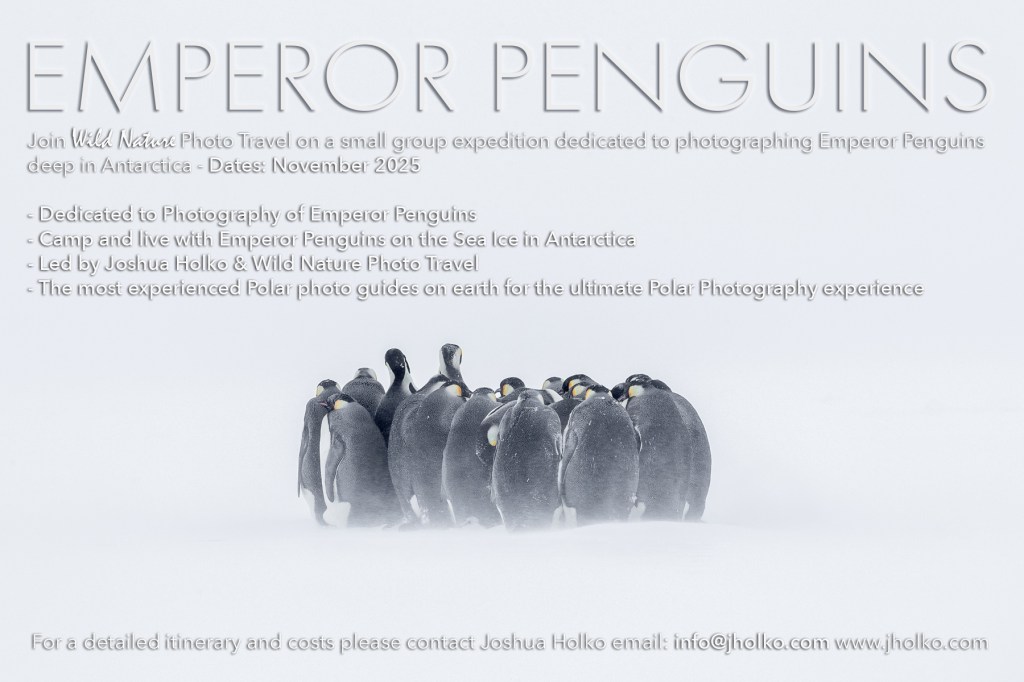
In late November / early December 2024, I ran my semi-annual wildlife expedition to the world’s most southerly Emperor Penguin colony at Gould Bay, deep in the Weddell Sea region of Antarctica. For this expedition, we flew from Punta Arenas at the bottom of Chile on a privately chartered Iceland Air 757 to the naturally occurring blue ice runway at Union Glacier in Antarctica. From this point, we overnighted at Union Glacier Basecamp before we took a 2nd smaller Basler aircraft another three hours out to the remote sea ice at Gould Bay, where we landed on the sea ice and established camp with the Emperor Penguins.
This year, for the trip report, I decided to utilise the video I recorded during each stage of the expedition to better illustrate the travel process to the Emperor Penguins and what it is like to camp, live with and photograph the emperor penguins. This year, we were fortunate to spend a full seven days (six nights) camped out at the colony. This provided us phenomenal opportunities and the chance to photograph in various weather conditions. Personally, my favourite day was heavily overcast with light snow. I have yet to encounter a full-on blizzard out at the colony, but I am hopeful for future years!
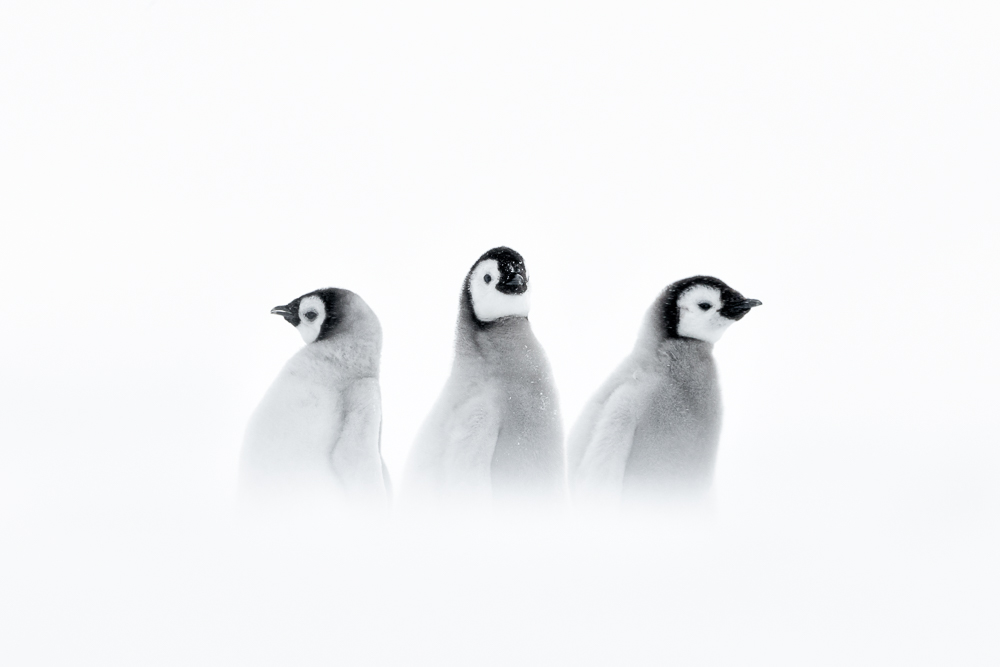
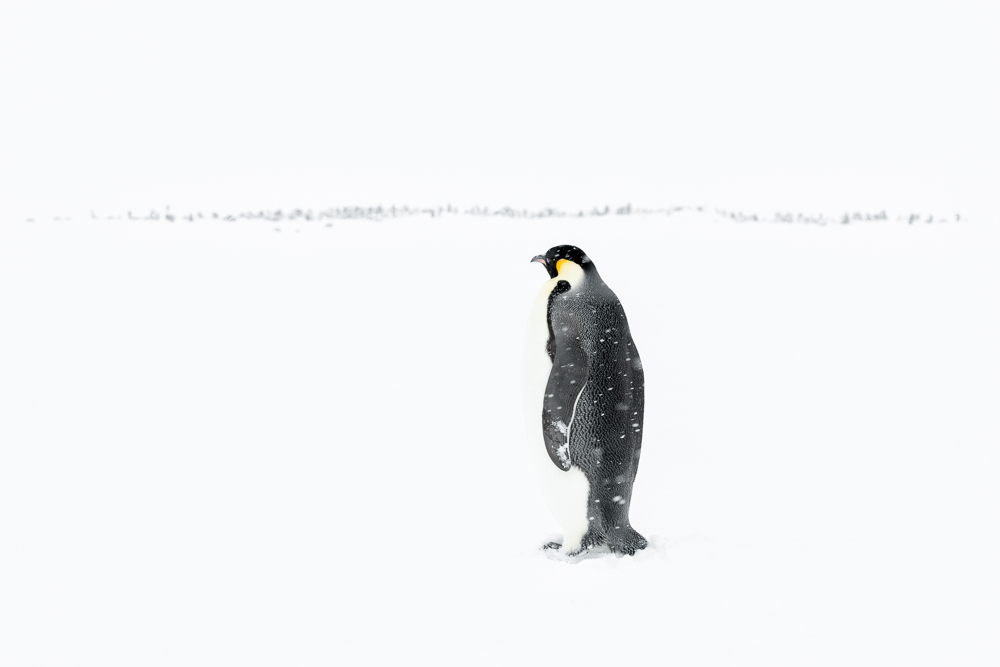
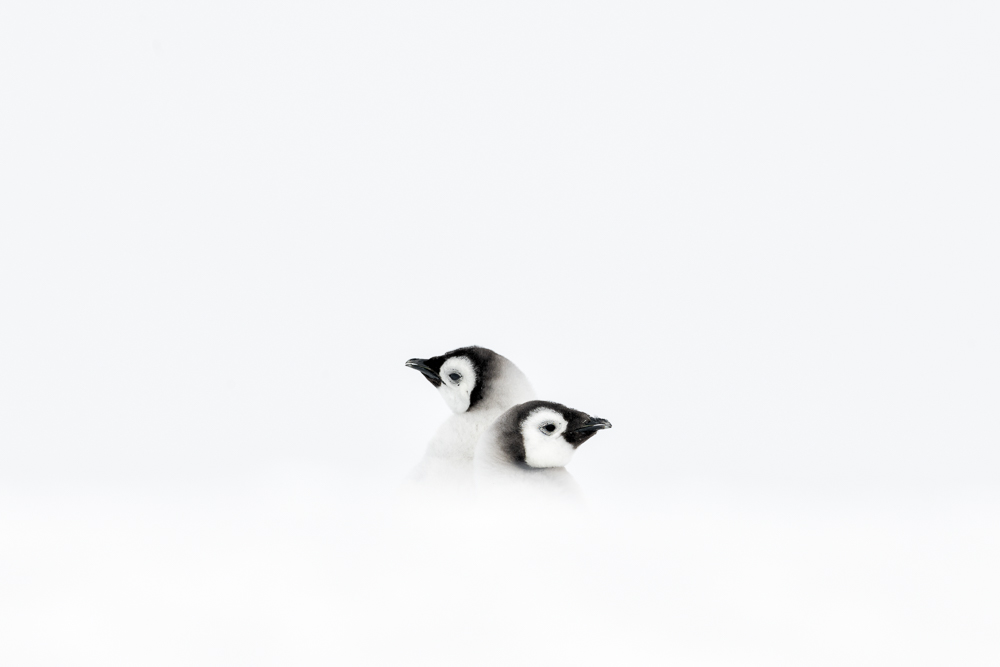
I am still working through the more than five thousand images I made during the course of the week spent out on the sea ice with the penguins, but I have included a few favourites already processed below from what I felt was our best few days – heavily overcast conditions and light snowfall.
The above montage footage was all shot with the new Canon EOS R1 at 4K 120 fps with the Canon RF 600mm F4L IS handheld. This was the first outing with the new Canon EOS R1, and I am blown away by both the ergonomics and performance of this camera. There is a purity and depth of colour to the 14-bit RAW files I have only seen before in much more expensive medium format cameras. The eye tracking focus (yes it can track the black eye of an Emperor Penguin against black feathers), the pre-capture, the build quality and overall performance all stack up to make this the best camera I have yet used. I will have more to say about this in a future podcast.
I will return to the world’s most southerly Emperor penguin colony in early November next year (2025) to lead another small group of photographers on this incredible expedition. If you have ever wanted to photograph the world’s largest and most elegant, photogenic penguin, this is the expedition for you. Limited places are still available on this extraordinary expedition. Please contact me for more details.
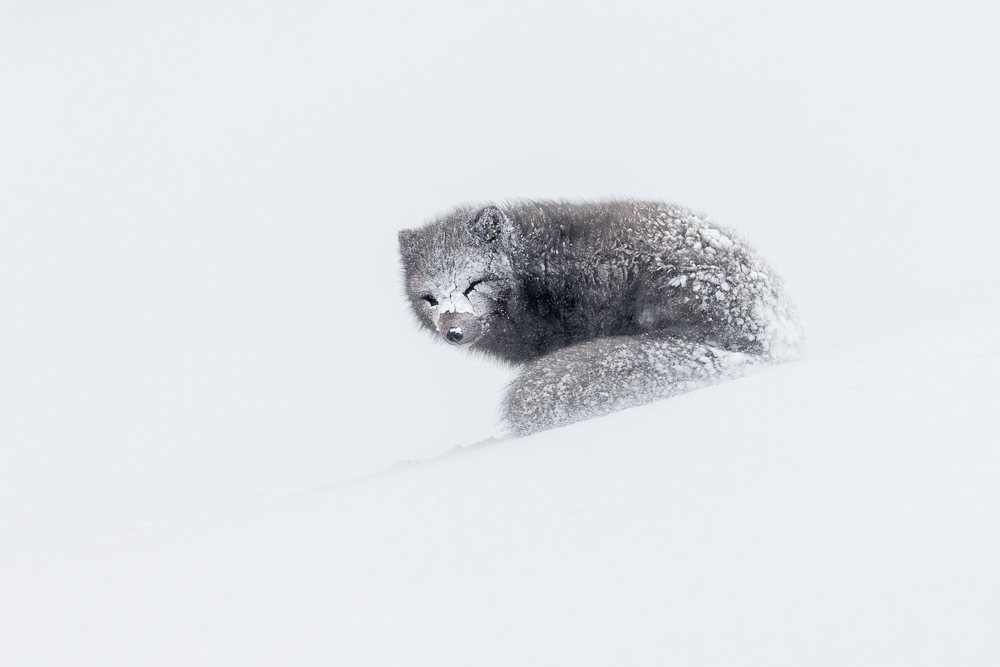
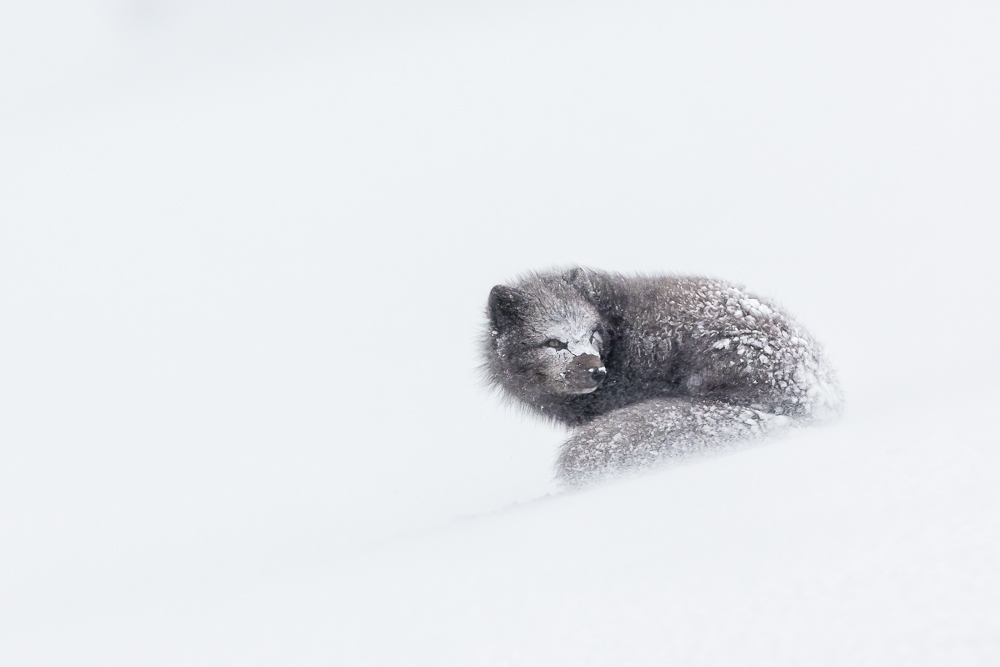
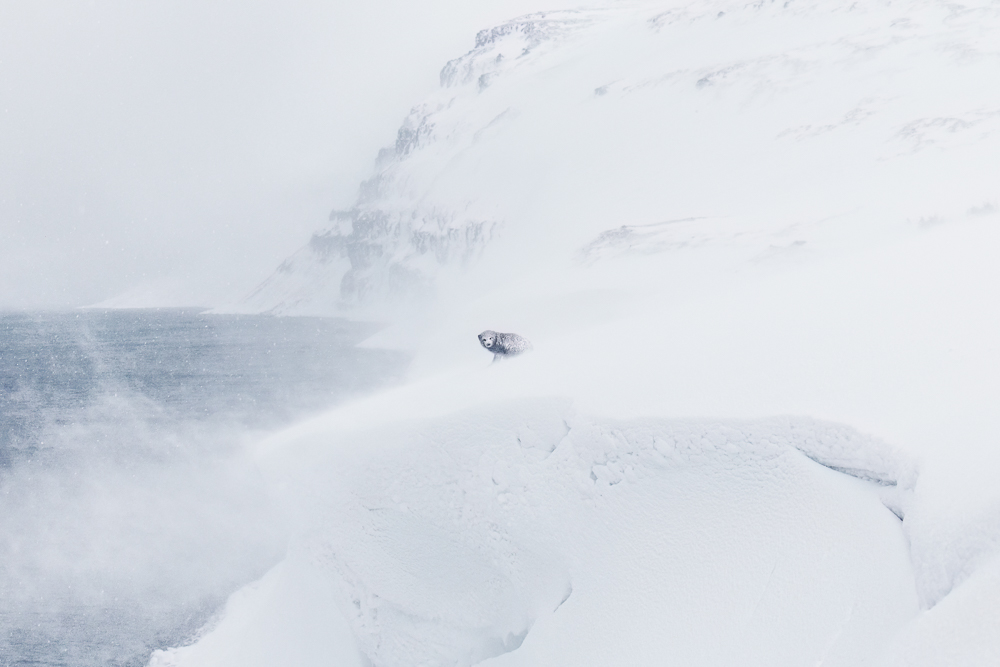
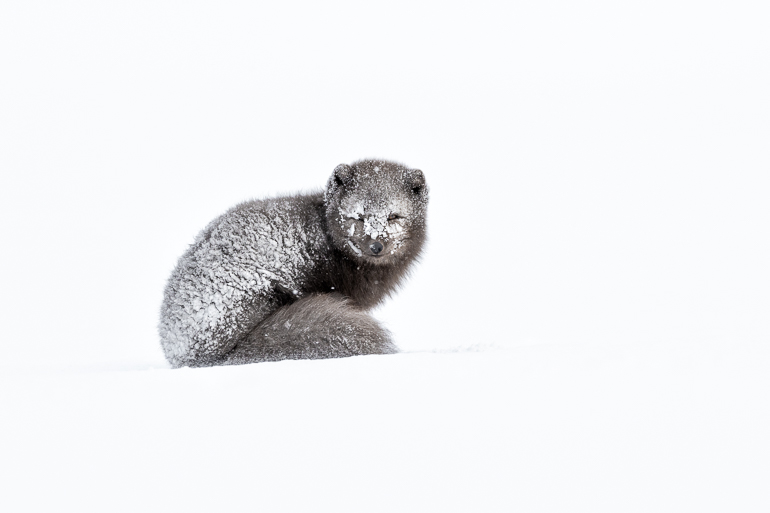
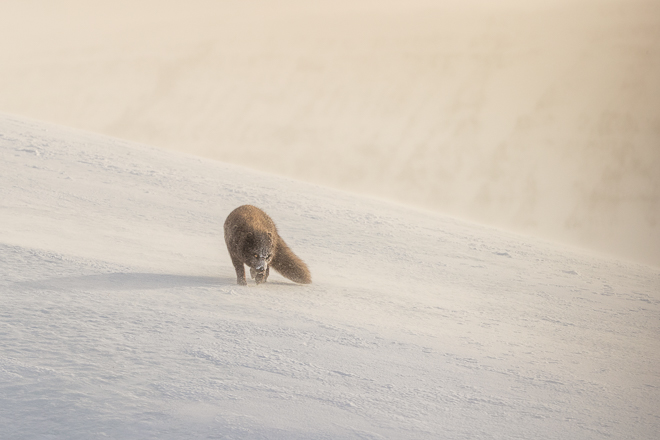
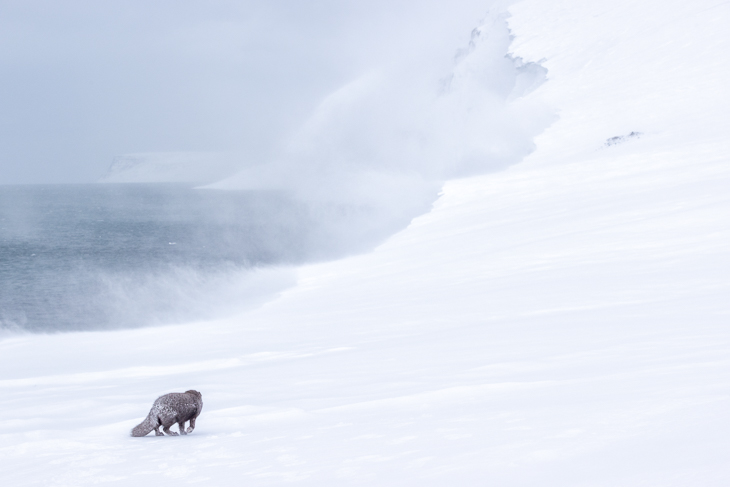
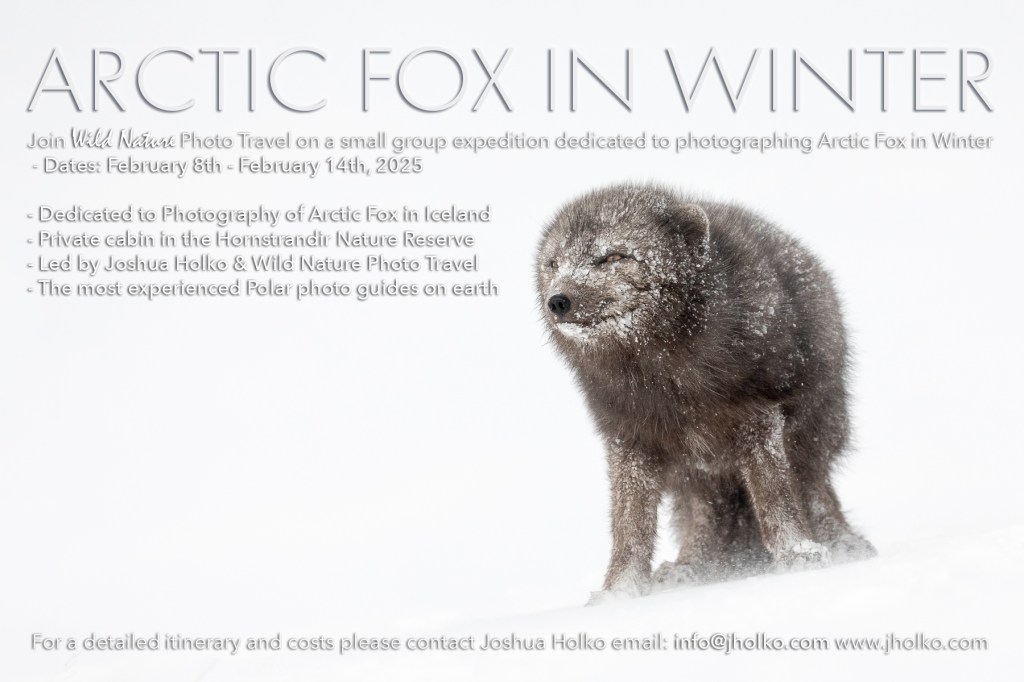
Without a doubt, my favourite conditions for photographing the Arctic Fox are winter blizzard conditions. The flying snow creates a white-out that cleans up any background mess, and the flying snow sticks to the fox’s coat and gives extraordinary context and much-needed drama. These conditions define the environment of the Arctic fox and paint the perfect canvas on which to photograph this amazing opportunist. Contrary to appearances, these conditions are far easier to photograph in than they appear. With modern auto focus in mirrorless equipment, the cameras have no problem finding and tracking the eye of the Arctic Fox in these conditions. In past years, I would often stop down the lens to ensure adequate depth of field if focus missed slightly. Now, with eye-auto focus, I can open up the lens and shoot wide open, as in this case – f4 at 600mm. Why shoot wide open? A wide-open aperture helps soften the surrounding snow’s slope, creating a contained picture inside the 35mm frame. This technique can be used to great effect to help keep the viewers eye both inside the frame and on subject.
In September of 2021, I wrote a rather lengthy blog post HERE on the problems of flying with camera equipment. Given this post was now more than four years ago, it is time to do an update and see what, if anything, has changed. Much of this post is a re-hash, but its just as releveant today as it was four years ago when I first penned it. Before I dive into the details, it is worth examining the problem and the available solutions for flying with camera gear. I have been flying with camera gear internationally for decades, and over the years, I have learned a few things about what works and what doesn’t. Some history is needed to put all of this in context, and as such, this will be a bit of a long post, so bear with me as there is a lot to cover and discuss. If you have struggled with international travel and camera gear, then I hope this will be of interest to you.
Anyone who travels internationally (or domestically) with camera gear knows that one of the big problems is packing all your equipment safely for travel and being ready to go when you reach your destination. It is a thorny problem, and there has never been a great solution. There are countless YouTube videos on this issue. To date, none of them, to my mind, solve the problem in an elegant fashion that provides the user with an optimal travel and destination solution. The problem is you must compromise on the airport travel segment or the destination – it is almost impossible to pack for both in one bag.
Camera Backpacks: The problem with backpacks as a travel solution is they are heavy when laden with camera gear, and schlepping them through airports becomes a real chore. Especially when you are running late and have to run to the gate. If you fly once a year, this might not be too much of an issue for you, but if you are a regular traveller and travel with long lenses, you will already appreciate that backpacks are not ideal for navigating airports. Anything large enough to accommodate all the equipment is usually too big for carry-on (and too heavy). I long ago abandoned backpacks as a method for transporting camera gear through airports. They might be fine if you carry a small, lightweight mirrorless system with a few wide-angle lenses, but they are a real pain with bigger cameras and large telephoto lenses. They are also a real annoyance whenever you need to use a bathroom (there is never anywhere to put them off the floor) or go through security. In hot airports, they become uncomfortable on the long walk to the gate. I love backpacks on location, as they are undoubtedly the best way to move equipment around in the field, but not for destination transiting.
I own around half a dozen camera backpacks that include the original Gura Gear Kiboko and several different models of the Gura Gear Bataflae. I also own a few different-sized F-stop camera backpacks, a Lowe Pro Trekker for my 600mm, and two different Mr. Jan Gear backpacks. Each serves a different need and purpose; depending on where I am travelling and what I need to take with me, I vary the bag I carry. For safari-style workshops, where you need something with easy access that you can store on the seat of the game vehicle, the Mr. Jan Gear or Gura Gear bags are hands down the best thing since sliced bread. Their design means you can easily accommodate a lot of equipment on the seat of the safari vehicle next to you, and you don’t even lose any space because of their genius side-opening flaps. The bags are super light (made of super-strong lightweight sailcloth), and there isn’t much to dislike outside of the price tag. They are the best thing on the market for their intended purpose.
For hiking, the inbuilt frame of the F-Stop backpacks makes them the ideal choice. They are comfortable for extended periods of walking or hiking and have the best harness system I have yet tried in a dedicated camera backpack. They also have an innovative access system that allows you to access all of your gear without diving into the top of the bag and pulling everything out to get to something at the bottom. There are numerous sizes to choose from and several different brands on the market; ultimately, all do the same thing in one form or another. Again, there isn’t much to dislike outside of their ridiculous price. Speaking of which, why is it that the moment a bag is labelled a camera bag, its price seems to triple? Some of F-Stops backpacks are now closing in on $1,000 USD. That is just ludicrous for a backpack in my opinion.
The other problem with all backpacks is that they are soft, and cameras and lenses can be easily damaged inside them as you move around airports and planes. If you have ever watched someone shoehorn their carry-on suitcase into the overhead and crush your camera bag, then you know exactly what I mean. I’ve watched airline staff stuff so much into an overhead that everything gets crushed. I am always acutely aware of and always try to pack the overhead in such a way as to protect my bag. It is one of those travel stresses I could do without. Soft backpacks are fine on location when you need to move around, but they are sub-optimal at best in airports.
RollerBags: Roller bags are probably the best way to transport camera gear through airports and have been my go-to solution for many years. With wheels and the ability to roll, the bag’s weight becomes far less of a concern. The problem with roller bags is that they are typically quite heavy, even when empty, and of course, they are not very practical when you are on location and ready to shoot. My solution has always been to pack a backpack as part of my checked luggage and then re-pack the gear from the roller into the backpack at the other end. It’s not an elegant solution, as it almost always requires two checked bags (one to accommodate the camera backpack). If you are willing to travel with two checked bags, it’s a reasonable solution, and it has served me well for many years. Although I admit I am tired of manhandling two large checked duffel bags through international airports. So much so that I went looking for a new solution. I will come to this shortly.
I own half a dozen roller bags and have a love/hate relationship with them. Probably the best one is the Lightroom F-Stop Roller (sadly discontinued for many years now). It combines a hard/soft roller with a hard bottom and sides and a soft top. It has a place for a laptop, and it holds a ton of gear for its size. It is also the lightest roller for its size by a good margin. Sadly, it has been discontinued for many years, and no replacement exists. My Lightroom Roller has been around the world more times than I can count, and it is close to being on its last legs (honestly, it’s kaput). The bearings in one of the wheels are finished, and the handle is starting to come apart. It has served me well, and has been put out to pasture and retired. In my opinion, F-Stop messed up when they discontinued this bag. I know several people who own them who, like me, lament this bag being no longer available.
I also own several other roller bags, including the expensive and somewhat flawed Think Tank Airport V.3. This is, quite honestly, the purchase I regret the most. For a soft-sided roller, this bag is heavy (around 5kg), even when empty, and takes a paltry amount of equipment because of its flawed interior design. Within ten minutes of trying to pack this bag, I recognized that I had made an error in judgment with its purchase. The only trip it ever did with me was on its way home from the New York photo expo, and I cursed it the entire way home. Since then, I have moved it on, and it no longer takes up space in my cupboard. While its features sound good on paper, they do not translate well for travel. I wish Think Tank had consulted with photographers who travel extensively before they designed this bag.
The other problem with roller bags is that most of them are soft, and the equipment inside is subject to damage, just like if inside a backpack. The hard-sided roller bags on the market go some way to alleviating this problem but usually do so at the expense of added weight. Most hard-sided rollers are also traditionally made of cheap plastics that tend to crack and split very quickly. I have tried several non-photography hard-sided rollers, and they never last more than 12 months before they either crack, split or otherwise fall apart. The F-stop Lightroom roller was a hybrid bag with a tough hard bottom and sides that worked well. It doesn’t offer the same level of protection as a Pelican, but it was a reasonable compromise. To date, I have not heard of a dedicated camera roller bag that has hard sides all around outside of those like Pelican and SKB. And those fall into a very different category of camera bag.
Pelican Cases: Pelican cases are the safest way to travel with your camera gear (provided you can carry it onto the plane). They are indestructible, waterproof, and can be configured in various ways. The problem with Pelican cases is that if you check them (and your gear), you are challenging the baggage handlers to do their utmost (and they will try) to destroy it. Baggage handlers seem to believe that Pelican cases are designed to be thrown and mishandled because the contents are well protected. While they are unlikely to do anything but cosmetic damage to the outside, they will cause a lot of shock to the internal cameras and lenses. Lenses with Image Stabilisation, such as big telephoto lenses, are particularly susceptible to shock damage because of their floating elements, and as such, I would never recommend checking a Pelican full of big lenses. Checking the case also opens you up to the possibility of lost luggage and theft.
Pelican makes a light carry-on version called the Pelican AIR 1535, which is a roller that can hold quite a bit of equipment with its TrekPack system. However, it still leaves the problem of needing to re-pack at the destination if shooting out of a Pelican isn’t possible for your trip. Shooting out of a Pelican case might be fine for a studio photographer, but if you are working out in the landscape or from a ship, it is not usually ideal. The other problem with the Pelican AIR1535 is that it is more than a fraction too small inside for a 600mm f4L IS Lens because of the design of the interior lid foam. Even with their TrekPack system, it’s a very tight fit (uncomfortably so, in my view). The problem is the foam inside the lid costs you roughly an inch of height and has to be severely compressed to accommodate a 600mm lens. When I test-packed this case, I realised I was just too uncomfortable with how much of a squeeze it was to accommodate the 600mm lens, and I returned it. It is an exceptionally well-designed case, is light for what it is, and, had it been half an inch more accommodating in-depth, would probably be my current solution.
My Ongoing Solution: Some four years ago, I became aware that Think Tank (makers of the awful Airport V.3 roller) had partnered with an American company called SKB Cases to try and solve the problem of flying with camera gear both in the airport and on location. Their answer is the i-Series of cases (yes, they really should have come up with a more imaginative name). If, like me, you have never heard of SKB, then you are not alone. Long story short, they make hard, tough cases just like Pelican and like Pelican, SKB is also manufactured in the United States. The net result of this partnership between Think Tank and SKB is a pretty cool solution that goes some way to solving the airport and field dilemma.
In brief, SKB has manufactured a tough pelican-style roller case that meets airline carry-on restrictions in conjunction with Think Tank and provides a dedicated insert that can be lifted out and used as a backpack or carry bag on location. When you order the case, you stipulate how you want the interior configured – either as a backpack, a carry case, or a case with a lid organizer. The genius of this design is that you don’t need another backpack or bag at the other end (unless you are going to be hiking). Once you arrive at your destination, you open the case, lift out the insert, and away you go—simple, elegant, and relatively efficient.
I was somewhat dubious at first, but after a little online research, a couple of coffees, and some YouTube reviews, it became apparent that SKB’s cases are at least as good as Pelican and, in some ways, appear more carefully thought out and better engineered. Having directly compared the SKB to the Pelican Air 1535 I would say they are more alike than different. I would give a slight edge to the SKB for its improved clasps and to the Pelican for its stronger handles (more on this below). Given my experience with the Think Tank Airport V3, I was somewhat dubious, so I carefully measured my gear against the quoted internal dimensions and found it would all fit. So, I took a punt and ordered the Roller Case and carry insert option. I was going to make a short video on this, but Think Tank and SKB have done a decent enough job of it for you to get the idea.
I opted for the carry insert option and not the backpack or lid organizer option, as the carry bag offers just a bit more depth, which is required to house a 600mm f4 lens securely. If you don’t own a 600mm lens, you could use the backpack option. The SKB 3i-2011-7DZ (who comes up with these model numbers!) is an airline carry-on approved size, watertight and dustproof rolling hard case with a removable zippered divider interior designed by Think Tank.
Although the SKB roller is more or less identical to Pelican’s AIR1535 it has more internal depth because it does away with the thick foam in the lid. Instead, the top section is padded by the insert’s soft lid. If you are familiar with the F-Stops ICU system, this is a very similar approach. It works better than Pelicans TrekPack system as you gain nearly an inch in height. Although the TrekPack system is modular, it is a bit like pluck foam in that once you set it up, you are more or less stuck with the same configuration. I prefer velcro-style foam dividers, which can easily be reconfigured to suit changing gear.
It is essential to be clear that the SKB/Think Tank solution isn’t perfect. For starters, it doesn’t provide sufficient room to leave a camera mounted to the 600mm lens once on location. If you need to be able to leave a camera mounted to the 600mm lens, you have no option but to gate-check another backpack (like a Lowe Pro Trekker). 600mm lenses provide unique travel challenges that are hard to overcome, and one has to make compromises. Additionally, because of the hard and rigid sides, there is no room for ‘bulge’ and as such, the bag doesn’t hold quite as much as an F-Stop Lightroom Roller. But these things are a compromise and something has to give. In the end, I think it’s better to trade a little space for the security of a rigid Pelican-style case.
Another alternative I experimented with is ditching the internal dividers inside the lift-out carry bag and opting instead for cameras and lenses in camera and lens pouches. This option provides a lot more space than the internal soft carry case and dividers but requires a bit more care when packing. Of course, it adds cost as well as its necessary to purchase soft camera and lens cases from the likes of Lens Coat. It also kind of removes some of the elegance of the lift out solution. Swings and roundabouts…. After some experimentation, I ditched this solution as I was never comfortable with all the loose items in the case – despite them being in pouches.
One aspect of the SKB/Think Tank solution I like is the ability to quickly remove the padded insert from the case when it’s full of equipment. Suppose you are ever challenged at the airport to check the case because it has wheels or because the airline staff member dislikes you. In this situation, you can quickly lift out the padded insert, sling it over your shoulder with the included strap, check the empty hard case, and walk onto the plane with all your equipment. You can do this with F-stop backpacks as well, but it’s a bit more fiddly to get the internal insert out, in my experience, when it’s packed with gear.
This solution appears, on the surface, quite suitable for airport travel, as it offers a hard shell roller case that maximises the protection of the camera gear and lenses. It then provides a backpack or carry case once on location. How does it work in practice?
So Whats the Verdict? After more than four years of travelling through airports and well over two hundred international flights, I can tell you that the SKB solution works (for me). It is not perfect, and I have had several broken carry handles and have had to replace the rolling wheels – the latter being my fault for repeatedly dragging the case over rocky, uneven ground it was simply not designed to cope with. The broken handles are the result of a design flaw (although SKB claim I have overloaded the case?), whereby the plastic pin that holds the handle in place is inadequate once the case is fully loaded (it should be machined aluminium). Credit to SKB though for excellent customer service as they replaced the pins for me twice free of charge. They also replaced the wheels free or charge.
The SKB case has sucessfully protected all of my equipment over the last four years without incident. I can get 2 Canon EOS R3 bodies (or Canon EOS R1’s), a 600mm F4, a 14-35mm f4, a 70-200mm f2.5, a 24-105mm f4 and a couple of spare batteries in the case – thats plenty for most photography trips. It remains an easy way to navigate through airports and I still love the ability to remove the insert and sling it over my shoulder if I need to or am challenged by a grumpy airport official. In the field, I can take the insert out and put it into either a dry bag or repack the gear into a seperate backpack. Its not a perfect solution, but its as close as I have yet encountered for airport and field travel. If I plan to repack into a backpack then my preference is the Mr. Jan Gear Boris – it swallows a tone of gear and works well in the field.
Why not just use the Pelican 1535 Air? I would actually prefer to use the Pelican version if possible as its significantly lighter than the SKB case when both are empty. However, the Pelican 1535 is not as large internally and despite my best efforts will not swallow the same amount of equipment as the SKB. The loss in internal dimensions in the 1535 is significant and if you shoot large pro bodies (EOS R3 and EOS R1’s or Nikon Z9’s) like I do, you may well find they dont fit properly. I do like the TrekPak system offered by Pelican and if you shoot a smaller system from someone like Sony (or perhaps Canon EOS R5 cameras) you may find the 1535 Pelican sufficient for your needs.
Full Disclosure: I am not affiliated with Think Tank, SKB, Pelican or F-Stop camera bags. I used my hard-earned cash to purchase the SKB / Think tank solution and all the F-Stop camera bags. I have been and remain an unpaid ambassador for Mr. Jan Gear and Gura Gear camera bags and have several bags I have been supplied by them for review over the years. I paid for the original Kiboko and original Mr. Jan Gear Boris with my own money. I am actually not interested in free camera bags and have turned down several offers to be an ambassador for different brands in recent years.
The Arctic fox, with its thick fur coat and keen survival instincts, is one of the most iconic animals of the polar regions. For photographers, it represents a unique challenge and an unparalleled reward. Over the years, I have spent countless hours tracking and photographing this elusive creature in northwestern Iceland. Photographing the Arctic fox’s beauty has been my mission, but also the stark and fragile environment it inhabits. Some years ago I did a book on the Arctic Fox that covered my time spent photographing these animals in Winter. I will soon be starting work on a subsequent book on this incredible feat of Nature’s engineering. In the meantime, I wanted to share some of my thoughts and ethos on photographing these animals as the Arctic Fox remains one of the least understand and most persecuted Arctic mammals.
The Arctic fox is a true survivor of the extreme cold and desolate landscapes of the Arctic. Known for its striking seasonal changes—white (or brown) in the winter and blue/grey or grey in the summer—it blends into its environment, making it both a challenging and fascinating subject for photography. For me, the appeal of the Arctic fox lies not only in its visual charm but in its adaptability and resilience. Photographing Arctic foxes is about more than just snapping a picture of a rare Arctic animal—it’s about telling the story of an incredible species that thrive in some of the harshest conditions on Earth. Their playful, inquisitive nature, juxtaposed against the severe landscapes of ice and snow, creates opportunities for compelling visual storytelling.
One of the most significant challenges of Arctic fox photography is their elusive and cautious behaviour. These animals are small and nimble, often disappearing into the vast white landscape before a photographer can even reach for their camera. They are exceptionally fast, and their natural camouflage, especially in winter when their fur blends perfectly with the snow, makes spotting them difficult even in open tundra landscapes.
The importance of patience when photographing Arctic foxes cannot be underestimated. The best photographs are rarely the result of luck—they are the product of careful observation, waiting, and understanding of the animal’s behaviour. This means spending long hours in freezing temperatures, often in complete silence, waiting for the right moment when the fox reveals itself in the right light and setting. Patience is, after all, a key requirement in wildlife photography.
Despite the challenges, the experience is most definitely part of the adventure. “It’s not about rushing to get the shot,” instead, “it’s about immersing yourself in the environment and allowing nature to unfold in front of you.” Like many of the region’s inhabitants, the Arctic fox demands a photographer’s respect and humility.
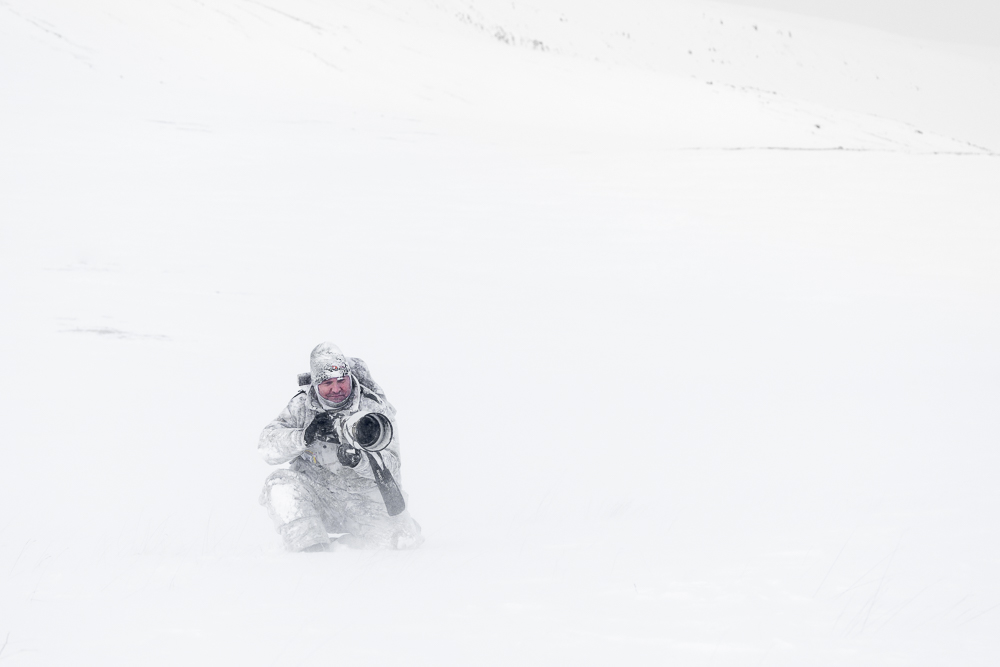
The Arctic fox’s home is a land of extreme cold in Winter, and being prepared is paramount. Inferior camera gear can struggle in freezing conditions, so I recommend using weather-sealed cameras and lenses, along with a solid tripod, to prevent camera shake in high winds or on uneven terrain like ice and snow. Batteries drain quickly in the cold, so he always carries spares, keeping them warm in inner pockets.
Another important consideration for Arctic fox photography is clothing. Always dress in layers, making sure to keep your core warm while ensuring you can remain mobile. Staying warm and comfortable is crucial because wildlife photography, especially in the Arctic, often involves long periods of stillness while waiting for the perfect shot. It is a good idea to avoid overburdening yourself with too much gear. “Stay nimble,”. The Arctic fox is quick and often unpredictable, so a heavy gear load can slow you down. Typically, I will use long telephoto lenses for wildlife photography, such as 400mm or 600mm, allowing me to capture the fox from a respectful distance without disturbing its natural behaviour. I also have a preference for the look of wildlife images with telephoto compression.
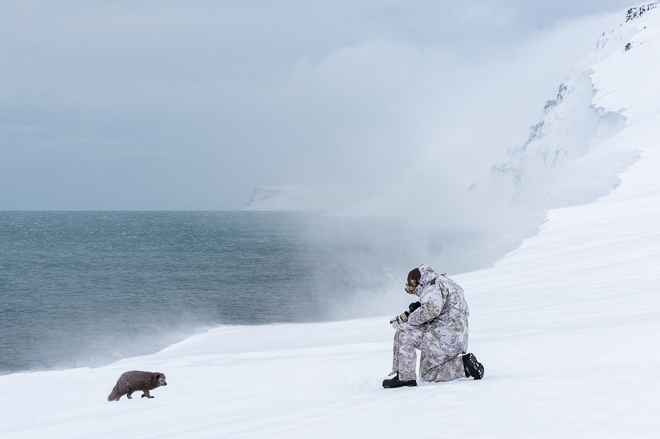
Success in Arctic fox photography stems from an understanding of the animal’s behaviour and habitat. Arctic foxes are scavengers, often following polar bears and other predators searching for leftover food. Anticipating their movements increases the chances of an encounter. The best moments to photograph Arctic foxes often happen when they are unaware of human presence. We need to avoid making loud noises or sudden movements that could scare the fox away. Instead, we observe from a distance, allowing the fox to go about its activities naturally. Whether it’s searching for food, playing with its mate, or navigating the snowy landscape, these moments are intimate glimpses into the life of this extraordinary animal. We are also mindful of the light and the environment in which we photograph Arctic foxes. The Arctic’s soft, diffused light—especially during the golden hours at sunrise and sunset—casts a magical glow over the landscape, enhancing the fox’s natural beauty. I prefer these times of day for their softer contrasts and ethereal feel, which help convey the serenity and isolation of the Arctic wilderness.
Photography is about more than just technical precision. It’s about capturing emotion and telling a story. In Arctic fox photography, this often means finding ways to highlight the animal’s fragility and resilience in an unforgiving environment. I love images portraying the fox as a solitary figure amidst vast, barren landscapes, reinforcing the isolation that defines much of the Arctic. By placing the fox in wide, empty frames, I can underscore its challenges as a small predator in a vast wilderness, subtly commenting on the environmental threats posed by climate change.
In some photographs, it’s possible to show the Arctic fox’s lighter side, offering a sense of hope and vitality even in such a stark environment. These contrasting moods—loneliness and playfulness, vulnerability and strength—are key elements in an effective storytelling approach to wildlife photography.
Photography in the Arctic is not just about creating stunning images; it’s also about raising awareness of the threats facing this fragile ecosystem. The Arctic fox, while adaptable, is increasingly vulnerable to climate change. As temperatures rise and sea ice retreats, their hunting grounds are shifting, and competition with other predators, like the red fox, is intensifying. It is my hope to inspire others to not only appreciate the beauty of the Arctic but also to take action to protect it. Our photographs serve as a powerful reminder of what’s at stake, offering a window into a world that is rapidly changing.
My own approach to Arctic fox photography, I believe, is defined by patience, preparation, and a deep respect for the natural world. My images capture the Arctic fox in its element, offering a rare glimpse into the life of one of the Arctic’s most enchanting creatures. Through the lens, the Arctic fox becomes more than just a subject; it becomes a symbol of the Arctic’s resilience and vulnerability, inviting viewers to connect with both the animal and its environment in profound ways.
For those inspired by my work, the challenge of photographing the Arctic fox is an invitation to step into one of the most extreme and beautiful landscapes on Earth, where patience and persistence are rewarded with images that evoke the timeless spirit of the frozen North.
In late September 2024, I ran a short 4-day photography workshop on the Snaefellsnes Peninsula on Iceland’s stunning southwest coast. This workshop was designed as an optional extension for participants from our Greenland East Coast Scoresby Sund Expedition (Read the Trip Report). It offered a more relaxed, leisurely pace, providing time to immerse ourselves in the unique geological beauty of the basalt coastline.
The Snaefellsnes Peninsula is often referred to as “Iceland in miniature” because it encapsulates many of the country’s varied landscapes—volcanic craters, jagged coastlines, waterfalls, and black sand beaches—all within a compact area. For photographers, it’s a treasure trove of textures, shapes, and dramatic contrasts, making it an ideal location for capturing grand vistas and intricate details. During our time on the peninsula, we visited several iconic coastal locations, including Arnastapi, Gatklettur, and Malarif, each offering something different for the keen photographer.
One of the key philosophies I encourage in these workshops is the importance of exploration by foot. The Snaefellsnes coastline is rugged and dramatic, with intricate basalt formations that beg to be photographed from multiple angles. Rather than just stopping at viewpoints or busy tourist spots, we took the time to walk along the shoreline with cameras ready, searching for compositions that capture the essence of the place. The basalt formations in this region offer endless opportunities for wide-angle photography and more intimate detail work. The sharp geometric lines of the basalt columns contrast beautifully with the often turbulent seas, creating the perfect scene for long-exposure photography. At the same time, the interplay of water against rock creates opportunities for capturing more abstract and fine art compositions.
• Arnastapi: Known for its dramatic cliffs and the famous basalt rock arch, Gatklettur, this location provided breathtaking seascapes and fascinating rock formations. It’s a photographer’s playground, with each step revealing new textures and compositions.
• Gatklettur: The natural arch is a centrepiece for any visit to this region, and we spent time here exploring the surrounding coastline, capturing the sweeping views and focusing on the arch as the subject in long exposures.
• Malarif: Located near the iconic lighthouse of the same name, Malarif offers expansive views of the coastline and was one of the highlights of our explorations. Here, the waves crashing against the basalt cliffs created perfect conditions for dynamic coastal photography.
We parked at various locations around the peninsula and then explored the surrounding areas on foot, both early in the morning and late in the afternoon. We photographed during the “golden hour” and stayed on location well into the sunset, capturing the changing light as it played off the landscape.
Iceland’s weather is notoriously unpredictable, and the initial forecast for the workshop was not promising—heavy rain and overcast skies were expected. However, the Icelandic gods smiled upon us, and we were instead treated to several days of ideal photographic conditions. Overcast skies created soft, diffused lighting, perfect for landscape photography. This gentle light minimized harsh contrasts and allowed us to capture the fine details in the basalt rock and surrounding landscapes.
One of the unexpected highlights of the trip was our visit to the Hraunfossar waterfalls, a series of waterfalls that cascade out of a lava field into the Hvítá River. To our delight, we arrived just as the autumn colours were at their peak. The contrast between the vibrant reds, oranges, and yellows of the foliage against the cool blues of the water and the dark lava rock was spectacular, creating scenes that were a photographer’s dream.
The Hraunfossar waterfalls are easily accessible by a nearby walking path, which allowed us to explore different vantage points and compositions without rushing. This location was a wonderful opportunity to slow down and appreciate the subtle beauty of the Icelandic landscape in autumn.
As our four days ended, we returned to Keflavik, where we concluded the workshop with outbound flights. It was a short but highly productive trip, filled with the moments that make Iceland a true haven for photographers. Each day offered something unique and memorable, from the striking basalt coastline to the vibrant fall colours. This workshop was about capturing beautiful images and fostering a deeper connection with the landscape. Walking the coastline, breathing in the crisp autumn air, and experiencing Iceland’s natural wonders up close was as rewarding as the photographs we took home.
For those looking to explore Iceland in the future, the Snaefellsnes Peninsula offers an unparalleled combination of beauty, variety, and solitude, even in well-known spots. With the right approach—tripod and camera in hand, ready to explore—you’ll find endless opportunities to create photographs that tell the story of this incredible part of the world. We will likely be offering a further Iceland landscape workshop in the future. Please contact us to register your interest.










 www.WILDNATUREPHOTOTRAVEL.com