For those who may have missed it (on different time zones), the webinar I did for BenQ yesterday evening on advanced post-production of Polar wildlife with NIK software has now been uploaded to YouTube.
Month: November 2024
Canon EOS R1 and EOS R5MKII Quick Set-Up Tips PDF Guide
Canon has released a useful PDF document on optimally setting up both the EOS R1 and the EOS R5 MKII cameras. You can download the PDF directly HERE.

New Camera Day – Arrival of the Canon EOS R1 Camera November 2024
It felt like this day would never come, but finally, the embargo on the sale of the hotly anticipated Canon EOS R1 flagship camera has been lifted, and this morning at 9am, I took delivery of two Canon EOS R1 cameras. My initial information (which came from Canon) that the camera would not arrive until the 18th of November was incorrect, and Canon Australia did, in fact, deliver the cameras on the 14th of November in line with the USA release date embargo. Of course, like any new camera, there is a lot to set up and a lot to learn. Thankfully, the camera is similar to my much-loved EOS R3, so I hope it does not take too long to develop new muscle memory for the camera controls. I hope to squeeze in a podcast on my initial impressions before I leave for Antarctica and the Emperor Penguins in just six days.

Nik Advanced Post Production Webinar for BenQ November 2024
Just a friendly reminder, I will be giving a Zoom webinar on the 14th of November (in two days’ time) for BenQ on advanced post-production with Nik Software. The webinar will cover the tools I use inside Nik Color FX to put the final spit and polish on wildlife photographs from the Polar regions. The webinar is free – but you do need to register to attend. Register HERE

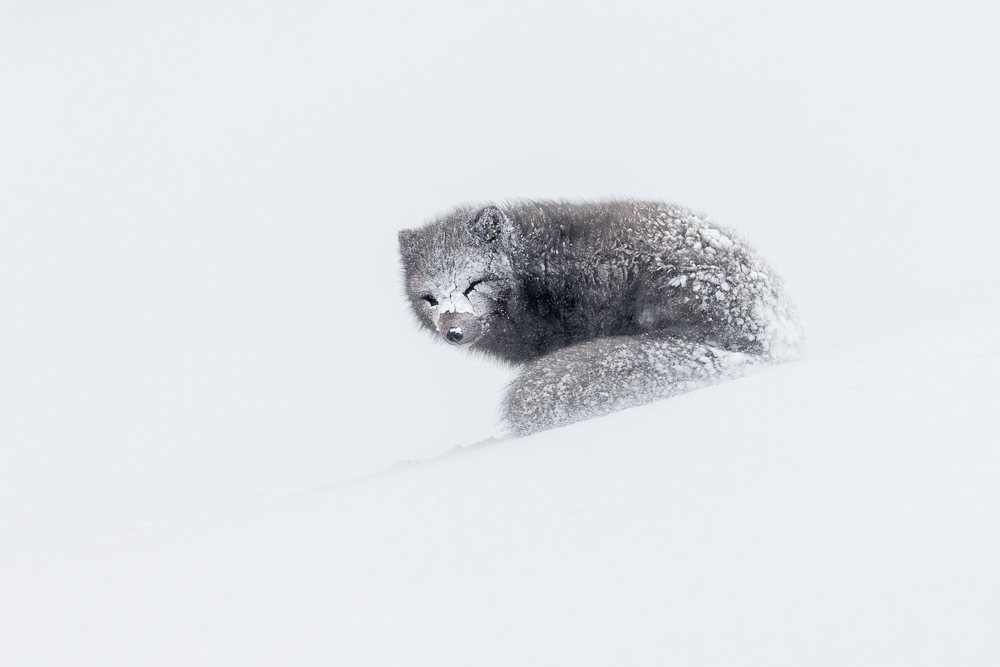
Photograph of the Month November 2024 – Arctic Fox in Flying Snow
Without a doubt, my favourite conditions for photographing the Arctic Fox are winter blizzard conditions. The flying snow creates a white-out that cleans up any background mess, and the flying snow sticks to the fox’s coat and gives extraordinary context and much-needed drama. These conditions define the environment of the Arctic fox and paint the perfect canvas on which to photograph this amazing opportunist. Contrary to appearances, these conditions are far easier to photograph in than they appear. With modern auto focus in mirrorless equipment, the cameras have no problem finding and tracking the eye of the Arctic Fox in these conditions. In past years, I would often stop down the lens to ensure adequate depth of field if focus missed slightly. Now, with eye-auto focus, I can open up the lens and shoot wide open, as in this case – f4 at 600mm. Why shoot wide open? A wide-open aperture helps soften the surrounding snow’s slope, creating a contained picture inside the 35mm frame. This technique can be used to great effect to help keep the viewers eye both inside the frame and on subject.
 www.WILDNATUREPHOTOTRAVEL.com