I have just published episode 125 of my Wild Nature Photography Podcast. In this episode, I discuss some of the upcoming Wild Nature Photo Travel workshops and expeditions, as well as my latest lens acquisition (hint – it’s a zoom!). Also in this podcast, some exciting news on my new exhibition at Xposure in the United Arab Emirates early next year, as well as pre-orders for the new Bird Photographer of the Year Volume 10, Canon Firmware fiasco, and my thoughts on the judging of the recent Australian Photographic Prize.
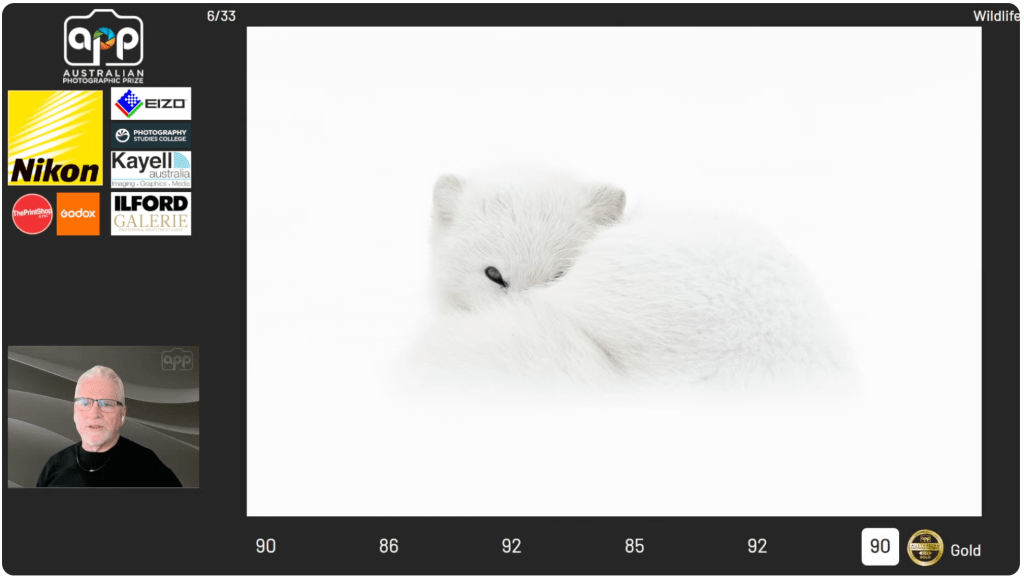
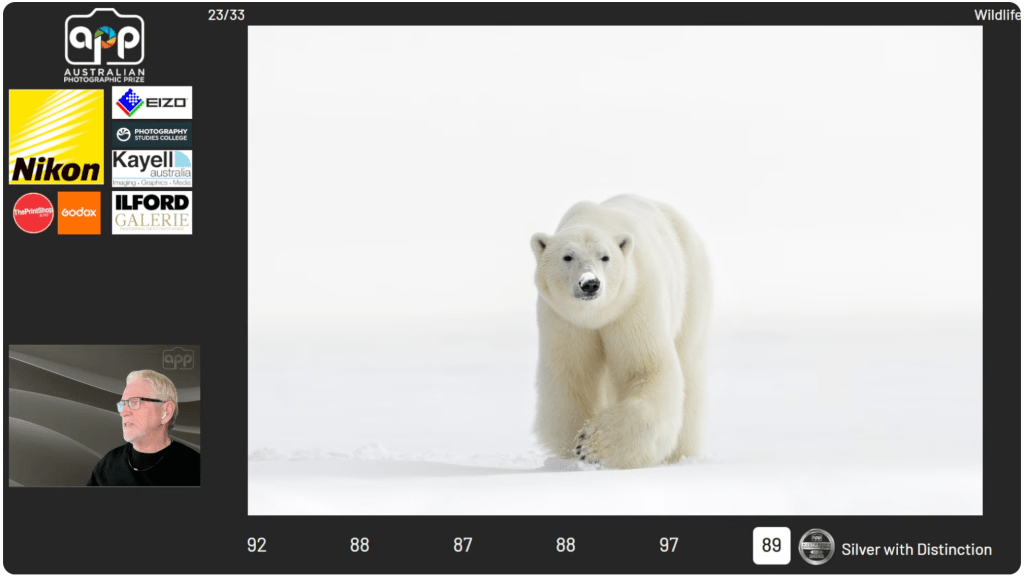
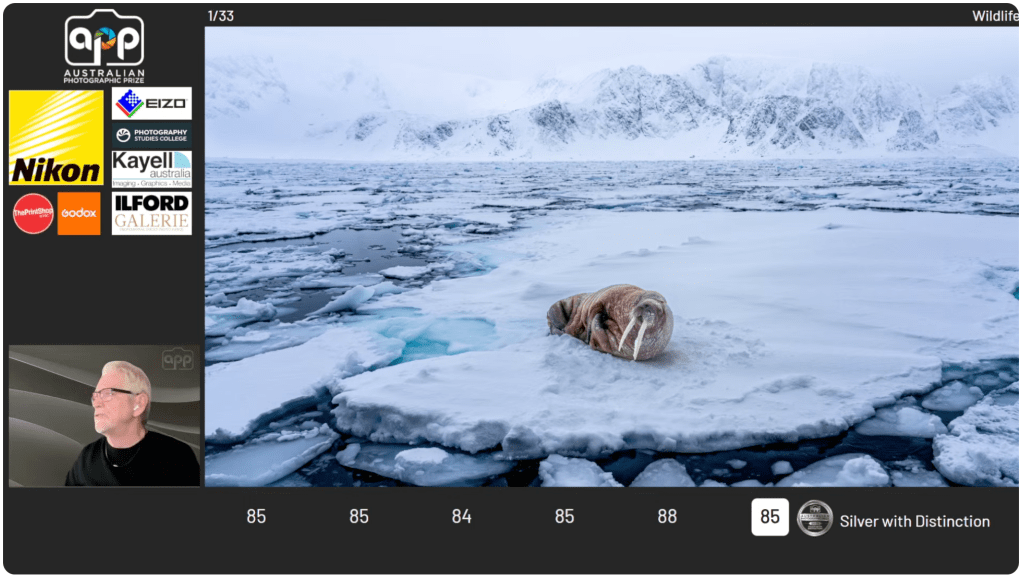
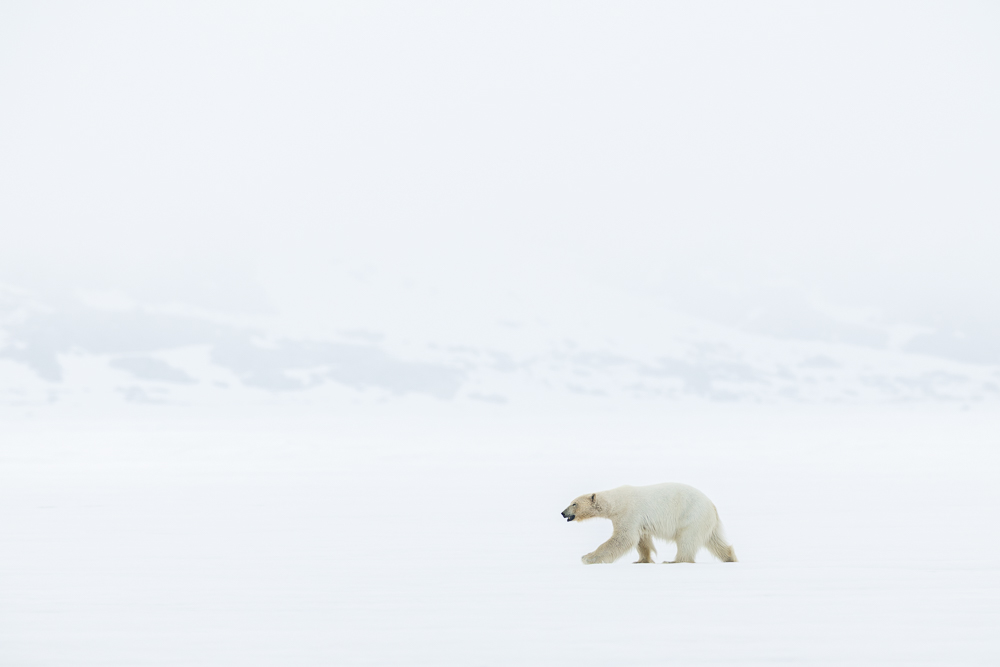
The Australian Photographic Prize Wildlife category was judged on Saturday, 19 July. This year, I decided to enter the single-image Wildlife category of the Australian Photographic Prize at the last minutedue to my hectic travel schedule. I just caught up on the results on You-Tube this morning during some downtime here in Melbourne. Of the four photographs I chose to enter this year, all four made the final round of judging (top 35 entered images in the category). Two of the four received highly coveted Gold Awards, and the remaining two images both earned Silver with Distinction awards, with the Polar Bear being only 1 point shy of a third Gold award. I am not sure what held back the Polar Bear from Gold, as the average scores from the judges is 90.4, which should be a Gold Award? Screenshots of the judge’s scores and images are included below. The overall winner of the category will be announced in the next few days.
Ultimate Polar Bear Expedition: Svalbard, June 10th to June 27th, 2025 – There are trips that linger in the soul long after you return to solid ground. And then there are expeditions that define your entire career and stay with you for the rest of your life. The 2025 Ultimate Polar Bear Expedition to Svalbard falls firmly into the latter category. Eighteen extraordinary days in the High Arctic, ten of which were spent deep in the sea ice north of 81 degrees latitude, delivered what can only be described as the most productive and fulfilling polar bear photography experience of my life. Perhaps best of all, it was shared with a wonderful group of like-minded photographers that made the camaraderie as fulfilling as the photography.
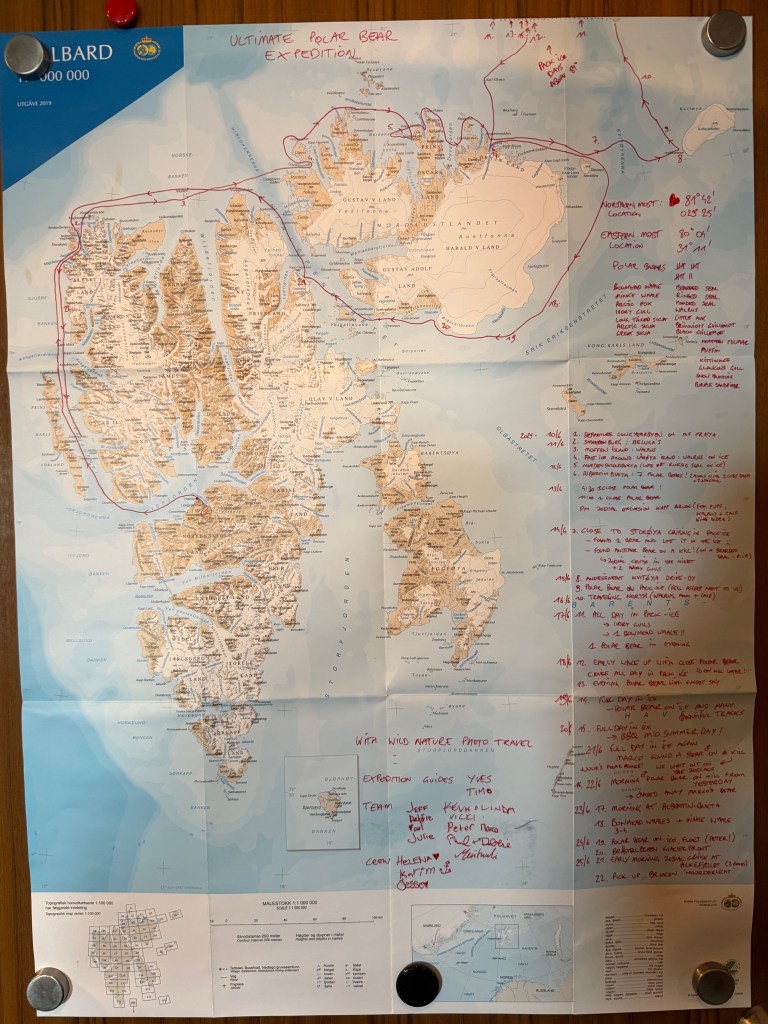
We departed Longyearbyen on June 10th aboard our trusted expedition vessel M.S Freya, with a small team of passionate photographers from around the world. The anticipation was electric as we pushed north through calm waters (we had superb weather the entire expedition), heading for the ice edge with hearts full of hope and memory cards ready for the magic of the Arctic. The pack ice would be our home and our canvas. What followed was an experience nothing short of astonishing. The map below traces our journey from Longyearbyen up into the pack ice and back.
Svalbard Ultimate Polar Bear Expedition Notes
10/6 – Departure Longyearbyen aboard M.S Freya
11/6 – S,eergenburg with a pod of Beluga Whales and Mofen Island with a big colony of Walrus
12/6 – Nordenskioldbukta with a lot of ringed seals on the ice
12/6 – Albertinibukta – 7 Polar Bears! 2 Polar Bear females with 2 cubs each and one adult bear
13/6 – 2 x Polar Bear! Plus zodiac excursion to Kapp Bruun with Arctic Fox pups, Walrus and King Eiders
14/6 – Close to Storoya cruising in the pack ice. Found one bear but lost it in the ice. Found another bear on a recent kill (bearded seal) zodiac cruise during the night plus ivory gulls
15/6 – Andreeneset Kvitoya Drive by and a Polar Bear on the pack ice that fell asleep nearby
16/6 – Travelling further north with Walrus mom and calf
17/6 – All day in the pack ice with Ivory gulls, one Bowhead whale and a Polar Bear in the evening
18/6 – Early wake-up call with Polar Bear on a kill and cruise all day in the pack ice. Evening Polar Bear with sunset sky
19/6 Full day in the pack ice. Polar Bear on the ice and many bear tracks
20/6 – Full day in the pack ice and Midsummer BBQ
21/6 – Full day in the pack ice. Polar Bear on a kill (great spot Marco!) Polar Plunge for those who were feeling brave!
22/6 – Morning and afternoon Polar Bears on kills
23/6 – Morning at Albertinibukta with Bowhead whales and Minke Whales later in the day
24/6 – Polar Bear on ice floes (Great spot Peter!) Brasvellbreen glacier cruise from the ship
25/6 – Early morning zodiac cruise at Alkefjellet (two Arctic Foxes)
26/6 – Sailing to Longyearbyen
27/6 Disembarkation
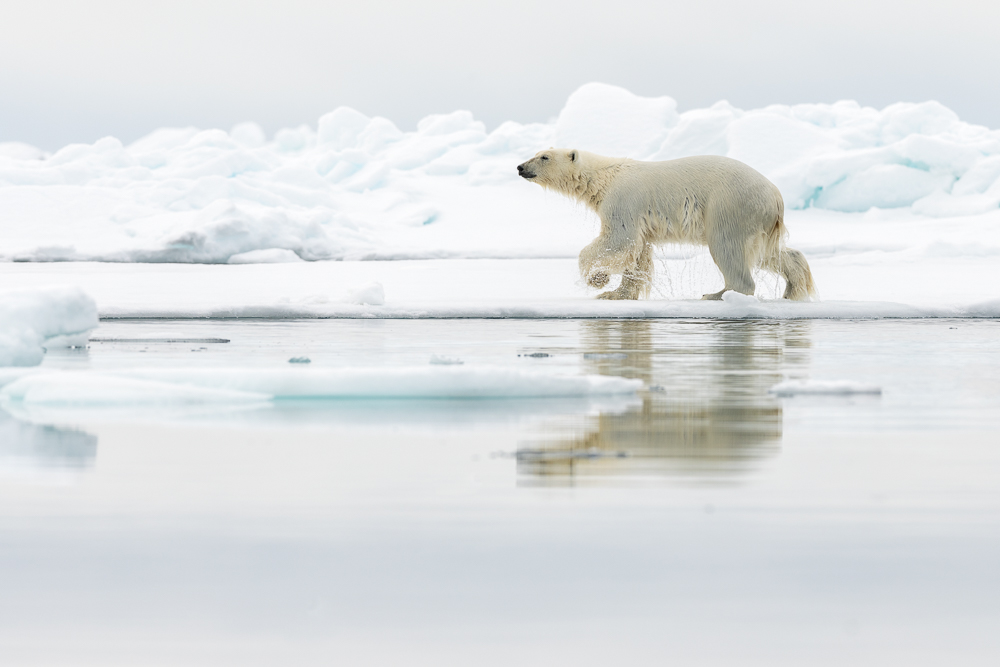
A Bear a Day: Eleven Photo Bears and Eighteen in Total – The defining goal of this expedition was simple but profound: to photograph wild polar bears in their natural habitat. Achieving that goal is never guaranteed in the Arctic; the sea ice moves, conditions shift, and wildlife follow their own rhythms. Yet somehow, over the course of this journey, we encountered a total of eighteen individual polar bears – a bear a day! Eleven of those encounters resulted in what I classify as true photographic opportunities—bears at close range, in beautiful light, behaving naturally. And not just bears at a distance, but bears that approached us, curiously and calmly, in serene Arctic light.
The pack ice north of 81 degrees offered us these moments in abundance. We would often park the vessel, engines off, drifting silently with the ice. We let the Arctic come to us. And it did. Again and again. Some bears were lone males, strolling confidently across the floes. Others were mothers with cubs, cautious and observant. All were healthy, well-fed, and moving with the slow, deliberate and majestic elegance that only polar bears seem to possess. In these moments, standing on the deck of the ship with a camera in hand, there is a stillness and majesty to Nature and the high Arctic that is impossible to capture with mere words.
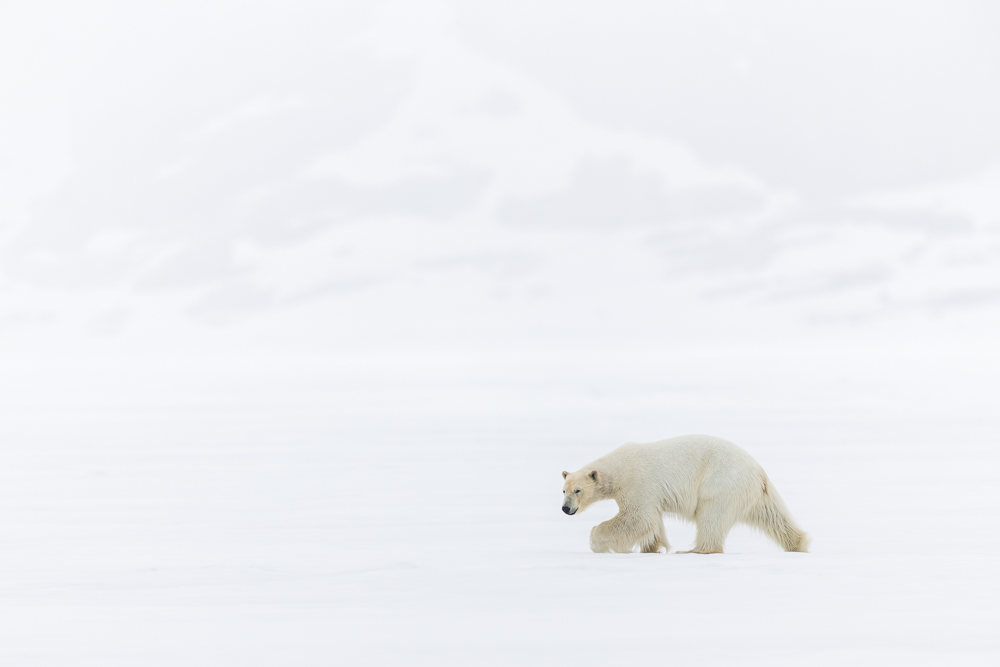
One particular morning stands etched in memory: a young male emerged from the fog, padding across the ice under soft, diffused light. He approached to within a few meters, sniffing curiously before settling down and resting in front of us. We spent a wonderful amount of time with him in absolute silence. Just the breath of the bear, the creak of the ice, and the soft click of mirrorless shutters. As Nature photographers, these are the moments we dream of.
Spending ten full days in the northern pack ice was, in itself, a once-in-a-lifetime privilege. This region, far beyond the 12 nautical mile limit of Svalbard’s archipelago, remains wild and unregulated—raw Arctic wilderness where the laws of nature, not tourism and bureaucracy, still rule. It’s in these outer reaches, around 81.42 degrees north and 30.56 degrees east—just 20 nautical miles shy of Russian waters—that we found the essence of the polar bear’s world. There was even an opportunity to scout for Polar Bears from the hot tub on the back of the ship!
This was the furthest east I have ever ventured with a group of photographers on a Svalbard expedition. The sea was mirror-calm, allowing us to navigate deep into the ice fields. Ice floes drifted slowly under endless daylight, broken only by the occasional pressure ridge or melt pool glowing turquoise under the midnight sun. Every hour held photographic potential: glowing pastels at 3 a.m., long shadows and golden rim light at midnight, overcast diffusions that made every texture sing.
We never rushed. With 18 days at our disposal, we could take the time to wait, to observe, to drift. Patience rewarded us over and over again. It’s this kind of time-rich, immersive experience that elevates a polar expedition from a trip to a truly transformative journey. The 360º degree video below courtesy Yves Adams – thank you.
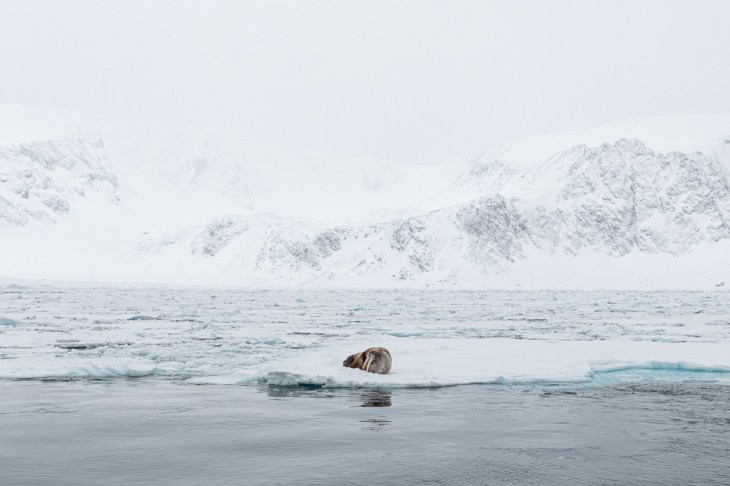
While polar bears were our primary focus, the Arctic did not limit its generosity to a single species. Walrus were abundant, often hauled out on ice, bobbing in the water beside the ship, or interacting in social clusters on floes. We enjoyed close-up photography of these massive, tusked mammals in perfect, still conditions—reflections in melt pools, nose-to-nose confrontations, even young calves beside their mothers.
Arctic foxes, typically elusive in summer, surprised us with six separate encounters. On a bird cliff slope, a curious fox went about its morning routine. On another day, we watched two fox cubs playing high on the side of a remote bird cliff. Each fox offered not only photographic opportunities but a deeper insight into this clever and resilient predator’s summer behaviours.
And then there were the birds—a vital part of the Arctic tapestry. Ivory gulls circled gracefully above the ice. Glaucous gulls called overhead. Black-legged Kittiwakes wheeled and dived near ice edges, and both black and Brünnich’s guillemots dotted rocky cliffs and ice margins. Each added a layer of life and energy to the frozen world. For the first time in my life, I was privileged to witness four Bowhead whales surfacing in the calm, pre-dawn hours. Massive, ancient, and rarely seen, they moved with quiet dignity through the glass-like sea. The ship held its breath. We stood together and watched history swim past. For me, this was not a photographic opportunity (whales from ships are rarely photogenic), but a moment to put the camera down and simply enjoy the wild Arctic.
Although the pack ice held most of our attention, our route also allowed us to visit some of Svalbard’s most remote and dramatic locations. At Kvitøya, a ghostly white island shrouded in fog, we paid homage to the history of Arctic exploration and experienced one of the most surreal landscapes on Earth. Storøya gave us panoramic views and solitude, a place where the ice meets sky in perfect harmony. And of course, the massive face of the Brasvellbreen glacier front always inspires awe. This photograph from a previous expedition when it was still permitted to fly drones in this region.
Alkefjellet, with its sheer cliffs and swirling bird colonies, offered a different kind of drama. Thousands of guillemots filled the sky, their cries echoing from rock walls. It was a thunderous reminder of the abundance and chaos of life that clings to even the smallest ledge in the Arctic. Yet, throughout all of this, the focus remained always on the bears. Every decision, every mile travelled, was in pursuit of the next potential encounter. It is essential to recognise the stringent regulations that govern interactions with polar bears in Svalbard. Within the 12-nautical-mile territorial limit of the archipelago, all landings and bear observations are subject to Norwegian law. These laws exist to protect both wildlife and humans.
However, during this expedition, we spent the majority of our time well outside this zone. In the northern pack ice, far beyond the reach of these regulations, we were able to photograph bears in a manner that was both free and ethical, always with the utmost respect for the animals and their environment. We never chased. We let them come to us. It’s a crucial distinction—one that makes all the difference in the world.
To the best of my knowledge, this was the first dedicated polar bear photography expedition to Svalbard, featuring a comprehensive 18-day itinerary. That extra time proved invaluable. It allowed us to explore farther, respond flexibly to changing conditions, and, most importantly, spend ten full, uninterrupted days in the heart of the pack ice. There were no forced diversions, no unnecessary landings. Just ice, bears, and the profound silence of the Arctic. The photographs included in this report represent only a small fraction of those taken during the expedition. It will likely be many months or even years before I have the opportunity to fully mine all the gems from this trip.
Such a long-duration expedition also fostered something else: camaraderie. Onboard the ship, a deep bond formed between the photographers. We shared meals, techniques, stories, and laughter. We stood shoulder-to-shoulder on deck, eyes locked on the horizon. That sense of shared purpose—of mutual respect for the craft and for the wilderness—was as vital to the experience as the bears themselves.
As I write this, safely back in the world of green trees and mobile reception, I find myself still adrift in that world of ice and light. The images are extraordinary, but it’s the feeling that stays with me: the calm, the connection, the privilege. The high Arctic is an incredibly special place and it is always a privilege to travel there to experience a true polar wilderness.
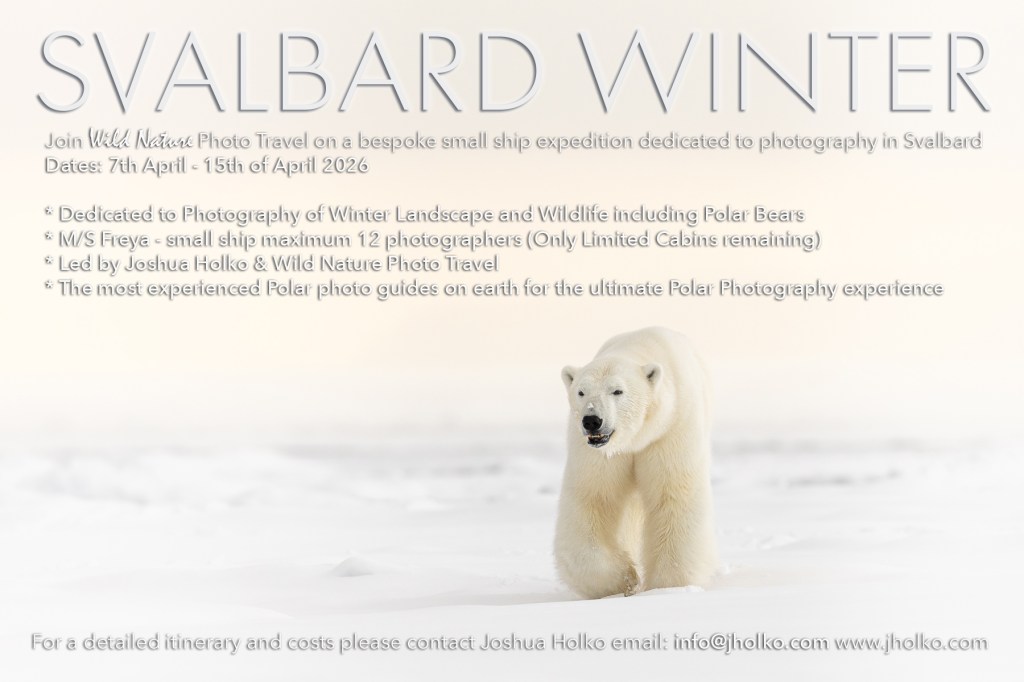
Our next polar bear expedition to Svalbard is scheduled for April 2026. We will journey in early spring, when the landscape is still cloaked in winter white and the low sun paints everything in gold. That trip will offer new challenges and new rewards—frozen fjords, early cubs, and pristine snowscapes.
I am also currently developing plans for a second, extended 18-day expedition for late autumn 2027. This will be a unique opportunity to experience Svalbard as the light fades into polar night, and the bears move toward the edges of the returning ice. In the meantime, we have just a few places left on our April Winter light expedition next year, 2026.
For now, I carry this summer’s expedition with deep gratitude. To those who joined me—thank you for your trust, your passion, and your companionship. And to the Arctic: thank you for reminding us that magic still exists, far to the north (away from the politics of the world), where the ice never sleeps – Stay Wild.
Canon has today released new firmware for the EOS R1. The firmware is now available to download from Canon Japan. It will propagate to other Canon sites throughout the day. There are a number of interesting new features, but unfortunately, the capability to bind pre-capture to a MFN button is not yet amongst them (clearly the Canon Engineers did not get the memo!). Canon EOS R1 Firmware v1.1.0 includes the following changes:
The security function has been improved.
A password can now be requested when the power is turned on.
You will need to set a password the first time.You can change the settings so that the password request screen does not appear.You can check the history of password changes, network information changes, etc.
You can now update the firmware on the camera alone by downloading it from the Internet.
A “finder display priority mode” has been added, which turns on the viewfinder when the camera’s rear sensor detects a person.
100/120Hz flicker can now be automatically detected during live view.
It is now possible to register the focus position in the preset function of the camera remote application CR-A100. When used with the Robotic Camera System CR-S700R, this makes it easier for the photographer to focus on the intended subject distance and take pictures.
Added [Panning Assist] to the menu. When panning with a compatible lens, camera shake correction and subject blur correction are performed during exposure.
The servo AF characteristics have been expanded to include [Case Special], which is suitable for shooting subjects through a net, such as badminton and volleyball.
Added support for the digital camera software development support kit (EDSDK/CCAPI).
A function has been added that allows you to protect an image at the same time as rating it.
Supports CFexpress cards up to 8TB.
Cards over 8TB require a low level format in the camera.
Any card over 8TB will be treated as an 8TB card.
Cards over 2TB cannot be used for firmware updates
A setting has been added to lower the image capture frame rate to prevent heat generation when connecting the CR-A100 and taking remote shots over long periods of time.
When transferring images with voice memos via FTP, the order of transfer has been changed to voice memo, then image. Also, if a voice memo is added to an image waiting to be transferred, the image and voice memo will be transferred last.
The number of shots recorded during pre-continuous shooting can now be set in single increments.
[Airplane Mode] has been added to the shooting button customization.
It is now possible to simulate exposure when using a strobe.
AF tracking performance has been improved for subjects that are difficult to focus on when shooting video.
Fixed an issue that could cause Err70 to occur when enlarging the display after shooting with [Blackout Free Display] set to “On” and [Servo AF 1st Frame Release/One-Shot AF Release] set to “Release Priority.”
Fixed an issue where Err70 could occur during Bluetooth communication due to interference from other Bluetooth devices.
Fixed the phenomenon that Err70 would very rarely occur when repeatedly shooting in “High-speed continuous shooting +”.
Fixed the phenomenon that Err70 would very rarely occur when shooting with the electronic shutter immediately after starting up the camera.
Fixed the phenomenon that Err70 occurs very rarely when recording video with the “FHD239.8P/200.0P” setting.
Fixed an issue that occasionally caused Err70 to occur when using the camera in movie mode with the frame rate set to “50.00P” and [Movie Digital IS] set to “On” or “Strong.”
Fixed an issue that could cause Err70 to occur while waiting to shoot when [Pre-recording] was set to “On” and [Auto Transfer] to image.canon was set to “Yes”.
Fixed an issue that could cause the camera to stop working properly if [Review] was set to “Off” and the monitor displayed a low brightness image after taking pre-continuous shots.
Fixed an issue that could cause video recording to be impossible when using remote live view shooting in EOS Utility with HDMI output.
Fixed an issue where large RAW images could not be transferred via Camera Connect.
Fixed the issue of being unable to connect to a Wi-Fi 7 compatible router.
For those of you with Global Rescue Insurance policies, please be aware of the following important update regarding travel in Greenland:
We are writing to inform you of an operational update: Global Rescue is suspending member field rescues and evacuations from Greenland. At this time, we do not feel confident that we can provide the level of service in Greenland that our members expect due to the lack of reliable operational resources in the region.
Global Rescue will continue to offer:
24/7 medical advisory services for members travelling in Greenland.
Fee-for-service transport in the event of an emergency, when feasible.
For questions or further clarification, please contact Member Services team at memberservices@globalrescue.com or +1 (617) 459-4200
Wild Nature Photo Travel partners and is an affiliate with Global Rescue.











 www.WILDNATUREPHOTOTRAVEL.com