Tomorrow, I am leaving Sweden for the last European workshop of the year, the White Horses of the Camargue in France. This sold-out workshop has been something I have been looking forward to for a very long time now. Actually, ever since I saw images of the horses more than a decade ago in an early tutorial Canon published on how to use their Digital Photo Professional software. I was never enamoured with Canon’s DDP software, but the images of the charging horses stuck in my mind, and I am excited to have my own opportunity to photograph these beautiful horses very soon, alongside all the participants on this trip. To be clear, there are not wild horses we are going to photograph. These are domestic, trained horses, and this is an opportunity to practice, hone and perfect techniques that can be applied to wildlife.
I am somewhat saddened that Canon was unable to supply me with the 100-300mm f/2.8L RF IS lens in time for this workshop (before I left Australia in August), as I feel this would have been the ideal glass for the occasion (fast and the perfect focal range). As such, I am packing both the 70-200mm f2.8L IS and the 400mm f2.8L IS. The 100-300mm is now waiting for me at Canon in Australia and will be joining my arsenal of lenses for next year’s workshops. I am particularly keen to put this lens to use on my Arctic Fox workshops in northern Iceland early in the year.
After I finish in France, I will head back to Sweden for a few days before wrapping up my European stay for the year and returning to Australia for the summer. The last workshop of the year will be to Antarctica for the Emperor Penguins in November before we kick off the 2026 year! I will write more about what is coming up in 2026 in a separate post later this year.
This year’s Wild Wolves of the Taiga Workshop promised something different from our usual Arctic expeditions (Read our Trip Reports). In northern Finland, near the Russian border, we sought not polar bears against ice or penguins against snow, but wolves in the dense, shadowed Boreal forests of the north. Alongside them, the mighty brown bear, an apex predator in its own right, roamed this land of lakes, moss, and towering spruce. There is a quietness and tranquillity that hangs in the air in this part of northern Finland, different from the austere, white silence of the polar regions. The forest in this part of Finland is thick with life, an ancient hush, the breath of a primordial forest older than memory. This is a forest that still feels untouched by humans, where wild animals roam, and it is the perfect place to photograph wolves and bears.
The small group of photographers who joined us this year were seasoned travellers and photographers, each hungry for Nature and that blend of patience, anticipation, and wild reward that defines this craft of Wildlife photography. Our base for this workshop was rustic, yet comfortable. A series of wooden lodges tucked into the forest edge by the side of a beautiful lake. After long sessions in the hides, it was a pleasure to return to the lodge, to peel off warm layers, and share a drink and stories into the evening.
Most afternoons began the same. After an early lunch, we packed our gear, prepared thermoses of coffee, and made our way quietly into the forest. The hides are simple wooden structures, each carefully chosen with background in mind, and each with narrow viewing slits just wide enough for a lens and viewing. The hides are not heated, but this time of year, the temperatures have not yet dropped below freezing, and a few warm layers are all that is required to stay comfortable during a hide session. Many of the hides have additional low-angle viewing and photography ports that allow for low-angle shooting at eye level (a preference of mine whenever possible).
From early afternoon until the fall of night, we sat in silence, our cameras ready, long glass poised—500mm and 600mm lenses dominating the lineup at most of the hide locations, with shorter lenses preferred at the lake hides. Typically, wolves are notoriously shy and long lenses are usually chosen to capture images as they move through the Autumn grasses. Patience is the lifeblood of hide photography. Hours pass with only the sound of wind in the branches or the distant call of a raven. Yet within that stillness, a strange transformation occurs: one begins to hear the forest’s subtler voice, and in those moments, we come closer to Nature. It is a reminder that as Nature photographers we should define the success of our day by how we interact with our environment more so than the success of an individual photograph.
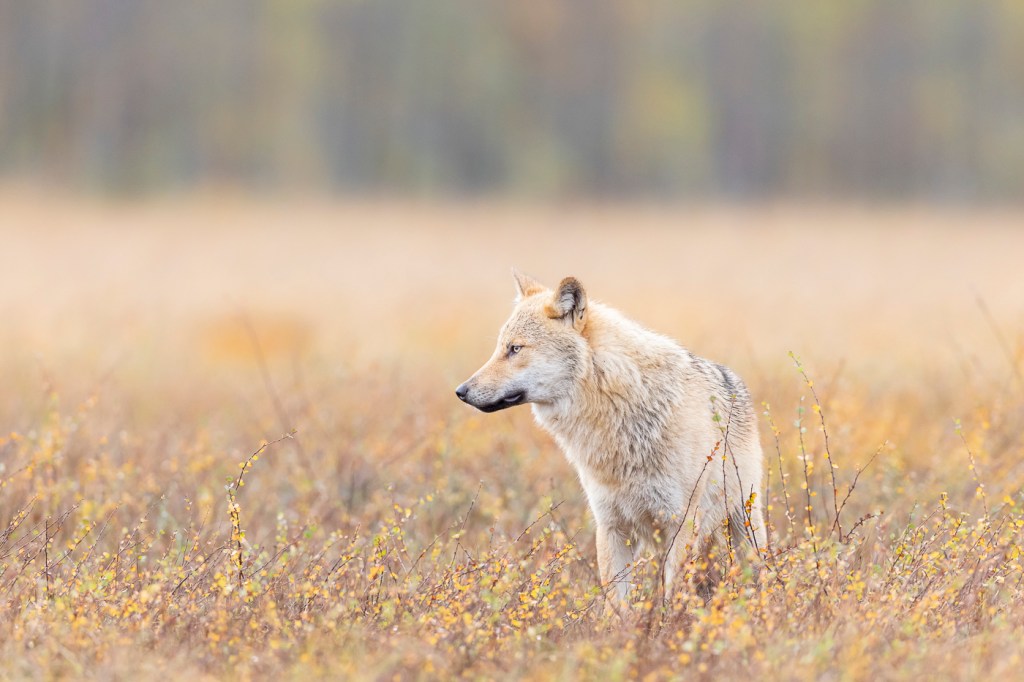
The sun never gets truly high in the sky this far north in Finland at this time of year, and days are frequently overcast, providing a natural softbox of light for the wildlife. Autumn colours were also at their peak the week of our workshop, providing the ideal backdrop to photograph both the wolves and bears. It was on the first evening that we saw our first wolf. At first, it was only a shape, an outline moving low among the yellow grasses. Then, slowly, a wolf emerged. Its presence was electric. In the silence, every photographer held their breath. The wolf paused, ears high, eyes alert, framed by the Autumn forest and the soft yellow grasses. These are the moments we live for as wildlife photographers.
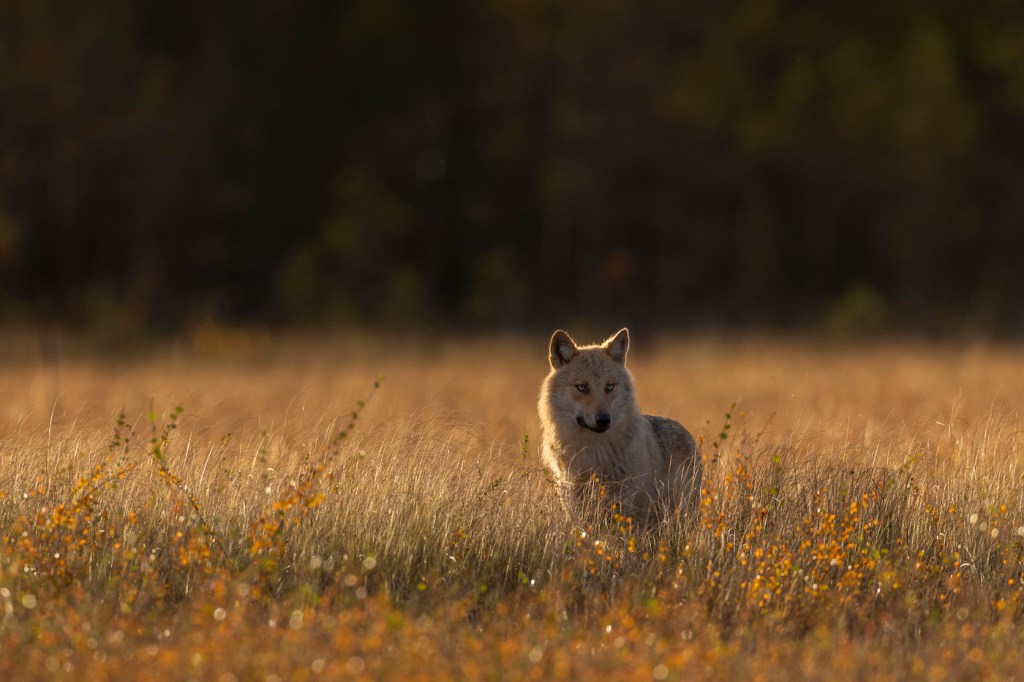
In that moment, the forest was no longer merely a backdrop. It was alive, primordial, a cathedral of colour in which this animal was both priest and ghost. The wolf lingered only a minute, perhaps two, before slipping back into shadow. But it was enough. That encounter imprinted itself on all of us, and we thirsted for me. As fate would have it, we would not have to wait long before a second wolf would grace the stage in front of our cameras.
If the wolf is shadow and mystery, the bear is weight and presence. Several evenings, we were graced by the appearance of European brown bears, their hulking frames pushing through the underbrush. The approach of a bear is almost never heard. Their giant weight is carried on huge paws that enable them to tread silently through the forest. This time of the year, the bears are preparing to hibernate and are at their fattest and most hulking.
Photographing them required equal patience and speed. Bears often moved with surprising silence, and when they appeared, it was crucial to react quickly. The 500mm and 600mm lenses gave us reach, isolating the animals against the soft tapestry of forest and mist. At one point, three young bears appeared by one of the lake hides. The young bears were cautious, climbing a nearby tree while foraging on the lake shore. The scene was tender, primal, and moving. To witness such a moment—protective, raw, and timeless—was worth every hour of waiting.
Although the hides were positioned in known territories for wolves, bears, and wolverines, we did not see the latter this year. Wolverines are elusive at the best of times, shadows within shadows, and their absence reminded us of the unpredictability of true wilderness. Some may count it as disappointment. I do not. For me, the wolverine’s absence underscores the authenticity of the experience. This is not a zoo. It is not staged. The forest offers what it will, and we come not with demands but with reverence and thanks for every encounter.
If the wolves and bears were our subjects, then the forest itself was our stage and sometimes, our main character. There were evenings when the mist rolled in, making it seem as though the trees were floating islands, suspended in an ocean of pale grey. In such moments, even without wildlife, there was profound beauty. At other times, the golden light of late afternoon filtered through the canopy, igniting the grasses with a fiery brilliance. To photograph a wolf or bear in such light was almost transcendent—the animal bathed in an atmosphere that seemed half-real, half-myth.
This interplay between animal and environment is where authentic wildlife photography resides, not in the portrait alone, but in the story of creature and place, bound together by light and moment. Background is critical to the simplicity, but must also tell the story of the environment. No one wants a photograph that looks like it was taken in the zoo. Hide photography is not glamorous. It is hours of stillness, cramped legs, whispers, and waiting. Yet it is in this waiting that something rare is found: a kind of meditation. The modern world rarely allows us to sit for four, five, or six hours with no distractions, no noise, but only the wind and the beating of our own heart. In the hide, time stretches. Senses sharpen in anticipation. When the wildlife does appear, the scene comes alive.
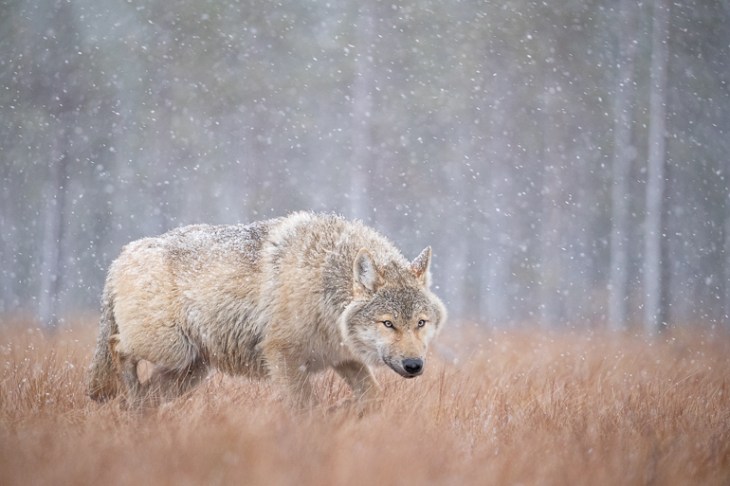
The variety of photographs captured on this workshop is always astonishing. Some photographers pursue close portraits with their 600mm primes, filling the frame with piercing eyes and powerful musculature. Others leaned into wider perspectives, showing animals as small figures dwarfed by the immensity of the forest. Both approaches spoke to the diversity of vision that such a place inspires. Running two cameras in an environment such as this is often a good idea, as it can significantly enhance diversity in a portfolio. For me personally, one frame lingers. A wolf, mid-step, crossing a clearing as fog draped around the forest floor. The background is a soft blur of spruce, with a muted palette of greens and greys. Minimal. Poetic. A distillation of the primal soul of this land.
The 2025 Wild Wolves of the Taiga Workshop reaffirmed something I hold dear: Wildlife photography is not only about animals. It is about the connection between us and Nature, between patience and reward, between what is seen and what is deeply felt. The Taiga forest, vast and breathing, reminded us that wilderness is both fragile and unyielding. There are only a few places left on this earth that still feel untouched by man, and that makes this part of Finland exceptionally special. We are returning again next year 2026, and 2027 to this magical forest realm for the Wolves and Bears, and full details are now available on the website at www.jholko.com/workshops. Please contact me for any details.
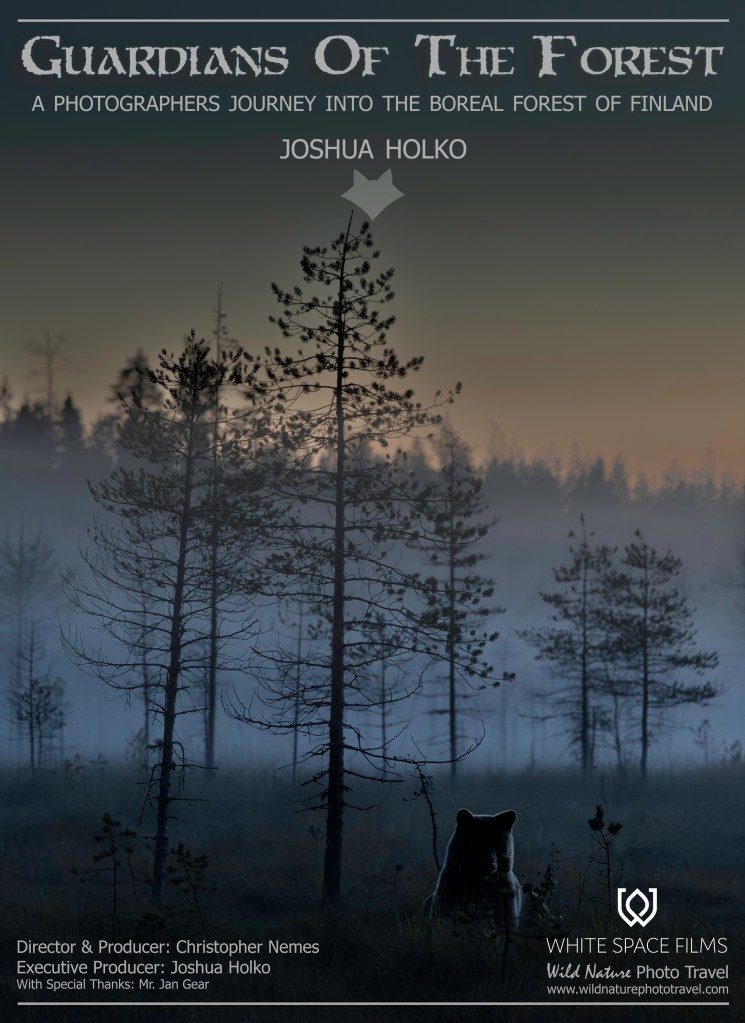
As some of you may be aware, I was also working on a new short film project during this visit to the Taiga forest in Finland with my good friend Chris Nemes from White Space Films. We wrapped filming earlier this month (September) and hope to release the film before Christmas this year, 2025. This short film is a journey into the mind of what it takes to produce a great wildlife photograph. Teaser poster below:
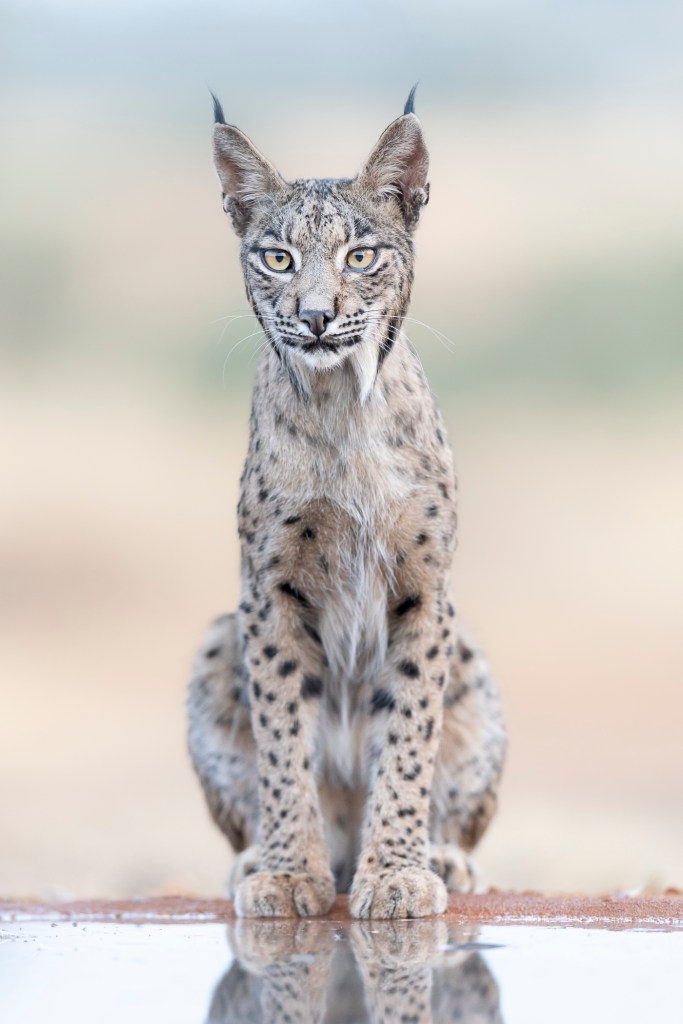
In late August 2025, I was invited to Spain by my friend Craig from Canon Rumours to try to photograph the rare and endangered Iberian Lynx. When the invitation arrived, despite knowing embarrassingly little about the Iberian Lynx, I did not have to think long. A chance to photograph one of the world’s most endangered cats? I was in.
When I boarded the flight from Stockholm to Madrid, I knew two things: Summer in Spain is brutally hot and that the Iberian Lynx, one of the rarest wild cats on the planet, would prove a serious photographic challenge. As a photographer drawn to clean, monochromatic Polar palettes, the thought of sitting in dusty hides in circa 40 °C heat was not exactly thrilling. Still, the opportunity to capture this rare feline in its mysterious, sun-baked territory outweighed almost every misgiving. I took a deep breath and plunged into the heat….
The heat hit me like a sledgehammer the moment I stepped off the plane in Spain. A visceral wave of silent oppressive heat —immobile, thick and heavy. The summer heat of Spain is a different kind of quiet from the cryogenic Arctic silence I’m so used to. The hides we would use to try and photograph the Iberian Lynx are located roughly two hours’ drive from Madrid, so after picking up a rental car, we made our way through Spanish traffic in the witching hour to our remote countryside hotel.
On our first visit to the Mediterranean scrubland, we were greeted by a dusty yellow and ochre savanna of golden grasses and parched scrubland. I knew, from the monochromatic environment, that there was fantastic potential to make a great photograph. The ever-present question was whether the Lynx would show itself? These are knife-edge moments for a wildlife photographer. Recognising the potential for a great photograph which fate then fails to deliver is far more painful than failing to ever see the opportunity in the first place.
Once on location in the first hide, I was struck by how the simple palette resonated with me: ochres, muted ambers, and sandy yellow browns. Though far from the polar monotones I love, this warmth held its own poetry. The canvas spoke of simplicity, a pared-back approach to composition focused on form, light, and the delicate tension of a wild cat’s movement in a monochromatic environment.
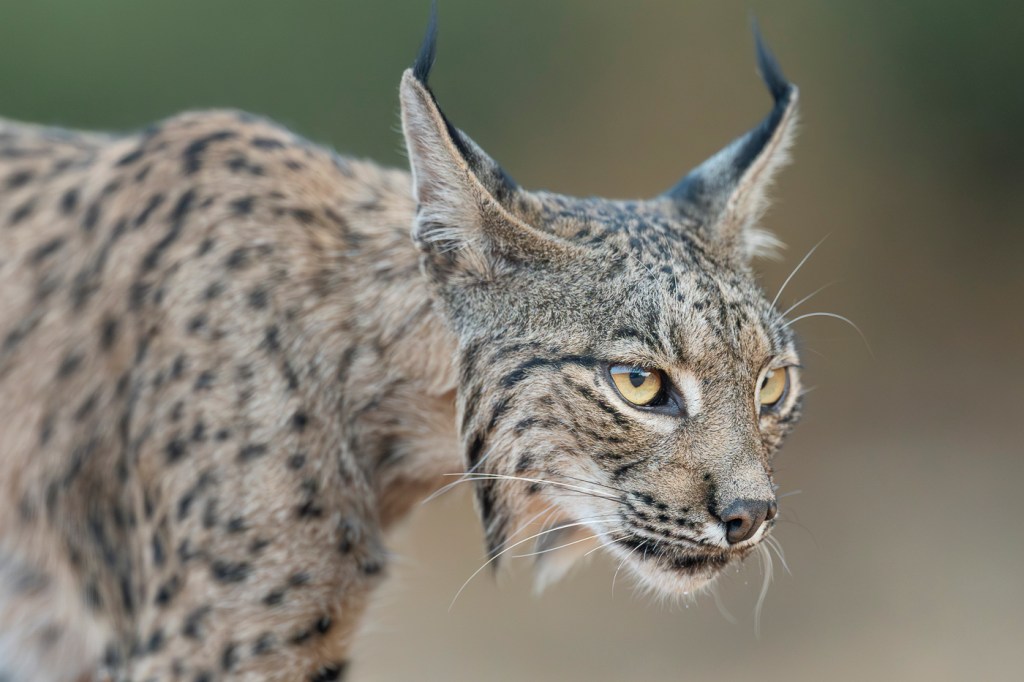
Over the next several days and nights, I found myself trapped in a hazy, hot loop of the good, the bad, and the ugly: • The Good: Quiet cool mornings when a Lynx would gently pad into frame mid-stride. I’d catch that ghost-like elegance in the yellow light, the quiet puff of dust beneath its paws, eyes locked on something off-scene. Those frames, where all the elements converged—Lynx, environment, light—are, for me, the essence of pure wildlife photography. These moments don’t just create photos; they are narrative fragments of a moment impossible to stage. • The Bad: That infernal heat. The hide, far from insulated (and without air-conditioning), became a furnace by midday. My skin glistened with a sheen of sweat; my gear felt hotter than freshly forged steel. I wondered, not for the first time, if my love for Arctic minimalism made me a masochist in deserts. I learned quickly to guard against overheating and to keep water nearby, yet the scent of dust and sun-baked earth permeated everything. • The Ugly: The waiting (in combination with the heat) was often brutal. For every brief, but sublime encounter, there were hours of nothing. Empty frames. Moments when I thought I’d made a mistake, dragging a heat-stricken body into a setting so foreign. But then, a whispered movement, a ghost emerging from the heat haze and scrub at the edge of the long lens, and all doubts evaporated.
As the heat roiled and baked the landscape into silence. I was dozing in a stupor of dehydration and sweat when I saw a Lynx approaching the watering hole: I lifted the camera as a juvenile Lynx, golden-spotted, ghosted through the frame. Its stride kicked up a whisper of dust, matching the dry hues of the ground. In that split second, everything came alive, and I arrived at my destination.
The animal paused, ears perked, body taut, before pausing to drink. I reviewed the frame on the back of the camera, and felt the familiar – yet rare – click of alignment: subject, environment, dynamics, story. It was that single mid-stride shot that would later feature as my Photograph of the Month for September: the monochromatic palette, the poised motion, the swirl of dust embodying primal drama.
What struck me most was how much this experience echoed my love for the polar environment, despite being so juxtaposed. In both cases, simplicity reigns. The Iberian landscape, in its parched austerity, offers the same clarity of tone I see in snow: minimal distractions, a palette narrowed, subtle tonal relationships bold yet understated. The Lynx, defined sharply against the sombre background, becomes a living shape, a typographic form in motion.
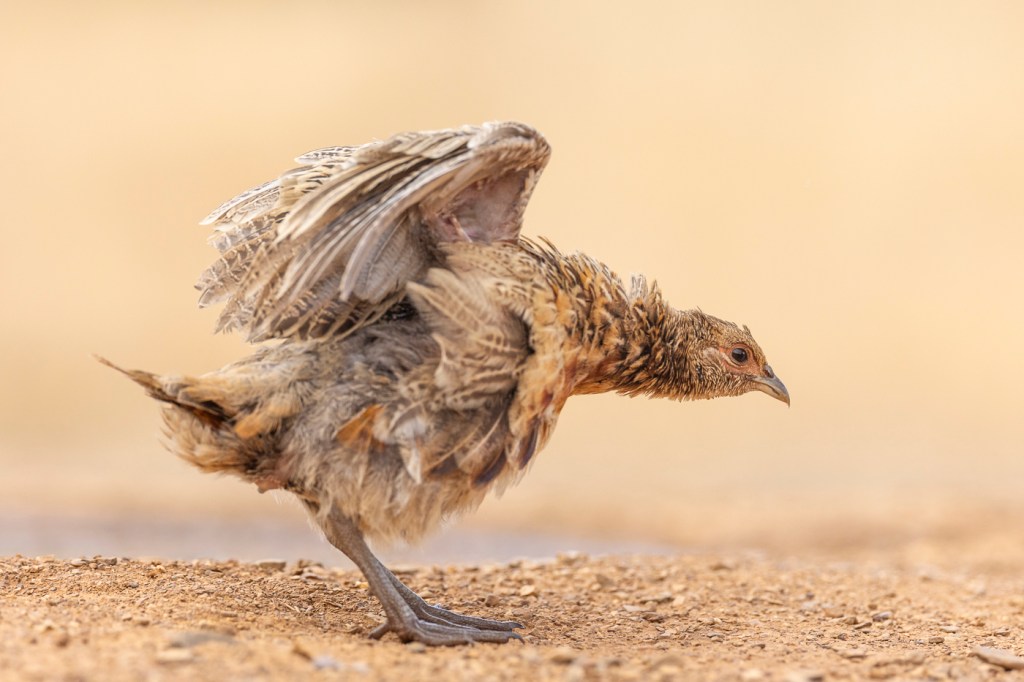
The muted yellows and browns required that I look for contrast not in colour but in texture and light. The yellow and oranges of the dust, the ridges of dried grasses, the Lynx’s fur catching the slanting sun—these become the tools to create something magical. The challenge was to stay patient and observant, to wait for that perfect convergence. Moments with the Lynx in front of the camera are fleeting and rare. A 5-hour hide session may result in just a few seconds with a Lynx as it passes by, or pauses at the watering hole to drink, or it may result in nothing more than lost sweat and patience in the oppressive heat.
This trip reaffirmed something I often say: that wildlife photography, at its core, is simplicity and emotion. It is about telling a story without clutter—just animal and environment, moment and mood. Here, the Iberian Lynx told its story in pauses, in dust kicking beneath silent paws in the harsh Spanish summer environment. It was not explosive behaviours—but rather subtle, refined, ghostly poetry. Of course, the opportunity for dramatic behaviour is always there, but this requires serendipity, and with just three full days in the hides, the odds were not stacked in our favour to witness or capture dramatic interactions. We came close, one afternoon, when seven Lynx approached the hide simultaneously from the scrub only to have one of them suddenly spook and within a flash all seven vanished into the haze and dust not to be seen again. These are the trials and tribulations of being a wildlife photographer. Sometimes the most potent and evocative shot is snatched from your grasp when you can almost taste it. Yet that’s wildlife photography. Joy and frustration, woven together. And when nature finally offers a glimpse—however fleeting—it feels earned and profound.
I’m grateful I pushed through the summer discomfort. This trip was not just about ticking a species off a list; it was about learning the language of a new landscape, discovering a different form of beauty, and testing myself outside my comfort zone. It was also about determining the best time to visit and how the experience could be improved for future visits and workshops. The primary reason I have consistently advocated for scouting trips like this is to identify potential problems or issues and resolve them before an organised trip.
Encountering and photographing the Iberian Lynx has left an imprint. It’s a reminder that wildlife photography is both about what you endure—and what you learn to see. In the dust we often call ugly, there lies possibility. In the patience we endure, there lies a reward.
To those who ask if I’d sit in a hide at 40 °C for these photos: yes—because when that Lynx steps into frame, all the heat, all the waiting, all the effort fades. What remains is the photograph, and afterwards, the memory it carries. We also have to remind ourselves that it is the journey that matters and that the destination only arrives when the hard work is accomplished.
Will I return to Spain? The answer is ‘Yes’ – but on very different terms. Or, better said, on terms I can dictate and where I can ensure the right experience for all. If you have listened to my recent podcast (number 130) on this experience, then you already know the issues I had with this particular trip. However, I have been discussing and working through these problems in detail with the owners, and we are planning to run a future trip where we (Wild Nature Photo Travel) will take over the entire hides for a period of five days in December. This time of year is renowned for having the most Lynx activity, as the young Lynx are being kicked out by their parents. Additionally, the Lynx are in their thicker winter coat and at their most photogenic. Perhaps best of all, temperatures are far more temperate. With a complete takeover of the hides on the cards for a completely private experience, we know we can offer the best possible experience. We will have more details soon (and you can reach out if you wish to pre-register). Until then, the experience and memory of Spain serves as a not-so-gentle reminder that sometimes we need to suffer for art – so that our art can suffer for us.
A few days ago, I received exactly this question via email: ‘What, in your opinion, Josh, is the best workshop for Mammals that doesn’t necessitate a boat? I get tragically sea sick when I even look at the ocean and can’t even entertain the idea of getting on any boat.I know it’s a stupid fear, but I can’t join anything that needs a boat or ship.’ Before we get to my answer, I did seek the author’s permission to write about this, which they kindly agreed to:
With apologies to the author for my brief chuckle at their thalassophobia, I did not have to stop and think about this for very long. My immediate answer is the Arctic Fox workshop we offer in Iceland in Winter. However, this requires a boat ride (albeit a very short one) and thus takes this workshop out of contention. I realised on a second reading that the question also contained the plural of the word ‘mammal’, and that changes the game further. For others, my answer remains the same, though. If you are happy to target one species specifically and put all your effort and focus (pardon the pun) on that critter, then the Arctic Fox workshop in Hornstrandir Nature Reserve is unmatched for encounters that will leave you breathless and your memory cards full.
However, if you can’t even look at the ocean without getting nauseous and want the opportunity to photograph multiple large carnivore mammals in a stunning Autumn setting, then the Wolves and Bears of Finland are equally unmatched. This is a workshop that will see you depart with memory cards full of keeper images of Wolves and Bears, an ear-to-ear grin and a vastly more profound understanding of wildlife photography. I still hold to this day that Finland (along with Mongolia) is one of the most underrated destinations on earth for wildlife. From the private hides we use, it is common to see and photograph Wild Wolves, Brown Bears and Wolverine – all close up and not at a significant distance. While many hold Yellowstone in the USA as the mecca for Wolves, I can assure you from much first-hand experience that it isn’t a patch on Finland’s offering of these incredible canines.
Northern Finland is the only location I have ever photographed Wolves from, where I came away from a single week-long trip with enough photographs for an entire book – Never Cry Wolf (and yes, I have been to Yellowstone and photographed Wolves there). This is not an isolated incident. Every autumn visit has yielded both incredible opportunities and powerful photographs. In addition to the mammals in Finland, we often photograph both White-tailed and Golden Eagles – all from the exact location. There is also a plethora of smaller forest birds, including such species as the Crested Tit and the Great Spotted Woodpecker. I have even photographed the European Pygmy owl in this region. You can check out the full portfolio for Finland HERE. And, It isn’t just the photography that makes this Finland workshop so special. It is a combination of the ease of access (there is minimal walking required as we drive to the hides – the walk is less than 100m), the homely and cozy log cabin we use as a base and the incredible surroundings of the Boreal forest. Not to mention the breathtaking landscapes around the many lakes in this location. This is a workshop that invites and offers the photographer the opportunity to deep dive into their mammal photography in a location unmatched anywhere on earth, in my experience. Capturing a stunning portfolio is only the beginning. Expect to come away with not only powerful and evocative images, but a deeper appreciation of Nature and a better understanding of what it takes to create emotive images.
It is for these many reasons that I have engaged my friend Chris from White Space Films for the second time in the same year to join us this September to make a short film about what it is like to photograph wild Wolves (along with the Brown Bears) in this part of Finland. We start shooting next month and hope to wrap our field shooting toward the end of September with a release of the film before Christmas. Our September workshop this year is long sold out – but we have now opened bookings for our August 2026 Workshop. Details are online HERE. Please get in touch with us if you would like the opportunity to photograph these apex predators in a stunning Autumn setting.
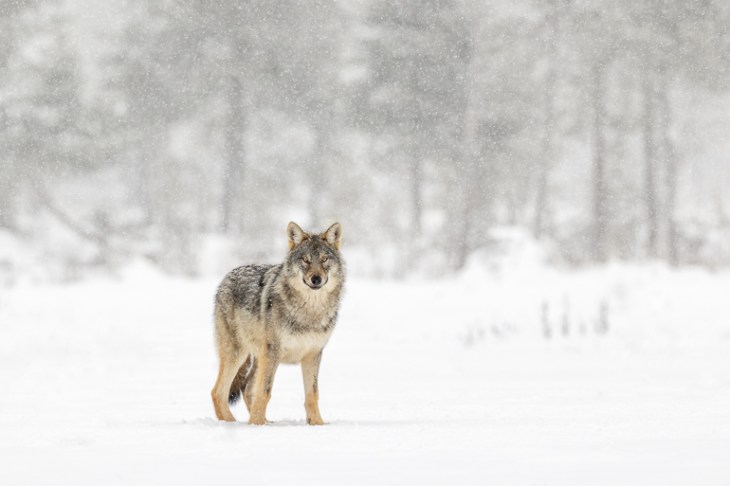
I can hear the question now – What about Winter in Finland? Yes, Winter is possible, and the snow-covered ground and frozen Taiga forest, in combination with the low angle of the sun, can serve as the perfect winter setting and backdrop. This combination alone has fueled my creative imagination and lured me back for repeat Winter visits. However, this time of the year, the bears are hibernating and the wolves are notoriously difficult to see and photograph during the short daylight hours – preferring to visit the hides at night under the cloak of darkness. Over the years, I have tried on several occasions to photograph Wolves in the depths of winter (December / January) in Finland with little to no success. I have seen their tracks and heard their howls on the wind, but that magical image of a wolf softly padding through deep, fresh snow against a frozen forest wall under golden winter light has eluded me to date. Whilst the allure of a soft white canvas, illuminated by winter’s glow, continues to draw me back, it is essential to temper expectations that a winter trip for Wolves can be an exercise in frustration. It is not uncommon to enter the hides at first light, surrounded by recent wolf tracks in deep, fresh snow, only to watch the short golden hours tick past before darkness again envelopes the Boreal forest – without so much as a Raven for company to pass the time.
Autumn, on the other hand, offers not only an explosion of fiery forest colour, but the chance to photograph these predators in the first snows of winter. On several Autumn trips, we have been blessed with snow, and all of the images in the Finland Winter Portfolio HERE of Wolves were made at this time. Autumn is brief this far north in Finland, and the seasonal line is frequently blurred between Autumn and Winter, providing opportunities to photograph in snow when the weather turns toward Winter.
If you are a frequent traveller to this Scandinavian part of the world and looking to expand your portfolio, then you may wish to roll the dice and try in Winter. We will be offering a future Winter trip to Finland to try for Wolves again, but recommend this only to those frequent travellers willing to invest the time and effort, and who understand that failure is a distinct possibility. If it is your first visit (or even second or third) to Finland for Wolves and Bears, then I strongly recommend Autumn as the perfect time to visit for all those reasons listed above. Of course, nothing is guaranteed in Wildlife photography, but you do significantly stack the deck in your favour for both sightings and photographs at this time of the year.
Regardless of when you choose to travel to Finland, the experience of photographing Wolves in the Boreal Taiga forest remains one of the most underrated and rewarding experiences a wildlife photographer can have. There is something very primal about Wolves, and the eerie, haunting echoes of their howls stay with you long after you leave their forest home. This is a workshop I wholeheartedly recommend to anyone wanting to photograph mammals (and specifically carnivores) who doesn’t want to get on a boat. And even those who will happily embark on an ocean-going vessel for their next photograph will find this an experience not to be missed.
There are places in the world where time seems to be all but irrelevant—where silence has weight, and where life exists on the knife’s edge of wilderness. The Hornstrandir Nature Reserve, perched at the extreme northwestern edge of Iceland, is one such place. It’s here, amid weathered fjords and wind-bent tundra, that the elusive Arctic fox raises its young—unhunted, unharried, and at peace in one of the last true wilderness sanctuaries of the North.
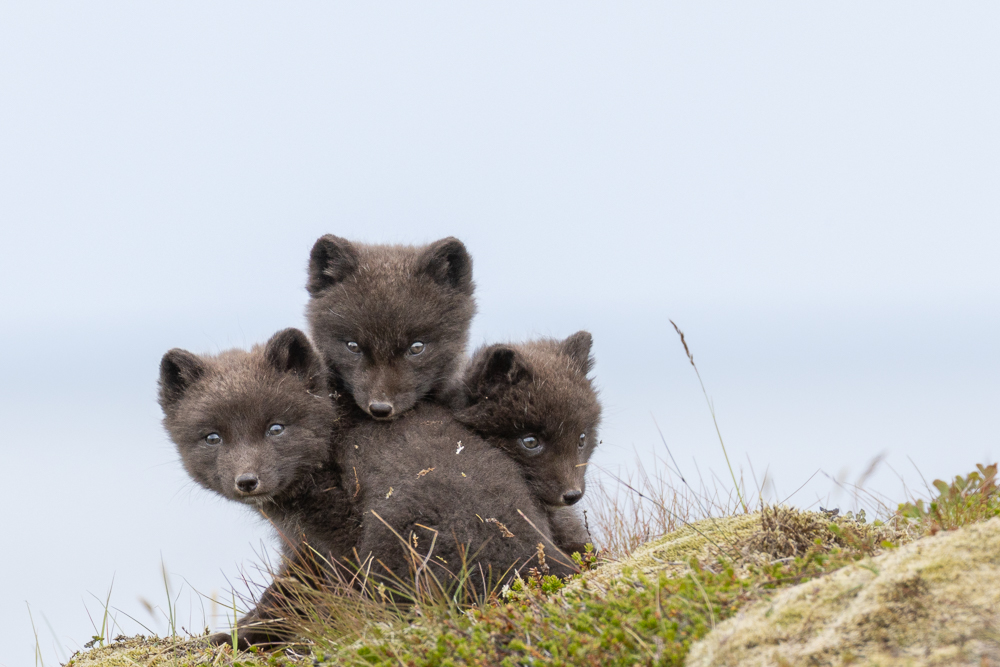
From July 1st to 7th, 2025, I had the privilege of leading a small group of photographers deep into this forgotten corner of the world for a summer workshop focused on Arctic fox cubs. What unfolded over those seven days was extraordinary: four healthy, playful cubs, fresh out of their den, exploring the world for the very first time. We had timed our arrival perfectly.
Our journey began in Ísafjörður, a sleepy town surrounded by steep fjords that comes alive in the summer months. From there, we boarded a privately chartered boat, cutting across the still ocean waters to Hornstrandir—a region completely uninhabited, unreachable by road, and where nature reigns supreme.
Upon landing on the shoreline, we were met with calm winds, mild temperatures, and the telltale silence that defines this place. The weather, often a wildcard in the Icelandic summer, held beautifully in our favour—a perfect mix of overcast skies for soft light and clear days for contrast and depth.
We walked in with our gear, a short but deliberate walk through tundra meadows and coastal cliffs until we reached our remote cabin—our “home away from home” for the week. Modest, but wonderfully cozy, the cabin offered reliable power, heat, and a warm shower, giving us a comfortable base from which to photograph and recharge both batteries and bodies.
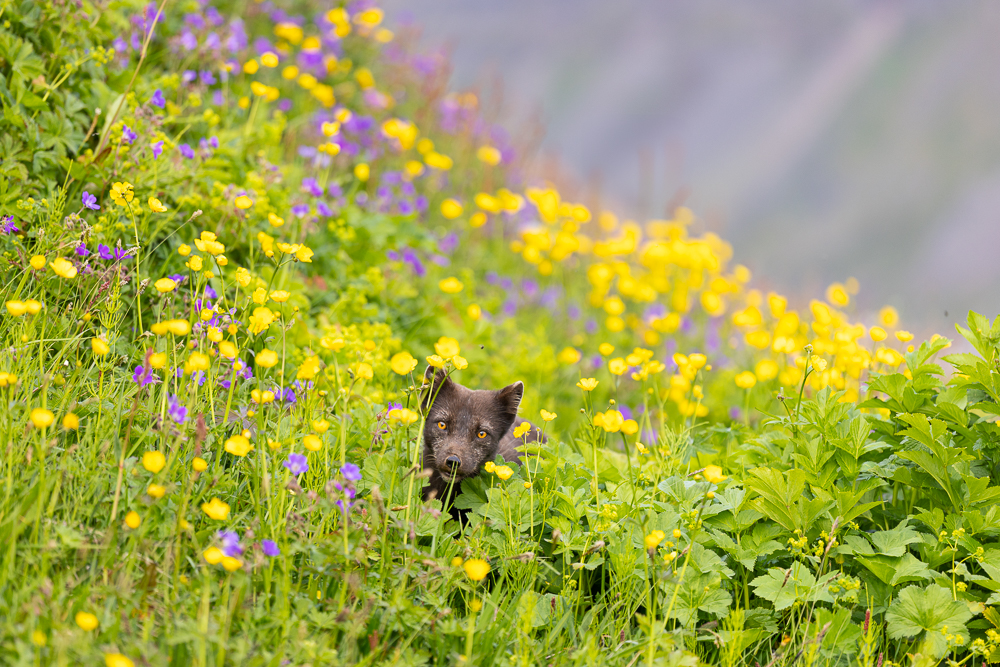
The Arctic foxes in Hornstrandir are protected under Icelandic law and unaccustomed to human threat. This gives us a unique window into their lives—a rare chance to observe them with minimal disturbance. We knew from previous years where a known female fox maintained her territory, and it was near this location that we carefully established our viewing distances, always respectful, always still. And then, like a miracle borne of silence: four cubs.
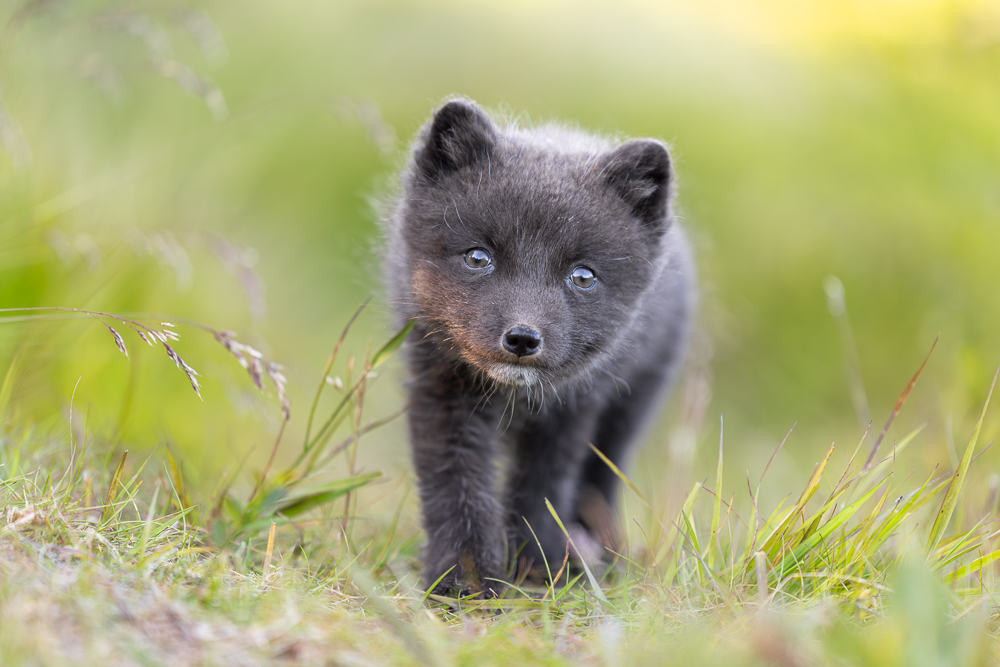
Emerging from the mossy lip of their den, blinking in the soft summer light, they appeared with hesitant steps and twitching ears. They were healthy, inquisitive, and full of energy, bounding across the lichen-covered rocks, chasing each other through patches of Arctic thyme, and occasionally collapsing in an exhausted heap under the watchful gaze of their mother.
The timing could not have been better. They had just begun venturing out from the den—still clumsy and unsure, but filled with curiosity. For a wildlife photographer, this is the golden moment: when behaviour is at its most revealing, when innocence radiates through every movement, and when images tell stories as ancient as nature itself.
What makes photographing foxes in Hornstrandir so special isn’t just the opportunity to see them—but the privilege to be so close to them. These animals, free from hunting pressure, exhibit a calm curiosity rather than fear. They observe, approach, and sometimes come so near you can hear the soft pad of their feet over the tundra.
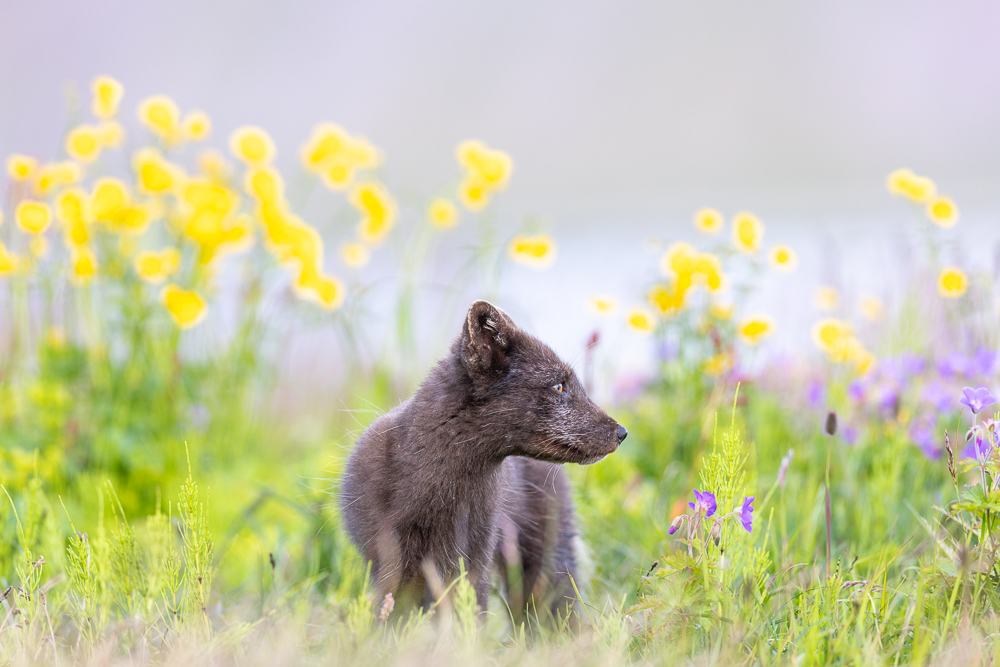
Each day we returned to the den, observing routines and behaviours. The mother—sleek, somewhat shy, and blue-morph—would occasionally trot off on short hunting forays, returning with fish scraps or shellfish to feed her litter. The father appeared more often, showing no fear and regularly approaching for an inquisitive look at our cameras.
Photographically, we were gifted beyond measure. Overcast days gave us beautiful softbox light, perfect for portraits and detail-rich imagery. On clearer days, the drama of shadow and contrast lent itself to more stylized compositions. Whether it was cubs backlit in the golden light of an endless Arctic evening, or nestled in the moss under moody skies, every session offered something new.
The joy of these moments wasn’t just in the photography—but in the quiet communion with the land and its wild inhabitants. No roads, no cars, no noise. Just wind, sea, and the faintest rustle of foxes through grass. Arctic summer light is both gift and challenge. With nearly 24 hours of daylight, we were afforded unparalleled flexibility in our shooting schedule. We often chose to photograph in the “shoulder hours”—early mornings and late evenings when the light was most flattering and the cubs most active. Remarkably, the weather held throughout the trip. Overcast periods were long enough to allow deep exploration without ever feeling rushed. For a workshop in a location as volatile as the Hornstrandir coast, this was a blessing not to be understated.
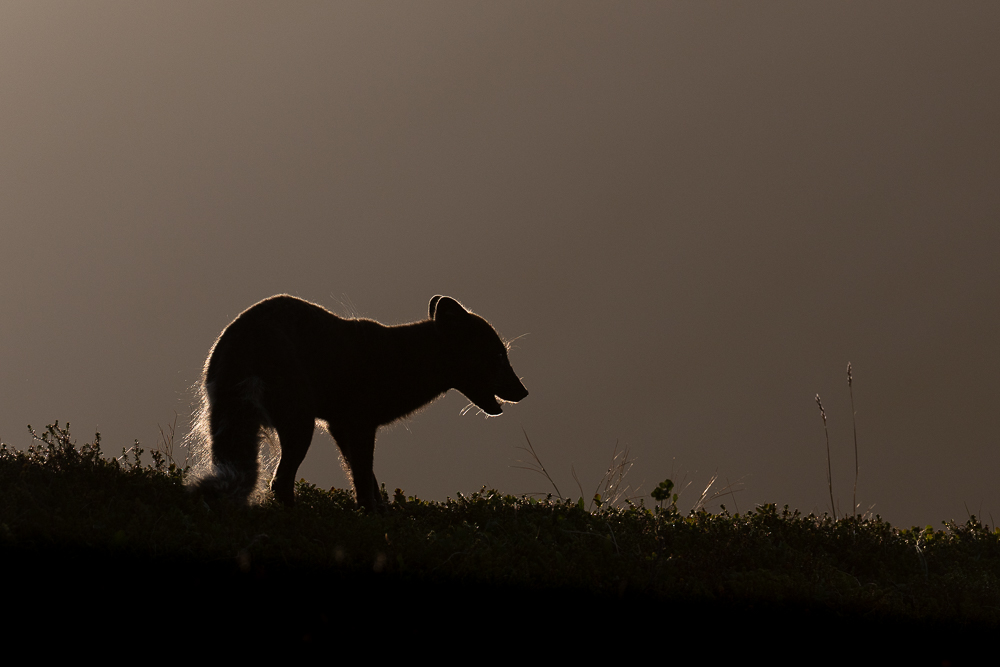
One early morning brought backlit opportunities near to the den. The effect was sublime—foxes outlines luminous against the dark backdrop. We whispered to each other that it felt like being inside a dream, and the resulting images remain among the most evocative of the trip.
Our remote base was everything a field workshop should be: rugged, warm, and welcoming. After long hours on the tundra, we would return to hot meals, shared stories, and laughter around the table. We reviewed our images, shared techniques, discussed post-processing ideas, and most importantly, connected as a group of like-minded creatives driven by a shared love of wild places.
There is something profound about being unplugged from the world, present only in the moment and the landscape. No internet. No distractions. Just photography, nature, and the camaraderie that grows from shared experience.
While the fox cubs were our primary focus, Hornstrandir never fails to deliver more to the attentive eye. Ptarmigans, still in mottled plumage, clucked their way through the underbrush. Seabirds wheeled overhead—kittiwakes, Arctic terns, and the ever-charismatic black guillemots. Occasionally Harlequin ducks could be found and photographed at the river mouth.
One evening, as the sun dipped low across the fjord, a group of common seals surfaced near the shoreline, curious about our presence. And once, in the quiet hour just after midnight, I watched a white-tailed Eagle glide silently along the ridge—not common, but not impossible here.
Yet, no sighting ever pulled our hearts away from those cubs. Every time we returned to the den, it felt like a reunion. The trust they showed us grew stronger each day, and by the end of the week, we felt like we were witnessing the emergence of a new generation—one that had accepted our quiet presence as part of their world.
On our last morning, the light broke crystal-clear over the fjord. We made our way back to the den one final time. The cubs were more adventurous now, ranging further, playing harder, their confidence growing with every hour. We spent our final moments watching them tumble and yip, playing in the morning light. I watched through the viewfinder, but also over the top of the camera, wanting to etch this memory into my mind as much as onto my memory card.
Then, slowly, we packed our gear, said our goodbyes to the family we had quietly shared space with for a week, and began the walk back to the coast. Our private boat met us in the calm waters, and as we pulled away from Hornstrandir, the reserve faded into mist and memory.
This workshop was, without doubt, one of the most intimate, joyful, and meaningful I’ve ever had the privilege to lead. To witness and photograph Arctic fox cubs just as they emerge into the world is to be part of something deeply elemental—life at its beginning, in one of the world’s last great refuges. For all of us on the trip, the experience will echo long after the images are printed and the gear cleaned. It was more than photography. It was connection—to nature, to the wild, and to each other.
For those who feel the pull of the wild, who seek authenticity, silence, and the raw beauty of life on the edge—Hornstrandir awaits. Please get in touch with us to express your interest in a future workshop to this wonderfully wild and remote location.
















 www.WILDNATUREPHOTOTRAVEL.com