Since my podcast yesterday breaking the news that the Canon EOS R1 would be 24 Mega-pixels and feature Quad pixel Auto Focus and Canon Rumour’s subsequent post confirming the Canon EOS R1 specifications, YouTube has pretty much exploded with the specifications news. Comments on the videos the Ordinary Film Maker posted to date make for pretty hilarious reading (assuming you have nothing else to do). Judging by the comments. some of these people really need to get away from their keyboards and spend more time in Nature :-). The content is good, though, and worth your time if you are interested in the Canon EOS R1 or the Canon EOS R5. I expect a lot more news to drop in the next few weeks.
Tag: Photography
Post Production Ethics and the Use of Generative Artificial Intelligence
AI-generated images are literally swamping social media platforms. Many of the Nature photography groups on Facebook I have historically been a part of are now drowning in A.I generated images as surrepticious users attempt to outdo each other in a seemingly never-ending quest for likes and views. Disclosure does not appear anywhere on most posters radar, and the intent is very clearly to deceive and fool the viewer. These posts are often immediately apparent to the trained eye; but even an untrained eye can quickly check the posters photo album to see that they have nothing else even close to what they are claiming is their photograph. It is a very sad run-away train of one-up manship that is significantly blurring the lines between Nature photography and “computer-generated art” (and I use the word ‘art’ loosely). Where will it end? I have no idea, but at least in the Nature space, the use of generative A.I tools appears to be highly destructive to accurate depictions and documentation of Nature. Or, at the very least, it causes significant confusion about what is real in the Nature space.
Since the rise of generative A.I tools, I have been receiving more correspondence asking if I use any A.I techniques to enhance my photographs. The answer is NO. A long time ago I published an ethics statement on my website HERE fully disclosing how I approach processing my photographs. I have now updated this to include the exclusion of A.I generative tools.
ETHICS AND POST-PRODUCTION
All of the photographs on this website are single-image captures without HDR (High Dynamic Range) or multi-image compositing techniques. No focus stacking or blending of multiple exposures has been used, and there are no overlayed textures or dropped-in skies or foregrounds. Panoramas do include stitched images.
I learned the craft of photography by shooting 35mm transparencies (primarily Fujichrome Provia 100 and Velvia 50). Transparencies had very little exposure latitude, and outside of a third of a stop on either side of a correct exposure, the slide was either over or under-exposed and destined for the trash. I learned the hard way that it was critical to get my exposures correct in camera and this is something I still try very hard to achieve today shooting digitally. I use graduated neutral density filters in the field extensively in my photography to help tame the dynamic range found in Nature. I bias my exposures to the right (ETTR) wherever possible to try and capture the most information possible in my RAW file. The RAW file on the right was overexposed by one stop (without clipping the highlights) in order to capture more data. The exposure was then corrected during post-production in Adobe Lightroom.
All of the photographs on this website were shot with Canon digital cameras in RAW and post-processed in Adobe Lightroom. Adjustments include White Balance, Color and Tone, Capture Sharpening, and equivalent techniques to darkroom dodging and burning.
Any excessive noise or grain from high ISO captures is treated in Lightroom or other noise reduction programs with subtle adjustments of the Noise Sliders. Any sensor dust spots are removed in post production – but that is the extent of any digital cloning or manipulation.
Post-processing is utilised to faithfully reproduce the natural colours and light captured in the field. Never to create something that wasn’t there. Additionally, no artificial intelligence (AI) generative technologies or tools have been used to create or enhance these photographs. My work remains true to the traditional craft of photography, ensuring authenticity and integrity in every image. I want the viewer to enjoy the majesty and beauty of Nature as it appears on our mother Earth.

Canon Release New Firmware for Big RF Glass April 2024
Canon has released firmware updates to five RF-mount telephoto lenses.
- RF100-300mm F2.8 L IS USM Firmware Version 1.0.6
- RF400mm F2.8 L IS USM Firmware Version 1.0.6
- RF600mm F4 L IS USM Firmware Version 1.0.6
- RF800mm F5.6 L IS USM Firmware Version 1.0.4
- RF1200mm F8 L IS USM Firmware Version 1.0.4
Even with fast zoom operations, it is now easier to focus (RF 100-300 f/2.8L IS USM Only). The electronic shutter system has improved the control of the panning assist after the second continuous shot.
I am unsure exactly what ‘easier to focus’ means in Canon’s vernacular. Perhaps they mean quicker or better to focus? Or Both? In any case, that comment only applies to the new 100-300mm f2.8L IS RF lens. The other note concerns all the telephoto lenses noted above and panning assist – a feature I have only begun to dabble with so far. Nevertheless, it is always recommended that the firmware be updated to the latest.

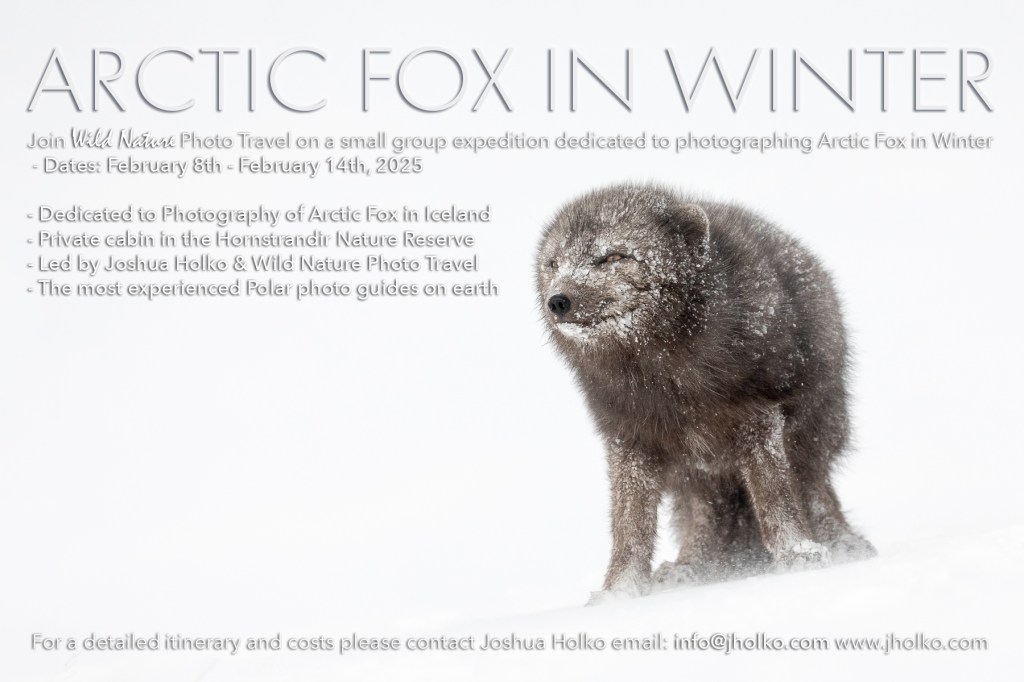
Arctic Fox in Winter in Iceland Expedition Report 2024
In early February 2024, I led my annual winter expedition to the remote Hornstrandir Nature Reserve in northwestern Iceland to photograph the Arctic Fox. This is an expedition I have been leading every year for many years now (excluding the COVID pandemic) and is one very near and dear to my heart. Over a decade ago, I visited this remote Nature Reserve to find and photograph the Arctic Fox. Now, more than ten years later, and having guided many groups to this location, this is one of my number one preferred workshops to lead.

As I have written frequently, the Arctic fox is Nature’s most remarkable feat of engineering and is an incredibly photogenic subject in the snow-covered Iceland landscape. In the far north of Iceland, the Arctic fox is protected inside the Nature reserve, and it is possible to get extremely close to these wild animals. The north of Iceland is probably the best place in the world to photograph the Blue Morph variety of the Arctic Fox. While the white morph dominates most of the Arctic, the Blue Morph is more common only in Iceland. In Winter, the chocolate brown coat of the blu-morph makes for a stunning contrast against the winter snow.

For this expedition, our group convened in Isafjord in the northwest of Iceland early in the morning on our scheduled departure day. We then took the roughly one-hour boat ride (on our chartered boat) across the fjord on calm seas to our remote cabin—our warm and cozy home for our week-long workshop.
This year, we had five individual foxes around the cabin. Two of the five were two-year-old cubs we only saw on our last day. I have been photographing several of these foxes, including the dominant female and male for years, and we are very much old friends. Seeing at least two first-year cubs active in the area was also fantastic. There was no successful breeding last year, so it is excellent that the two-year-old cubs from the prior year are doing well.

Winter in Iceland can be particularly fickle, and one never knows what the weather will bring. It is possible to have everything from sunshine to blizzards to driving rain. This year, we began our workshop with fantastic snow conditions that saw us photographing for many hours across our days in the field. We were straight into the photography on day one on arrival. Bags were unpacked, camera gear assembled, and we were straight into photographing Arctic Foxes. The foxes are typically most active in the early morning and late afternoon, which at this time of year meant we were out shooting from about 9:30am until roughly 4:30pm. The winter light is short this time of year in Iceland, but the sun’s low angle makes for superb photography throughout the day.

Over the next few days, we experienced various conditions that perfectly summarised Iceland’s freeze/thaw climate. Conditions for our workshop this year were absolutely superb, with ideal conditions for capturing the drama of Iceland’s winter weather. We had everything from breaking sun to blizzard conditions, providing an excellent opportunity to create a diverse portfolio of images during the workshop.
This year, we had some wonderful snow cornices and deep snow drifts that provided outstanding opportunities to capture dramatic images of the fox in the landscape. It was possible to make photographs with everything from 16-35mm all the way to 600mm,
I will return to the far north of Iceland in the Winter of 2025 to lead another workshop for the Arctic Fox and then again in 2026. There are now just a couple of places remaining on my 2025 expedition. If you have ever wanted to photograph Nature’s most remarkable survivor in Winter, this is your opportunity. Our remote cabin is ideally situated as a cozy home away from home and provides a beautiful base from which to photograph the Arctic Fox. Places are minimal; please contact me for complete details.

Those who appreciate wildlife photography and would like to own some of the photographs from these expeditions can order my book on the Arctic Fox from my online publishing house – Melrakki Publishing.
Photograph of the Month April 2024 Arctic Snow Hare Gallop
The photograph of the month for April 2024 comes from my recent winter expedition to the east coast of Greenland (full trip report coming soon). It shows an Arctic Snow Hare in full gallop during a howling -40º C blizzard behind the small Inuit village of Ittortoqitormit on the East coast of Greenland. I photographed it with the Canon EOS R3, and the Canon RF 600mm f4L IS lens. The real challenge of this photograph (other than avoiding frostbite) was keeping the fast-moving subject in the frame as it galloped at high speed through the snow. The blizzard wind was incredibly strong, making hand-holding the lens impossible. To counter this, I lay down in the snow, using the snow cover as a makeshift tripod, cranked up the ISO to 1600 and opened up the f-stop to f6.3. This close to the subject meant the depth of field would be extremely narrow, making focus critical. Anything less than perfect focus on the eye would result in zero keepers. Incredibly, the Canon EOS R3 could track and nail focus on the eye of the fast-moving Snow Hare despite the howling wind and flying snow. Focus Case 2 was used to ignore the whirling snow around the hare. The blue background is not the sky (which could not be seen in the white-out conditions), but the wooden wall of one of the small painted houses in the village. This is an excellent example of how depth of field control can be carefully employed to control backgrounds and enhance a photograph. Without the blue background, there would be almost no contrast between the Snow Hare and the background.