Today, I am excited to launch a new and exciting cooperative initiative: the Wild Nature Photo Travel Team. The Wild Nature Photo Travel Team is an invitation-only team for photographers who have participated in at least one of our workshops or expeditions and would like to take advantage of our exclusive team membership benefits. Just one of the exciting benefits of membership is that there is NO single supplement on our workshops or expeditions (a huge cost saving for members). The full details of the team are already available online at Wild Nature Photo Travel Team.
ABOUT: The Wild Nature Photo Travel Team is an invitation-only team program for photographers and travellers who have participated in at least one of our Workshops or Expeditions and who would like to enjoy the travel and networking benefits of our exclusive team membership. We have quietly been inviting participants over the last couple of weeks, and our team already comprises photographers worldwide, many of whom have travelled and photographed with us across the planet, from the frigid polar regions of the Arctic and Antarctic to the arid deserts of Africa and beyond. When you join the Wild Nature Photo Travel Team, you gain access to our exclusive membership benefits below and access to one of the most knowledgeable and experienced photography travel groups in the world today.
Membership Benefits
As a team member, you will enjoy no single supplement costs for any of our specified workshops or expeditions, which will result in huge savings on travel costs. Travelling with your partner? No problem, contact us on an as needs basis to be personally looked after.
Receive early notification of upcoming Workshops and Expeditions, including preferential cabin or room selection when available.
You will have exclusive access to the Wild Nature Photo WhatsApp Team group chat. Here, you can ask questions and get answers about your photography and printing needs. You can also network with like-minded travellers and photographers in a private, knowledgeable, and exclusive group.
Exclusive discounts on selected workshops and expeditions, including last-minute places or cancellation options.
Bespoke Wild Nature Photo Travel Team Jacket. A custom-made high-end polar fleece mid-layer jacket designed and made in cooperation with Icelandic clothing company 66º North (RRP $275 USD). Designed for use as either a mid-layer on those cold winter days or as an outer layer on warmer days or during more strenuous activity.
Selective discounts on partner products from companies such as BenQ Photographic Displays, Mr. Jan Gear Camera bags and X-Rite Color Management Solutions.
Early Access to each episode of the Wild Nature Photography Podcast
The just-published July / August 2024 issue of Wildlife Photographic magazine includes one of my photographs of Emperor Penguins on the front cover and a feature article on my experiences photographing Emperors in the deep south of Antarctica. This is the seventh time I have been published in Wildlife Photographic and the sixth time I have been fortunate to score the cover shot! (the last five cover shot editions were on Walrus photography, Grey Wolf Photography, Pallas Cat Photography, Arctic Fox Photography, and Polar Bear Photography). I have also been previously been published in Wildlife Photographic for my Emperor Penguin photography.
Wildlife Photographic can be read on iOS and Android devices, as well as from any computer via our Web Reader at MagsFast. Please use the following link to obtain your free issue: Free Subscription to Wildlife Photographic Magazine.
In June 2024, I led what has become an annual (and much looked forward to) ground-level wildlife masterclass workshop in Zululand, South Africa. While African safaris are commonplace, the opportunity to work at ground level with wildlife (including Cheetahs) is unique and incredibly special. This approach provides chances for emotive, dynamic and powerful photographs that are impossible from traditional safari vehicles. Seeing cheetahs from the ground, walking with them, and photographing them on the hunt offers an unparalleled experience, as does the opportunity to photograph from custom high-end hides designed from the ground up for photographers. Not only does this workshop offer these opportunities, but it also boasts some of the only low-angle safari vehicles in all of Africa. Add all this together, and you have photographic opportunities that are simply unmatched anywhere in Africa.
This year’s workshop took place in Zimanga; a private game reserve in Zululand, spanning over 70 square kilometres and home to numerous species, including those beyond the African Big Five. The reserve features several state-of-the-art hides, enabling photography at ground level and at night, when many species come to drink at water holes. These overnight hides offer dramatic and unique photographic opportunities. In addition, this year we also took the opportunity to photograph at night from custom low-angle safari vehicles with spot lights to capture dramatic images of lions on the hunt.
For the duration of this workshop we had the entire game reserve to ourselves, allowing us unparalleled access and flexibility in our activities. This setup enabled us to tailor each day to the participants’ needs, enhancing the quality and variety of their photographic portfolios. Full camp takeover such as this is the key to ensuring everyone maximises their opportunities during our stay. Of course, anyone can visit a game reserve on their own, but being part of a full camp takeover means you get a lot more time in the hides and a lot more preference selection on daily activities. What this translates to is a far better portfolio of photographs at the end of the trip.
The highlight for many this year was the chance to walk with and photograph wild cheetahs on the hunt. This ground-level perspective is a game-changer, offering dramatic and unique shots of predators from a low angle. This year, we had several unique encounters, including some very close and dramatic moments with two fabulous Cheetah brothers. We were also fortunate to have outstanding backlit opportunities at the end of the day. This type of light is my favourite to photograph wildlife, and some beautiful photographs resulted from this session.
The overnight hides we use are equipped with kitchens, flushing toilets, and sleeping beds. They provide comfort and readiness for action with infrared triggers to alert you when wildlife is approaching. These hides are unmatched anywhere else in Africa and provide opportunities for dramatic and unique photographs of wildlife at night.
During the workshop, we also photographed various African bird species, including the beautiful Malachite Kingfisher (a personal favourite), with lenses as short as 70-200mm. This year, I did not keep a complete bird list, but sightings included many incredible species of Eagles, Vultures, Owls, and more.
I am offering this masterclass workshop again in May next year -May 7th to May 16th 2025. Whether it’s your first visit to Africa or you’re a seasoned safari-goer, the 2025 Zululand ground-level wildlife masterclass offers an incredible opportunity to photograph African wildlife at eye level. The exclusive camp takeover provides unmatched access and flexibility, enhancing the photographic experience for all participants. With only a few places remaining, please contact me soon to secure your spot. This workshop is an extraordinary adventure, offering unique and powerful photographic opportunities.
In May 2024, I led an exclusive wildlife, landscape, and aerial masterclass in Namibia. This meticulously designed workshop provided a unique opportunity to capture the incredible beauty of this remarkable country. We explored the iconic Dune landscapes of Sossusvlei from both land and air and ventured into multiple private wildlife game reserves, offering unparalleled opportunities for wildlife photography.
A little about Namibia: On the South Western Coast of Africa, where the icy Atlantic Ocean meets the world’s oldest desert lies a place known for its incredible landscapes and abundant wildlife. The unique combination of desert, grassland and cold ocean currents form a one-of-a-kind terrain found only here. For this reason, landscape and wildlife photographers from all over the world journey to the Namibia Desert to try to capture its ethereal beauty and fantastic wildlife.
The first half of our workshop was dedicated to visiting a variety of private game reserves. This allowed us to photograph wildlife at eye level in a private and secluded setting. We could get out of the vehicles in several locations and even walk with a small family of White Rhinocerous. We deliberately avoided large public game areas and reserves like Etosha (which does not allow access before sunrise and stipulates that you must be out of the park before sunset) to ensure the best possible photography conditions. Our professional guidance ensured that we were always in the right place at the right time for the best shots.
The second part of the workshop was landscape-focused and included a visit to the world’s oldest dunes – the Namib Dune Sea. We had intended to use private chartered helicopters for doors-off aerial photography over the dunes, but last-minute mechanical issues prevented any aerial work (the desert is not kind to machinery). Instead, we made the most of the time available and hiked into the dunes for breathtaking landscape opportunities. Of course, Deadvlei is a must-visit for anyone on their first visit to this region, but there is so much else on offer in Namibia. I have been fortunate to travel and photograph in Namibia more than half a dozen times. After much scouting, I have located some incredible locations in the dunes that others do not visit. We maximised our time in these locations at the best time of the day to provide unparalleled opportunities and photographs. These are opportunities simply unknown to the vast majority that visit Namibia.
Our workshop began in Windhoek, Namibia’s capital. We visited several private game reserves over the first week, where we photographed leopards, Cheetahs, Elephants, Lions and White and Black Rhinos. The nature reserves were carefully chosen and boasted over thirty different animal species consisting of plains game, including kudu, giraffe, eland, oryx, hartebeest, zebra, impala and many more that roam freely, as well as predators such as lion, cheetah and leopard, being familiar residents of the area. We also utilised a private hide for eye-level photography of the wildlife. In addition, there were more than 300 different bird species in the area to photograph.
After spending time in the private game reserves, we travelled to Swakopmund, where we boarded our private charter aircraft for the spectacular flight to Sossusvlei. This flight took us over the incredibly expansive Namib dune sea and provided an opportunity for some aerial imagery of this vast primordial landscape. This flight allowed us a bird’ s-eye view over the salt pans, Sandwich Harbour, shipwrecks, abandoned mining camps, and dune sea before landing at the Sossusvlei Lodge airfield.
Namibia
While in the Sossusvlei area, we explored the iconic DeadVlei and the limitless opportunities offered by the desert’s shifting sands. As we were already inside the park in our carefully chosen accommodation, we had the advantage of heading into the park an hour before sunrise and exiting an hour after sunset. This allowed us to see the sunrise and capture the dunes while the light was soft and shadows accentuated their towering shapes and curves. This area boasts some of the highest free-standing sand dunes in the world.
While in this area we hiked up into the dunes in the late afternoon to be in the best locations, when the light was at its very best for photography. These locations are off the beaten track and unvisited by tourists but provide some of the best dune photography to be found anywhere in the Namib desert. On our last day we had a wonderful encounter in a nearby canyon with a troop of Baboons that provided some incredible opportunities for back-lit wildlife.
At the end of our time in Sossusvlei we transferred back to Windhoek where we wrapped up and concluded our workshop with a farewell dinner before onward travel.
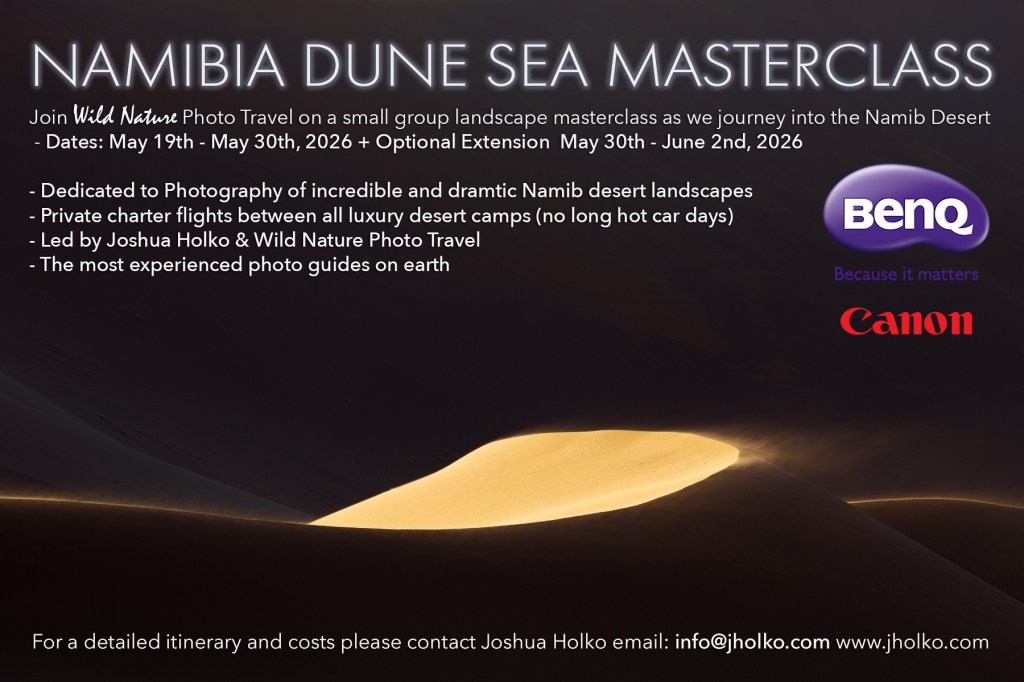
I will return to Namibia again in late May 2026 to lead another workshop in this incredible country. The workshop will focus on three carefully chosen and curated locations, including the Namib dune sea surrounding Sossusvlei. The workshop will also include air transfers between locations inside Namibia to minimise arduous drive times typical of most travel to this large country. We are still finalising the details, but we hope to open the trip for bookings very soon. You can pre-register your interest by dropping us an email.
In March 2024, I ran an all-new winter dog sled expedition to eastern Greenland in search of Arctic wildlife and stunning winter landscapes. Eastern Greenland is one of our planet’s most remote and pristine areas. In Winter, it is a hostile, frozen world with temperatures that frequently plummet below -40º. Frozen oceans, glaciers, and precipitous mountains are more akin to a scene from George Lucas’s planet Hoth (from The Empire Strikes Back) than the earth we know. It is a stunning, dramatic, epic landscape that makes for other-worldly photographic possibilities for photographers looking for an adventure outside their comfort zone.
For this adventure, we utilized local Inuit guides and Greenland sled dogs. With incredible stamina and power, a team of twelve sled dogs can pull over a thousand pounds for hours across the sea ice, making them the ideal means of transportation in Winter. The essence of this expedition was to capture the elusive Arctic wildlife in its winter habitat and to immortalize the breathtaking beauty of Greenland in its winter glory. Greenland, a place seldom explored in Winter, is a testament to the untouched Arctic Nature, a rarity to be found anywhere around the Polar Circle.
For this expedition, we flew from Reykjavik in Iceland to Constable Point in Greenland on a small Dash-8 plane, where we made camp for our first night. Our small group spent our first night in small mountain tents close to the ice runway of Constable Point to acclimate to the cold and exposure of the Arctic in Winter. This experience was a baptism by ice for the group, many of whom had never slept on sea ice in Winter. We ventured into Jameson land from our first camp, searching for Musk Ox – the prehistoric bison-like beast that survives and inhabits this region of eastern Greenland.
We only had to travel briefly (perhaps 10km) before our local Inuit guides spotted a small group of Musk Ox on a distant ridge line. Parking the sleds and dogs, we grabbed our cameras and long lenses and made our way stealthily across the landscape in the hope of some dramatic photographs. Fortuitously, the wind was blowing and catching both the loose spindrift and the woolly coats of the Musk Ox. These were ideal conditions to photograph these creatures. Skittish from decades of hunting, Musk Ox can be notoriously difficult to approach and, when agitated, can be more dangerous than Polar Bears. Maneuvering into position for the ideal background, we spent around an hour capturing images of these impressive animals in cold, windy and dramatic conditions before they finally tired of us and headed up a nearby mountain valley. Encounters like this are rare and a real photographic treat in the Arctic in Winter.
Our second and third nights saw us overnighting in an old hunter’s cabin. Although cold, the cabin afforded more protection than a tent and made for a more comfortable night. These hunters’ cabins typically consist of little more than four wooden walls and a roof, but they protect from the wind and some semblance of normality. Setting up cooking stoves inside the hut and removing the warm outer jackets that protect from the biting cold outside is possible. Of course, there are no facilities, and when nature calls, it is necessary to venture outside and find somewhere out of the wind to take care of personal business. Likewise, there are no showers or running water, and it is necessary to melt snow and ice for cooking and drinking.
From Jameson land, we turned south and headed out of the fjord across the frozen sea ice on our dog sleds to another hunter’s cabin approximately thirty kilometres south. We had spectacular views across the frozen sea ice from this location and excellent photographic opportunities with Ptarmigan in their winter plumage. Ptarmigans are usually quite approachable if you take your time and move slowly, and all of the group captured images of these beautiful birds. From this location, we could easily spot any approaching Polar Bears. Unfortunately, the sea ice remained empty, with no sign of bears from our high vantage point. Such is often the way with the King of the Arctic. With tens of thousands of square kilometres of habitat and perhaps only a few thousand bears inhabiting this region, an encounter is never guaranteed.
Continuing our journey across the sea ice to Cap Hope, we established our next camp in an old hut in the small abandoned settlement. We had our first and only encounter with a Polar bear here during this expedition. Spotted by one of our Inuit guides, the bear was quite some distance away on the sea ice (perhaps 5-6 kilometres, but visible through my binoculars), strolling away from us. Hurriedly, we headed down to the sea ice, hoping the bear would become curious and approach our position. Unfortunately, it was not to be, and the bear continued, disappearing into the distance as the sun set across the sea ice. While it was a fleeting encounter, it reminded us of the untamed wilderness we were exploring and that wildlife photography has no guarantees. It has been my experience that typically, one in seven Polar Bears provides a significant photographic encounter that yields tangible images. Most encounters are generally sightings only that rarely result in keeper photographs.
With a change in the weather forecast and a winter storm approaching, we decided to break camp and head back to the small village of Ittoqtoqitormet rather than stick to our original plan of heading to Cap Tobin. Although both were roughly the same distance from our current position, the town of Ittoqtoqitormet would offer us better accommodation, a hot shower and the chance to have a bed. The storm arrived a few hours earlier than predicted, giving us a real taste of what the Arctic can be like in Winter as we arrived in town. Our local guides’ experience proved correct, and shortly after we arrived, the storm intensified into a full winter blizzard that would last the next two days.
During the expedition, temperatures hovered around -20 to -36Celsius + wind chill. We had predominately excellent weather, with only our last two days and the storm’s arrival reducing visibility with strong winds and blowing snow.
We took the opportunity to photograph the Arctic Snow Hares in and around town. These Hares live around the old cemetery, providing fantastic opportunities in the blowing snow. Over the two days in town, we had several sessions with the Hares in what I would describe as ideal winter photographic conditions. The Hares are somewhat used to people, and it was possible to approach them within just a few feet.
At the expedition’s conclusion, we planned to take a helicopter from Ittoqtoqitormet to Constable Point to connect with our return flight to Reykjavik in Iceland. However, the helicopter was cancelled at the last minute due to the consistent blizzard conditions and near-zero visibility, leaving us stranded in town (Winter travel in the Arctic is never certain and always exciting). The cancellation would have meant a two-day delay in returning to Iceland, assuming the flight would go as planned from Constable Point. Rather than get stuck for two days, I quickly organized four locals with snowmobiles and sleds to take us from town to Constable Point across the sea ice. The journey should take around an hour and a half in good weather conditions. But, due to the blizzard and abysmal visibility, the journey took nearly three hours and proved quite the adventure. Our local Inuit guides showed their incredible skills, successfully navigating without GPS in what was effectively zero visibility to transport us to Constable Point.
Thankfully, I could rebook our group at the last minute on a return twin otter flight from Constable Point to Reykjavik, and we made this connecting flight with literally ten minutes to spare. Our long day of travel concluded in Reykjavik, where we wrapped up our winter expedition.
I sincerely thank our local guides and all who participated in this remarkable expedition. The success of these winter expeditions hinges on group dynamics and local knowledge. They require teamwork and cooperation from all. Our group aced this expedition, working together and ensuring a safe and successful outcome.
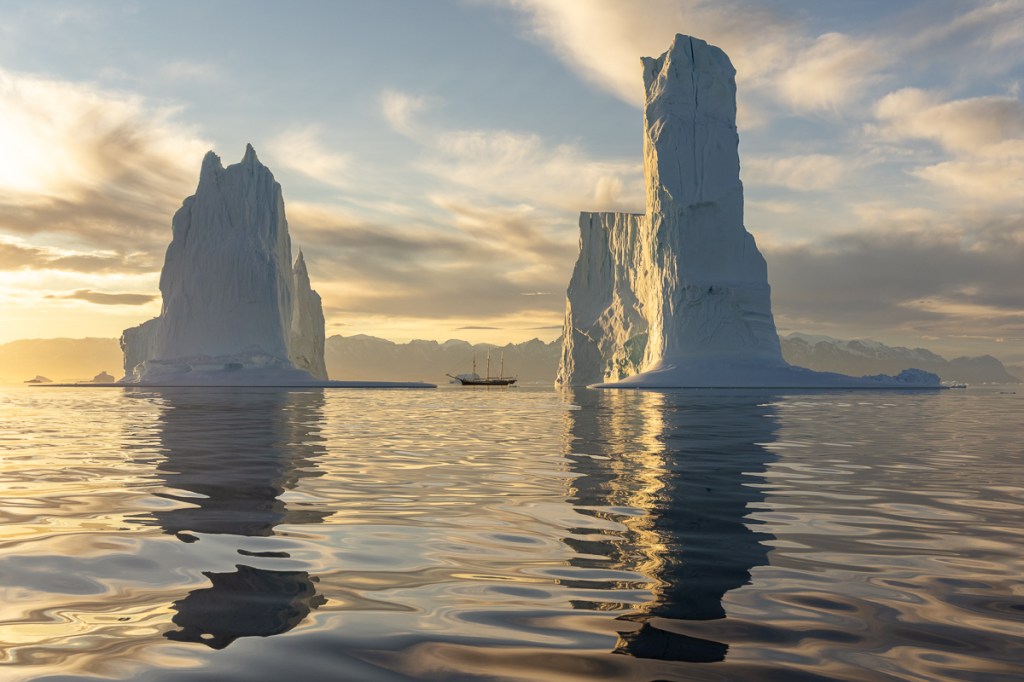
I will return to Greenland’s East Coast again in September 2024 for a more luxurious Autumn, ship-based expedition to Scoresby Sund. This expedition focuses on the incredible landscape and icebergs that drift as silent sentinels through this incredible fjord system. In addition, there will be a chance of wildlife, including Musk Ox and Polar Bears. We will be based on a comfortable, warm ship for the duration of this expedition that will serve as both our home and our photographic platform. Just two places remain now before this expedition is sold out. If you are interested in travelling to one of the world’s last untouched regions of the Arctic alongside a small group of like-minded, passionate photographers, please drop me an email to register your interest.
I will also return to Greenland in the Winter of 2025 to lead another dog-sled expedition across the sea ice in search of wildlife and dramatic landscapes. This expedition is already sold out, but I will soon be taking expressions of interest for 2026. If the idea of an adventure outside your comfort zone appeals and you feel you have the right stuff to explore Greenland in Winter via dog sled, then please reach out to register your interest – no obligation at this point.